500 dinara 1946 specimen
Market Prices
6 salesAbout This Note
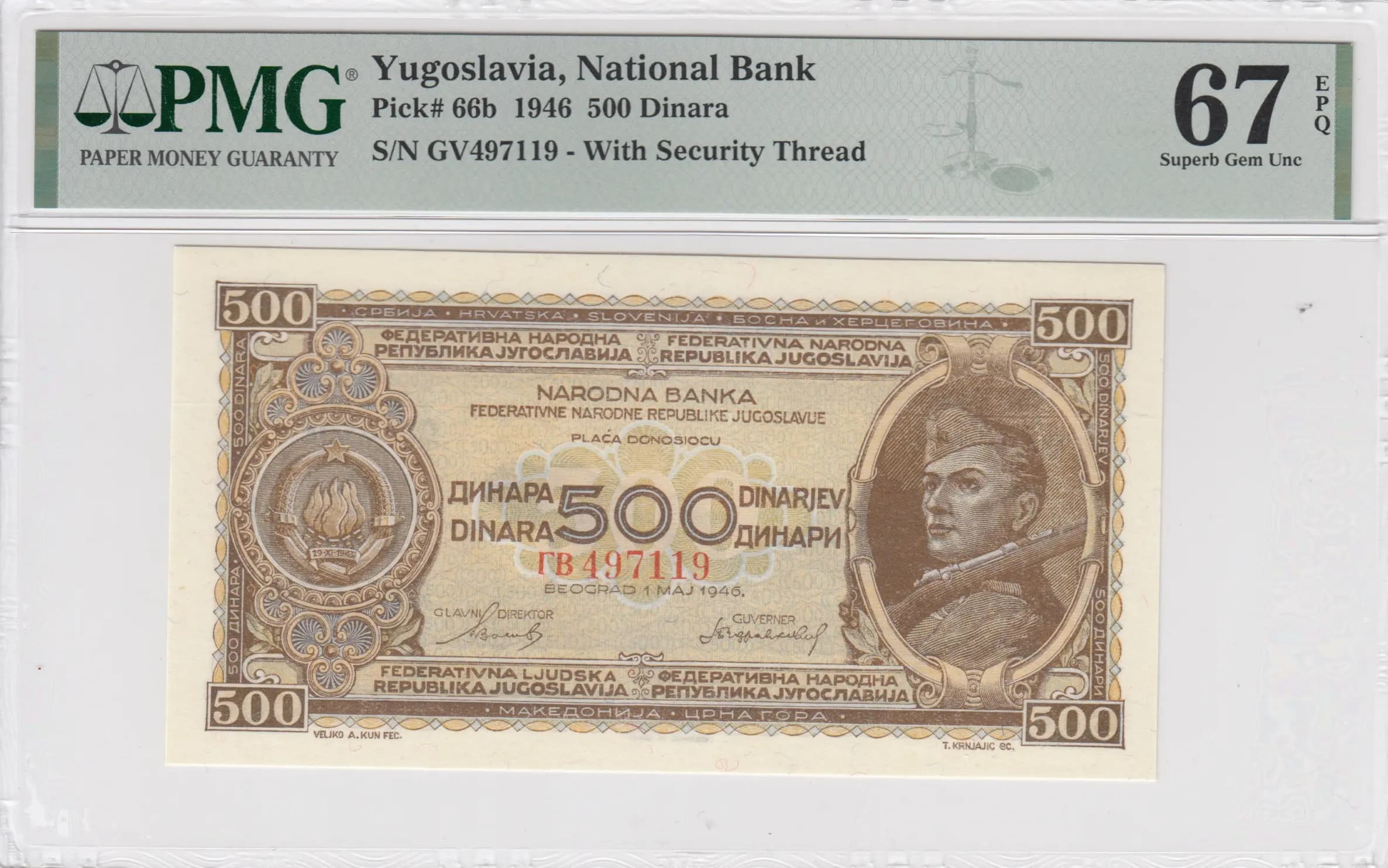
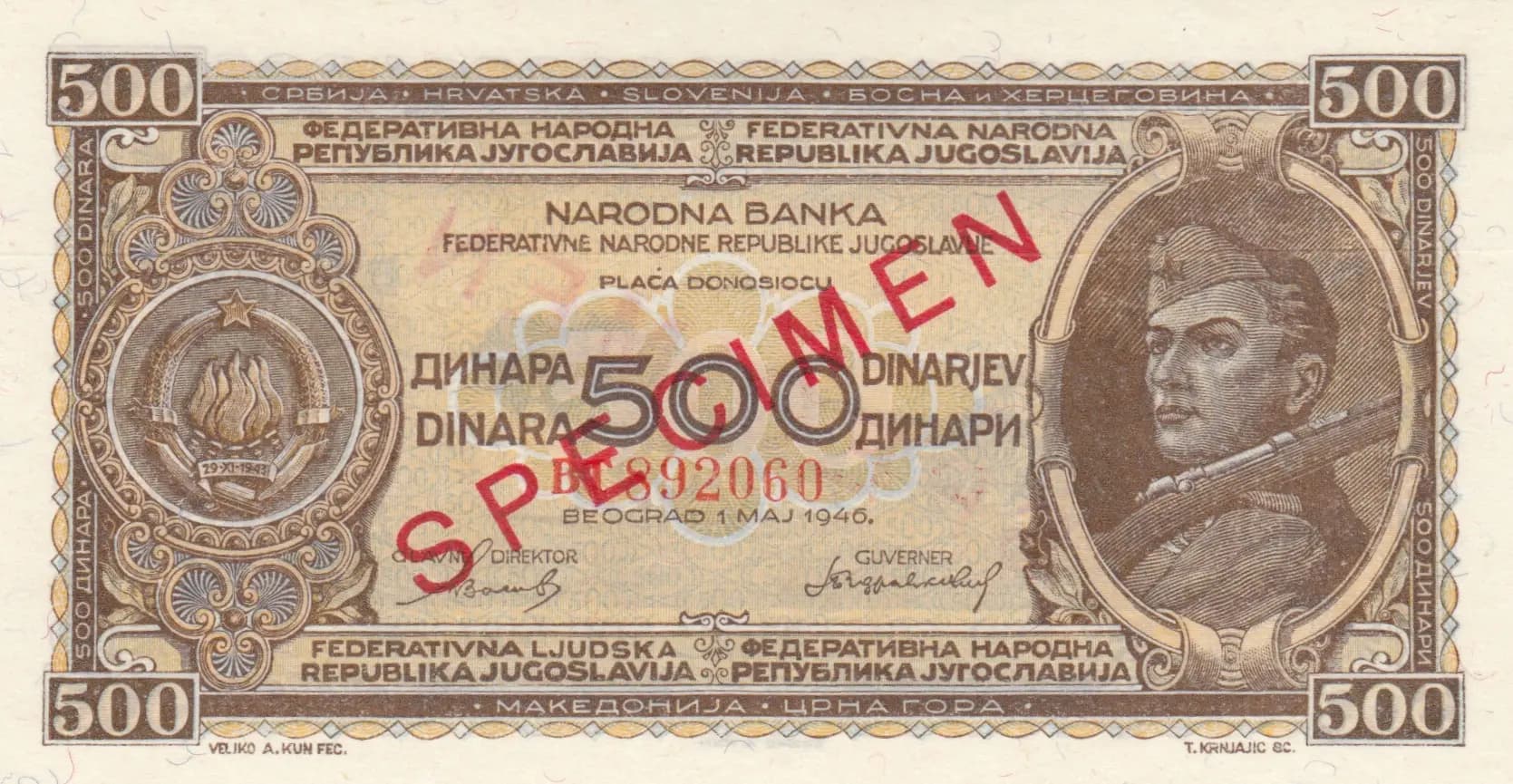
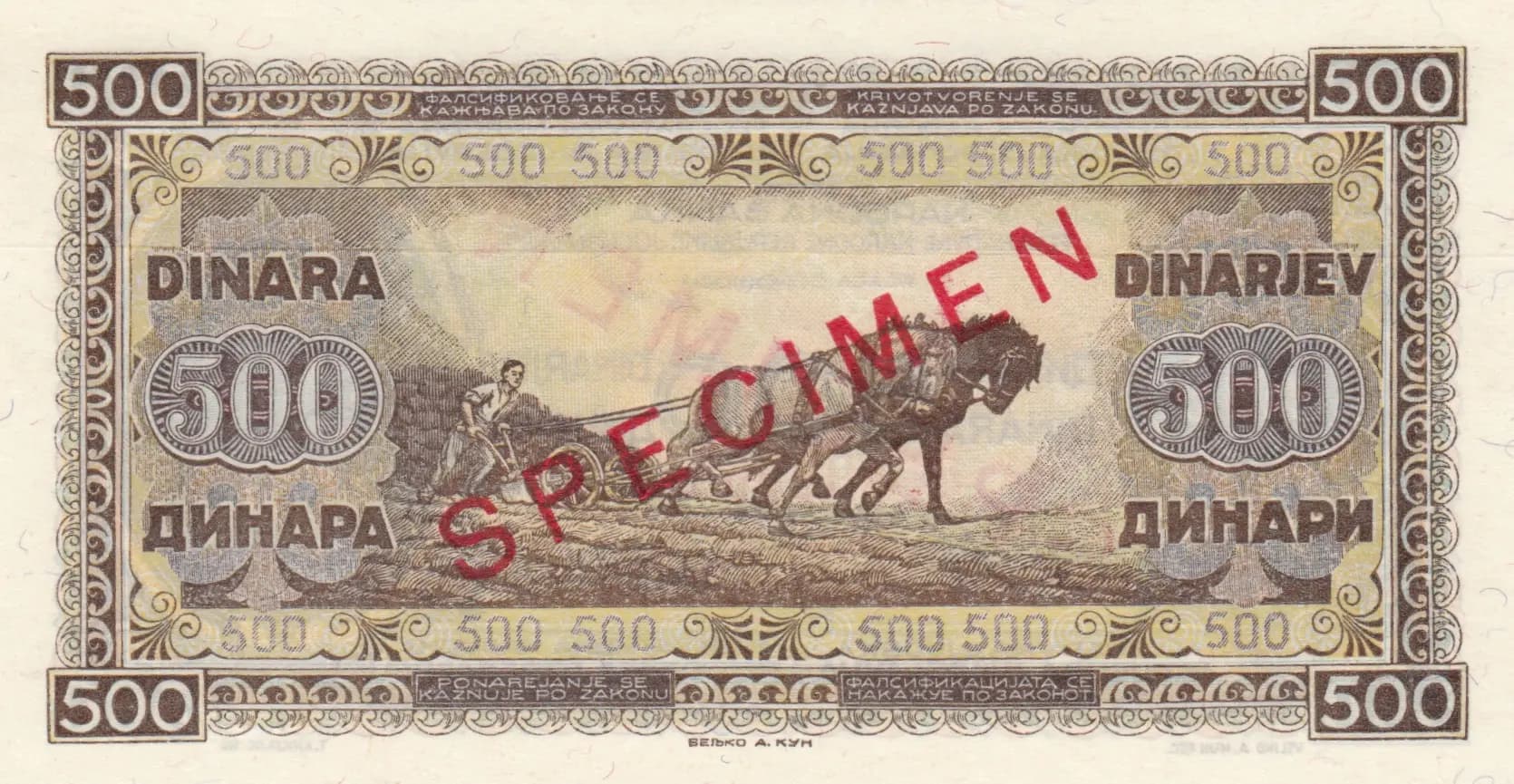
This is a 1946 Yugoslav 500 dinara specimen note from the newly formed Federative People's Republic of Yugoslavia, featuring a striking portrait of a Partisan military figure on the obverse and an agricultural scene on the reverse. The note displays the characteristic brown-toned engraving of early Yugoslav currency with ornate decorative borders, and bears the prominent red 'SPECIMEN' overprint diagonal across both sides. Despite the specimen designation and visible aging consistent with historical handling, this note represents an important early emission from Yugoslavia's National Bank and remains a desirable item for collectors of Balkan currency and post-WWII political history.
Common. The eBay historical price data provided shows consistent sales in the $25–$60 range for circulated to uncirculated examples over a seven-year period (2011–2018), with 2016 catalog values at $120 for UNC. The presence of multiple sales and the lack of any premiums or scarcity notations in the referenced catalogs indicate this is a regularly traded note with adequate supply. Early Yugoslav currency from 1946 is widely collected, and this denomination was printed in substantial quantities. The specimen designation does not significantly restrict supply, as specimen notes were produced in notable quantities for institutional distribution.
Issued on May 1, 1946, this banknote commemorates the establishment of Tito's Federative People's Republic of Yugoslavia, with the obverse portrait depicting a Partisan (identified as Milivoje Rodić, later a colonel in the Yugoslav army) honoring the partisan resistance movement that liberated the country during World War II. The reverse design featuring a farmer with a horse-drawn plow reflects the new communist state's ideological emphasis on agricultural labor and the working classes. The note's multi-lingual inscriptions in Cyrillic and Latin scripts across the six constituent republics—Serbia, Croatia, Slovenia, and Bosnia and Herzegovina—symbolize the unity of the newly federated socialist state.
The obverse features a prominent left-facing portrait of Milivoje Rodić, a Partisan military commander, depicted in military uniform with visible medals, symbolizing the heroic resistance and the armed struggle that established the new Yugoslav state. To the left of the portrait is the coat of arms of the Federative People's Republic of Yugoslavia enclosed in an ornamental circular frame, representing state authority. The reverse depicts a rural agricultural scene showing a farmer operating a horse-drawn plow in a worked field, reflecting the socialist emphasis on labor and agrarian production. Both sides are framed with ornate geometric and floral border patterns executed in fine engraved lines, with large denomination numerals '500' presented in decorative ornamental circles on the reverse. The color scheme employs brown as the dominant tone on a multicolor underprint, creating contrast and visual depth.
{"front":{"cyrillic_republic_names":"Serbia • Croatia • Slovenia • Bosnia and Herzegovina","cyrillic_issuer":"Federative People's Republic of Yugoslavia / National Bank of the Federative People's Republic of Yugoslavia","latin_issuer":"Federativna Narodna Republika Jugoslavija","denomination_cyrillic":"Dinara / Dinari","denomination_latin":"Dinarjev","payee_clause":"Plača Donošiocu (Pays to Bearer)","date_location":"Belgrade, May 1, 1946","signatures":"Director / Governor","engraver_credit":"Velkoa. Kun Fec / T. Krnjajic Sc","specimen_overprint":"Specimen"},"back":{"denomination_left":"500 Dinara / Dinarjev","denomination_right":"500 Dinara / Dinarjev","counterfeiting_warning_cyrillic":"Falsifikovanje se kažnjava po zakonu (Counterfeiting is punishable by law)","counterfeiting_warning_latin":"Krivotvorenje se kaznјava po zakonu","engraver_credit":"Velkoa. Kun","specimen_overprint":"Specimen"}}
Intaglio engraving (steel plate engraving), the standard security printing method for Yugoslav banknotes of this period. The fine line work visible throughout the design, ornate borders, and detailed portraiture are characteristic of intaglio production. The engraver credits 'Velkoa. Kun Fec' and 'T. Krnjajic Sc' indicate European security printers, likely from the Balkans or Central Europe, though the specific printing facility is not identified on the note. The specimen overprint in red was applied separately, typical of specimen notes produced for distribution to banks and numismatists.
This is a specimen note, indicated by the prominent red 'SPECIMEN' overprint crossing both obverse and reverse. The Pick catalog number is P-66bs, where the 'bs' suffix denotes 'banknote specimen.' The serial number visible is БЛ892060 (Cyrillic 'BL' prefix with numeric sequence). The May 1, 1946 date is the official issue date. No signature varieties or significant design variations are noted; the specimen overprint and the presence of engraver credits (Velkoa. Kun Fec and T. Krnjajic Sc) are the defining characteristics of this specific variety.