2 krone 1919
Market Prices
20 salesAbout This Note
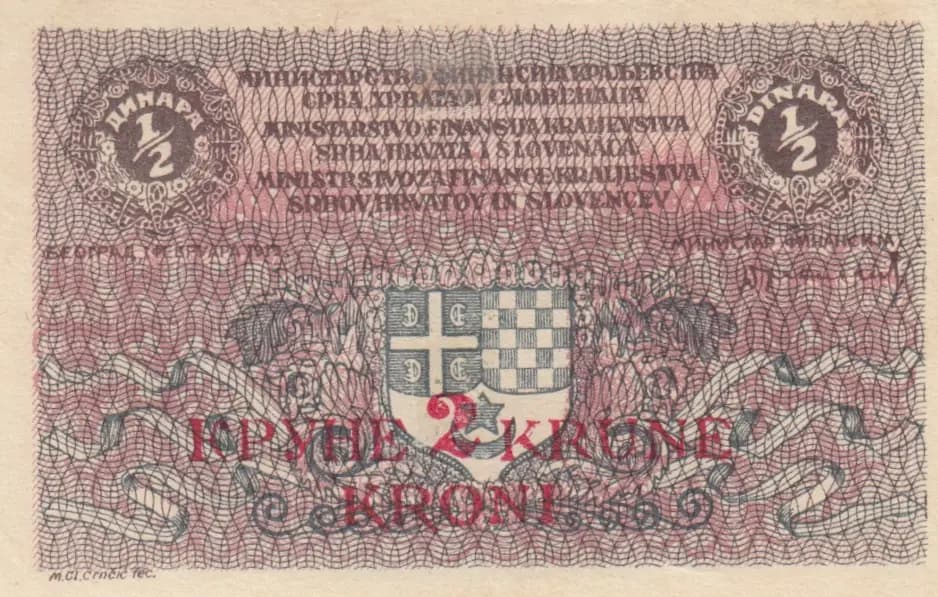
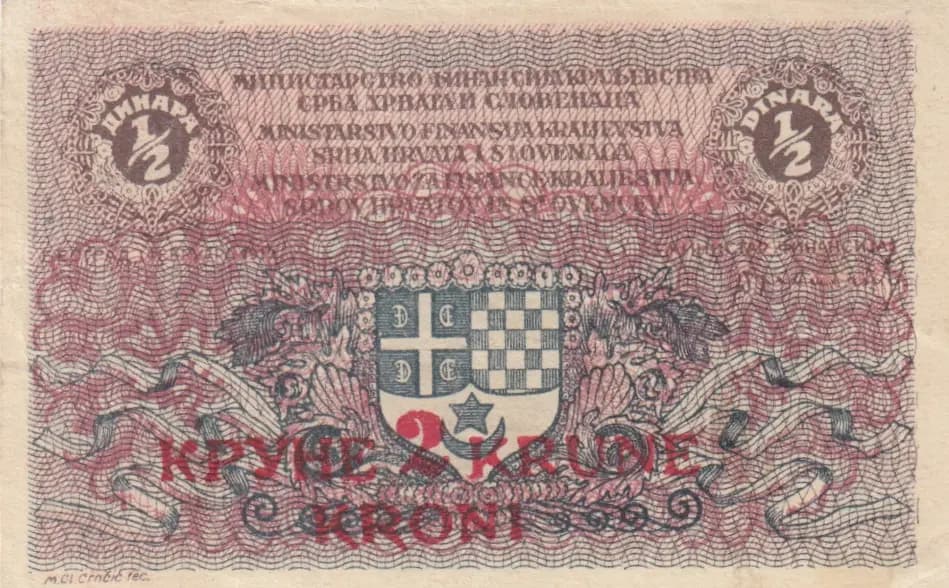
This is a 2 Kronen on 1/2 Dinara banknote from the Kingdom of Serbs, Croats and Slovenes issued in 1919, representing an early monetary transition in post-WWI Yugoslavia. The note exhibits an AU (About Uncirculated) condition with characteristic age-related foxing and tan patina consistent with early 20th-century paper currency, featuring ornate heraldic imagery and complex engraved patterns in red, pink, and brown tones. The presence of overprinted denomination (2 Kronen on 1/2 Dinara base) and Cyrillic text reflects the multi-ethnic administrative structure of the newly formed kingdom.
Common. The eBay price history shows consistent sales in the $3-$15 range for various grades (VG to VF), with catalog values of $3-$35 depending on condition. The regular issue status, no documented print run restrictions, and stable secondary market presence across multiple decades indicate this is a readily available note in the collector market. The AU condition grade is more desirable than lower grades, but the denomination and design do not command premium pricing typical of scarce or rare issues.
Issued on February 10, 1919, by the Ministerstvo Financija (Ministry of Finance) of the newly established Kingdom of Serbs, Croats and Slovenes, this note documents the immediate post-World War I reorganization of the Balkans. The central heraldic coat of arms with its distinctive checkerboard pattern and star represents the unified symbols of the South Slavic kingdom, while the multilingual inscriptions in Cyrillic script underscore the polyglot nature of the state formation. The overprinting of 2 Kronen denominations over 1/2 Dinara reflects the complex currency transition as the new kingdom consolidated monetary systems from its constituent regions.
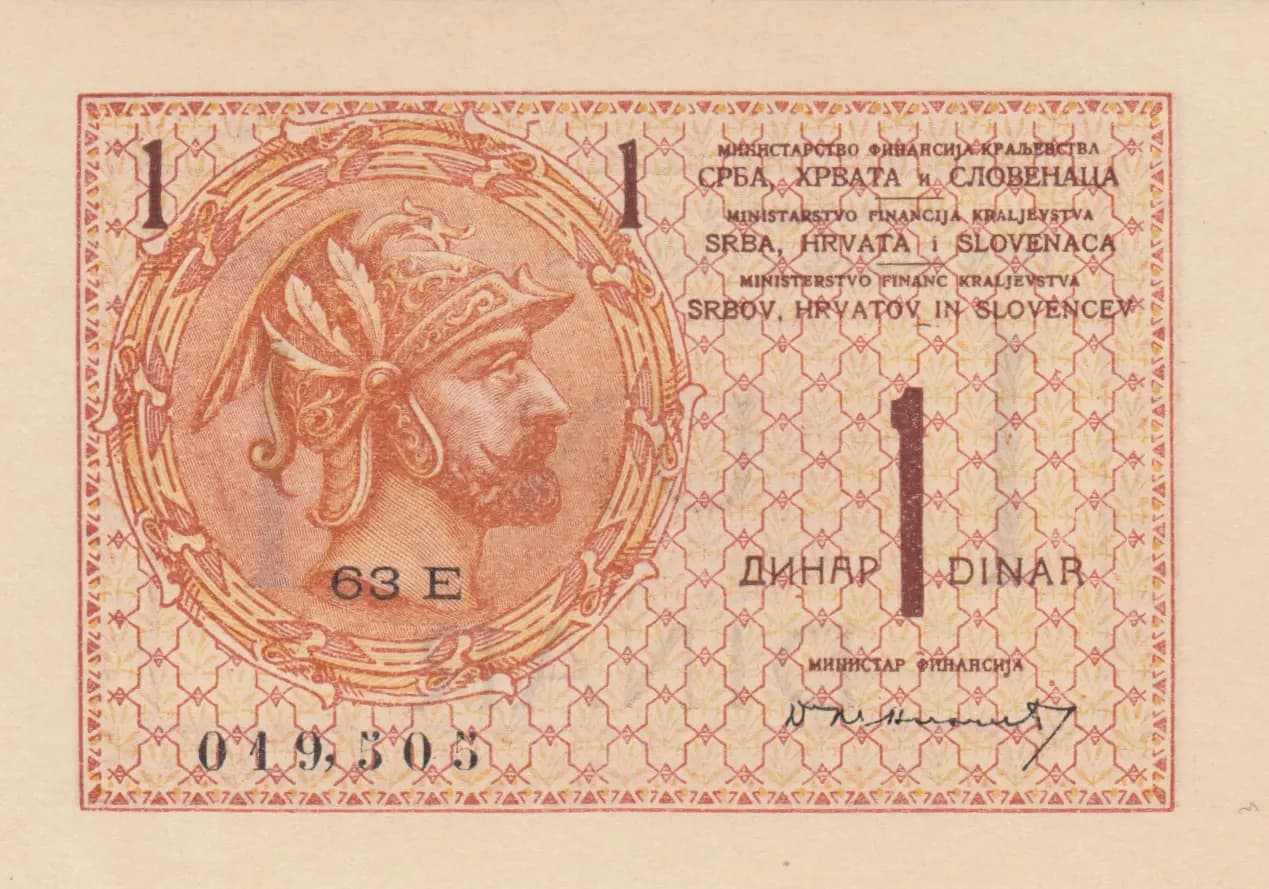
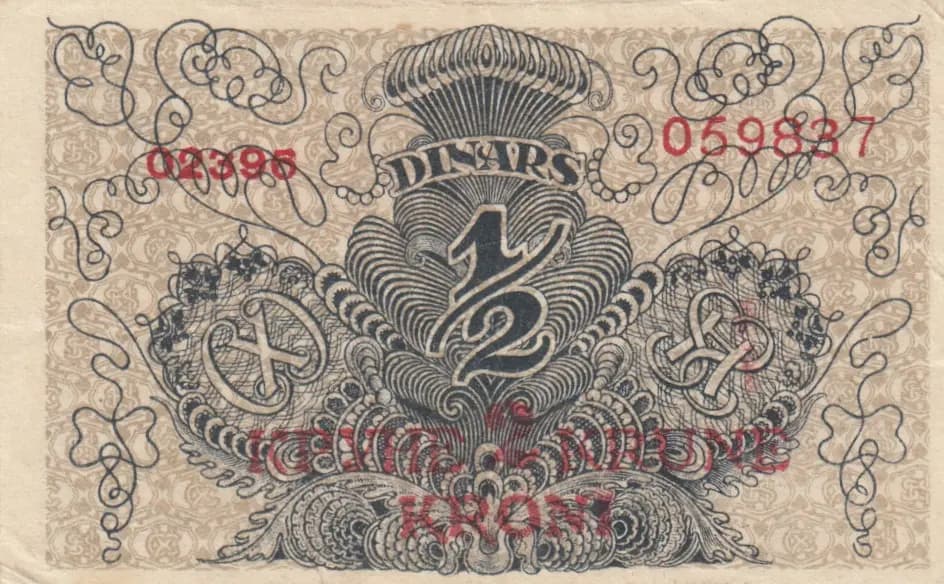
The obverse features a centrally positioned heraldic coat of arms of the Kingdom of Serbs, Croats and Slovenes, consisting of a quartered shield displaying the distinctive red-and-white checkerboard pattern (Šahovnica) characteristic of Croatian heraldry, surmounted by a star. The shield is flanked by ornate decorative borders in red and pink with dark brown scrollwork. Ornamental numerals '1/2' appear in decorative circles on the left and right margins, indicating the base denomination being overprinted. The reverse displays a large, ornately engraved numeral '2' as the central design element, surrounded by elaborate scrollwork, floral motifs, and geometric pattern backgrounds in beige, cream, dark blue, and red. Fine linear engraving patterns form security-oriented background designs throughout.
Front: 'MINISTERSTVO FINANCIJA' (Ministry of Finance), 'KRALJEVSTVA SRBA, HRVATA I SLOVENACA' (Kingdom of Serbs, Croats and Slovenes), with references to Croatia and Slovenia. Back: 'DINARA' (Dinara - currency denomination), large numeral '2' indicating denomination. Serial number '0598857' appears in red ink. The note includes multilingual text reflecting Cyrillic, Serbian, Croatian, and Slovenian administrative languages of the period.
Intaglio engraving (line engraving) on multiple color printing plates, producing the fine detail work visible in the geometric patterns and scrollwork. The multicolor printing using red, pink, brown, blue, and tan inks suggests separate plate impressions, typical of early 20th-century European banknote production. The complexity of the heraldic design and the precision of the ornamental numerals indicate production by a skilled security printer, likely an established European banknote house such as Giesecke+Devrient or Waterlow & Sons, though specific attribution would require printer research.
This note is cataloged as Pick P-14a (2 Kronen on 1/2 Dinara). The visual analysis confirms the overprint variety, with the denomination '2' overprinted in red on what was originally a 1/2 Dinara note. Serial number 0598857 is visible, though without documentation of serial number ranges or known printing quantities, individual serial number varieties cannot be definitively established. The Cyrillic text and multilingual inscriptions are consistent with the 1919 Kingdom of Serbs, Croats and Slovenes issuance. PMG population data indicates 5 catalog variants exist for Pick base number P-14, with P-14a being the identified variety for this specific overprinted denomination.