1 dinar 1919
Market Prices
35 salesAbout This Note
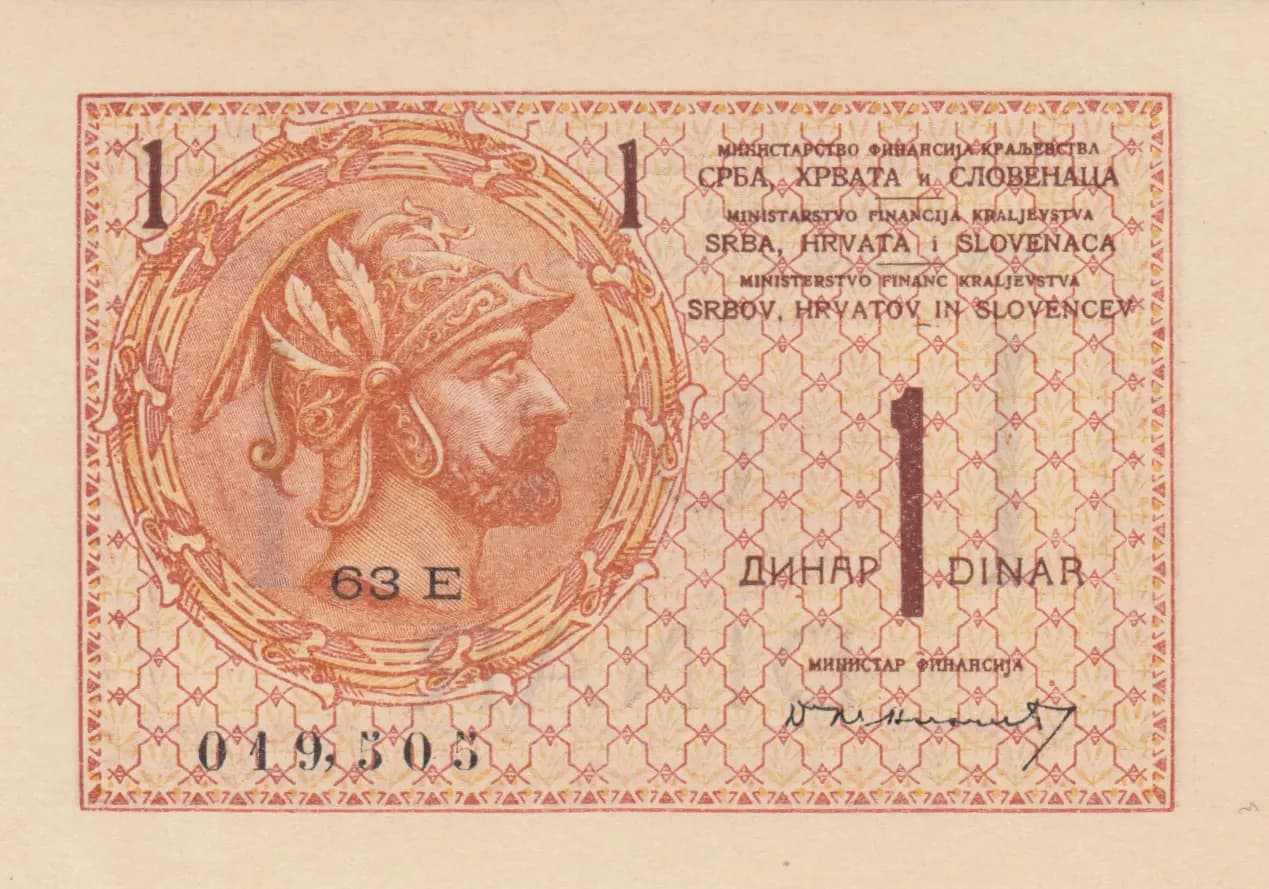
This 1919 Yugoslavia 1 Dinar (Pick P-12) presents a classical design featuring a bearded male portrait in profile within an ornate circular medallion, rendered in red-brown and orange-tan tones on cream-beige paper. The note exhibits excellent preservation with crisp printing, minimal wear, and the characteristic slight aging patina expected of early 20th-century currency, consistent with the UNC grade assignment. This denomination represents the early monetary foundation of the newly-formed Kingdom of Serbs, Croats and Slovenes, making it historically significant beyond its modest face value.
Common. eBay market data shows consistent sales activity across a 13-year period (2011-2024) with prices ranging from $1.91 to $27.50 depending on condition, with most UNC/EF examples selling in the $10-20 range. The 2016 catalog valuation places UNC examples at $45, suggesting moderate collector demand but steady market supply. With over 60 documented sales transactions and no evidence of restricted print runs or early recall, this Pick number represents standard circulation coinage for the early Yugoslav state and remains readily available to collectors at affordable prices.
This note was issued in 1919 by the Ministerstvo Financija (Ministry of Finance) of the Kingdom of Serbs, Croats and Slovenes, the newly-established state formed following the collapse of the Austro-Hungarian Empire after World War I. The trilingual inscriptions in Serbian Cyrillic, Serbian Latin, and French reflect the multinational composition of the kingdom and its need to communicate across diverse ethnic populations. The classical portraiture and ornate design signify the nation's attempt to establish monetary legitimacy and stability during a period of significant political and territorial consolidation.
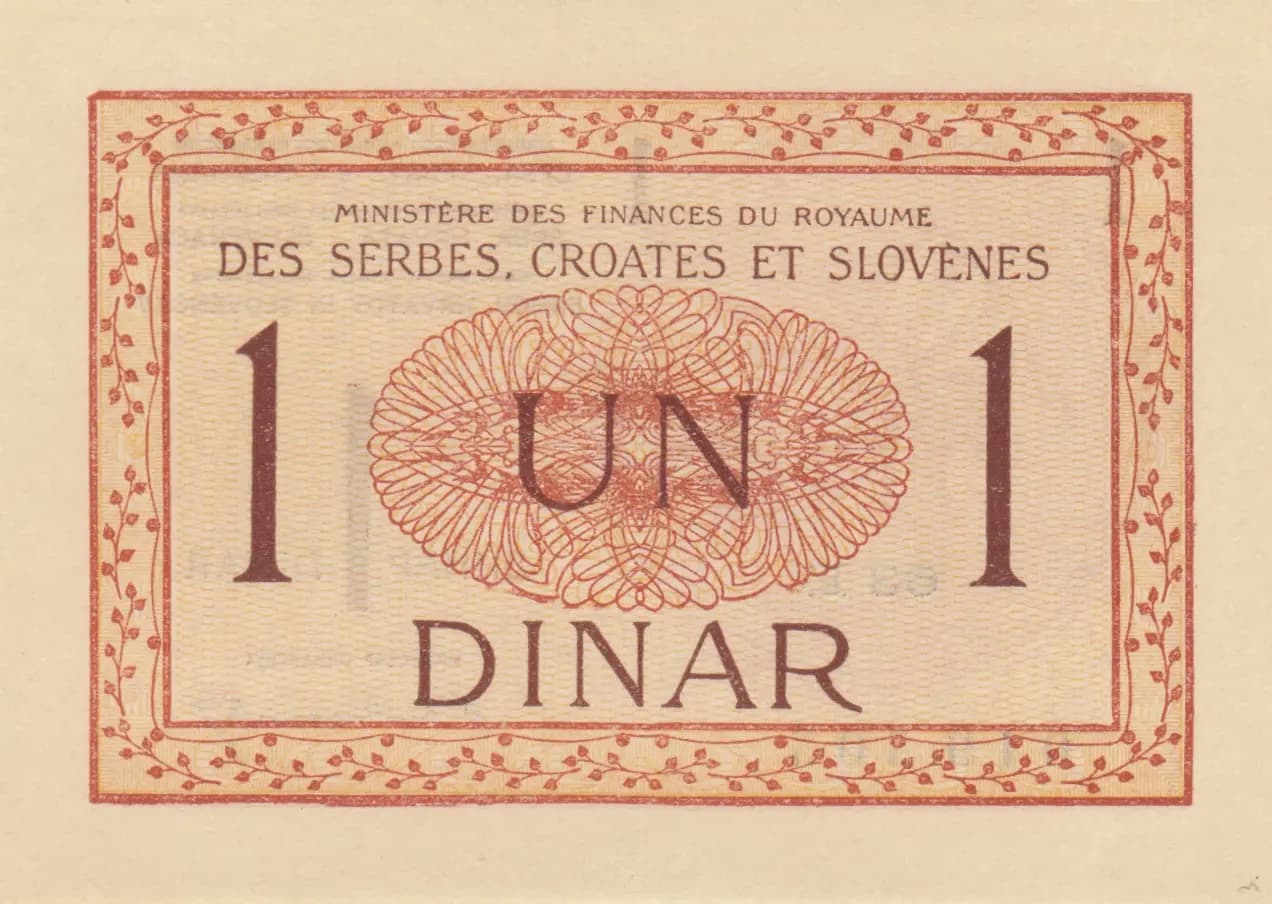
The obverse features a classical right-facing profile portrait of a bearded male figure wearing a laurel wreath, enclosed within an ornate circular medallion with decorative engraved borders. This portrait likely depicts Miloš Obilić, the legendary Serbian medieval hero, as confirmed by external catalog references. The background is filled with an intricate geometric pattern of repeating crosses and small diamonds, serving both as a security feature and aesthetic enhancement. The reverse showcases a large ornate rosette medallion at center with highly detailed geometric and botanical patterning, surrounded by a decorative border of ivy or vine leaves. The French overprint 'UN' appears across the central medallion on the reverse, underscoring the multinational administrative reach of the new Yugoslav state. Both sides maintain the red-brown and orange-tan color scheme on cream-beige paper stock.
Front (Obverse): 'МИНИСТАРСТВО ФИНАНСИЈА-КРАЉЕВСТВА СРБА, ХРВАТА и СЛОВЕНЦА' (Serbian Cyrillic: Ministry of Finance of the Kingdom of Serbs, Croats and Slovenes); 'MINISTERSTVO FINANCIJA KRALJEVSTVA SRBA, HRVATA I SLOVENACA' (Serbian Latin: Ministry of Finance of the Kingdom of Serbs, Croats and Slovenes); 'ДИНАР' (Serbian Cyrillic: Dinar); 'DINAR' (Latin: Dinar); 'МИНИСТАР ФИНАНСИЈА' (Serbian Cyrillic: Minister of Finance); Serial markings '68 E' and '01 9,305'. Back (Reverse): 'MINISTÈRE DES FINANCES DU ROYAUME' (French: Ministry of Finance of the Kingdom); 'DES SERBES, CROATES ET SLOVENES' (French: of Serbs, Croats and Slovenes); 'UN' (French: One, overprinted); 'DINAR' (Denomination identifier); Numeral '1' in upper left and lower right corners.
Intaglio engraving, the standard security printing method for banknotes of this era. The fine line work, ornate circular medallion details, intricate geometric patterns, and decorative vine borders visible throughout both obverse and reverse all bear the characteristic hallmarks of hand-engraved intaglio plates. The crisp impression quality and precise detail work observed in the visual analysis are consistent with professional security printing practices of early 20th-century European central banks. The specific printer for this series is not definitively documented in standard references, but the quality and style suggest contract work with an established European security printer.
This specimen exhibits serial number marking '68 E' with serial number '01 9,305', indicating this is from an early print run. The visual analysis identifies this as a standard issue without obvious overprints beyond the reverse 'UN' designation (French for 'One'). PMG population data indicates multiple variants exist under the P-12 base number (P-12A for 5 Dinara, plus higher denominations P-120 through P-126), but this specific note is identified as the base P-12 denomination. No signature varieties or date variations are apparent on the 1919 issue, which carries an ND (No Date) catalog designation despite the known 1919 issue year.