500 dinara 1946
Market Prices
31 salesAbout This Note
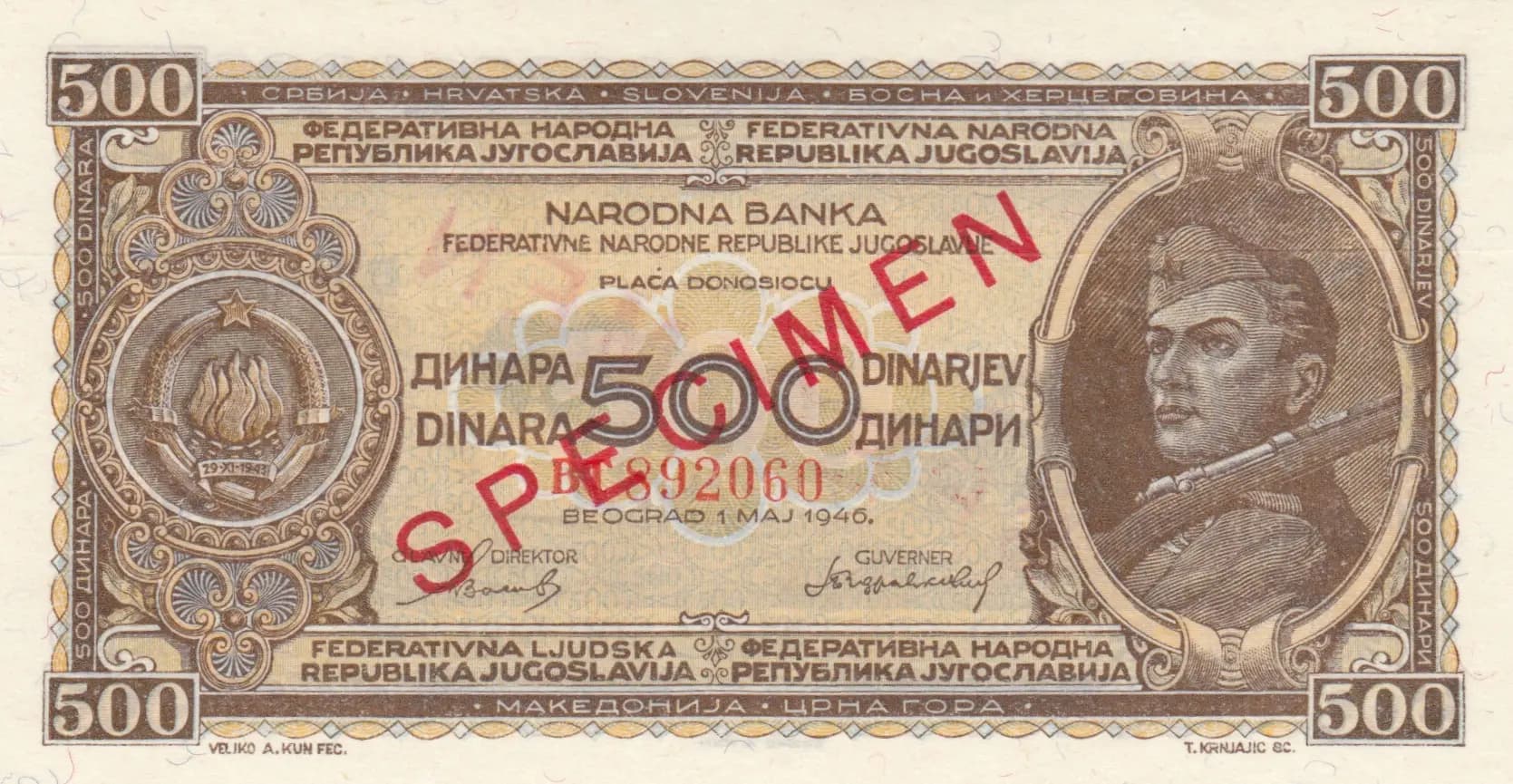
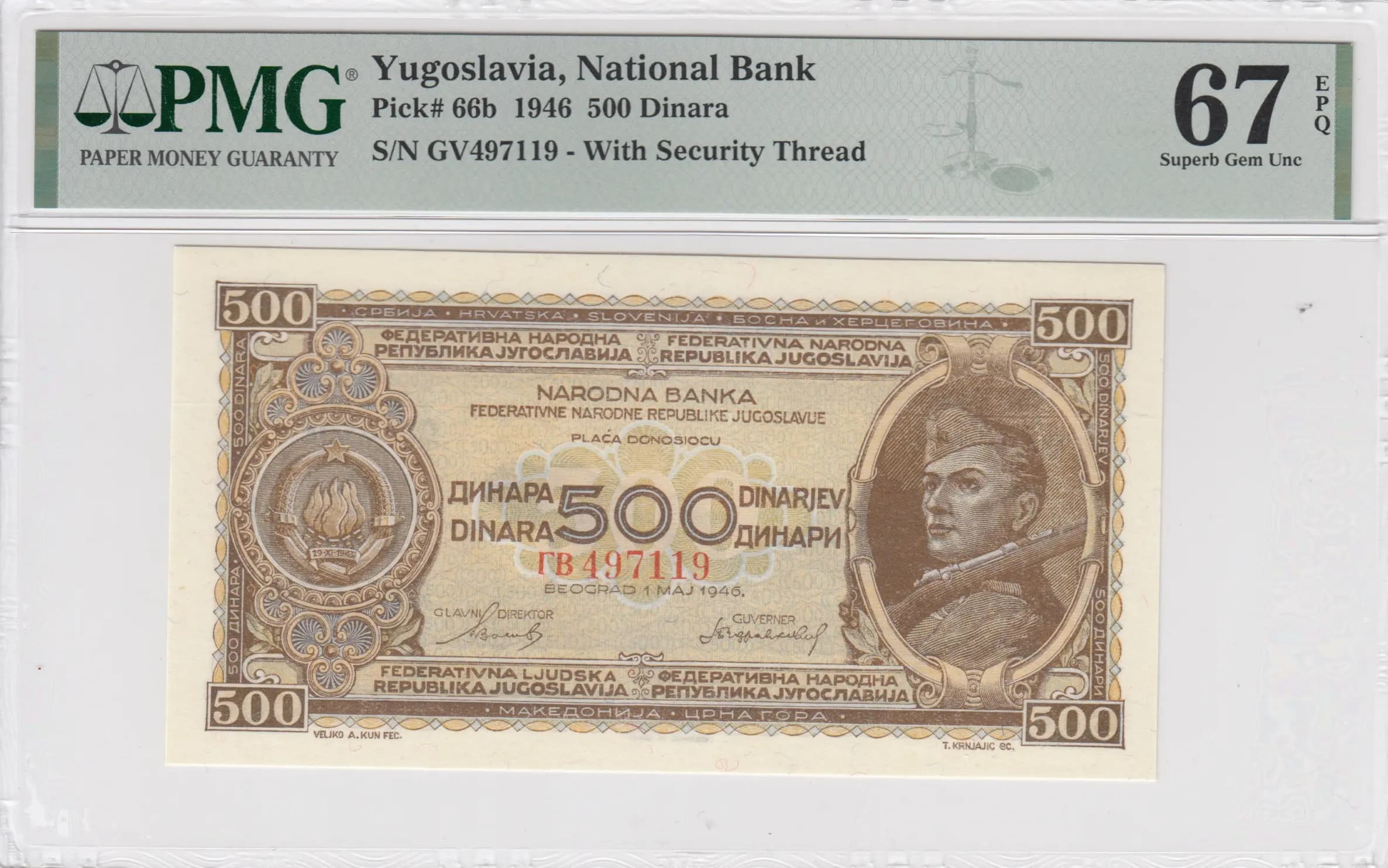
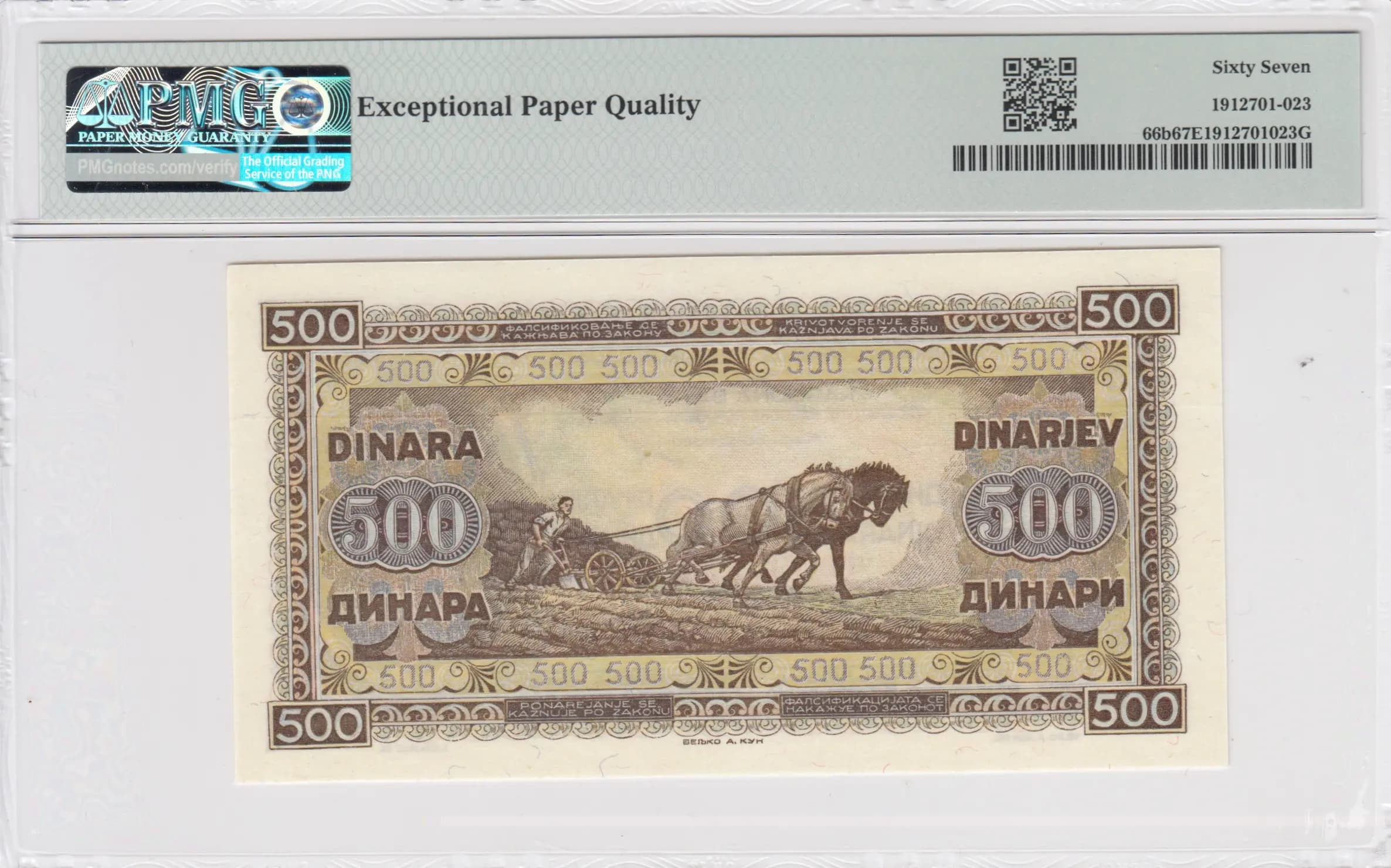
This is an exceptional PMG 67 Superb Gem Uncirculated example of Yugoslavia's 500 Dinara note from 1946, the first issue of the newly formed Federal People's Republic. The note displays pristine condition with vibrant brown and cream tones, crisp engraving throughout, and no signs of circulation. The obverse features a portrait of Milivoje Rodić, a partisan colonel, alongside the Yugoslav state emblem, while the reverse depicts a rural agricultural scene with a farmer and horse-drawn plow—powerful imagery symbolizing the nation's reconstruction in the immediate postwar period.
Common. Despite its historical significance as the first postwar Yugoslav issue, eBay market data shows consistent sales from $29 to $102 USD across PMG 65-66 grades over the past decade, with numerous examples regularly appearing in the secondary market. The note was produced in substantial quantities for circulation and remains readily available to collectors. PMG population data indicates multiple examples have been professionally graded. A PMG 67 example represents above-average condition rather than rarity.
Issued on May 1, 1946 (Labor Day), just months after Yugoslavia's liberation from Nazi occupation, this banknote represents the monetary authority of the newly established communist Federal People's Republic under Tito. The imagery—featuring a partisan soldier and agricultural labor—reflects the state's ideological focus on the working class and rural reconstruction. The note's inscription listing all six federal republics (Serbia, Croatia, Slovenia, Bosnia and Herzegovina, Macedonia, and Montenegro) symbolizes the unified multinational federation that had just emerged from the ashes of World War II.
The obverse portrays Milivoje Rodić, a decorated partisan and later Yugoslav Army colonel, shown in left profile wearing military attire with a peaked cap—a deliberate choice elevating the working-class soldier as a national hero. The left side features the state emblem of the Federal People's Republic: a torch surrounded by a wreath, symbolizing enlightenment and unity of the six republics. The reverse depicts a rural laborer guiding a horse-drawn plow through farmland, with hills rising in the background, embodying the agrarian ideals central to Yugoslav socialist reconstruction. Both sides employ an ornate decorative border of geometric and floral patterns in brown and gold tones on a cream background, typical of European postwar security printing.
Front side: 'Federal People's Republic of Yugoslavia' / 'National Bank of the Federal People's Republic of Yugoslavia' / 'Serbia • Croatia • Slovenia • Bosnia and Herzegovina • Macedonia • Montenegro' / 'Belgrade May 1, 1946' / '500 Dinara/Dinarjev' (in four corners) / 'Payable to bearer' / 'Chief Director' and 'Governor' (signature lines) / 'Veljko A. Kun fecit' (engraved by) / 'T. Krsljac sculpsit' (sculpted by). Back side: '500 Dinara/Dinarjev' (repeated in corners and border) / 'Veljko A. Kun' (artist credit) / Denomination repeated throughout ornamental border design.
Intaglio (steel plate engraving), the standard security printing method for Yugoslav banknotes of this period. The note incorporates a security thread visible in the paper (as noted in the PMG certification), fine-line engraving throughout the ornamental borders, and complex tonal gradations achieved through master engraver Veljko A. Kun's detailed work. The technique's intricate detail and security thread reflect the National Bank's commitment to producing notes resistant to counterfeiting during the early postwar period.
This is cataloged as P-66b, indicating it is a recognized variety within the Pick catalog system for the 500 Dinara 1946 issue. The 'b' designation typically indicates a specific printing variety, printing date, or signature variant. The specimen observed (serial number GV497119) reflects the standard production of this variety with no visible overprints, security markings, or non-standard features. The signature lines for 'Chief Director' and 'Governor' appear blank, consistent with many early 1946 issues where signatures were not yet applied at time of printing.