500 dinara 1963
Market Prices
25 salesAbout This Note
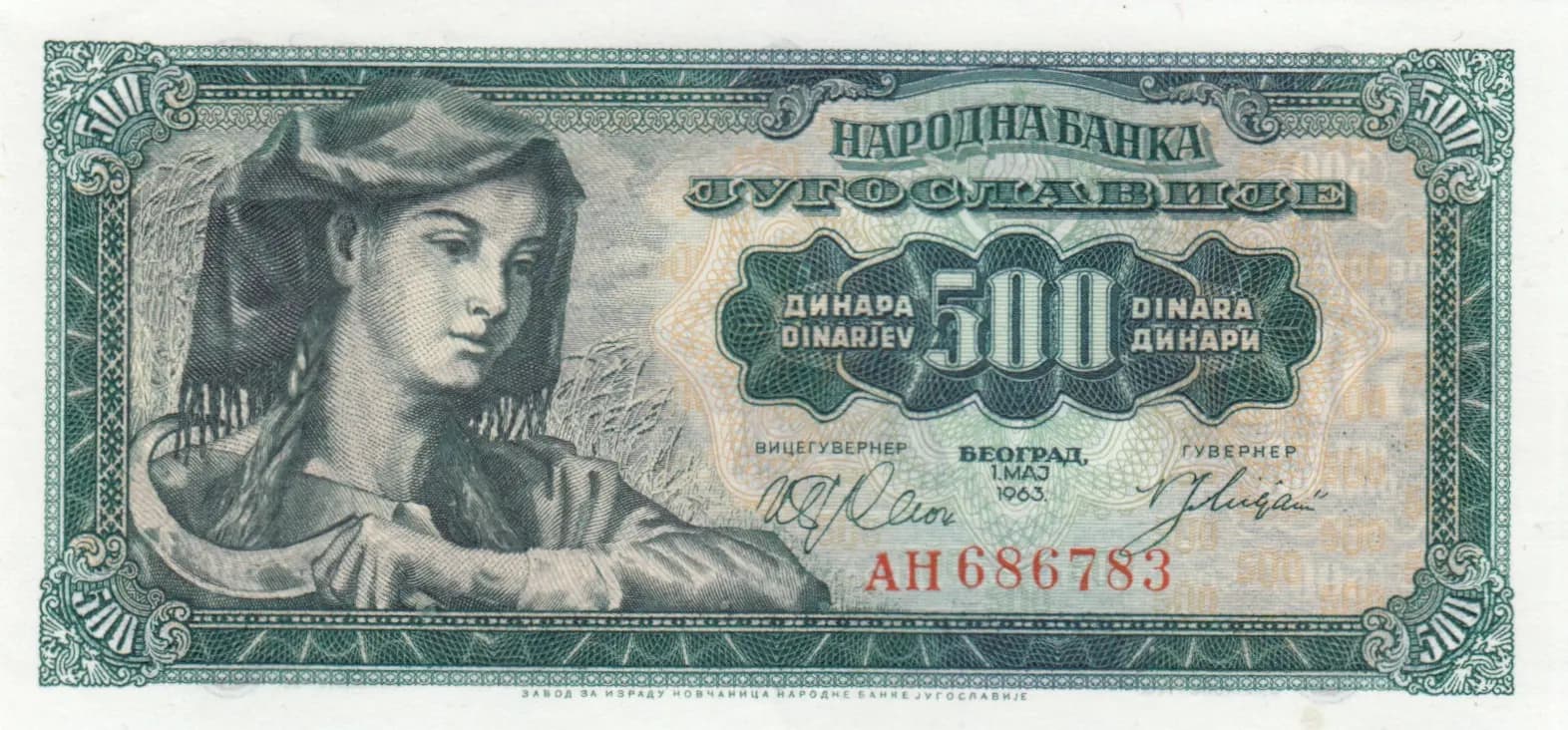
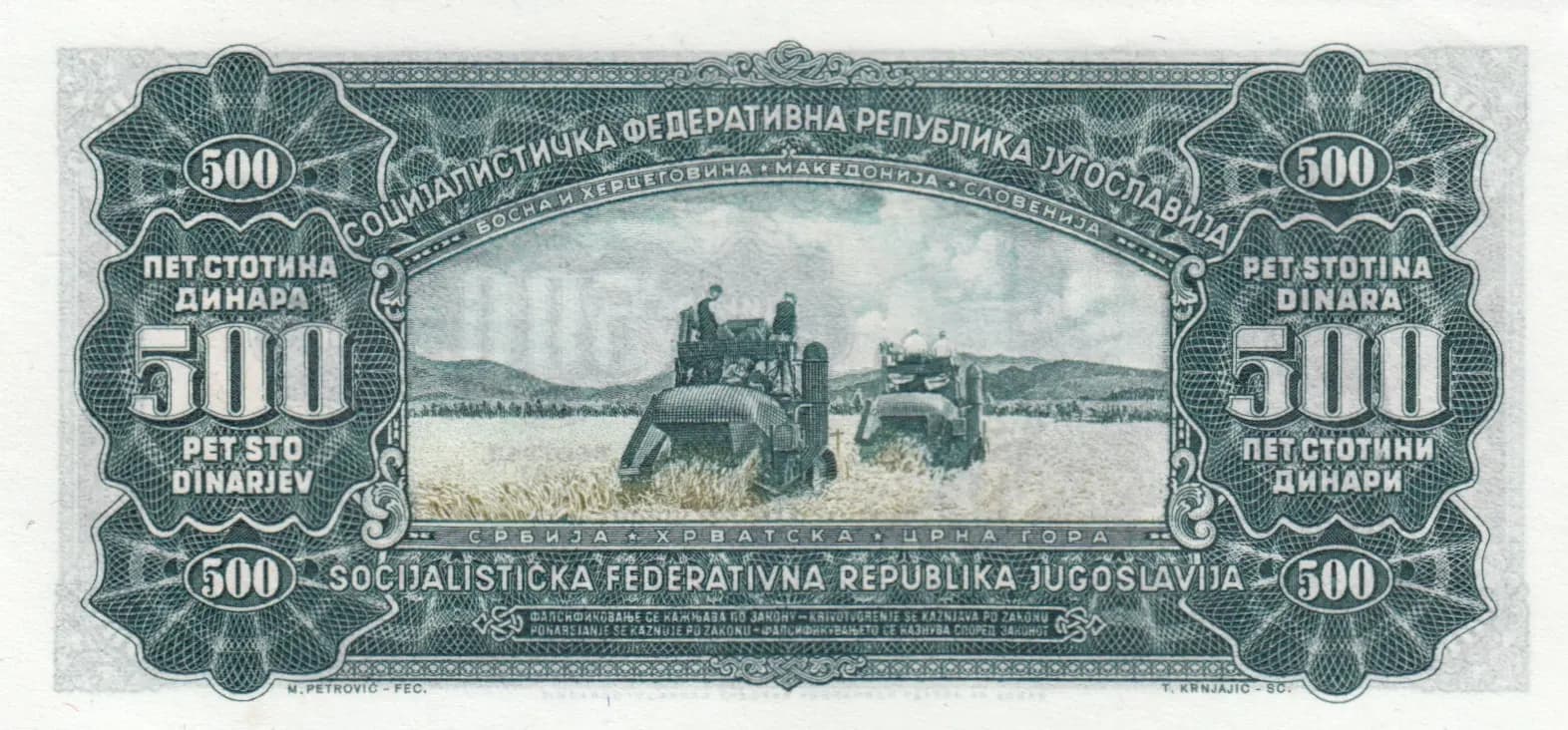
This is a pristine example of Yugoslavia's 500 dinara note from 1963, issued by Narodna Banka Jugoslavije. The note displays exceptional uncirculated condition with crisp printing, sharp details, and no visible wear. The obverse features a dignified portrait of a woman in formal military dress, while the reverse depicts an agricultural scene with combine harvesters and mountain landscape, reflecting Yugoslavia's post-war emphasis on modernization and collective farming during the early Socialist period.
Common. Secondary market data from eBay shows consistent sales of UNC examples in the $2.70-$6.29 range over an extended period (2012-2024), with catalog values listed at $5 UNC. The large number of transactions and stable, low pricing indicates this is a frequently available note with substantial print runs. No evidence of scarcity or special collector premium.
Issued in 1963 during the Socialist Federative Republic of Yugoslavia under Tito's regime, this note reflects the country's ideological focus on agricultural modernization and collective labor. The imagery of farm workers with mechanical harvesters symbolized Yugoslavia's transition from peasant economy to industrialized socialism. The bilingual inscriptions in both Cyrillic and Latin scripts represent the official policy of national equality among Yugoslavia's constituent republics.
The obverse features a left-facing portrait of a woman in profile wearing formal military or ceremonial dress with decorated shoulder insignia and high collar, rendered in fine black and white engraving on a cream background with green text elements. The reverse depicts an agricultural labor scene with multiple workers operating farm machinery (tractors and combine harvesters) in a cultivated field with mountain landscape visible in the background, executed in black and green tones. Both sides are framed by ornate decorative borders featuring scrollwork and geometric patterns, with shield-shaped denomination cartouches in all four corners. The bilateral presentation of text (Cyrillic and Latin scripts) emphasizes Yugoslavia's multinational character.
FRONT: 'Narodna Banka Jugoslavije' (National Bank of Yugoslavia), '500 Dinara/Dinarjev/Dinari' (Five hundred dinars in three languages), 'Viceguverner' (Vice Governor), 'Gouverner' (Governor), 'Beograd' (Belgrade), '1963', Serial number 'AH 686783'. BACK: 'Pet Stotina Dinara/Dinarjev/Dinari' (Five hundred dinars in three languages), 'Socijalističika Federativna Republika Jugoslavija' (Socialist Federative Republic of Yugoslavia), 'Bosna i Hercegovina · Makedonija · Slovenija' / 'Srbija · Hrvatska · Crna Gora' (listing all six constituent republics), Artist signatures 'M. Petrović - Fec.' (maker) and 'I. Krnjaić - Sc.' (sculptor).
Intaglio engraving (fine line engraving technique), executed by Zavod za Izradu Novčanica (Institute for Banknote Production) in Belgrade. The complexity of the background patterns, fine line work, and ornate border designs are characteristic of traditional intaglio printing used for security printing during this era. The quality of line definition and detail visible in the images confirms professional currency-grade engraving.
Serial number variant observed: AH 686783. The note exhibits characteristics consistent with the standard 1963 issue by Narodna Banka Jugoslavije (Pick P-74). The catalog reference notes a related issue by Federativne Narodne Republike Jugoslavije (Pick P-70), which is a distinct variety from an earlier issuing authority. No overprints or unusual date variants are apparent in this specimen. The artist signatures (M. Petrović and I. Krnjaić) appear consistent with the 1963 issue design.