500 dinara 1935
Market Prices
27 salesAbout This Note
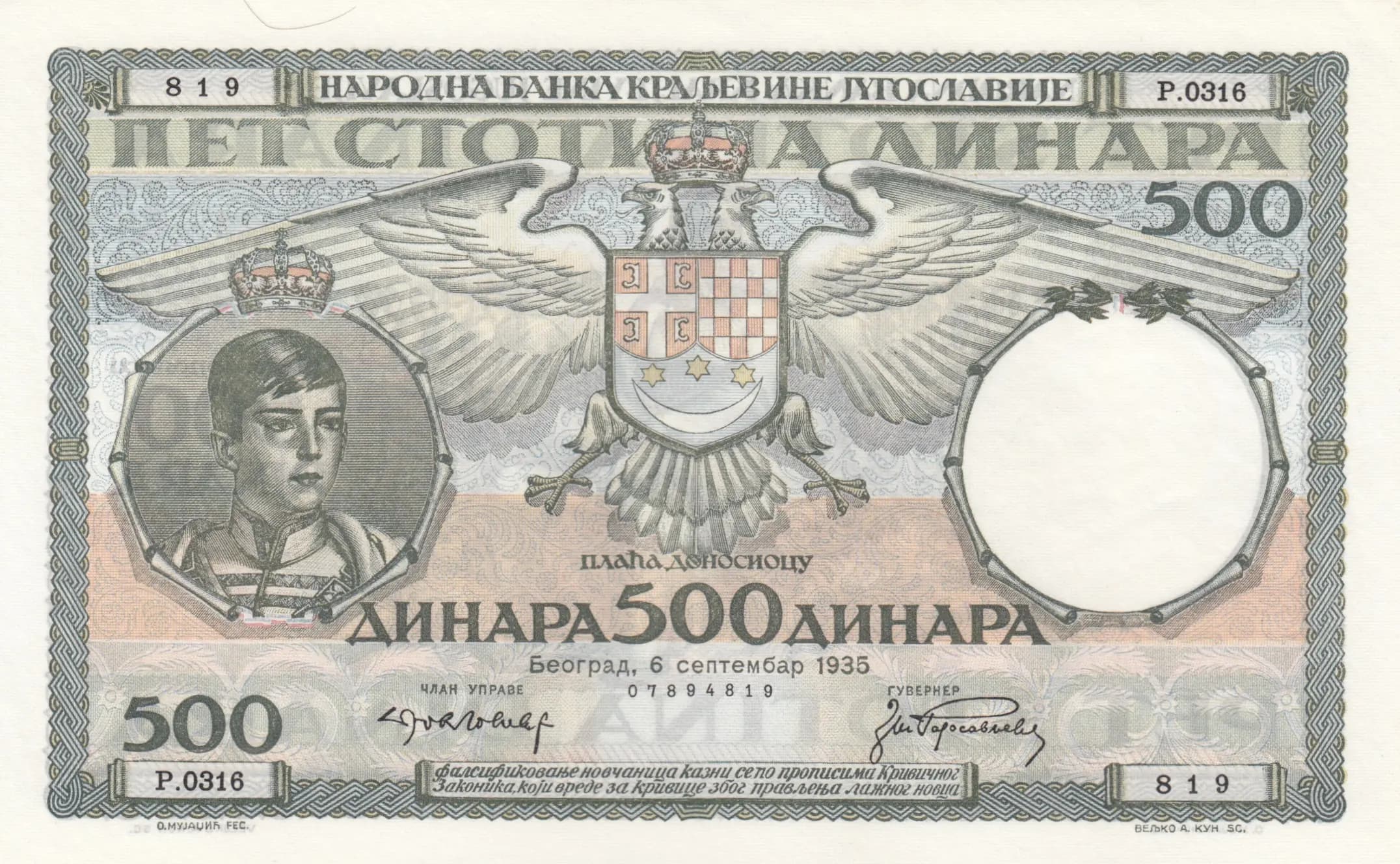
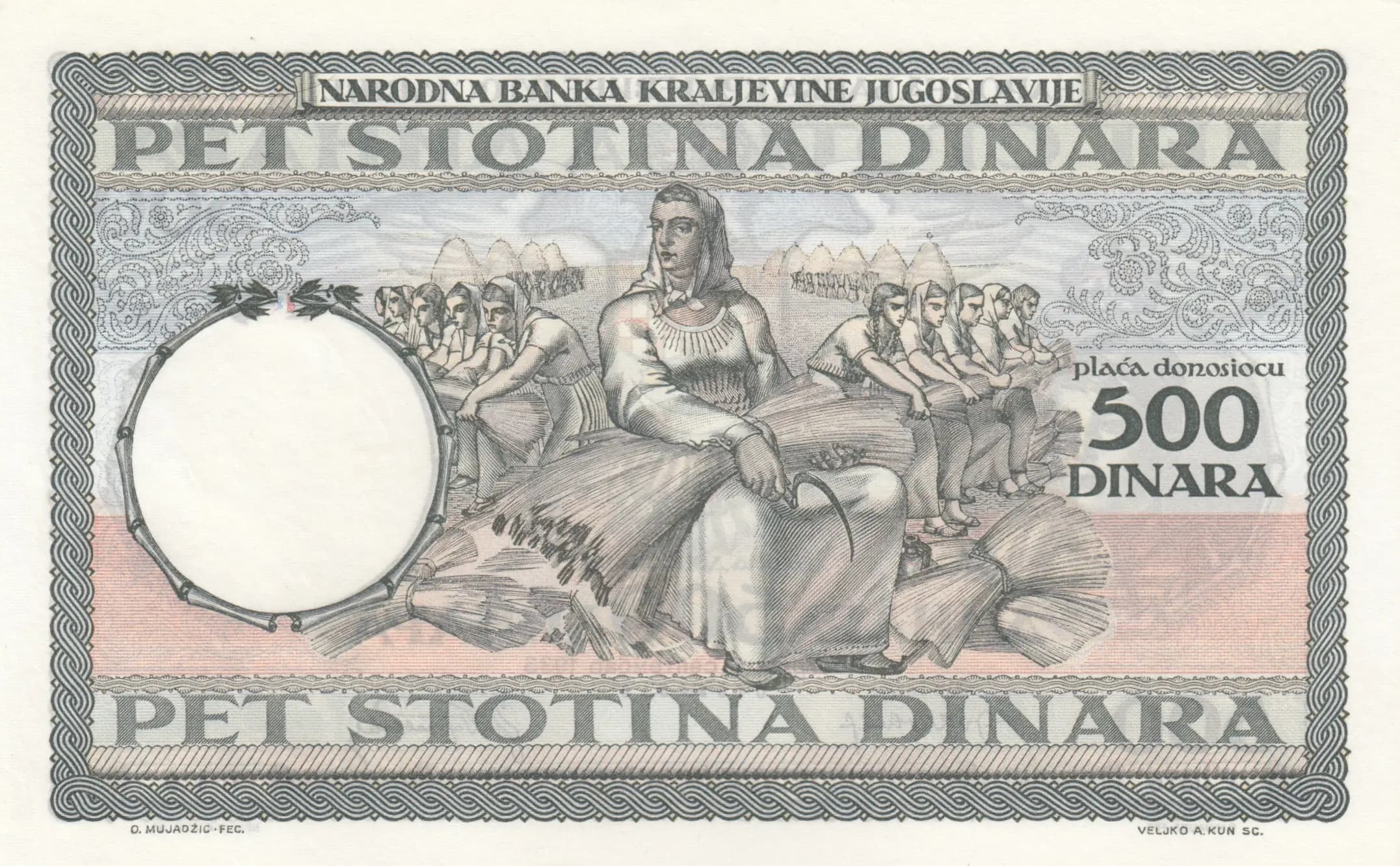
This Yugoslavia 500 dinara note from September 6, 1935 presents in exceptional uncirculated condition with crisp, sharp printing throughout. The obverse features a striking portrait of King Peter II in military uniform within an ornamental circular frame, accompanied by the national coat of arms of Yugoslavia—a double-headed eagle with spread wings bearing the iconic red and white checkered shield (Šahovnica) and three stars. The reverse displays an allegorical scene of peasant women in classical dress engaged in harvest work with wheat sheaves, symbolizing the agricultural prosperity of the Kingdom. The intricate geometric border patterns and fine line engraving on both sides exemplify the high-quality security printing standards of the Narodna Banka Kraljevine Jugoslavije.
Common. The eBay market data shows consistent sales volume spanning from 2010 to 2025, with uncirculated examples regularly selling in the $25-$70 range and professionally graded examples (PMG 64-66) commanding $60-$125. This indicates steady collector demand and adequate supply. Print runs for regular issues of the Narodna Banka Kraljevine Jugoslavije during the 1930s were substantial, and this denomination and date do not represent a short-lived issue or recall scenario. The AU grade specimen observed is in the sweet spot of collector preference and represents typical market pricing, confirming common status.
Issued in 1935 during the reign of King Peter II, this banknote reflects Yugoslavia's consolidation as a unified kingdom following World War I and represents the interwar period's economic stability under the National Bank of the Kingdom of Yugoslavia. The imagery—combining the young king's portrait with allegorical representations of peasant labor and harvest—emphasizes the agrarian foundation of Yugoslav economic identity and the modernizing state's authority. The bilingual Serbian/Cyrillic and Latin inscriptions reflect the multi-ethnic composition of the Kingdom and its efforts to present unified national identity across diverse populations.
The obverse features a left-facing portrait of King Peter II (then a young man, reigning 1934-1945) in Yugoslav military dress uniform with short dark hair, enclosed within an ornate circular frame of geometric patterns. Centrally positioned is the national coat of arms of Yugoslavia: a double-headed eagle with spread wings surmounted by a crown, bearing on its chest a shield displaying the characteristic red and white checkered pattern known as the Šahovnica (the shield of Croatia/Yugoslavia), with three five-pointed stars arranged above the shield. The reverse depicts an allegorical scene representing the prosperity and agricultural foundation of the Yugoslav state: a central female figure in classical dress seated and gesturing expansively, surrounded by other figures in period costume engaged with wheat sheaves and harvest materials, symbolizing fertility, abundance, and labor. Both sides feature the distinctive ornamental border composed of interlocking geometric patterns typical of Serbian/Yugoslav design aesthetic of the period. The color scheme comprises green-gray tones on light blue and pink underprint, with black engraving and red accents on heraldic elements.
FRONT: 'NARODNA BANKA KRALJEVINE JUGOSLAVIJE' (National Bank of the Kingdom of Yugoslavia); 'PETSTO DINARA' / 'PET STOTINA DINARA' (Five Hundred Dinars); '500' (numeric denomination); 'ДИНАРА' (Dinars in Cyrillic); 'Београд, 6 септембар 1935' (Belgrade, September 6, 1935); 'ЧЛАН УПРАВЕ' (Board Member); 'GUVERNER' (Governor); Artist signature 'G. MUŽAJOVIĆ FEC.' and engraver signature 'VELJKO A. KUN SC.'; Reference codes 'R.0316' and 'P.0316'; Serial number '07894819' and individual unit number '819'. BACK: 'NARODNA BANKA KRALJEVINE JUGOSLAVIJE' (National Bank of the Kingdom of Yugoslavia); 'PETSTO DINARA' / 'PET STOTINA DINARA' (Five Hundred Dinars); '500 DINARA' (numeric and text denomination); 'plaća donosiocu' (Pay to Bearer); Artist signature 'O. MUŽAJOVIĆ FEC.' and engraver signature 'VELJKO A. KUN SC.'
Intaglio engraving (line engraving and cross-hatching), characteristic of high-security banknote production of the 1930s. The note exhibits fine detail work including intricate geometric border patterns, detailed portraiture rendered through sophisticated cross-hatching, and fine line work throughout the allegorical scenes. The consistent, sharp impression and fine detail preservation indicates professional security printing by a specialist banknote printer. The signatures of engraver Veljko A. Kun and artist O./G. Mužajović are rendered in the note itself, typical of the era's documentation of artistic credit.
Pick catalog P-32 is listed as a single base variant. The observed note displays the standard design with signatures of O. Mužajović (artist) and Veljko A. Kun (engraver/sculptor), dated September 6, 1935 in Belgrade. Serial number format '07894819' with unit number '819' and reference codes R.0316/P.0316 appear standard. No known major varieties (such as signature variations, overprints, or color differences) are documented for this Pick number in standard catalogs. The note represents the regular issue without variants.