50 dinara 1965 specimen
Market Prices
3 salesAbout This Note
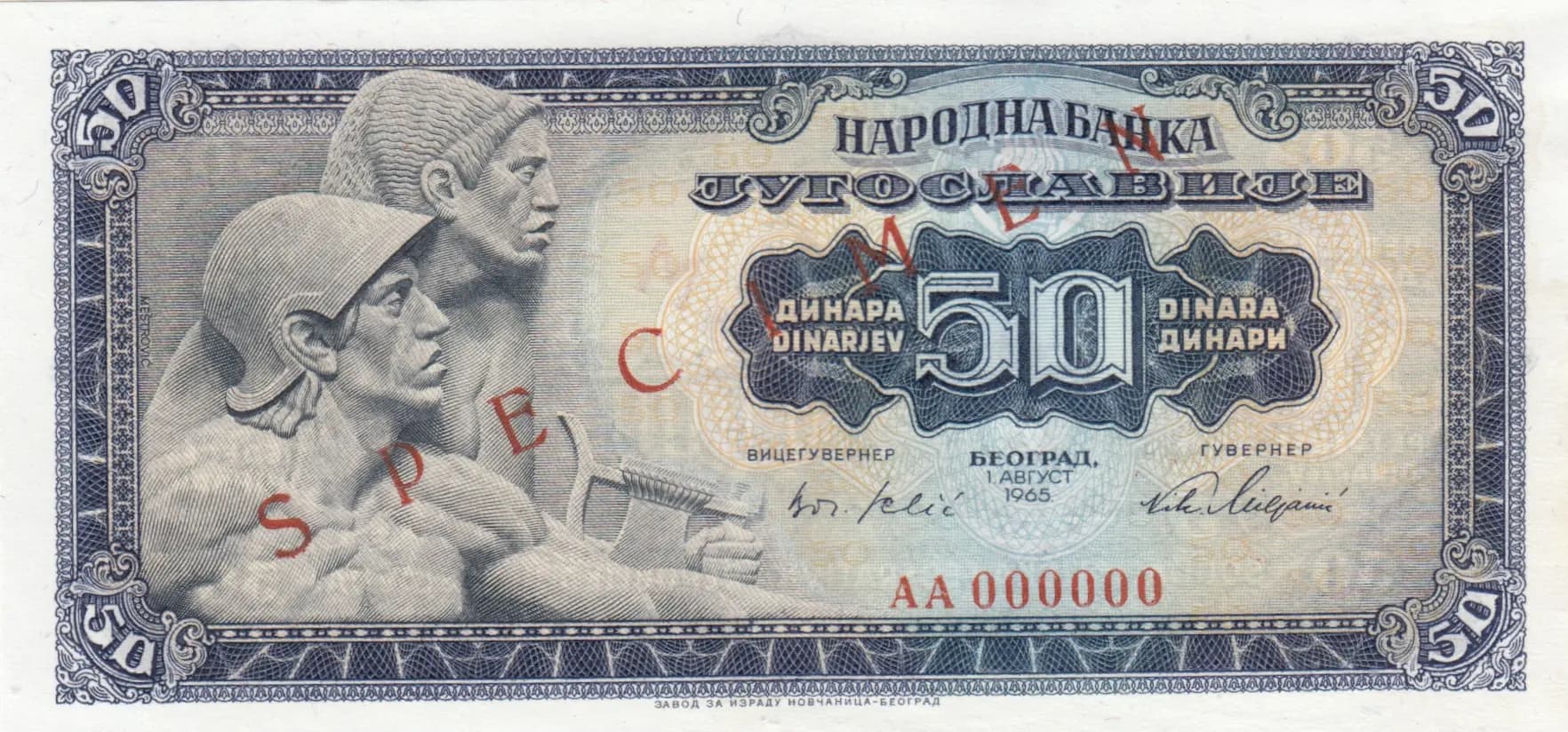
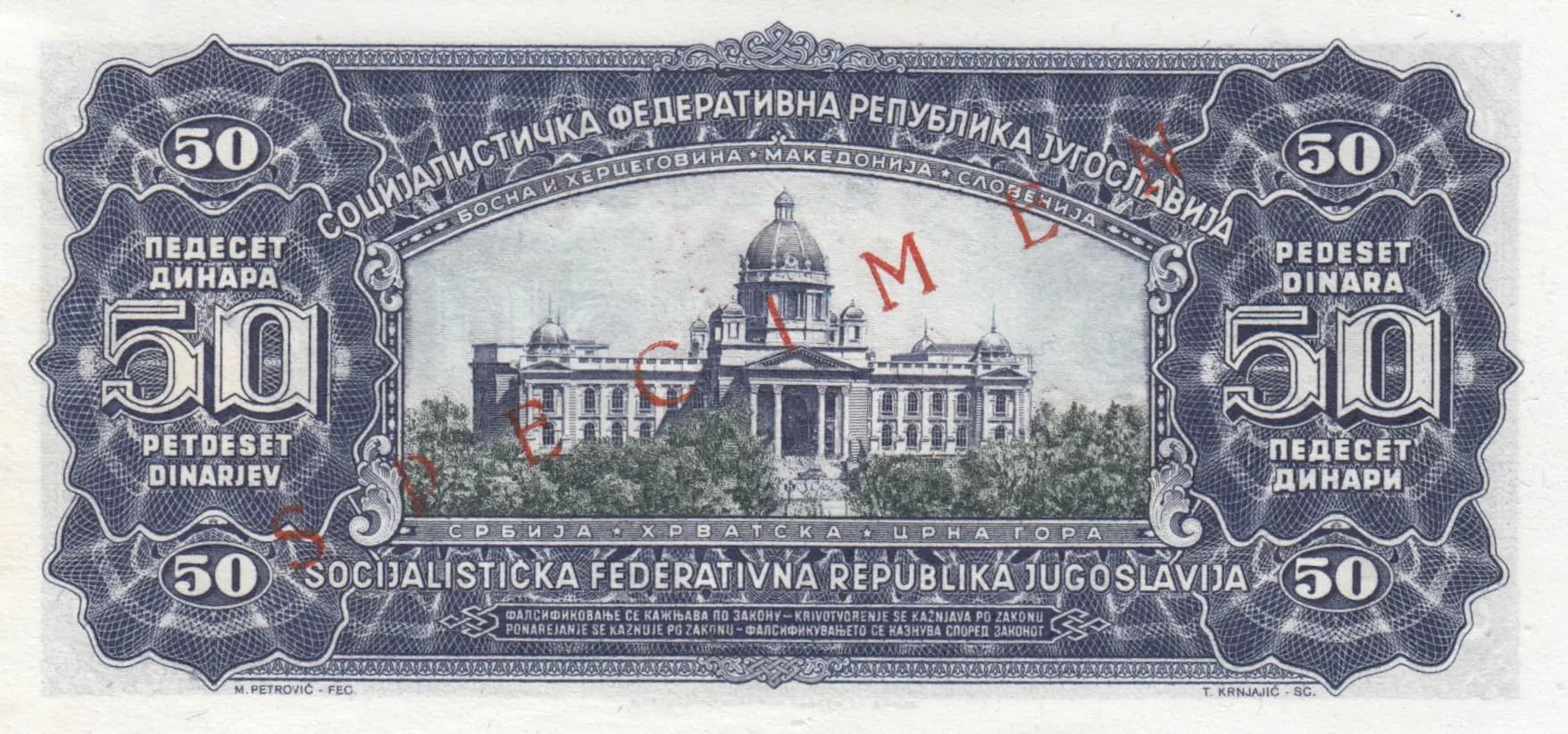
This is a 1965 Yugoslav 50 dinara specimen note in uncirculated condition, featuring a striking dual-portrait design of two male busts in profile on the obverse and a neoclassical parliament building on the reverse. The note displays the characteristic red specimen overprints and serial number AA 000000, confirming its status as a non-circulating sample. The detailed engraving work and multicolor printing demonstrate the high production standards of the Narodna Banka Jugoslavije, making this an attractive example of mid-1960s Yugoslav currency design.
Common. The 1965 50 dinara note (Pick 79) is a standard issue of the Yugoslav National Bank with presumably large print runs typical of mid-range denominations. Market evidence from the provided eBay sales data supports this assessment: uncirculated examples sold for $16-$22 in recent decades, and even a PMG 66-graded specimen brought only $43 in 2019. These prices reflect collector interest in Yugoslav currency without indicating scarcity. Specimen notes are somewhat more specialized than circulation issues, but this particular note appears regularly in the market, confirming its common status.
Issued on August 1, 1965, this banknote reflects Yugoslavia's status as a Socialist Federative Republic during Tito's era, with text acknowledging all six constituent republics (Serbia, Croatia, Montenegro, Bosnia and Herzegovina, Macedonia, and Slovenia). The parliamentary building depicted on the reverse symbolizes the federal government structure, while the portrait busts on the obverse likely honor national figures important to the Yugoslav state. This denomination and design series represents the currency system in place during Yugoslavia's period of relative economic stability and international non-alignment in the mid-1960s.
The obverse features two male portrait busts rendered in classical engraving style, positioned in profile facing right with the larger bust in the background and smaller in the foreground, likely representing significant Yugoslav historical or political figures. The reverse depicts a prominent neoclassical government building with a distinctive central dome and cupola, surrounded by landscaped grounds with trees, identified as the Parliament building in Belgrade. Both sides are framed by intricate ornamental borders featuring geometric and floral patterns typical of mid-20th century currency design. The denomination 50 appears in decorative cartouches positioned in the corners of both sides. The multicolor printing combines dark blue as the dominant color with gray, cream, green (for foliage), and red (specimen overprints), creating a visually sophisticated and secure design.
FRONT: 'Narodna Banka Jugoslavije' (National Bank of Yugoslavia); 'Dinara/Dinarjev/Dinari' (Fifty Dinara in multiple languages); 'Beograd, 1. Avgust 1965' (Belgrade, August 1, 1965); 'AA 000000' (specimen serial number); 'Zavod za Izradu Novčanica - Beograd' (Banknote Production Facility - Belgrade); 'Guvernera' (Governor); 'Viceguvernera' (Vice Governor); 'Specimen' (English overprint). BACK: 'Socialistička Federativna Republika Jugoslavija' (Socialist Federative Republic of Yugoslavia); 'Pedeset Dinara/Dinarjev/Dinari' (Fifty Dinara in multiple languages); 'Srbija · Hrvatska · Crna Gora · Bosna i Hercegovina · Makedonija · Slovenija' (all six constituent republics); 'M. Petrović - FEC' and 'T. Krnjajić - SC' (artist/sculptor signatures); Counterfeiting warnings in multiple languages: 'Falsifikovanje se kažnjava po zakonu' (Counterfeiting is punishable by law).
This note was produced using traditional intaglio/engraving processes, evidenced by the fine line work, detailed cross-hatching, and complex border patterns visible throughout both sides. The printer was the Zavod za Izradu Novčanica (Banknote Production Facility) in Belgrade, as stated on the obverse. The specimen overprints in red were applied as part of the non-circulation marking process. Multiple colors were achieved through successive passes of the intaglio plates, a standard security printing technique of the period that makes counterfeiting extremely difficult through manual reproduction methods.
This is identified as Pick-79s (the 's' denoting specimen status) from the 1965 issue dated August 1. The serial number AA 000000 is characteristic of specimen notes, which were typically issued with zero serial numbers or special prefixes. No significant varieties are noted in the visual analysis; this appears to be a standard specimen presentation of the 1965 design with red 'SPECIMEN' overprints and an 'M' stamp on the reverse, consistent with Yugoslav National Bank specimen marking protocols of the period.