50 dinara 1946 specimen
Market Prices
18 salesAbout This Note
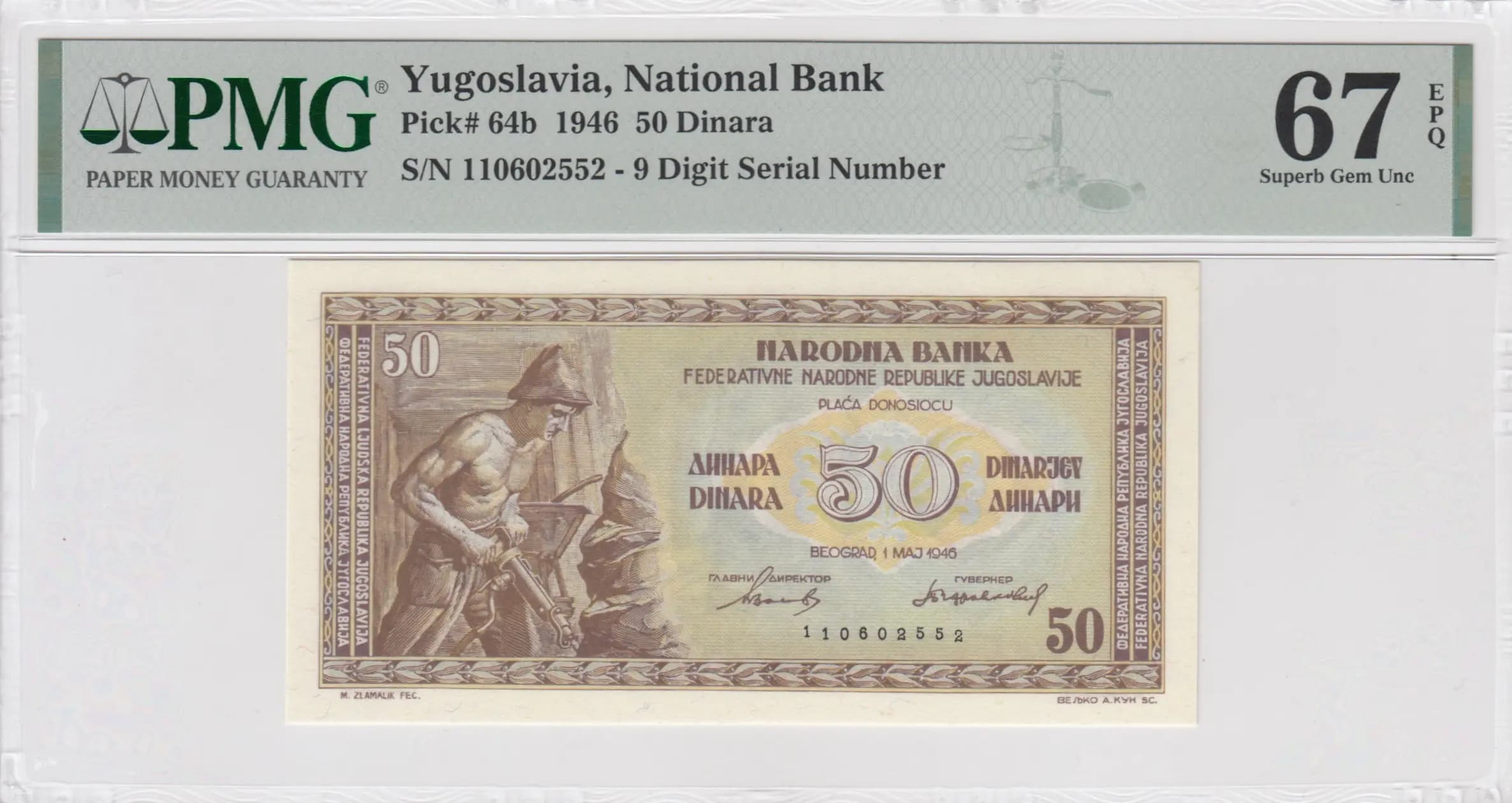
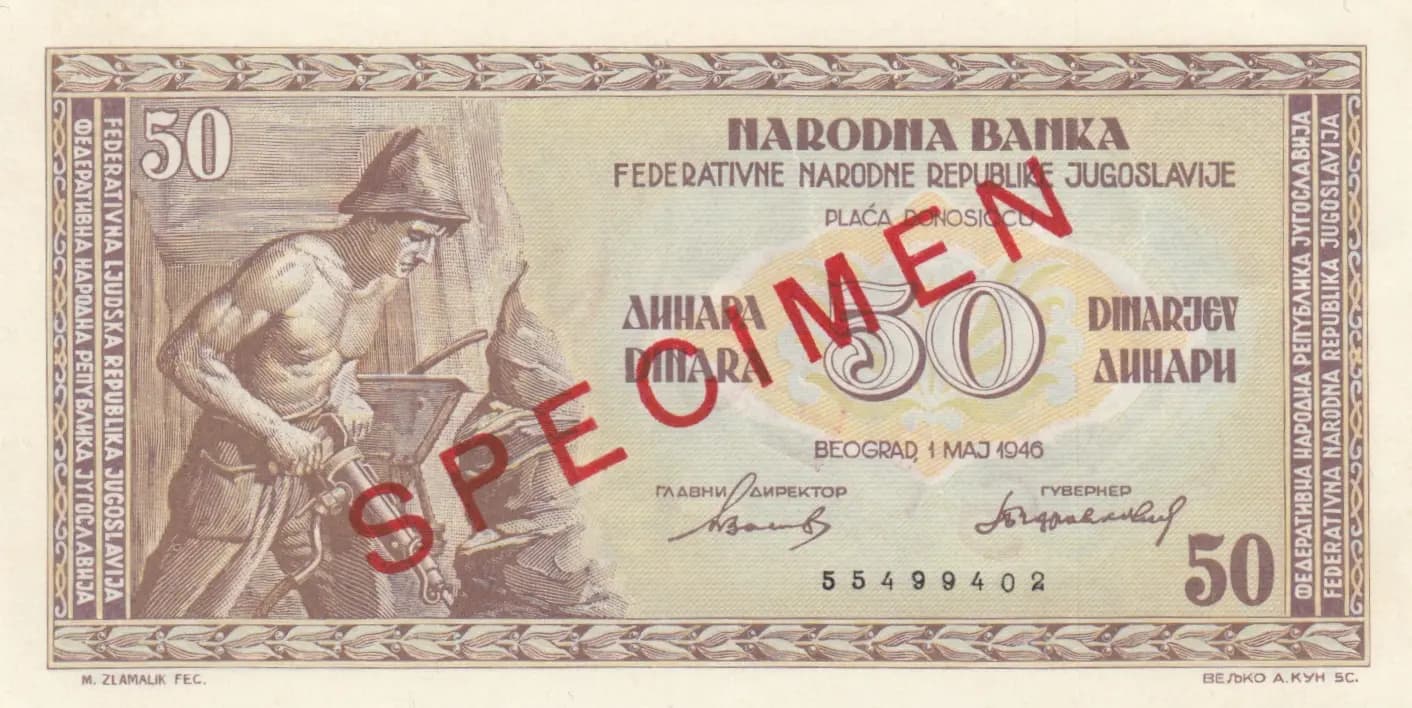
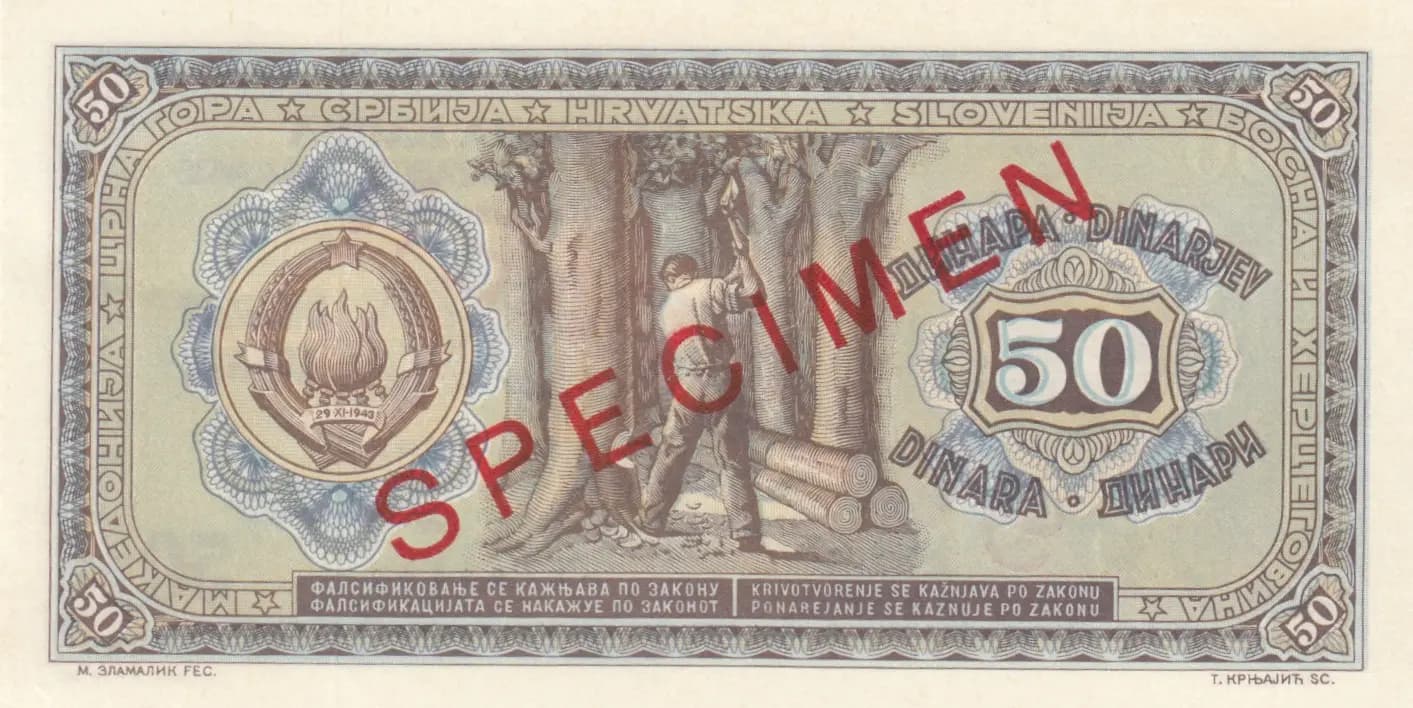
This is a pristine uncirculated specimen of the 1946 Yugoslav 50 dinara note issued by the Narodna Banka of the Federative People's Republic of Yugoslavia. The note features exceptional engraving quality with a miner depicted on the obverse and woodcutters in a forest labor scene on the reverse, both rendered in classical style with fine detail work. The red SPECIMEN overprint across the center identifies this as a non-circulating specimen note, and its pristine condition with sharp, well-defined printing throughout makes it an attractive example of early post-war Yugoslav currency design.
Common. While this is a specimen note (a non-circulating printing used for distribution to banks and officials), the 1946 50 dinara Pick-64 in general shows strong market circulation history with numerous documented sales across all grades over the past 15 years on eBay. eBay price data shows UNC examples selling in the $10–$34 range (2010–2020), with 2016 catalog valuation of $80 for UNC representing an outlier. The prevalence of sales data across VG, F, VF, EF, and UNC grades indicates substantial availability. Specimen notes of this issue are not restricted or particularly scarce in the numismatic market. Common rating is appropriate despite specimen status.
Issued on May 1, 1946, this note represents the currency of the newly established Federative People's Republic of Yugoslavia under Tito's leadership, just months after the end of World War II. The imagery celebrating labor—specifically the miner and woodcutter—reflects the communist regime's emphasis on industrial and agricultural workers as the foundation of the new socialist state. The inclusion of the constituent republics (Serbia, Croatia, Slovenia, Bosnia, and Montenegro) in the decorative border underscores the federal nature of the reconstituted Yugoslav state.
The obverse (front) features a left-facing male figure in classical engraved style wearing a hat and working with a hammer or similar tool, representing a miner—symbolizing industrial labor. The note is dominated by cream and beige tones with brown and reddish-brown engraving. Elaborate decorative border patterns with repeating leaf and vine motifs frame the design, with ornamental corner elements incorporating the denomination '50'. The reverse depicts a labor scene with multiple workers engaged in forestry or timber work, surrounded by logs in a woodland setting. Ornate circular medallions appear in the upper corners, with the left featuring a winged torch or flame symbol (representing the torch of revolution and socialist ideals) and the right displaying the denomination. A decorative band borders the reverse with a repeating pattern reading the names of Yugoslavia's constituent republics. Both sides employ fine line engraving throughout, with bilateral symmetry and classical artistic treatment typical of 1940s European currency design.
FRONT: 'Narodna Banka Federativne Narodne Republike Jugoslavije' (National Bank of the Federative People's Republic of Yugoslavia); 'Plaća Dostosilac' (Pay to Bearer); denomination in three languages—'Dinara' (Serbian), 'Dimarjev' (Slovenian), 'Dinari' (Croatian); 'Beograd 1 Maj 1946' (Belgrade May 1, 1946); signature lines for 'Glavni Direktor' (Chief Director) and 'Guberener' (Governor); serial number '5549940Z'; engraver credit 'M. Zlamalik Fes.'; printer credit 'Beljko A. Kun S.C.'; 'Specimen' (English overprint). BACK: Decorative border reading 'Gora * Srbija * Hrvatska * Slovenija * Bosna' (Mountain * Serbia * Croatia * Slovenia * Bosnia); denomination '50' and 'Dinara/Dinari/Dinarjev'; warning text 'Falsifikovanje se Kaznjavaju Po Zakonu' (Counterfeiting is Punishable by Law), 'Krivotvoren je Kaznjavaju Po Zakonu' (Forgery is Punishable by Law), 'Ponavljenje se Kaznuje Po Zakonu' (Reproduction is Punishable by Law); engraver credit 'M. Zlamalik Fes.'; printer credit 'T. Krnjajic S.C.'; 'Specimen' overprint.
Intaglio engraving (copperplate/steel plate), as evidenced by the fine, detailed line work, precise borders, and sharp definition of the portrait and labor scene visible in the images. Multiple engravers are credited: M. Zlamalik (Fes. = fecit/made), indicating primary engraving work. Separate printers handled obverse (Beljko A. Kun S.C.) and reverse (T. Krnjajic S.C.), suggesting a multi-stage production process typical of Yugoslav National Bank currency. The multicolor underprint visible on the obverse indicates additional color layering applied before the primary engraved impressions.
This note is cataloged as Pick-64as (where 's' denotes 'specimen'). The 1946 issue exists in at least two known varieties: P-64b (non-specimen regular issue with circulating numbers) and P-64as (specimen variant with red SPECIMEN overprint, as observed here). The serial number '5549940Z' uses an 8-digit format with letter suffix, consistent with the first issue described in reference catalogs. The specimen overprint in red diagonally across the note is the primary distinguishing feature of this variety, indicating this note was not intended for circulation but rather for archival and distribution purposes to financial institutions.