50 dinara 1941
Market Prices
5 salesAbout This Note
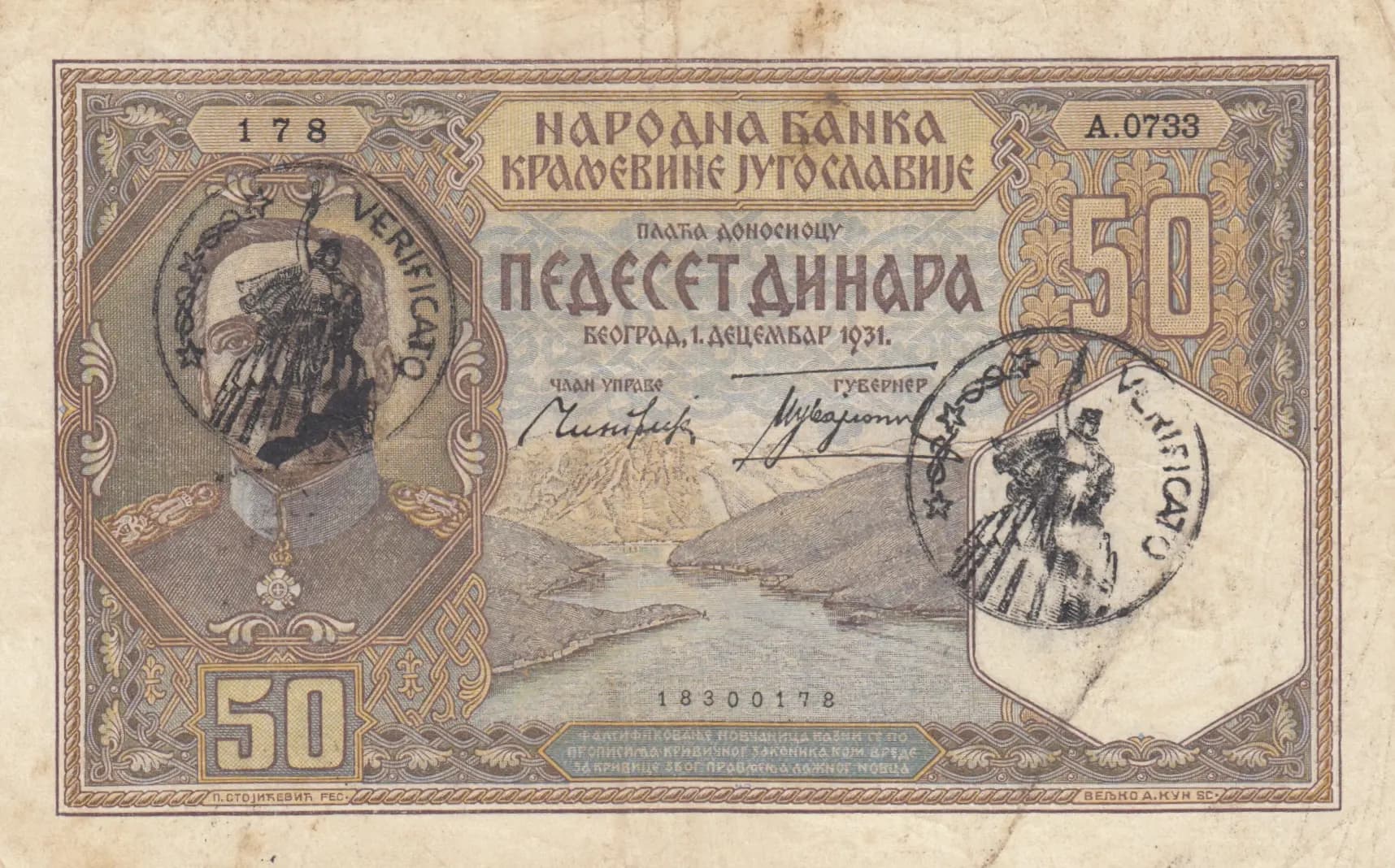
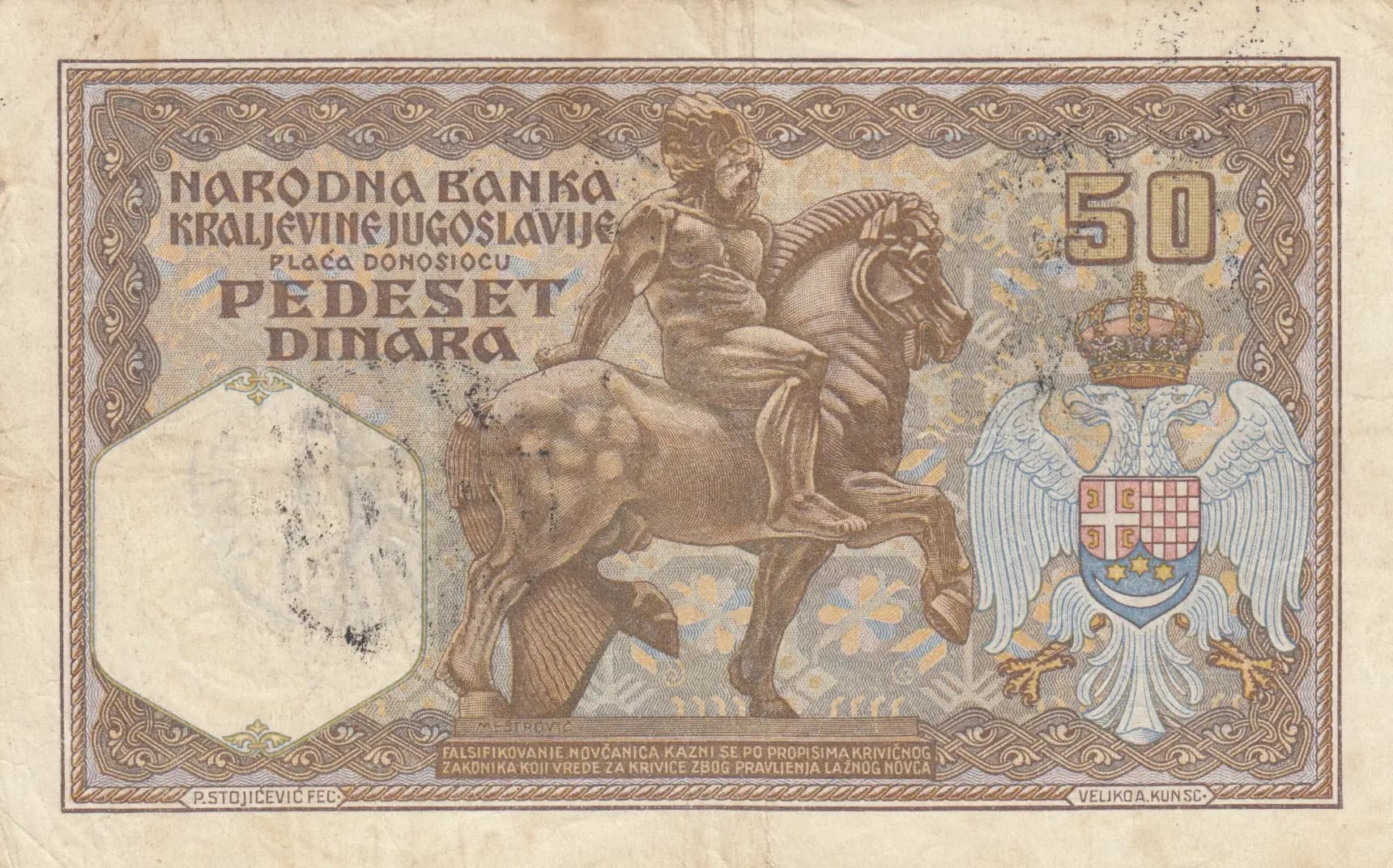
This 50 dinara banknote from the Kingdom of Yugoslavia, issued in 1941 under Italian occupation, presents a fascinating piece of WWII-era numismatic history. The note displays the classic pre-war design featuring King Alexander I in military dress on the obverse and an allegorical cherub with lion and Yugoslav coat of arms on the reverse, rendered in brown and multicolor tones with fine engraving work. In VF condition, it shows significant aging with foxing and creasing consistent with circulation during wartime, making it an authentic historical artifact from a turbulent period.
Common. Despite its historical significance as a WWII-era occupation note, this Pick number appears frequently in the numismatic market. eBay sales data shows consistent pricing in the $2-$15 range across various conditions, with multiple sales per decade recorded. The VF condition grade of this specific example aligns with typical eBay pricing of $8.50-$15.50 for similar examples. Large print runs during the 1931-1941 period and the fact that these notes remained in circulation post-war suggest substantial quantities survived. No evidence of unusual scarcity or collector premiums exists for this particular Pick number.
This 50 dinara note represents the transitional period following the German invasion of Yugoslavia in April 1941, when the Kingdom of Yugoslavia was partitioned and portions fell under Italian occupation. The continued use of pre-war National Bank of the Kingdom of Yugoslavia notes with imagery of King Alexander I (who died in 1934) reflects the complex political situation during occupation, where existing currency stocks were pressed into service rather than immediately replaced. The Italian Armed Forces issuer designation on this note indicates its use in Italian-occupied territories of Yugoslavia during the 1941-1943 period.
The obverse features a portrait of King Alexander I of Yugoslavia in formal military dress uniform, positioned on the left side, displaying medals and insignia of rank. The center depicts a landscape scene of a river valley with mountains and settlement structures along the water, characteristic of the Danube or similar Balkan geography. An ornate border with geometric and floral patterns frames the design in brown and gold tones. The reverse displays a classical allegorical composition featuring a cherub or putto (winged child figure) seated beside a lion, symbolizing strength and protection. To the right is the Yugoslav coat of arms featuring a white double-headed eagle on a blue background with a prominent red and white checkered shield (the Šahovnica) in the center, topped by a crown. Both sides employ fine guilloche patterns and line engraving as security elements.
FRONT SIDE: 'НАРОДНА БАНКА КРАЉЕВИНЕ ЈУГОСЛАВИЈЕ' (National Bank of the Kingdom of Yugoslavia) | 'ПАЛВА ДОНОСИОЦУ' (Pays to bearer) | 'ПЕДЕСЕТДИНАРА' (Fifty dinara) | 'БЕОГРАД, I.ДЕЦЕМБАР 1931.' (Belgrade, December 1, 1931) | 'ЧЛАН УПРАВЕ' (Member of Board) | 'ГУБЕРНЕР' (Governor) | Serial number: А.0733, 18300178 | Additional marking: 178. BACK SIDE: 'НАРОДНА БАНКА КРАЉЕВИНЕ ЈУГОСЛАВИЈЕ' (National Bank of the Kingdom of Yugoslavia) | 'ПЛАЋА ДОНОСИОЦУ' (Pays to bearer) | 'ПЕДЕСЕТ ДИНАРА' (Fifty dinara) | Engraver credits: 'P.STOJIČEVIĆ FEC' (P. Stojičević engraved this) | 'VELJKOAKUN SC' (Veljko A. Kun sculpted this).
Intaglio (steel engraving) printing, characteristic of high-security banknote production of the interwar and WWII period. The note was engraved by P. Stojičević (engraver) and Veljko A. Kun (sculptor), as credited on the reverse. The fine line work, ornate guilloche patterns, and detailed portraiture are consistent with traditional hand-engraved security printing techniques used by the National Bank of Yugoslavia and international security printers of the era. Multiple colors were applied through sequential intaglio passes.
Serial number variety: А.0733 (Cyrillic prefix А with numeric suffix). The note features a handstamp marking referenced in catalog data as appearing on 'p28' (page 28, likely indicating a footnote or variation listing in the Pick catalog). The date of original issue shown on the note is December 1, 1931 (БЕОГРАД, I.ДЕЦЕМБАР 1931), indicating this is an original pre-war design pressed into use during the 1941 occupation period rather than a new issue. The presence of handwritten signatures in the center suggests official authorization marking for use under Italian occupation. No known overprint varieties have been documented for this Pick number in the referenced sources.