50 dinara 1931
Market Prices
51 salesAbout This Note
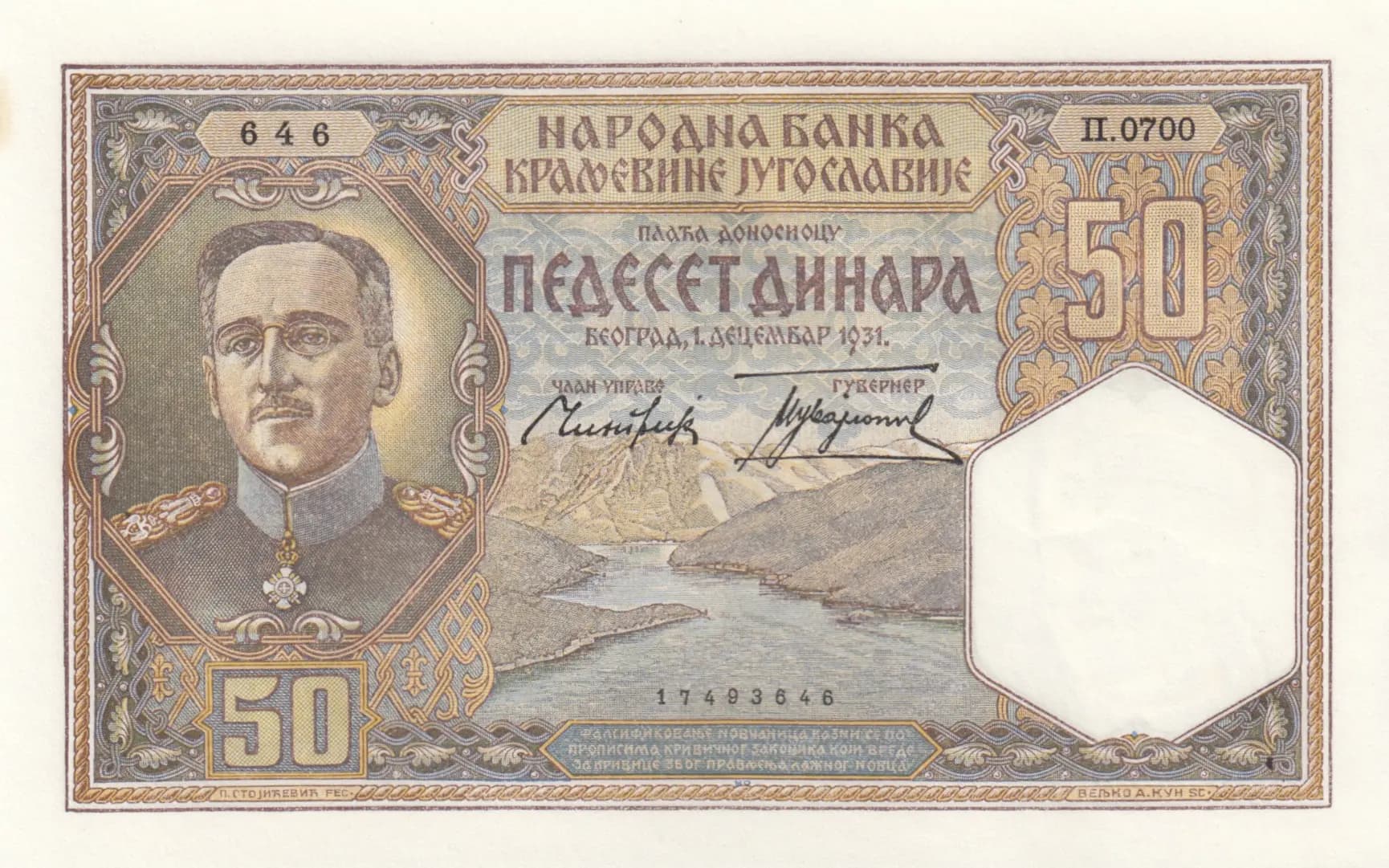
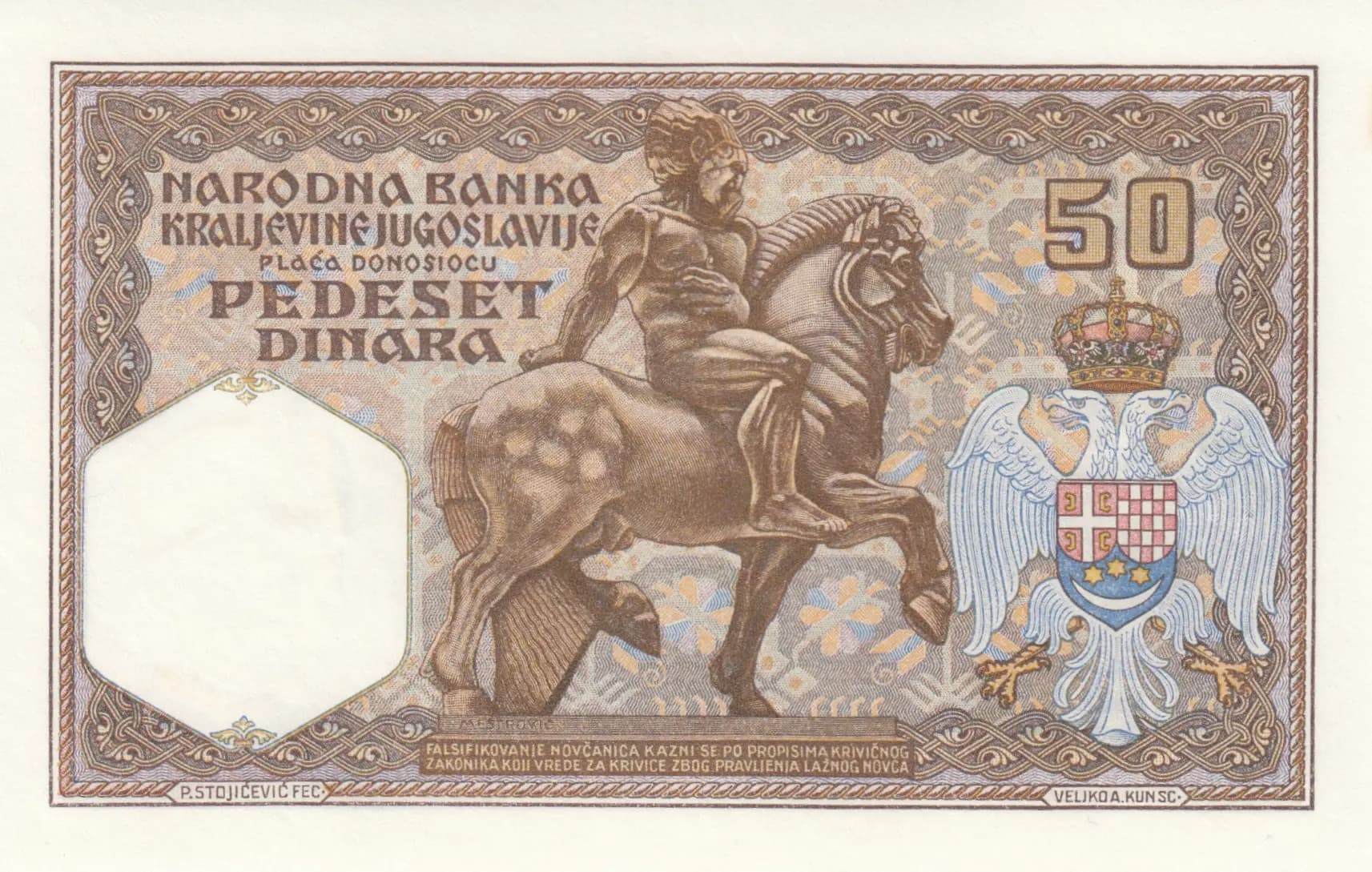
A magnificent example of Yugoslavia's 1931 National Bank issue, this 50 dinara note presents in uncirculated condition with crisp printing throughout and no visible wear. The obverse features King Aleksandar Karađorđević in military dress adorned with a chest medal, set against a mountainous river landscape rendered in brown and gold tones, while the reverse displays a classical equestrian allegory (Marko Kraljević's statue by Ivan Meštrović) alongside the Kingdom's double-headed eagle coat of arms. This note represents an important early stabilization period currency, combining royal portraiture with national heraldic symbolism in fine engraved detail.
Common. eBay transaction data shows consistent trading in the $10–$75 range across grades from VF to PMG 67, with UNC specimens regularly selling for $15–$45 between 2010–2020, and recent PMG 67 sales around $62–$75. Catalog values list UNC at approximately $20 (2016). The note's large print run under a stable national bank, combined with its survival in multiple grades and frequent market availability, confirms it as a standard issue without scarcity premium. The 1931 date series of Yugoslav National Bank notes is widely collected and not restricted.
Issued on December 1, 1931, by the Narodna Banka Kraljevine Jugoslavije during King Aleksandar I's reign, this note commemorates the consolidation of the Kingdom of Yugoslavia following the 1929 centralizing reforms. The portrait of King Aleksandar Karađorđević reflects his authority as unifier of South Slavic territories, while the reverse's depiction of the Marko Kraljević equestrian statue (a 1910 work by acclaimed sculptor Ivan Meštrović) symbolizes national pride and medieval Serbian heroic tradition. The Bay of Kotor landscape on the obverse emphasizes the Kingdom's Adriatic coast and territorial integrity.
The obverse features a formal three-quarter portrait of King Aleksandar I Karađorđević on the left, rendered in profile wearing a military dress uniform with glasses and a decorative chest medal or order of merit, enclosed within an ornate rectangular frame with geometric and floral security patterns. To the right, a naturalistic landscape depicts the Bay of Kotor with mountainous terrain and river valley, reflecting Yugoslavia's strategic Adriatic position. Large denomination numerals '50' appear in the upper right and lower left corners. The reverse showcases a classical allegorical equestrian composition (representing the Marko Kraljević statue by Ivan Meštrović) centered on the note, flanked on the right by Yugoslavia's coat of arms—a crowned double-headed eagle displaying a shield with the characteristic red-and-white checkerboard (šahovnica) pattern central to South Slavic heraldry, with additional shield elements in blue and gold. Both sides employ fine-line engraving throughout with ornamental borders featuring repeating geometric motifs.
FRONT: 'Narodna Banka Kraljevine Jugoslavije' (National Bank of the Kingdom of Yugoslavia) | 'Plaća donosiocu' (Payable to Bearer) | 'Pedeset dinara' (Fifty Dinara) | 'Beograd, 1. decembar 1931.' (Belgrade, 1st December 1931) | 'P. Stojičević fes.' (P. Stojichevich, engraver) | 'Velika A.K. Un Beg' (possibly a department or authorization mark) | Serial numbers: 17493646 and 646. BACK: 'Narodna Banka Kraljevine Jugoslavije' (National Bank of the Kingdom of Yugoslavia) | 'Plaća donosiocu' (Payable to Bearer) | 'Pedeset dinara' (Fifty Dinara) | 'Falsifikovanje novčanica kazni se po propisima krivičnog zakona koji važe za krivice zbog pravljenja lažnog novca' (Counterfeiting banknotes is punished according to criminal law provisions applicable to crimes of making counterfeit currency) | 'P. Stojičević fec.' (P. Stojichevich, engraver).
Intaglio engraving on banknote paper, characteristic of high-security currency production of the 1930s. The note demonstrates the fine line work typical of professional security printers of the interwar period, with multiple engraved plates creating the complex imagery and decorative borders. The engraver P. Stojičević is credited on both obverse and reverse. Printing likely executed by a major European security printer contracted to the Yugoslav National Bank, employing traditional steel plate intaglio methods.
This specimen bears serial number 17493646 with prefix designation 646 and administrative marking 'П.0700.' The engraver attribution 'P. Stojičević fes.' appears on both sides. While PMG records indicate a single variant cataloged for Pick 28, this note's specific serial range and administrative markings may represent one of multiple print batches within the 1931 issue. No overprints, date variants, or signature variants are evident on this specimen. The 1941 Serbian-only reissue mentioned in catalog notes represents a distinct later issue, not applicable to this 1931 Belgrade-dated example.