5 lire 1945
Market Prices
8 salesAbout This Note
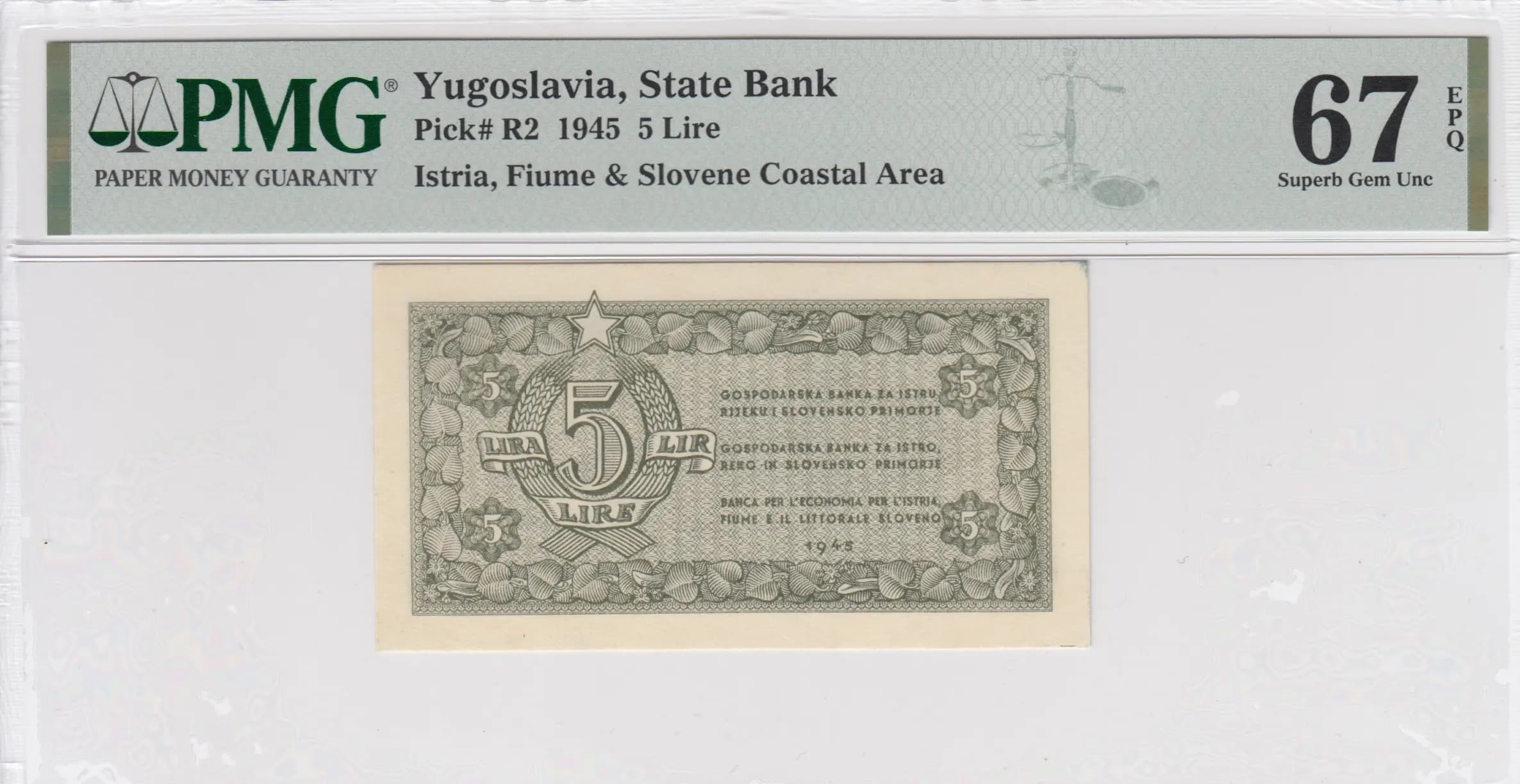
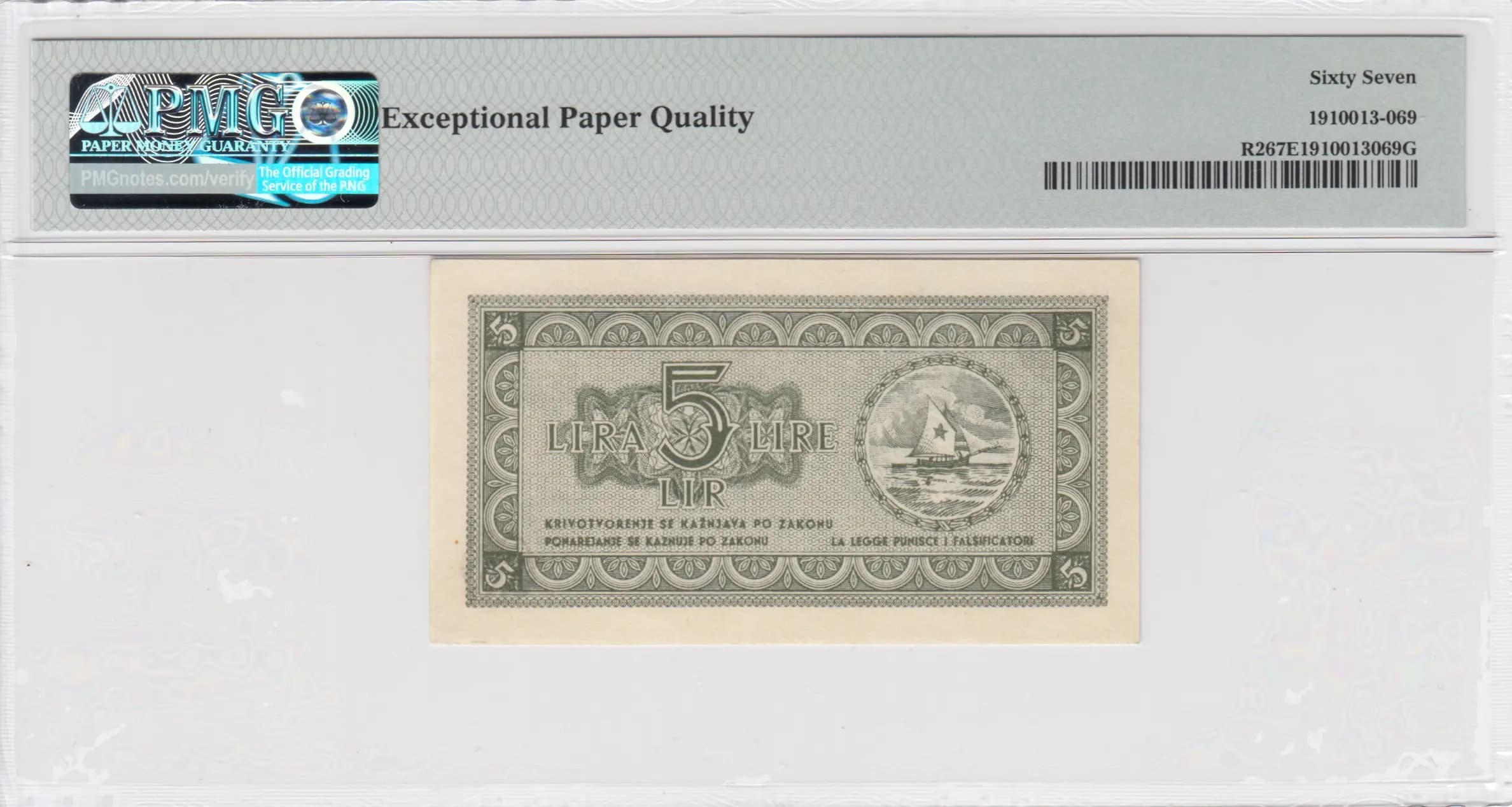
This is a PMG 67 EPQ graded 5 Lire banknote issued by the State Bank of Yugoslavia in 1945, representing a regional issue from the post-WWII period. The note exhibits pristine, uncirculated condition with crisp engraving, featuring a maritime-themed design with a steamship vignette on the obverse and an ornate star-and-wreath composition on the reverse. This particular grade (PMG 67) is notably scarce in the market, as evidenced by the significantly higher realized prices compared to lower-grade examples.
Common. While this specific PMG 67 EPQ grade is scarce and commands premium prices (recent comparable sold for $87.60 in 2020), the note type itself is relatively common in lower circulated grades. eBay market data shows consistent sales of this denomination in F-VF condition at $2-$15, indicating regular collector availability. The catalog 2008 values reflect this accessibility. High-grade examples command premium due to rarity of preservation, not print run scarcity.
This 5 Lire note was issued by the State Bank during the tumultuous post-World War II period in Yugoslavia, reflecting the region's complex geopolitical situation. The bilingual inscriptions in both Croatian/Serbo-Croatian and Italian, combined with the ship vignette and references to Istria, Rijeka, and the Slovenian Littoral, document the contested Adriatic territories of the time. The coastal imagery emphasizes the importance of maritime commerce and territorial identity in this ethnically and linguistically diverse region during its transitional period.
The obverse features a classical rectangular frame with decorative semi-circular border patterns. The denomination numeral '5' appears prominently in the center-left, flanked by 'LIRA' and 'LIRE' text. A circular vignette on the right side depicts a steamship or paddle-wheeler sailing rightward, symbolizing the maritime commerce vital to the Adriatic region and the territorial focus on Rijeka (Fiume). The reverse displays an ornate design centered on the numeral '5' surrounded by a laurel or oak wreath, topped by a five-pointed star and flanked by decorative shell or fan-like patterns. Both sides employ fine line engraving and crosshatching throughout the cream/beige background with greenish-gray inks. The ship vignette serves as an anti-counterfeiting security feature while reinforcing the economic identity of the issuing regional bank.
OBVERSE: 'LIRA' and 'LIRE' (Italian: Lira/Lire); 'KRIVOTVOĐENJE SE KAŽNJAVA PO ZAKONU' (Croatian: Counterfeiting is punished by law); 'POHAĐANJE SE KAZNUDE PO ZAKONU' (Croatian: Possession is punished by law); 'LA LEGGE PUNISCE I FALSIFICATORI' (Italian: The law punishes counterfeiters). REVERSE: 'GOSPODARASKA BANKA ZA ISTRU, RIJEKU I SLOVENSKO PRIMORJE' (Croatian: Economic Bank for Istria, Rijeka and Slovenian Littoral); 'BANCA PER L'ECONOMIA PER L'ISTRIA, FIUME E IL LITORALE SLOVENO' (Italian: Bank for the Economy for Istria, Fiume and the Slovenian Littoral); 'LIRA' and 'LIRE' (Italian: Lira/Lire); '1945' (date marking).
Intaglio (engraved) printing with fine line work and crosshatching typical of mid-20th century currency production. The intricate detail work, particularly evident in the ship vignette and decorative borders, indicates professional currency engraving standards. The specific printer for this Pick number is not definitively documented, though Italian and Yugoslav state printers were common choices for such regional issues of this period.
The Pick catalog references this as P-R2 for the 5 Lire denomination. PMG population data indicates three catalogued variants within this base Pick number (P-R20 for 10 Lir, P-R23 for 500 Lir, P-R24 for 1000 Lir), confirming this series encompasses multiple denominations. No specific serial number prefix variations, signature varieties, or date overprint varieties are evident from the visual analysis of this specimen. The bilingual Italian-Croatian inscriptions are consistent with the regional issuer designation.