5 lire 1944
About This Note
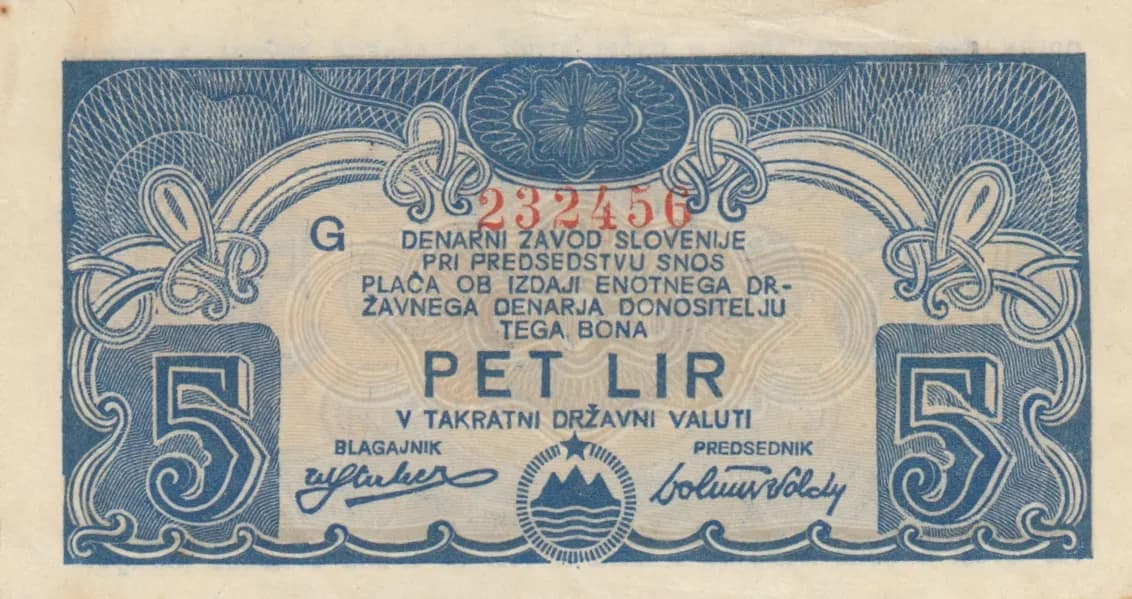
This is a 5 lire banknote issued by the State Mint of Slovenia (Denarni Zavod Slovenije) in 1944, representing a fascinating piece of Yugoslav monetary history during World War II. The note features elegant blue and cream ornamental engraving with shield and scallop-shell cartouches displaying the denomination, characteristic of mid-20th century Central European currency design. In AU condition, the note exhibits light foxing and age-related discoloration consistent with an 80-year-old historical document, with legible inscriptions and intact structural integrity.
Common. While this note represents an interesting historical piece from the Yugoslav partisan resistance period, it was issued as functional currency in what appears to be standard circulation quantities. The lack of specific rarity indicators (low serial numbers, special overprints, or documented short print runs) and its presence in collector markets suggests adequate surviving examples. AU-grade specimens are less common than circulated examples but not scarce.
This note was issued under authority of the SNOS (Slovenian National Liberation Council) Presidency on February 20, 1944, during the Yugoslav partisan-controlled territories of World War II. The inscriptions reference unified state currency issuance and are entirely in Slovene language, reflecting the assertion of Slovenian sovereignty during the resistance movement. The 'bond' (bona) designation and payment clause indicate this was issued as provisional currency during the transitional period before Yugoslavia's complete liberation and monetary reorganization.
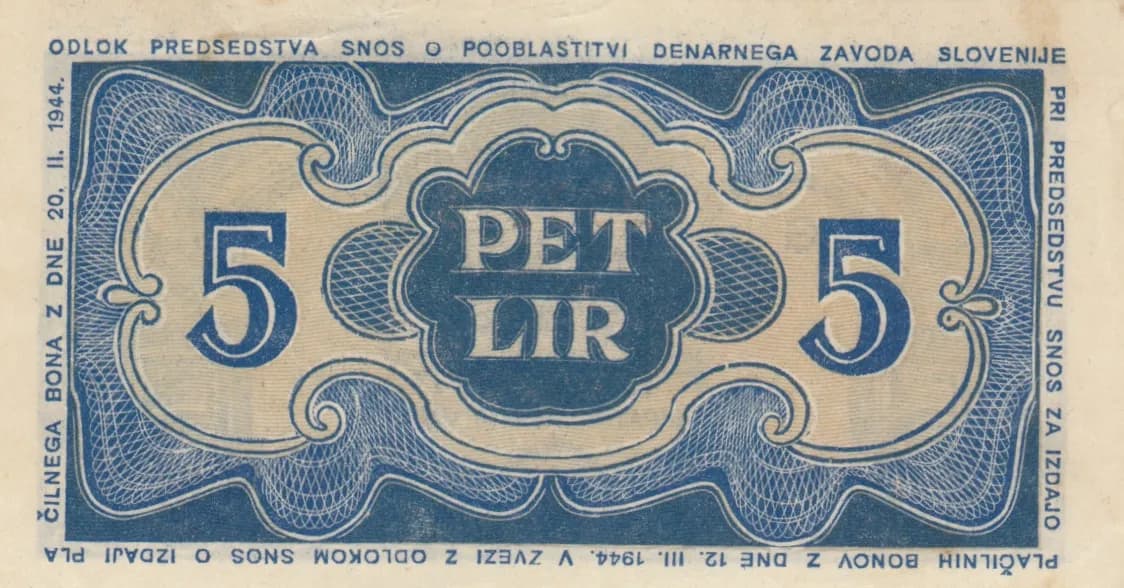
The banknote employs a symmetrical, ornamental design typical of wartime provisional currency. The obverse features a central shield-shaped cartouche containing 'PET LIR' surrounded by scrollwork and floral rosettes, with large ornate numerals '5' positioned in the top corners. A circular seal or emblem incorporating mountain and water imagery appears in the center, symbolizing Slovenian geography and national identity. The reverse displays a matching design structure with large '5' numerals framing a cloud or scallop-shell shaped central cartouche also bearing 'PET LIR.' No portraits are depicted; instead, the note relies entirely on heraldic and decorative elements appropriate to its status as emergency currency. Fine line engraving and cross-hatching throughout provide security through intricate detail work.
FRONT SIDE: 'PET LIR' (Five lire); 'DENARNI ZAVOD SLOVENIJE' (State Mint of Slovenia); 'PRI PREDSEDSTVU SNOS' (At the Presidency of SNOS); 'PLAČA OB IZDAJI ENOTNEGA DRŽAVNEGA DENARJA DONOSITELJU TEGA BONA' (Payment upon issue of unified state currency to the bearer of this bond); 'V TAKRATNI DRŽAVNI VALUTI' (In the then-current state currency); 'BLAGAJNIK' (Treasurer); 'PREDSEDNIK' (President); Serial number: 232456. BACK SIDE: 'PET LIR' (Five lire); 'ODLOK PREDSEDSTVA SNOS O POOBLASTILTVI DENARNEGA ZAVODA SLOVENIJE Z DNE 20. II. 1944' (Decree of the Presidency of SNOS on the authorization of the Mint of Slovenia from 20 February 1944); 'PLAČLJIVO BONA Z DNE 13. III. 1944 O IZDAJI ENOTNEGA DRŽAVNEGA DENARJA' (Payable bond dated 13 March 1944 on the issue of unified state currency); 'PRI PREDSEDSTVU SNOS' (At the Presidency of SNOS).
Intaglio engraving (line engraving) with fine hatching and cross-hatching background patterns. The ornate borders, numerals, and cartouches show characteristic depth and precision of engraved security printing. No specific printer attribution is evident from the visible inscriptions, though production would have occurred at or under direction of the Slovenian State Mint (Denarni Zavod Slovenije). The technique reflects Central European security printing standards of the 1940s period.
Serial number 232456 is visible on the obverse. The note is dated with two key dates: the authorization decree of February 20, 1944 (20. II. 1944) and the issuance/payment date of March 13, 1944 (13. III. 1944). Variations may exist in serial number sequences and potentially in signature blocks for 'Treasurer' (Blagajnik) and 'President' (Predsednik), though these are not legible in the provided images. No overprints or secondary modifications are apparent.