5 dinara 1965 specimen
Market Prices
3 salesAbout This Note
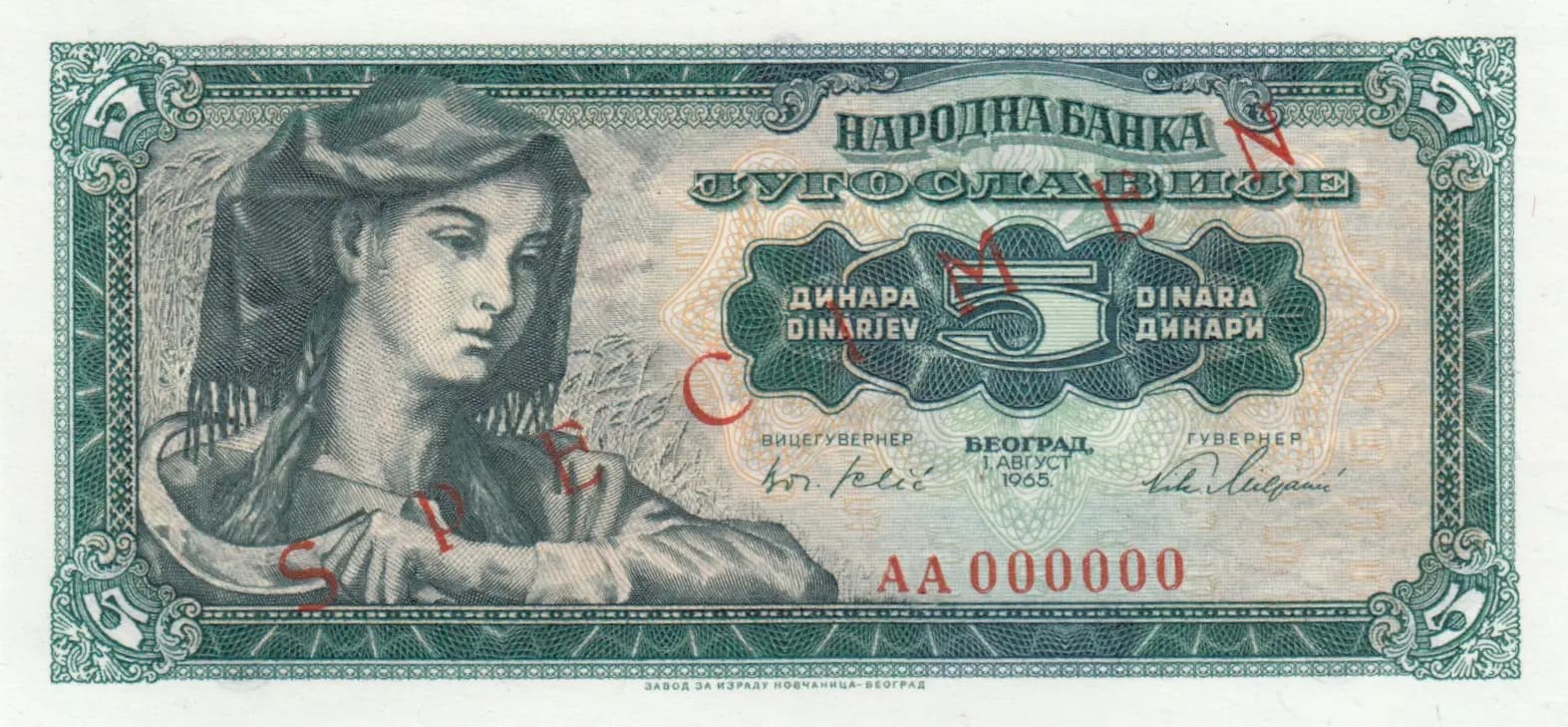
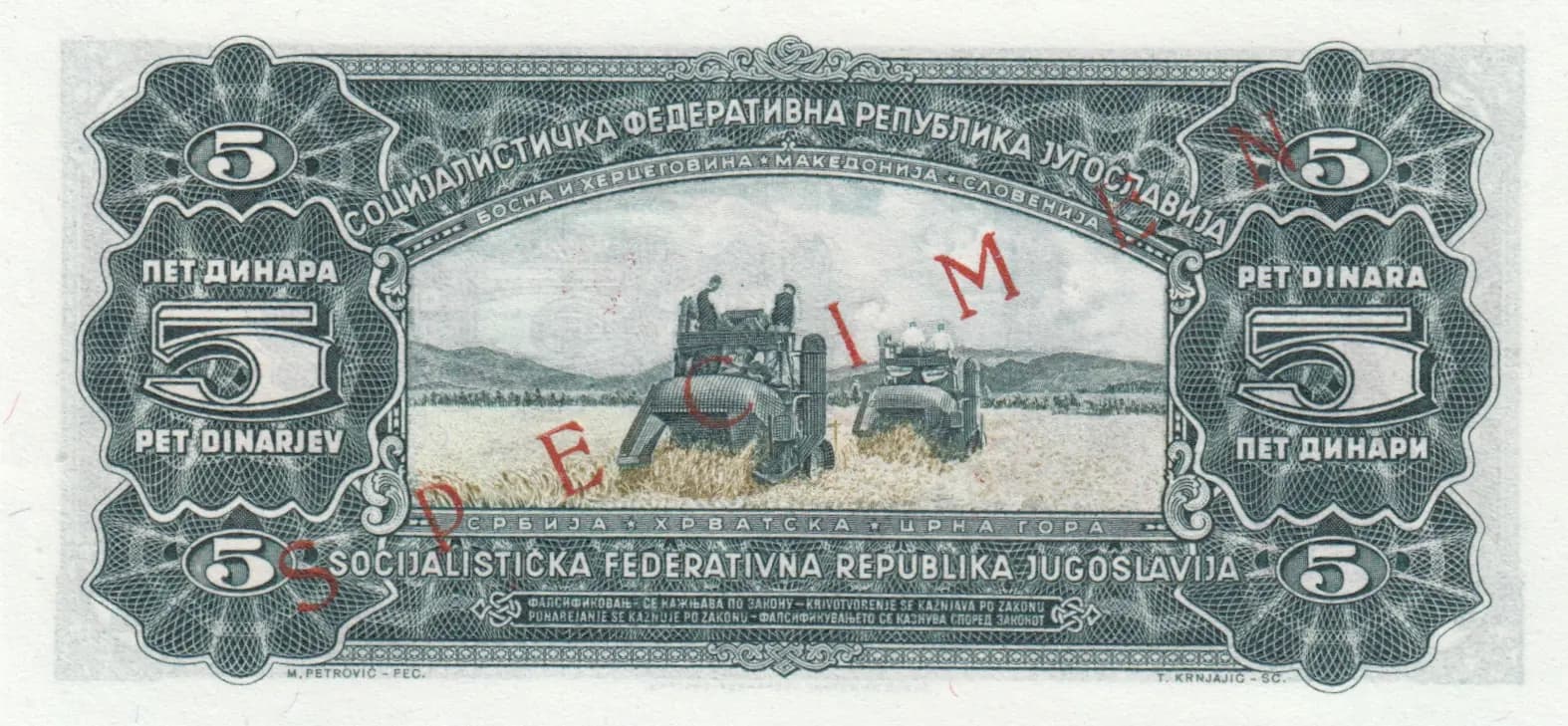
This is a pristine UNC specimen note of the 1965 Yugoslav 5 dinara (Pick P-77s), featuring an elegant portrait of a peasant woman in classical engraving style on the obverse and combine harvesters on the reverse. The note exhibits the characteristic green and multicolor palette typical of this issue, with red SPECIMEN overprints and dummy serial number (AA 000000) confirming its status as a non-circulating specimen. As a specimen note in uncirculated condition, this example represents a historically significant artifact from Yugoslavia's mid-1960s agricultural economy era.
Common. While this is a specimen note (which is inherently less common than circulated examples), specimen notes from major 20th-century banknote series are widely collected and regularly available. eBay market data shows recent sales in the $15-20 range for UNC examples, with PMG-graded examples reaching $52, indicating steady but not exceptional demand. The 1965 Yugoslav 5 dinara was part of a standard issue series from a major state bank, and specimen examples are neither particularly scarce nor highly sought after. The specimen designation and uncirculated condition are collector-appealing but do not elevate this beyond common status.
Issued on August 1, 1965, by the Narodna Banka Jugoslavije (National Bank of Yugoslavia), this banknote commemorates the Socialist Federative Republic of Yugoslavia's agricultural focus during the post-World War II period. The obverse depicts a peasant woman with a sickle, symbolizing the agrarian foundation of Yugoslav society, while the reverse showcases modern combine harvesters, representing the state's mechanization and modernization initiatives. This design reflects the Yugoslav government's promotion of collective farming and agricultural productivity during the early Cold War era.
The obverse features a finely engraved portrait of a peasant woman in left profile, wearing a traditional feathered or plumed head covering, rendered in black and green intaglio with exceptional detail. The portrait is framed by an ornate decorative border with classical scrollwork and floral elements in the corners, with the denomination '5' displayed in a scalloped cartouche at center-right. The reverse showcases a detailed vignette of two combine harvesters operating in an agricultural field with mountains or hills visible in the background, emphasizing Yugoslavia's modernization and mechanization of farming. Decorative denomination cartouches appear in all four corners, and the design incorporates bilingual text in Cyrillic and Latin scripts reflecting Yugoslavia's multilingual composition (Serbian, Croatian, and Montenegrin). Both sides feature red diagonal SPECIMEN overprints typical of non-circulating specimen printings.
FRONT: 'Narodna Banka Jugoslavije' (National Bank of Yugoslavia), 'Dinara'/'Dinarjev'/'Dinari' (Dinars in multiple scripts), '5' (denomination), 'Višeguberner' (Governor), 'Beograd' (Belgrade), 'Avgust 1965' (August 1965), 'Guberner' (Governor), 'AA 000000' (specimen serial number), 'SPECIMEN' (English overprint). BACK: 'Sociјalistička Federativna Republika Jugoslavija' (Socialist Federative Republic of Yugoslavia), 'Pet Dinara'/'Pet Dinarjev'/'Pet Dinari' (Five Dinars in multiple scripts), '5' (denomination in four corners), 'Srbija • Hrvatska • Crna Gora' (Serbia • Croatia • Montenegro), 'M. Petrović - FGS.' and 'T. Krnjajić - SS.' (signature lines for officials), 'SPECIMEN' (English overprint).
Intaglio engraving executed by the Zavod za Izradu Novčanica (Institute for the Production of Banknotes) in Belgrade. The visual evidence of fine line work, complex border details, and the characteristic depth of portraiture are consistent with traditional intaglio engraving methods. The absence of visible wear despite pristine condition confirms the specimen nature of this printing, which would not have been subjected to circulation.
This is identified as a specimen note (P-77s designation, where 's' denotes specimen status). The specimen is characterized by red diagonal SPECIMEN overprints and the dummy serial number 'AA 000000' visible in red on the front. The note is printed in two colors on the obverse (dark green on multicolor underprint) and primarily black and white on the reverse, consistent with the standard 1965 issue. The signatures lines reference positions for M. Petrović and T. Krnjajić, indicating this specimen represents the official design as approved for the August 1, 1965 issuance date.