20 dinara 1978
Market Prices
15 salesAbout This Note
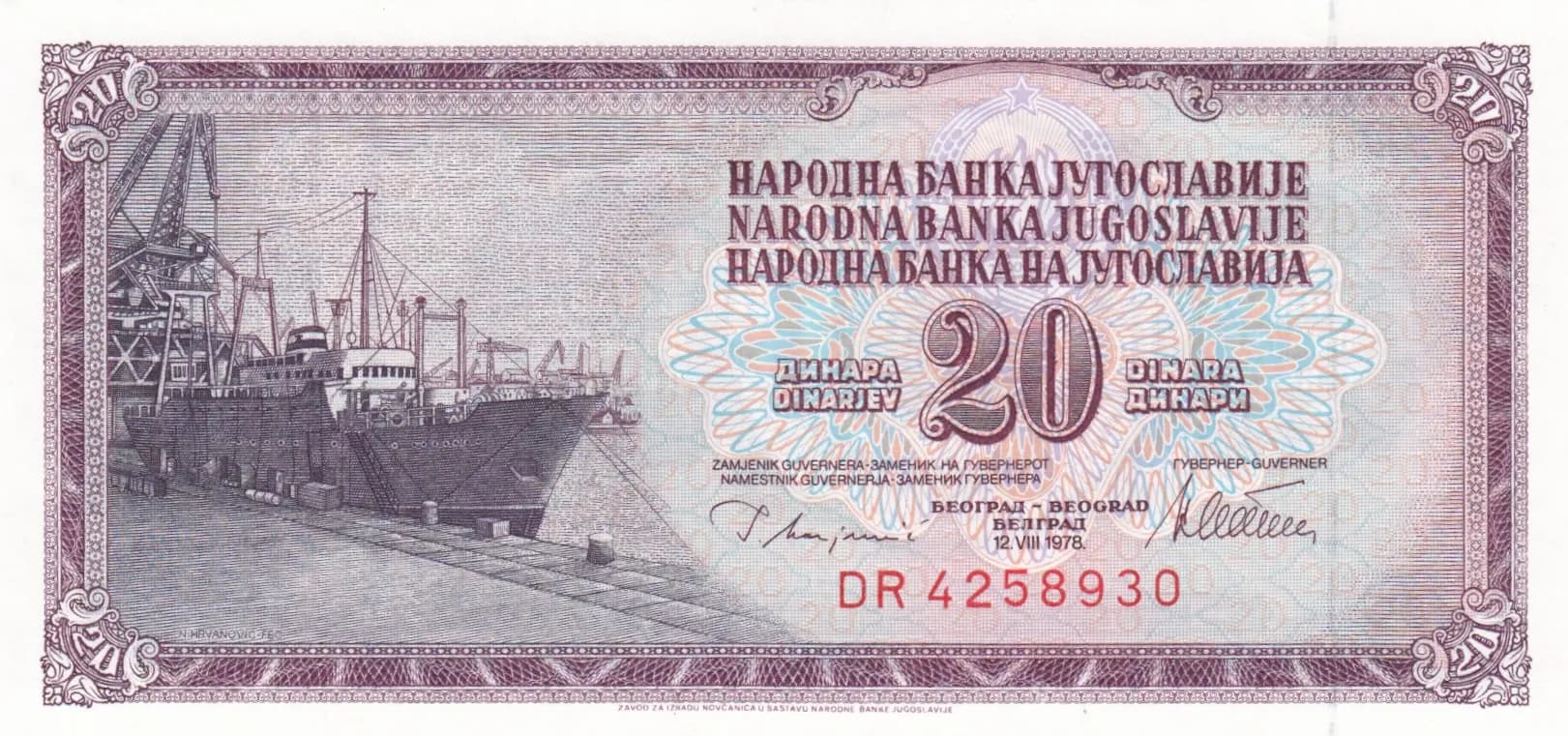
This is a 1978 Yugoslav 20 dinara note (Pick P-88a) in uncirculated condition, featuring a striking purple and multicolor design centered on a cargo ship with loading cranes at a port dock. The note displays exceptional print quality with fine line engraving, fresh colors, and no signs of circulation, wear, or damage. As one of the more visually distinctive denominations from Yugoslavia's socialist period, this example represents the late-1970s monetary design aesthetic with its multilingual inscriptions reflecting the country's federal structure.
Common. This is a regular circulation issue from 1978, part of a series that remained in production through 1981 (as noted in catalog references). The eBay sales data shows consistent, modest market values: UNC examples have sold for $0.74–$0.99 in recent years, with PMG-graded specimens commanding premiums ($12.50–$26.78 depending on grade) reflecting grading rarity rather than note rarity. The accessible pricing and frequent appearance in sales listings confirm this denomination was produced in substantial quantities. No evidence of low print runs, recalls, or short-lived issuance exists.
Issued by the Narodna Banka Jugoslavije on August 12, 1978, this note was produced during the Socialist Federative Republic of Yugoslavia under the leadership of Josip Broz Tito, a period of relative economic stability despite the country's eventual fragmentation. The prominent maritime imagery—a cargo ship actively loading or unloading at a modern port—symbolized Yugoslavia's importance as a Mediterranean trading nation and its industrial-economic capacity during the late socialist era. The multilingual inscriptions in Serbian/Croatian (both Cyrillic and Latin scripts), Slovenian, and Macedonian reflect the official recognition of the constituent republics and their languages within the federal structure.
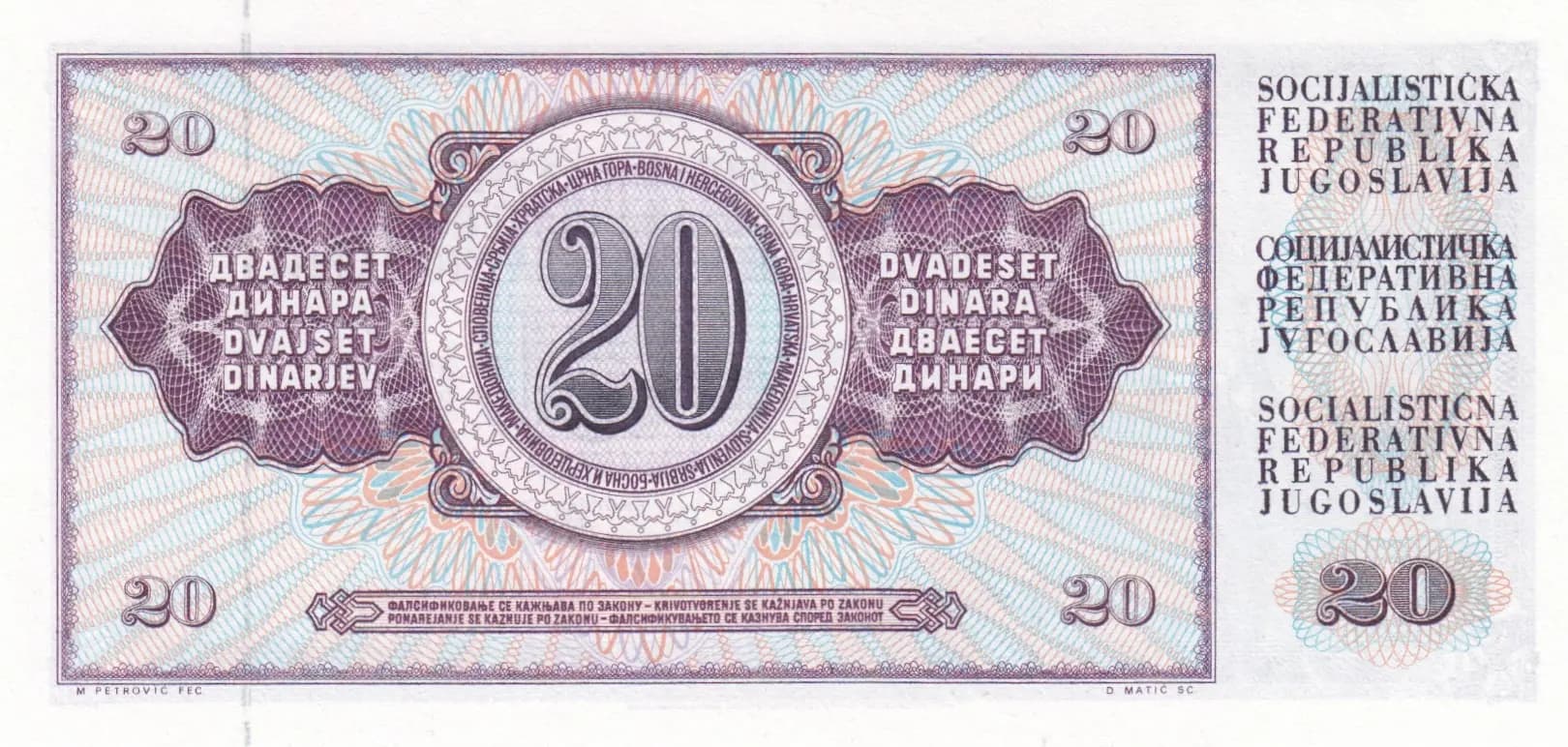
The obverse (front) features a large, detailed engraving of a modern cargo ship positioned dockside at the left side of the note, with prominent loading cranes visible, emphasizing Yugoslavia's maritime and industrial prowess. The denomination '20' is centrally placed in a decorative radiating design with baroque-style flourishes. Ornamental corner medallions frame the design with intricate scrollwork patterns typical of mid-20th century European banknote design. The reverse presents a large, ornate circular medallion centered on the note containing the numeral '20', surrounded by a distinctive star-pattern border that echoes Yugoslav socialist symbolism. Both sides employ fine-line engraving throughout with multicolored underprinting in purple/mauve, pink, and blue tones. The multilingual text blocks on both sides—in Latin and Cyrillic scripts across three languages—serve as both official recognition of the federal republics and as a security feature against counterfeiting.
FRONT: 'NARODNA BANKA JUGOSLAVIJE' (National Bank of Yugoslavia) appears in Serbian/Croatian (Latin and Cyrillic scripts) and Macedonian as 'NARODNA BANKA NA JUGOSLASIJA'. The denomination is expressed in all three official languages: 'DINARA' (Serbian/Croatian), 'DINARJEV' (Slovenian), and 'DINARI' (Macedonian). Signature titles read 'ZAMJENIK GUVERNERA-ZAMENIK NA GUVERNEROT' (Deputy Governor in Serbian/Croatian and Macedonian) and 'NAMESTNIK GUVERNERJA-ZAMENIK GUVERNERA' (Deputy Governor in Slovenian and Serbian/Croatian), with 'GUVERNER-GUVERNER' (Governor). Location and date: 'BEOGRAD - BELGRAD - BEOGRAD' and '12 VIII 1978' (12 August 1978). Serial number: 'DR 4258930'. BACK: The denomination is written out: 'DVADESET DINARA' (Serbian/Croatian), 'DVAJSET DINARJEV' (Slovenian), and 'DVADESET DINARI' (Macedonian). The central text reads 'SOCIJALISTICKA FEDERATIVNA REPUBLIKA JUGOSLAVIJA' (Socialist Federative Republic of Yugoslavia) in both Latin and Cyrillic scripts. Legal warnings appear: 'BANСFIKOВANJE SE KAZNUAVA PO ZAKONU' (Counterfeiting is punished by law) in multiple language variants. Artist credits: 'M PETROVIC FEC' (M. Petrovic made it) and 'D MATIC SC' (D. Matic sculpt).
This note was produced using intaglio (engraved) printing with multicolor lithographic underprinting, as evidenced by the fine line engraving details, crisp denomination numerals, and layered color application observed in the visual analysis. The Zavod za Izradu Novčanica (Banknote Production Institute) in Belgrade, the official Yugoslav state printer, produced this note. The combination of deep-set engraving for security details with colorful background designs is characteristic of Yugoslav banknote production during this period. The baroque ornamental borders and intricate scrollwork demonstrate the high technical capability of the state security printing establishment.
Pick P-88a represents the primary variety cataloged for the 20 dinara 1978 issue. Based on the visual analysis, this example bears the serial number 'DR 4258930' with the two-letter prefix 'DR', consistent with the described format of two prefix letters followed by a 6 or 7-digit serial number. The signatures shown correspond to officials serving under the 1978 date. No overprints or additional varieties are visible. The August 12, 1978 date is the primary issue date for this pick number, distinguishing it from the earlier 1974 issue (Pick P-85) and the later 1981 printing within the same series.