20 dinara 1936
Market Prices
44 salesAbout This Note
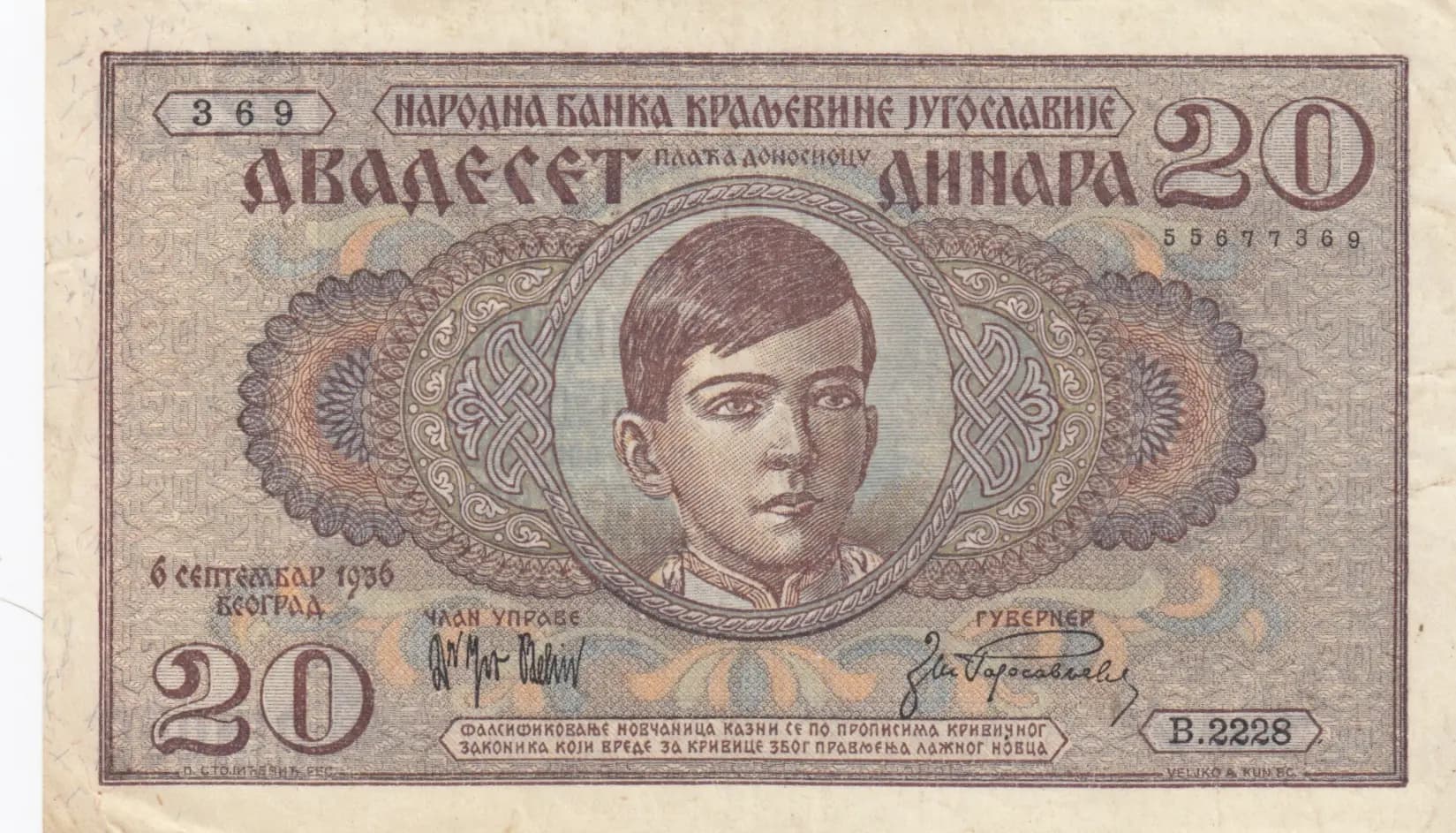
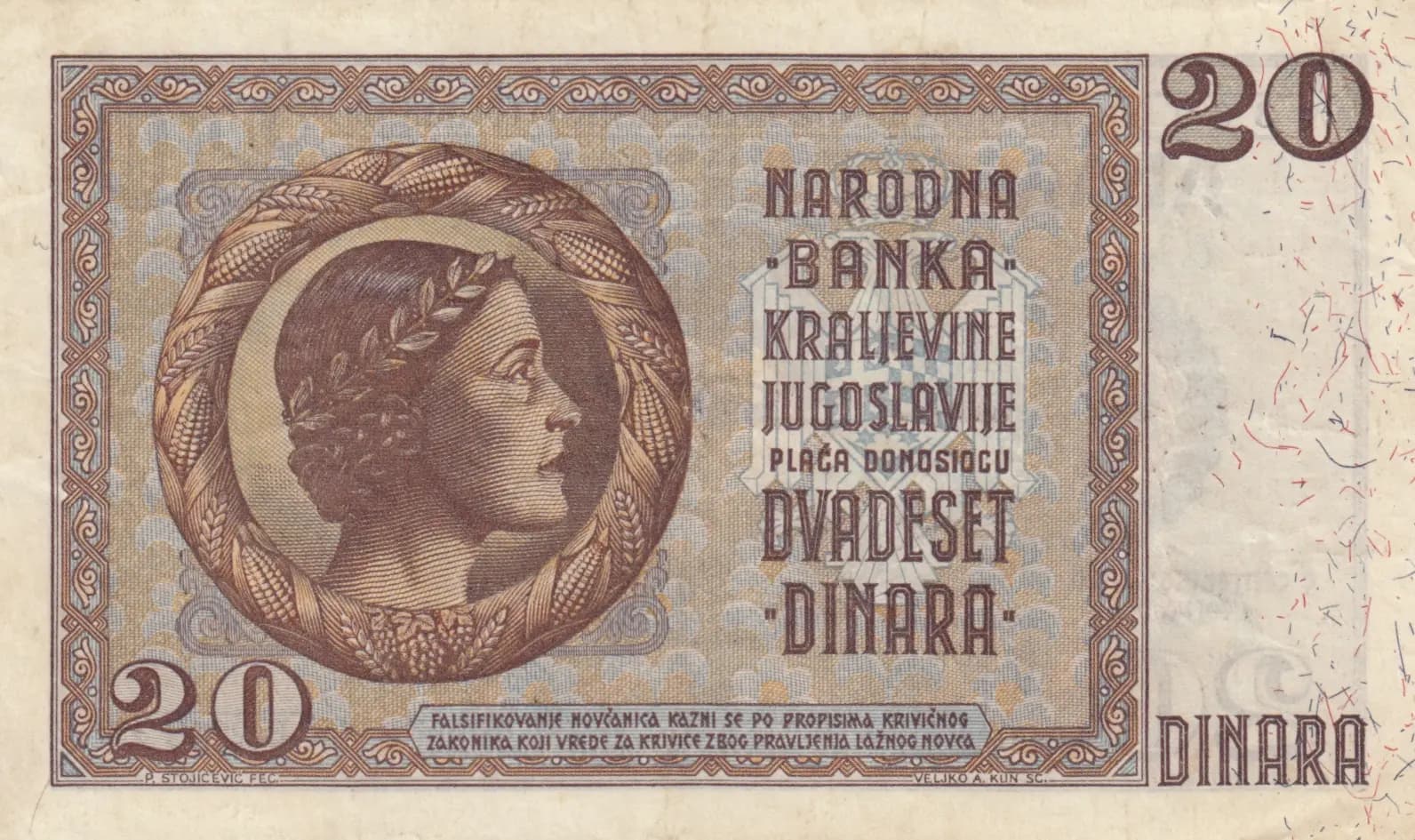
A handsome example of Yugoslavia's 1936 20 dinara note (Pick P-30) issued by the National Bank of the Kingdom of Yugoslavia on September 6, 1936. The front features a youthful King Peter II in profile within an ornate circular frame, while the reverse displays a classical allegorical female figure crowned with a wheat wreath, symbolizing prosperity and agriculture. In VF condition, this note shows expected age-related wear including foxing, creasing, and yellowing, with some manuscript notations visible on the reverse—a historically significant piece from the interwar Yugoslav kingdom.
Common. The extensive eBay transaction history shows consistent sales in the $2-$15 range for VF examples spanning over a decade (2010-2024), with no significant scarcity premium. Market data indicates healthy circulation of this denomination with stable, modest pricing. Catalogue values (2016) list VF at $10 USD, consistent with observed sales patterns. This was a regular issue with substantial print runs, and no documented scarcity or recall information exists for Pick P-30.
Issued during the reign of young King Peter II (who ascended to the throne in 1934 at age 11), this banknote represents Yugoslavia's monetary authority under the Narodna Banka Kraljevine Jugoslavije during a period of relative stability in the interwar kingdom. The allegorical reverse design celebrating agriculture and prosperity reflects the economic priorities of 1930s Yugoslavia, while the sovereign portrait on the obverse reinforces the legitimacy of the young monarchy during a transformative period in Yugoslav history.
The obverse features a formal portrait of King Peter II facing right, rendered in profile within an ornate circular frame adorned with classical scrollwork and geometric borders in brown and tan tones. The reverse displays an allegorical female figure (representing Prosperity or Agriculture) in classical style, facing right and adorned with a wheat or laurel wreath, similarly enclosed in a decorative circular frame. Both sides employ symmetrical ornamental borders with repeated geometric patterns characteristic of interwar Yugoslav banknote design. Large denomination numerals '20' appear in opposite corners on each side. The overall aesthetic reflects classical numismatic traditions combined with early 20th-century engraving standards.
FRONT: 'NARODNA BANKA KRALJEVINE JUGOSLAVIJE' (National Bank of the Kingdom of Yugoslavia); 'DVADESET DINARA' (Twenty dinars); '6 SEPTEMBAR 1936 BEOGRAD' (6 September 1936 Belgrade); 'ČLAN UPRAVE' (Board member); 'GUVERNER' (Governor); Anti-counterfeiting warning in full Cyrillic text regarding criminal penalties. BACK: 'NARODNA BANKA KRALJEVINE JUGOSLAVIJE' (National Bank of the Kingdom of Yugoslavia); 'PLAĆA DONOŠILACU' (Payable to bearer); 'DVADESET DINARA' (Twenty dinars); 'DINARA/DINARO' (Dinars); matching anti-counterfeiting warning text.
Intaglio (engraved) printing, evidenced by the fine line work, detailed portrait rendering, and complex geometric border patterns visible throughout. The detailed classical allegorical imagery and intricate wreath work indicate high-quality steel plate engraving. This was the standard security printing technique for Yugoslav banknotes of this era, likely produced by a European security printer contracted by the Yugoslav central bank.
The examined specimen displays serial number 5567736 with reference designation B.2228. The note is dated 6 September 1936 in Belgrade. This represents the standard 1936 issue variety; no documented major varieties (such as signature variations, overprints, or significant date variations) are known for Pick P-30. The presence of manuscript notations in red/brown ink on the reverse may indicate post-issue bank markings or institutional handling marks rather than a distinct printing variety.