1000 dinara 1946 specimen
Market Prices
About This Note
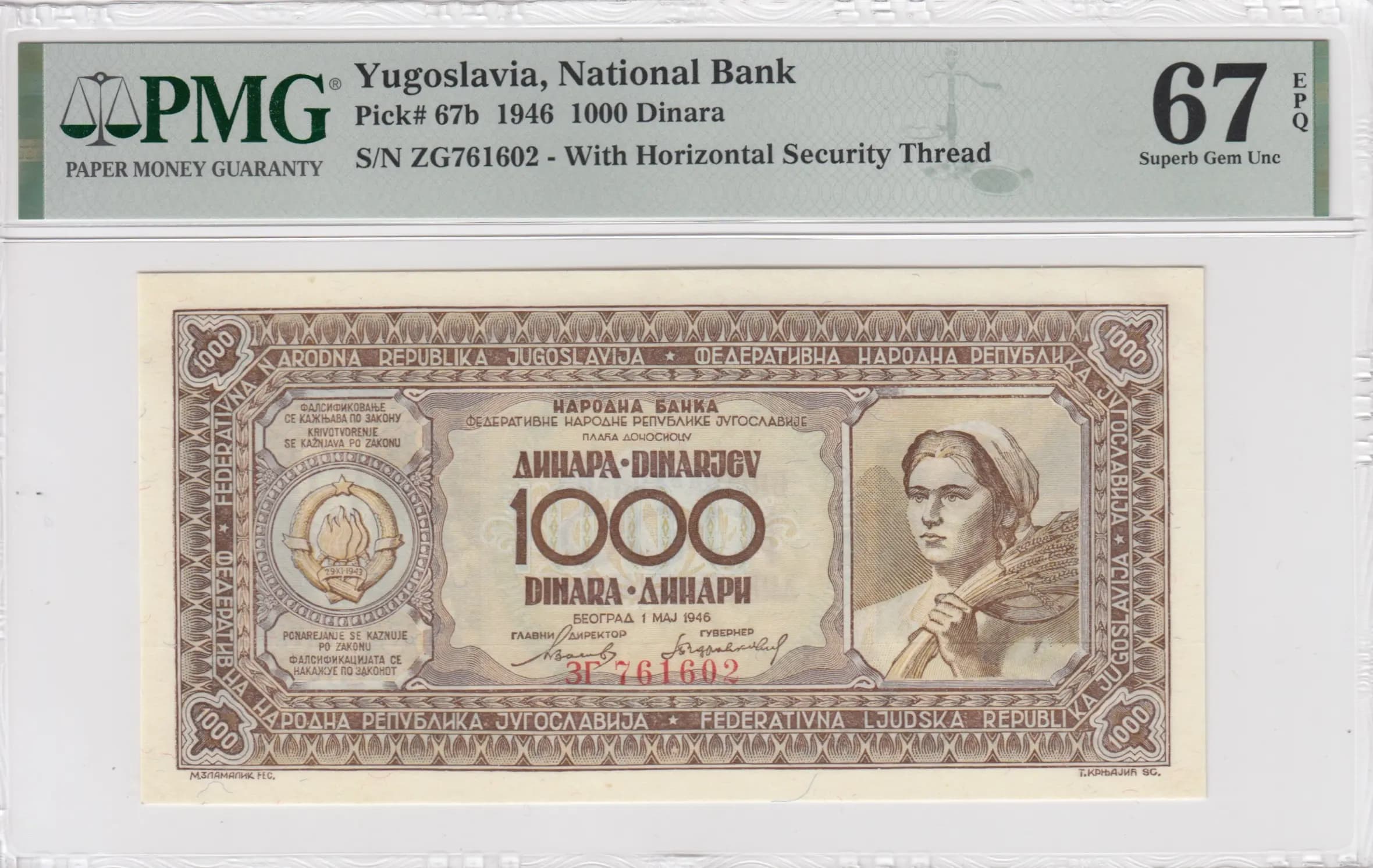
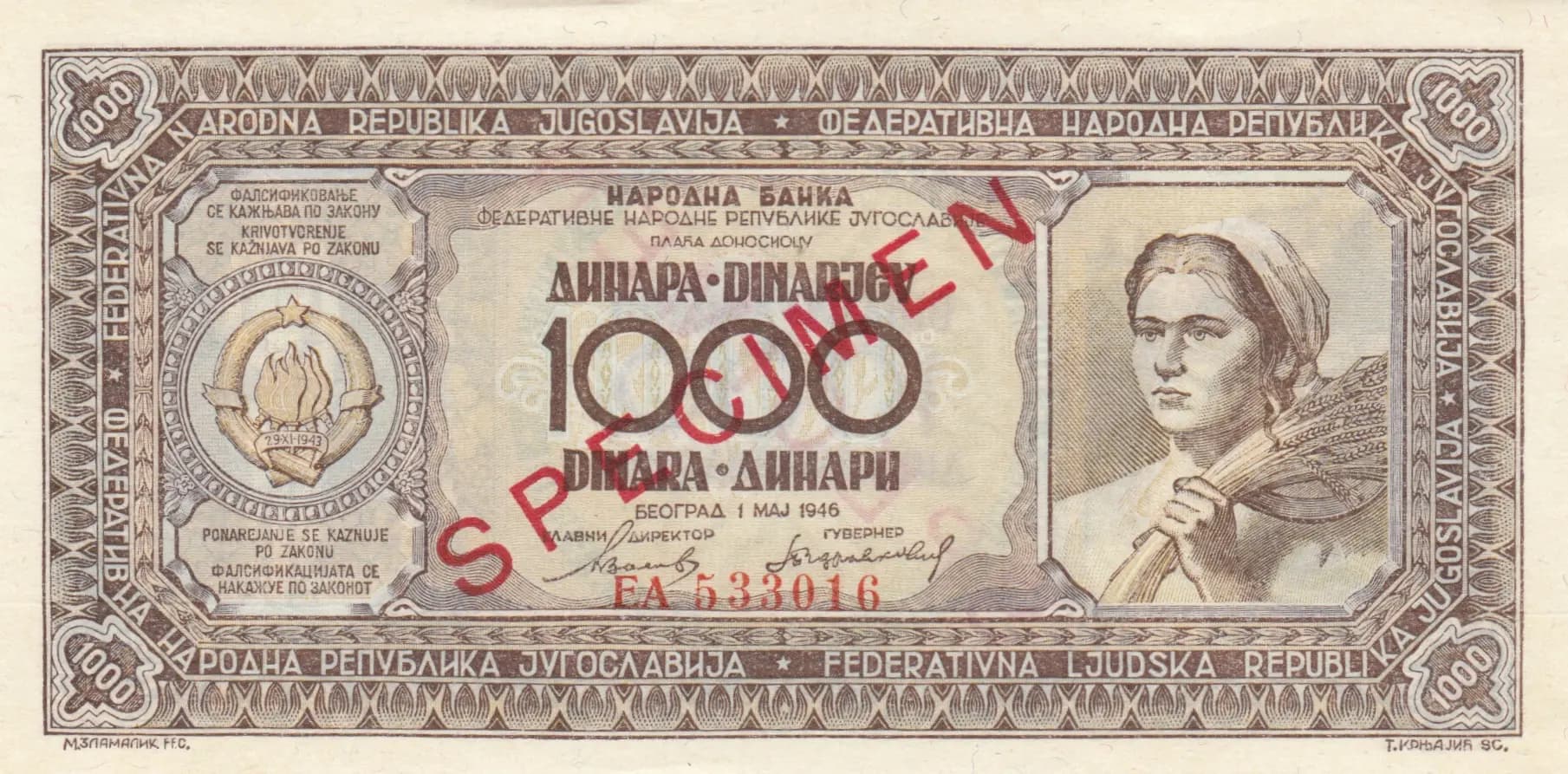
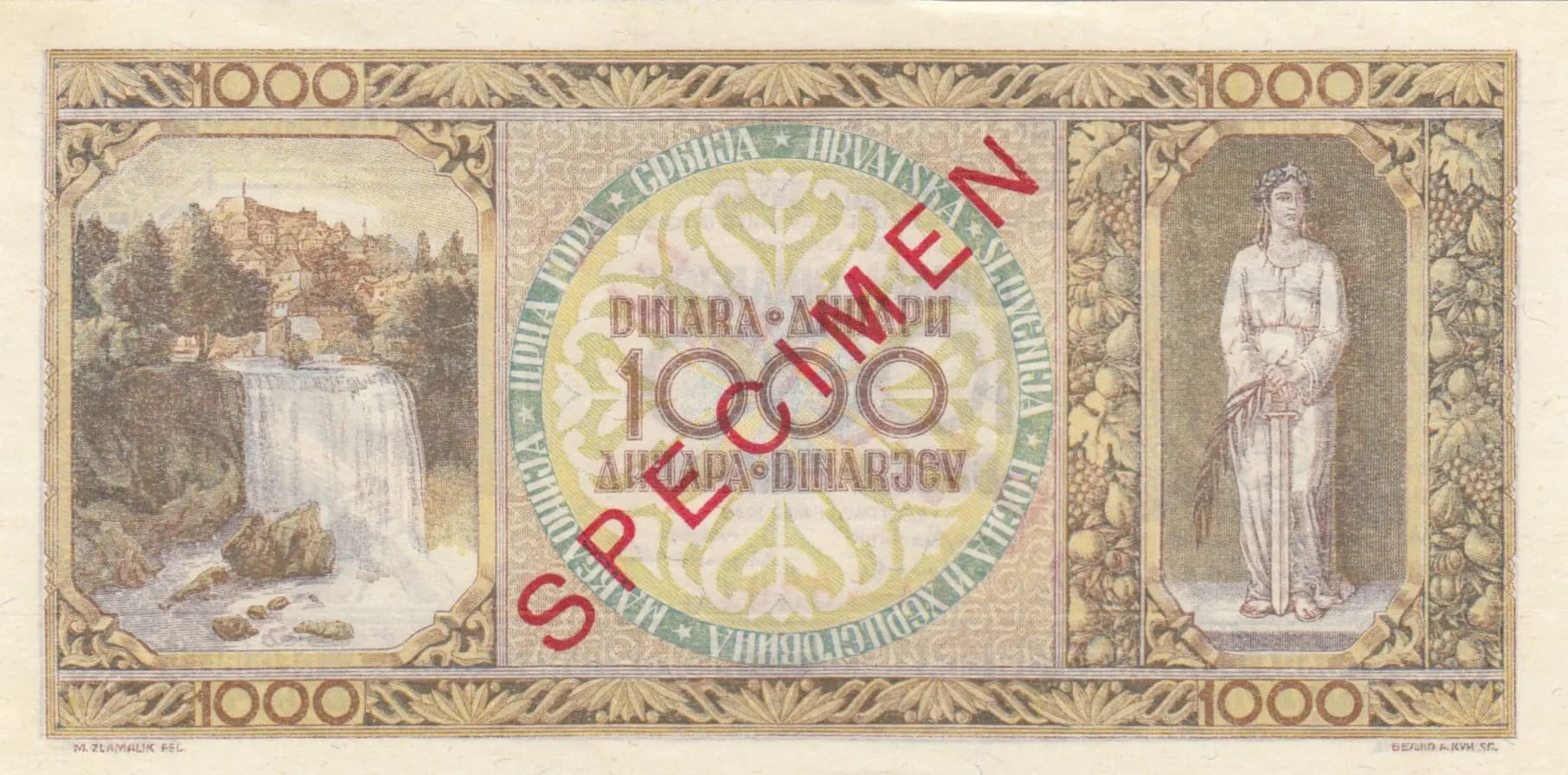
This is a spectacular AU specimen example of the 1000 Dinara from the Federal People's Republic of Yugoslavia, issued on 1 May 1946. The note features exceptional engraving quality with a peasant woman in traditional dress holding wheat on the obverse and the iconic Jajce waterfall landscape paired with an allegorical woman in classical dress on the reverse, both marked with red SPECIMEN overprints. As a specimen note in this condition, it represents an important early post-war Yugoslav currency issue and demonstrates the high-quality intaglio printing standards employed by the nascent communist state.
Common. Although this is a specimen note from an early post-war issue, Yugoslav 1000 Dinara notes from 1946 circulate with reasonable frequency in the collector market. Current eBay market data shows examples trading across a wide range from under $2 to $450 USD depending on condition and provenance, with a 2016 catalog value of $115-$225 for uncirculated examples. The wide range and availability of listings indicate this is not a scarce variety. Specimen notes command a modest premium over circulated examples but remain readily obtainable for collectors.
This 1000 Dinara note was issued just one year after the end of World War II and the establishment of the Federal People's Republic of Yugoslavia under Tito. The obverse's depiction of a peasant woman with wheat stalks symbolizes agrarian labor and the working class ideology central to the new socialist state, while the reverse's Jajce waterfall references the historic Congress of Jajce held in 1943, which formally established the anti-fascist National Liberation Committee as Yugoslavia's government-in-waiting. The ornate Yugoslav coat of arms (the five-pointed flame torch) appears prominently on both sides, emblematic of the unified, federal nature of the newly formed multi-ethnic socialist republic.
The obverse features a left-facing portrait of a Yugoslavian peasant woman in traditional folk costume holding stalks of wheat, symbolizing agricultural labor and the working class foundation of the new socialist state, positioned on the right side of the note. The left side displays the Yugoslav coat of arms (a shield with a five-pointed flame torch surrounded by a circular medallion), representing national unity. The reverse depicts the Jajce Waterfall in Bosnia—a cascade tumbling down a forested hillside with fortified structures in the background—a celebrated natural landmark and symbol of Yugoslav heritage. Opposite this landscape, on the right side of the reverse, is an allegorical female figure in classical white dress holding laurel branches, personifying victory and national pride. Both sides are framed by ornate engraved borders with repeating floral and geometric patterns executed in the finest intaglio tradition.
FRONT: 'Narodna Banka Federativne Narodne Republike Jugoslavije' (National Bank of the Federal People's Republic of Yugoslavia) | '1000 Dinara / Dinari' (One Thousand Dinars, bilingual script) | 'Beograd 1 Maj 1946' (Belgrade, 1 May 1946) | 'Specimen' (red overprint) | 'Guverner' (Governor) and 'Glabni Direktor' (Chief Director - signature lines) | 'M. Slamarik F&C' (printer mark) | 'T. Krajajuk Sc.' (engraver mark) | 'EA 533016' (serial number). BACK: '1000 Dinara / Dinari / Dinarjev' (One Thousand Dinars, trilingual denominations) | 'Specimen' (red overprint) | 'M. Zlamalik F&C' (printer mark) | 'Beograd A. Kum Sc.' (location and engraver mark).
Intaglio engraving (line engraving and steel plate engraving), characteristic of high-security banknote production of the period. The printer mark 'M. Slamarik F&C' and various engraver marks ('T. Krajajuk Sc.' on the obverse, 'A. Kum Sc.' on the reverse) indicate professional security printing, likely by a Central European bank note printer experienced in multi-color intaglio work. The fine line work, intricate portrait rendering, and detailed decorative borders are consistent with hand-engraved steel plate production methods standard for Yugoslav currency in this era.
This note is identified as Pick P-67bs, where 's' denotes the specimen overprint status. The PMG population report lists P-67M as the standard 1000 Dinara variety and P-67X as an alternate 1000 Dinara catalog variant, indicating minor cataloging variations exist for this denomination. The serial number 'EA 533016' and the date 'Beograd 1 Maj 1946' (Belgrade 1 May 1946) are consistent with the inaugural issue date. The red SPECIMEN overprint and lack of circulation are defining characteristics of this specimen variety, as opposed to standard issued notes from the same printing.