1000 dinara 1946 specimen
Market Prices
12 salesAbout This Note
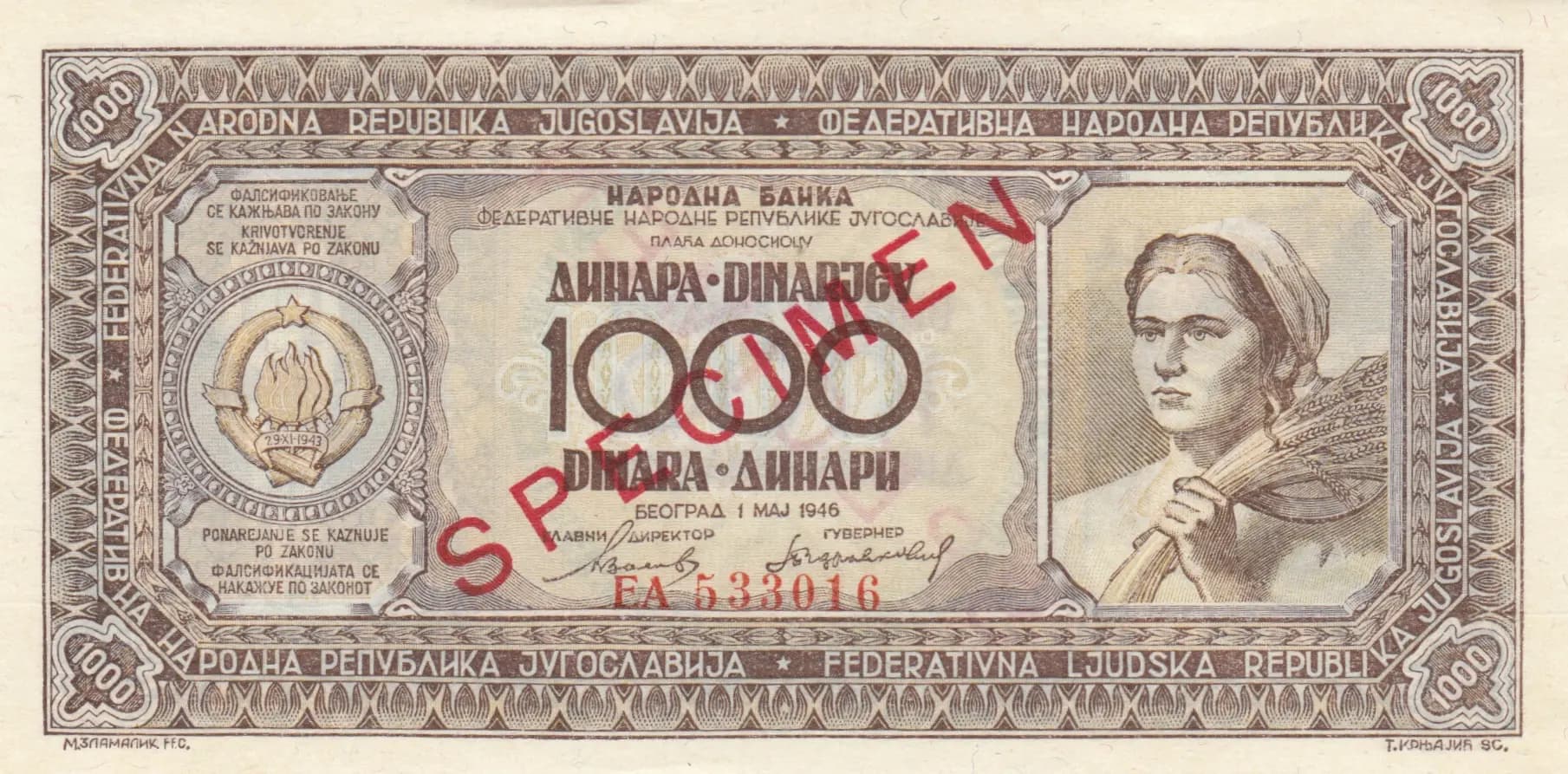
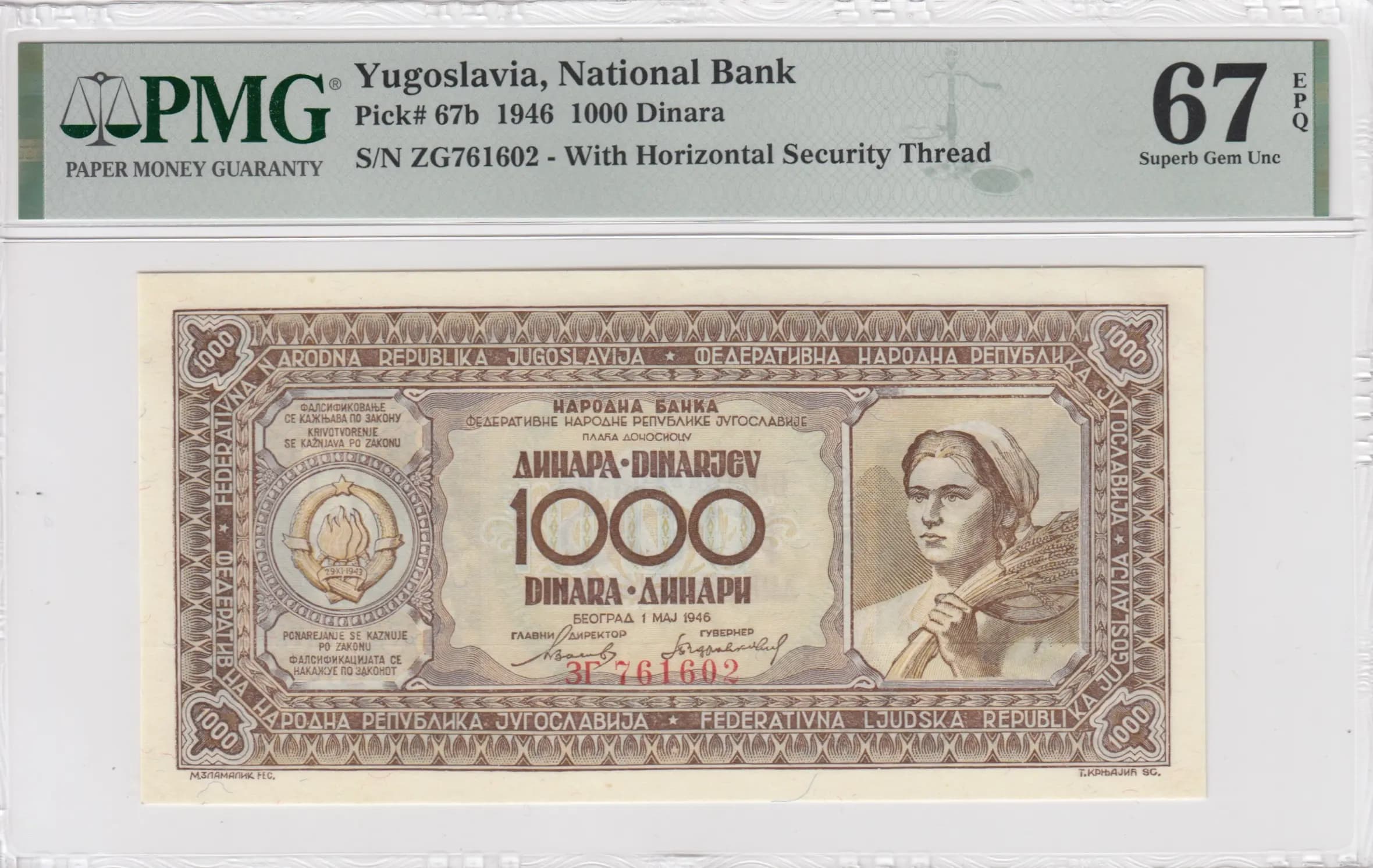
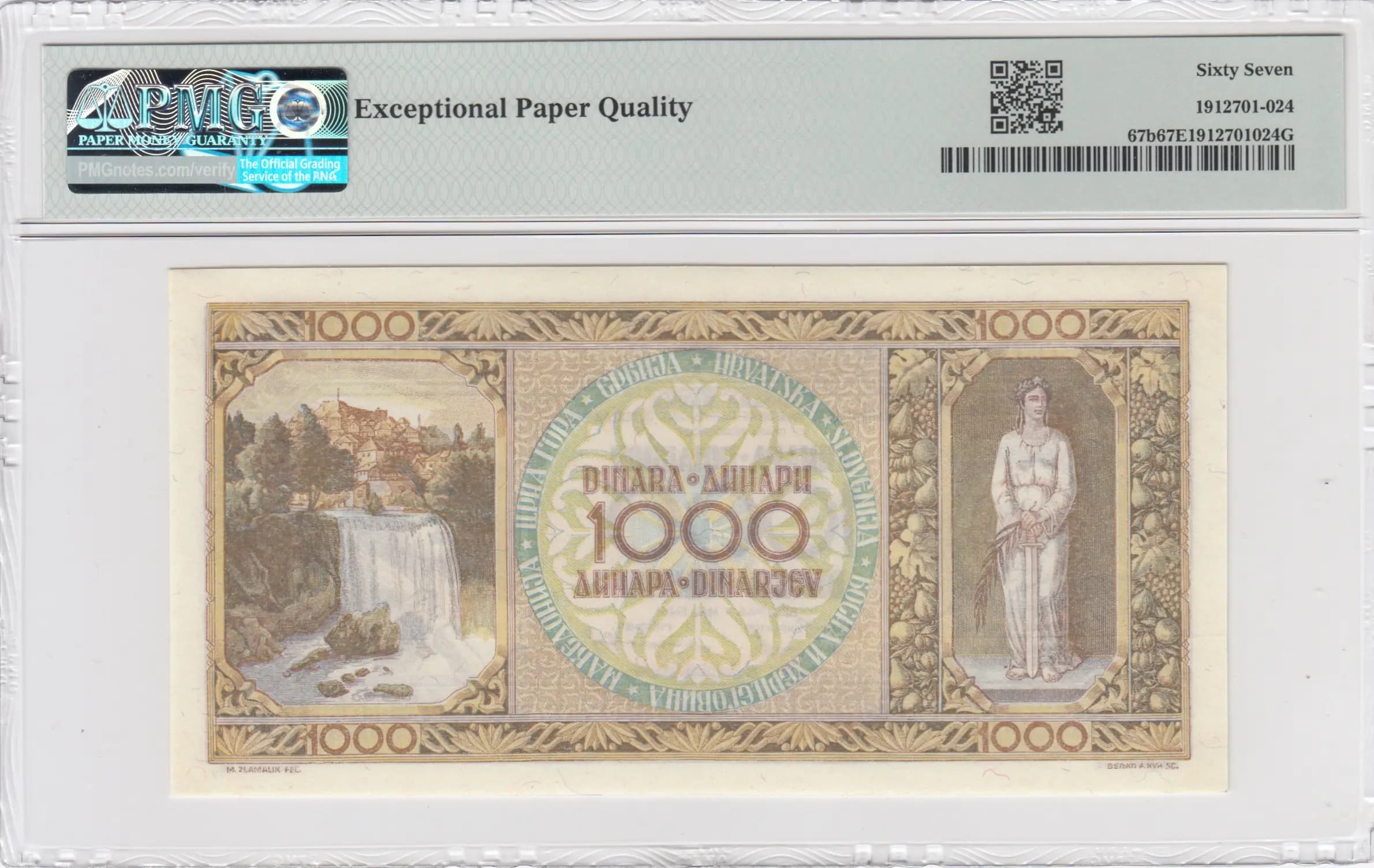
This is a PMG 67 EPQ graded 1000 Dinara note from Yugoslavia's first post-WWII emission, dated 1 May 1946. The note displays exceptional condition with sharp printing, vibrant brown and cream coloring, and no visible wear. The obverse features a traditional Yugoslav peasant woman with ears of corn, while the reverse depicts the iconic Jajce waterfalls and an allegorical female figure with sword, making this a historically significant example of early Yugoslav currency that commands solid collector value in higher grades.
Common. While this is a 1946 emission from the early Yugoslav period, it was part of a substantial regular-issue release by the National Bank. Market data shows consistent sales across multiple condition grades, with PMG 67 examples selling in the $150-155 range historically, indicating steady but not exceptional demand. The denomination (1000 Dinara) was widely circulated, and significant quantities survived the Yugoslav hyperinflation period of the 1990s. No evidence of short print runs, recalls, or scarcity exists for this Pick number.
This note was issued by the National Bank of the Federative People's Republic of Yugoslavia just one year after the country's liberation from Nazi occupation and the establishment of Tito's communist federal state. The iconography—a peasant woman representing agricultural labor, the waterfalls of Jajce (site of the AVNOJ partisan meetings that established the new Yugoslavia), and the sword-bearing allegorical woman symbolizing victory and revolution—directly reflects the new regime's emphasis on popular unity, agrarian values, and revolutionary triumph. The Cyrillic inscriptions and multilingual denominations (Dinara/Dinari/Dinarjev) underscore the multi-ethnic, multi-lingual nature of the newly unified Yugoslav federation.
The obverse features a portrait of a Yugoslav peasant woman in traditional folk costume with head covering, positioned on the right side facing right, symbolizing the agrarian base of the new socialist state. On the left is the state emblem—a circular torch/flame design representing the revolutionary spirit. The reverse showcases the Jajce waterfalls (Plitvice-region landscape) on the left, representing Yugoslavia's natural heritage and the symbolic location of partisan wartime meetings. The right side displays an allegorical female figure in classical white robes holding a sword, representing victory, justice, and revolutionary triumph. Ornate geometric borders frame both sides, with fine line-work and decorative corner ornaments throughout. The color scheme of cream, tan, and brown provides a warm, official appearance typical of post-war European currency design.
Front side: 'NARODNA BANKA FEDERATIVNE LJUDSKE REPUBLIKE JUGOSLAVIJE' (National Bank of the Federative People's Republic of Yugoslavia); 'BEOGRAD · 1 MAJ 1946' (Belgrade · 1 May 1946); '1000 DINARA · DINARI' (1000 Dinars); Serial number: ZG761602; Series designation: 3Г. Back side: '1000 DINARA · DINARI' (1000 Dinars); '1000 DINARA · DINARDZU' (1000 Dinars in alternative case form); denomination repeated in corners.
Intaglio (copperplate) engraving with multicolor printing. The sharp fine-line work visible in the decorative borders, portrait details, and ornamental elements is characteristic of professional intaglio currency engraving. The horizontal security thread is integrated into the paper structure. This note was produced by the Yugoslav National Bank's printing facilities, likely using traditional engraved plates common to post-war European currency production.
This note is cataloged as Pick 67b (1000 Dinara variety). The PMG population report indicates 17 variants exist for the base Pick 67 number across different denominations (1, 2, 5, 10, 20, 50, 100, 500, and 1000 Dinara), with P-67b and P-67a both designated as 1000 Dinara variants. The visible serial number ZG761602 with series designation 3Г indicates this is from a later printing sequence. The horizontal security thread is a distinguishing security feature of this issue. Without direct comparison to other 1000 Dinara variants (P-67a and P-67M), precise differentiation between sub-varieties cannot be definitively stated, but the presence of the security thread and series marking are consistent with later printings of this denomination.