1000 dinara 1963
Market Prices
20 salesAbout This Note
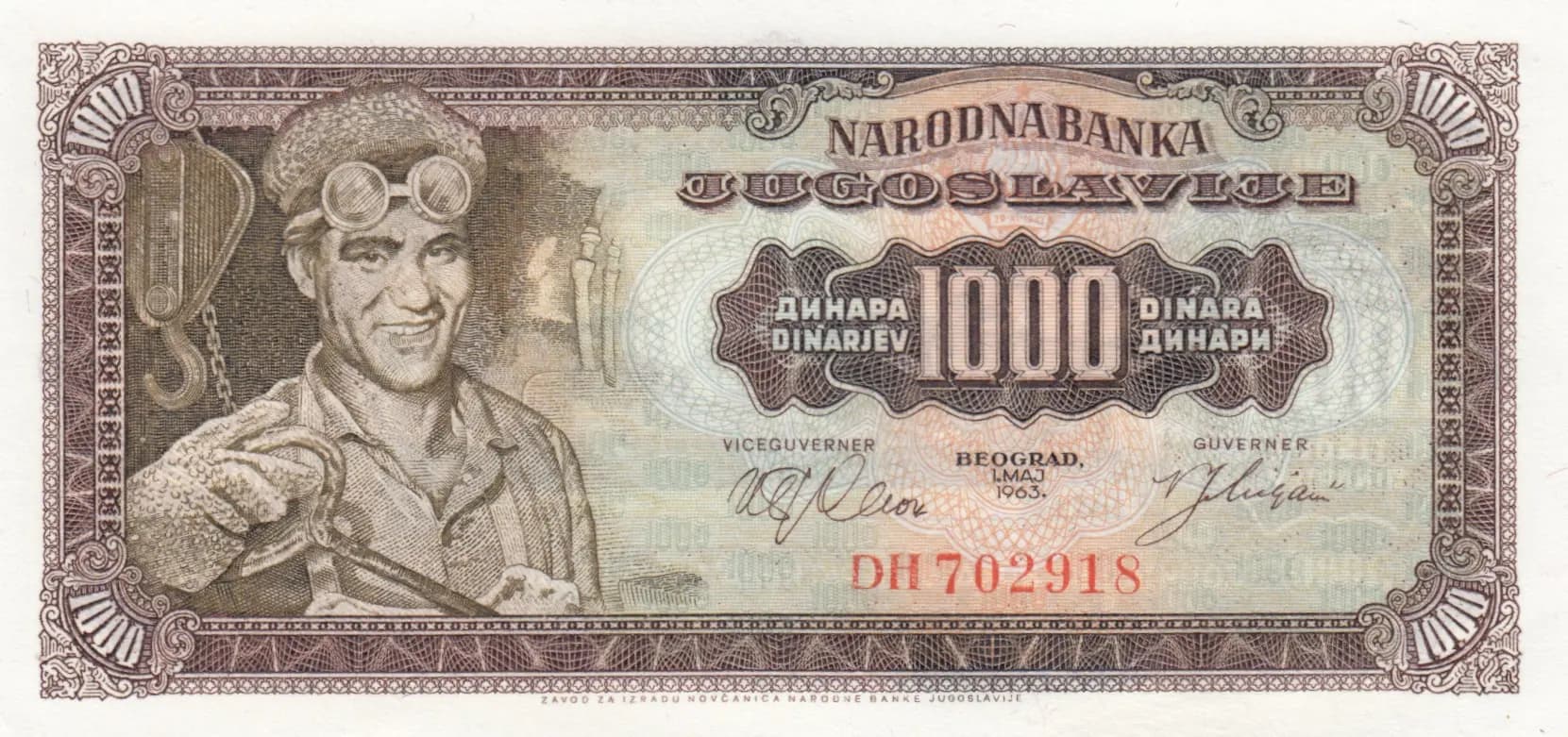
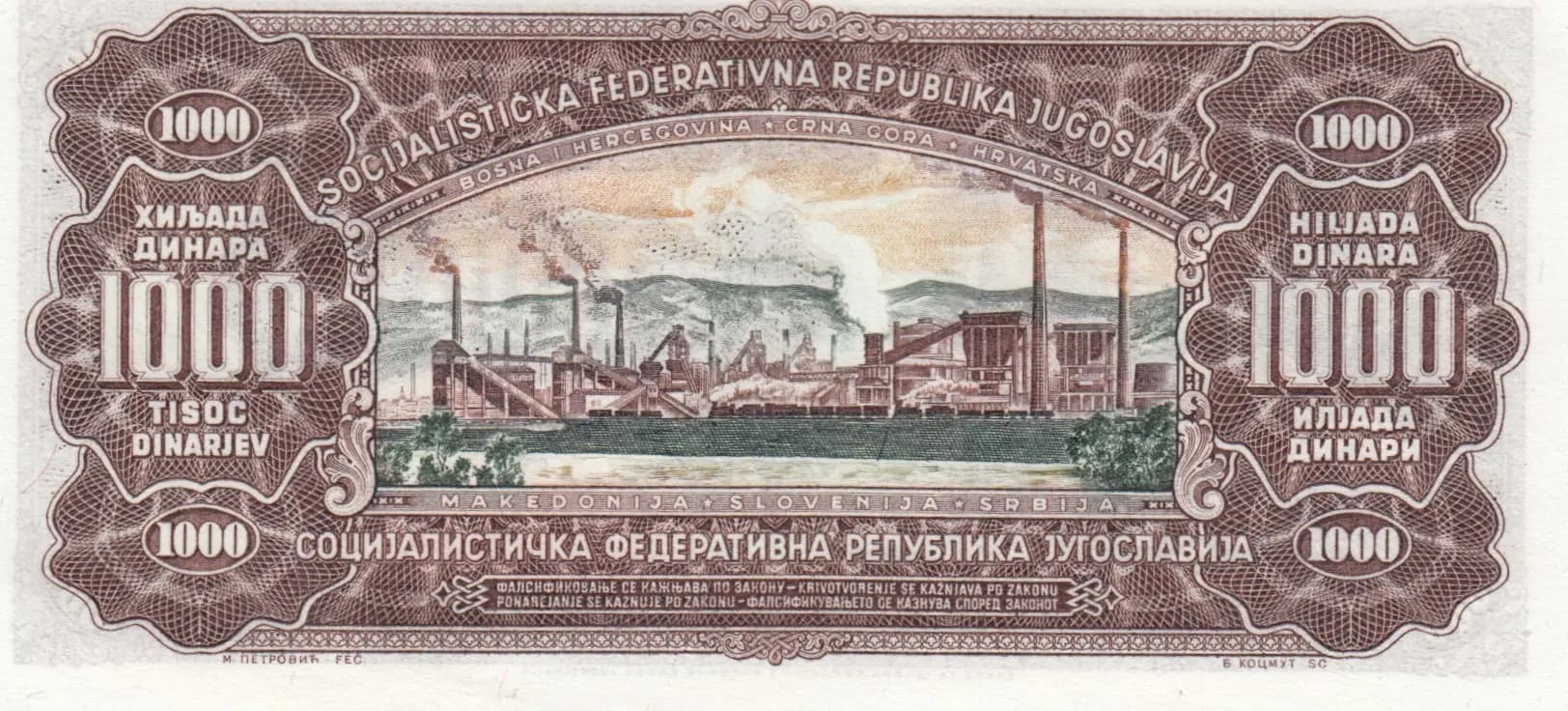
This 1963 Yugoslav 1000 dinara note (Pick-75) presents an exceptional example of mid-century socialist-era banknote design, observed here in uncirculated condition with crisp, sharp printing throughout and no visible wear or damage. The obverse features a striking portrait of steelworker Arif Heralić rendered in fine intaglio engraving, while the reverse depicts the Zenica steel mill complex—both imagery celebrating Yugoslavia's industrial modernization under Tito. The ornate baroque-style borders with elaborate guilloche patterns and multiple denomination cartouches exemplify the sophisticated security printing standards of the Narodna Banka Jugoslavije.
Common. This note exhibits no characteristics suggesting rarity. eBay price tracking data spanning 2009-2024 shows consistent sales in the $1-$23 range, with UNC examples typically selling for $3-$6, AUNC for $8-$13.50, and PMG-graded specimens for $13.50-$22.50. The 2019 catalogue valuation of $4 (UNC) corroborates the common classification. Large print runs of Yugoslav currency from the stable 1963 period were typical, and no recall or shortage data suggests scarcity. The denomination and accessibility on the secondary market confirm this as a common issue.
Issued on May 1, 1963 (International Workers' Day), this note reflects the Socialist Federative Republic of Yugoslavia's emphasis on industrial development and workers' achievements during the post-WWII reconstruction period. The deliberate choice to feature Arif Heralić, a real steelworker hero, and the Zenica mill—one of Yugoslavia's largest industrial complexes—demonstrates the regime's propaganda use of currency to celebrate socialist labor and national industrial prowess. The multilingual inscriptions in Cyrillic and Latin scripts, listing all six constituent republics (Bosnia and Herzegovina, Montenegro, Croatia, Macedonia, Slovenia, and Serbia), underscore Yugoslav federalism during its most stable and prosperous decade.
The obverse showcases a professionally engraved portrait of steelworker Arif Heralić positioned at the left, depicted wearing work goggles pushed up on his forehead and formal attire, with a confident, smiling expression—a deliberate iconographic choice presenting the socialist worker as dignified and proud. The denomination '1000' is prominently displayed in an ornate oval cartouche at center with multiple language variants reflecting Yugoslavia's multilingual federation. The reverse features a detailed intaglio rendering of the Zenica steel mill complex, a major industrial facility depicted with multiple tall smokestacks, substantial manufacturing buildings, industrial infrastructure, and a waterway in the foreground, with mountainous terrain in the background. Both sides employ an elaborate baroque-style decorative border with classical flourishes, fan-shell corner designs, and intricate guilloche patterns—typical of high-security currency printing of the era.
FRONT: 'Narodna Banka Jugoslavije' (National Bank of Yugoslavia) / '1000 Dinara / Dinarjev / Dinari' (1000 dinars in various Slavic declensions) / 'Beograd, I. Maj 1963' (Belgrade, 1st May 1963) / 'Guverner' (Governor) / 'Viceguverner' (Vice Governor) / Serial number: DH 702918. BACK: 'Socijalistička Federativna Republika Jugoslavija' (Socialist Federative Republic of Yugoslavia) / 'Bosna i Hercegovina • Crna Gora • Hrvatska • Makedonija • Slovenija • Srbija' (Bosnia and Herzegovina • Montenegro • Croatia • Macedonia • Slovenia • Serbia) / 'Hiljada / Hiljade / Hiljade Dinara' (Thousand dinars in various declensions) / 'Petrović' (likely a signature or official's name).
Intaglio (copperplate/steel engraving) throughout, executed by the Zavod za Izradu Novčanica (Banknote Printing Works) in Belgrade. The fine line engraving is evident in the portrait detail, industrial landscape rendering, and the extensive guilloche background patterns. The multicolor underprint visible in the visual analysis indicates multiple-pass intaglio printing with careful color registration. The security features include the intricate engraved linework, complex background patterns, and the sophisticated use of multiple colors within the intaglio process—all characteristic of the Yugoslav state's advanced printing capabilities.
The serial number prefix 'DH' observed on this example (DH 702918) represents one of the standard print batches for the 1963 issue. The visual analysis indicates 'I.MAJ 1963' as the issue date, which is consistent with the May 1, 1963 official issue date recorded by catalogues. No significant varieties (major signature variations, overprints, or printing errors) are evident from the visual inspection. Per catalog references, related notes from the Federativne Narodne Republike Jugoslavije series exist (see Pick-71), but this specimen belongs to the Socijalistička Federativna Republika Jugoslavija series, representing the later federal structure.