1000 dinara 1955
Market Prices
15 salesAbout This Note
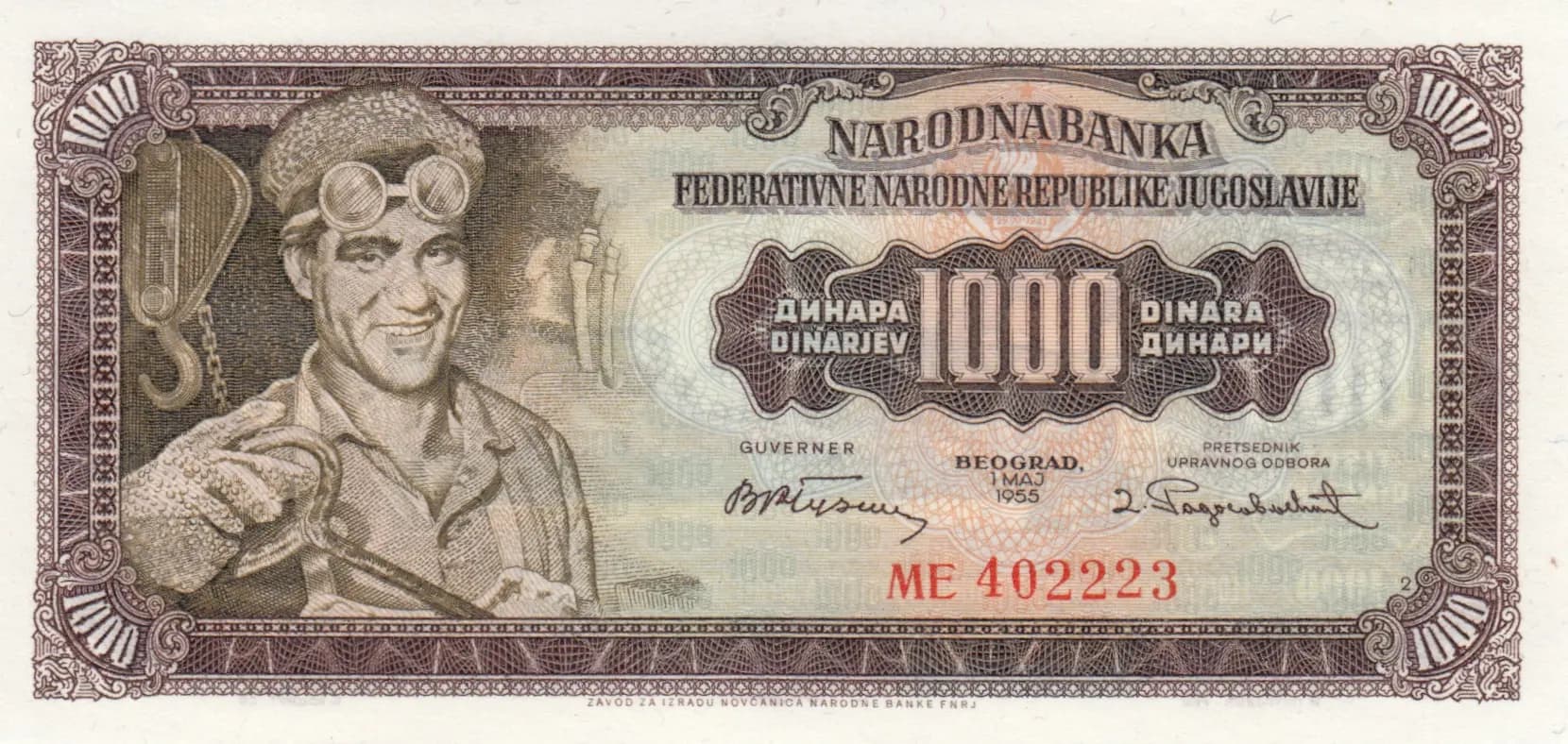
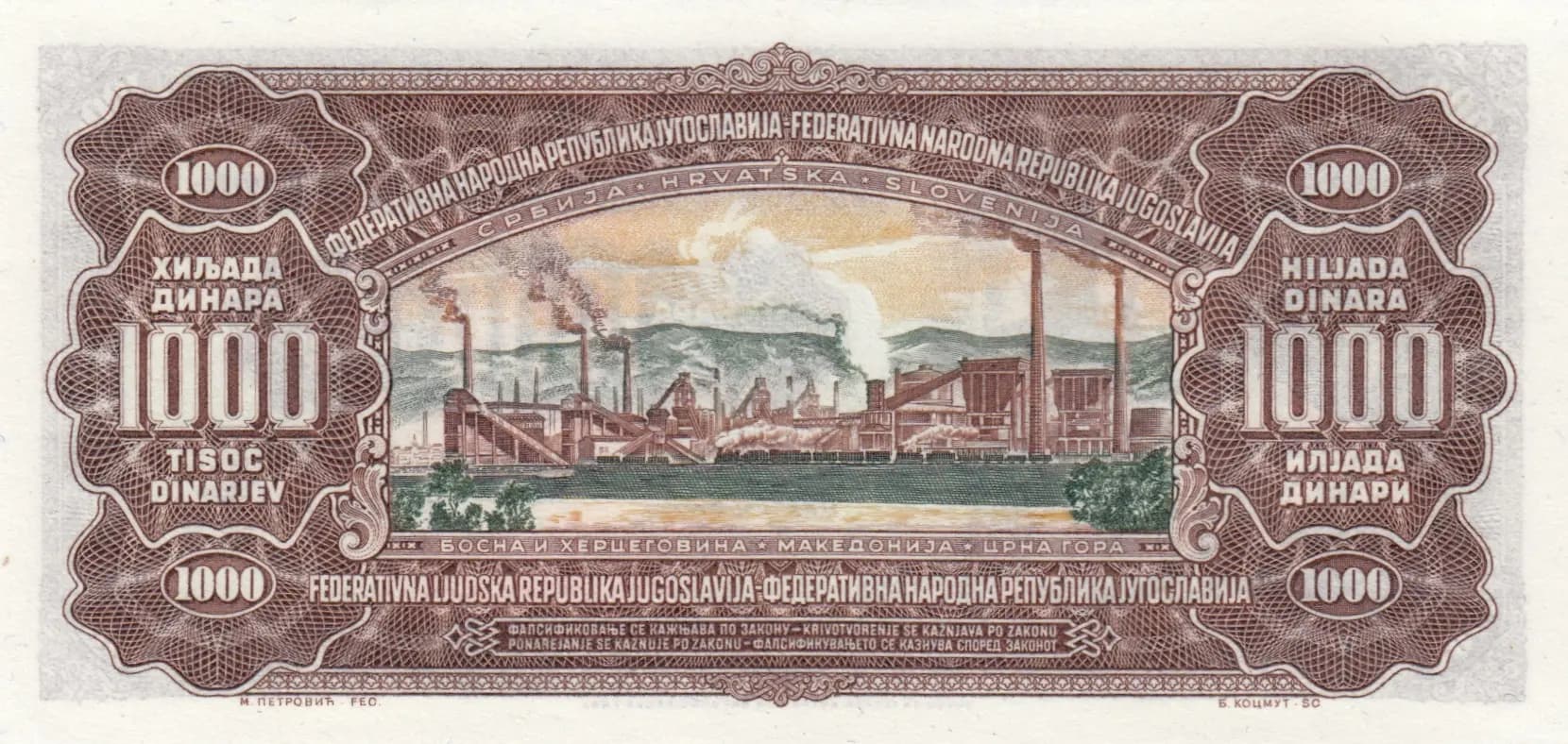
This 1000 Dinara note from the Federal People's Republic of Yugoslavia (May 1, 1955) presents in pristine uncirculated condition with crisp printing and vibrant color saturation throughout. The obverse features a striking portrait of steel worker Arif Heralić in work attire with industrial safety goggles, while the reverse depicts the Zenica steel mill complex with multiple smokestacks—imagery celebrating Yugoslavia's post-war industrial development. The note's exceptional state of preservation, combined with its historically significant subject matter documenting the socialist industrial era, makes it an appealing example for collectors of Yugoslav currency and Cold War-era numismatics.
Common. This note remains readily available in numismatic markets, as evidenced by consistent eBay auction activity with UNC examples selling for approximately $16-49 USD historically, and 2016 catalog values listing UNC at $225. The print run for this 1955 denomination was substantial, and significant quantities have survived. While not worthless, the combination of high mintage, excellent preservation of many examples, and modest collector demand places it firmly in the common category despite its historical significance.
Issued on May 1st, 1955 (International Workers' Day) by the National Bank of the Federal People's Republic of Yugoslavia, this note commemorates the country's reconstruction and industrial development following World War II. The featured portraits and industrial landscape—specifically the Zenica steel mill representing Bosnia's manufacturing importance—reflect the Yugoslav socialist government's emphasis on heavy industry and worker heroism as cornerstones of national identity and economic progress during the early Cold War period.
This note exemplifies Yugoslav post-war commemorative currency design. The obverse features Arif Heralić, a celebrated Serbian-Bosnian steel worker who achieved heroic status in Yugoslav socialist culture, depicted at left in authentic work attire with welding goggles positioned on his forehead and holding industrial implements. The portrait is rendered in fine detail against a cream and beige background, framed by an ornate border featuring shell motifs and scrollwork in the corners. The denomination '1000' is displayed centrally in a decorative dark panel with text in both Cyrillic and Latin scripts, reflecting Yugoslavia's multilingual federal structure. The reverse showcases the Zenica steel mill in Bosnia and Herzegovina—one of Yugoslavia's most important industrial complexes—rendered as a detailed landscape scene with multiple tall smokestacks, industrial buildings, and a river or water body in the foreground, set against a hilly backdrop. This imagery symbolizes the nation's industrial transformation. Both sides feature comprehensive inscriptions naming all six constituent republics and warning against counterfeiting, with the fine engraving throughout serving as a security measure.
FRONT SIDE: 'NARODNA BANKA FEDERATIVNE NARODNE REPUBLIKE JUGOSLAVIJE' (National Bank of the Federal People's Republic of Yugoslavia) | '1000' with 'ДИНАРА' (Cyrillic: Dinara) and 'DINARJEV' (Serbo-Croatian: Dinars) | 'BEOGRAD, I MAJ 1955' (Belgrade, May 1st, 1955) | 'GUVERNIER' (Governor) and 'PRETSEDENIK UPRAWNOG ODBORA' (President of the Board) with signature lines | 'ZAVOD ZA IZRADU NOVCANCA NARODNE BANKE FNRJ' (Banknote Production Plant of the National Bank of FNRY). BACK SIDE: 'ХИЉАДА ДИНАРА' / 'HILJADA DINARA' / 'TISOC DINARJEV' (Thousand Dinars in multiple scripts) | '1000' in all four corners | 'FEDERATIVNA NARODNA REPUBLIKA JUGOSLAVIJA' (Federal People's Republic of Yugoslavia) | 'SRBIJA • HRVATSKA • SLOVENIJA • BOSNA I HERCEGOVINA • MAKEDONIJA • CRNA GORA' (Serbia • Croatia • Slovenia • Bosnia and Herzegovina • Macedonia • Montenegro) | 'FALSIFIKOVANJE SE KAŽNJAVA PO ZAKONU' / 'KRIVOTVORENJE SE KAZNJAVA PO ZAKONU' (Counterfeiting is punished by law) | Artist signatures: 'М. ПЕТРОВИЋ ГЕС' (M. Petrović) and 'Б. КОШМУТ ЗС' (B. Kosmut).
Intaglio engraving (line engraving), as evidenced by the crisp, deeply impressed imagery with fine line work throughout the border patterns, portraits, and landscape scene. The note was produced by Zavod za Izradu Novčanica (Banknote Production Plant) in Belgrade, the official printing facility for Yugoslav currency. The multiple text layers in both Cyrillic and Latin scripts, intricate decorative elements, and the sharp definition of fine details indicate traditional high-security banknote engraving practices employed by central European security printers of the 1950s.
This example is identified as Pick P-71b variant. The note exhibits the characteristic features of the 1955 issue: obverse portrait of Arif Heralić, reverse depicting the Zenica steel mill, serial number in red (ME 402223 observed on this example), absence of plate numbers, and the distinctive May 1st, 1955 date. The P-71b designation distinguishes it from related Yugoslav notes; Pick catalog P-75 represents a similar note issued by the later Narodna Banka Jugoslavije under a different issuing authority. No significant printing varieties or notable overprint variants are documented for this specific Pick number.