100 dinara 1965 specimen
Market Prices
3 salesAbout This Note
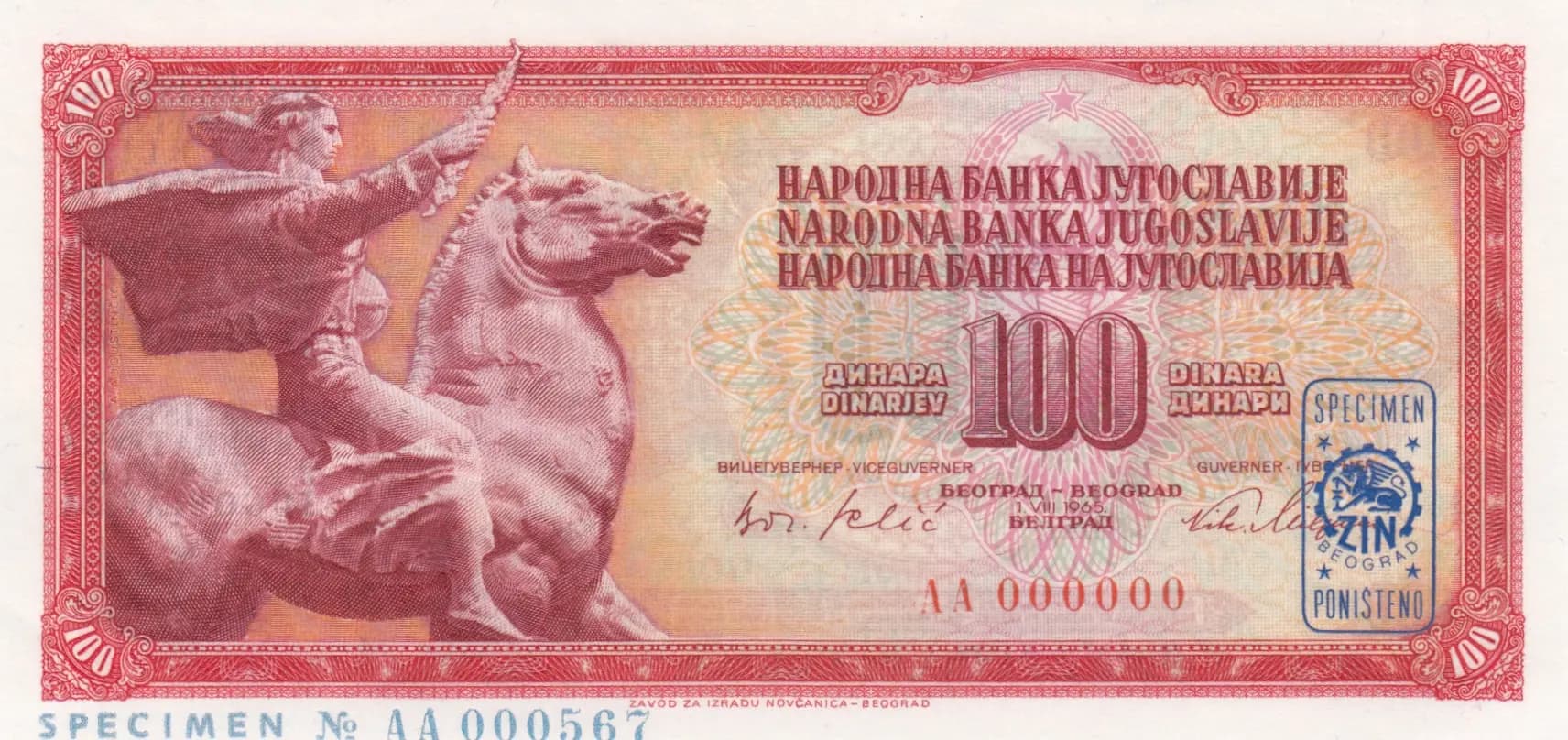
This is a 1965 Yugoslav 100 dinara specimen note in uncirculated condition, featuring the iconic allegorical 'Peace' sculptural design by Augustinčić on the obverse. The note displays exceptional clarity and sharpness with no wear, creases, or damage, characteristic of specimen notes preserved in pristine condition. As a specimen note with blue 'SPECIMEN' overprint and serial number AA 000567, it represents an important reference example from the National Bank of Yugoslavia's mid-1960s currency series.
Common. While this is a specimen note, the 1965 Yugoslav 100 dinara (P-80s) was produced in substantial quantities for distribution and reference purposes. eBay market data shows specimen and UNC examples consistently selling in the $30-70 range across multiple sales from 2017-2020, indicating steady collector demand but abundant supply. The catalog 2019 UNC value of $40 further confirms common status. Specimen notes from major world currencies of this era are typically available in moderate quantities, and Yugoslavia's monetary system produced numerous such reference pieces.
This note was issued on August 1, 1965, during the Socialist Federative Republic of Yugoslavia's post-World War II period under Tito's leadership. The featured 'Peace' sculpture by Croatian artist Ivan Meštrović (Augustinčić) references the United Nations, symbolizing Yugoslavia's commitment to international peace and its position as a non-aligned nation during the Cold War. The multiethnic and multilingual design—with text in both Cyrillic and Latin scripts—reflects Yugoslavia's diverse constituent republics and its ideological emphasis on workers' solidarity and socialist values.
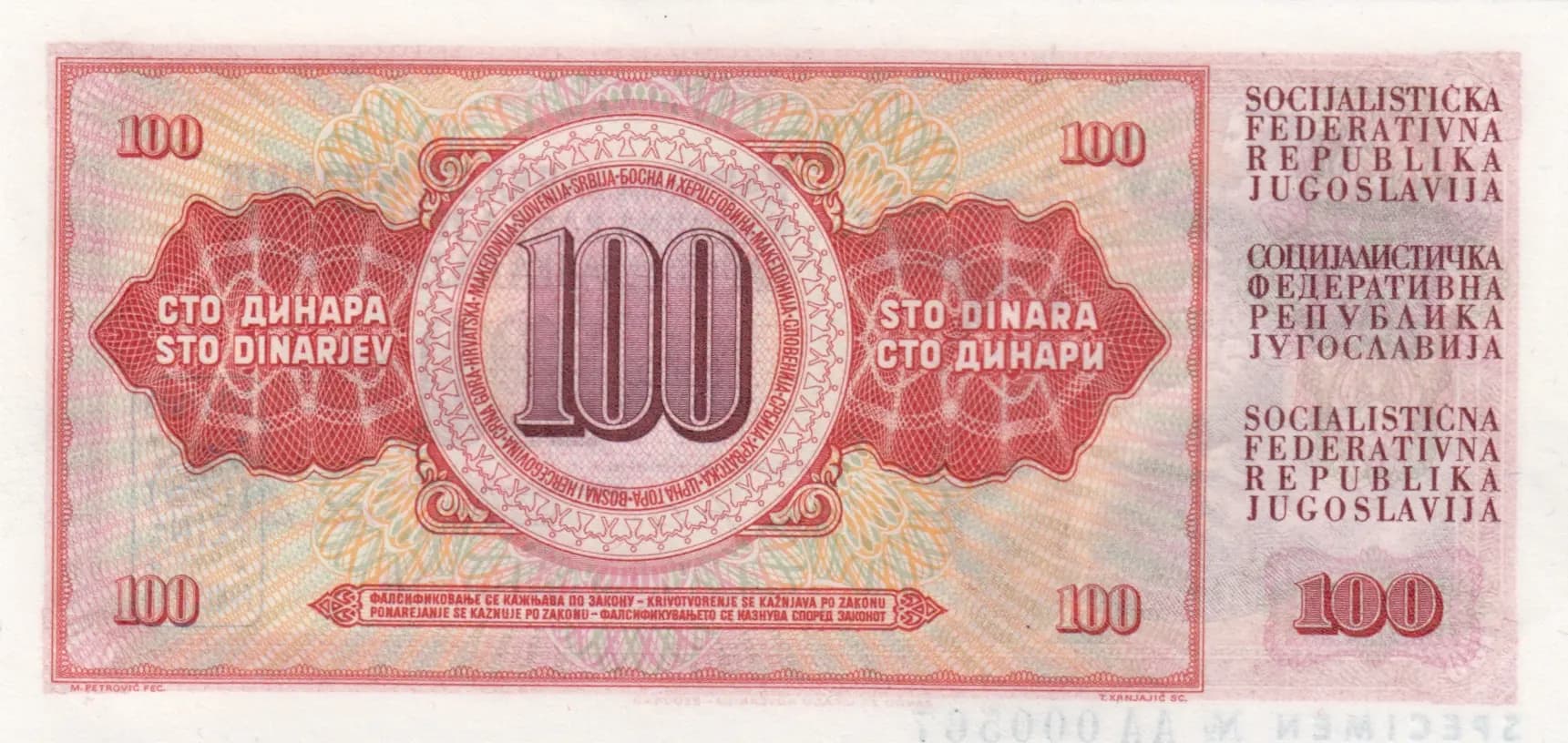
The obverse features the renowned 'Peace' allegorical sculptural relief by Ivan Meštrović (titled 'Augustinčić' in the catalog), depicting multiple classical figures in high relief positioned on the left portion of the note. This is a symbolic representation of the famous sculpture located in the garden of the United Nations headquarters in New York, chosen to represent Yugoslavia's international diplomatic standing. The reverse displays a large ornamental circular frame with a star border containing the denomination '100,' surrounded by symmetrical decorative scrollwork, geometric patterns, and diamond-shaped ornamental elements. The design employs a dominant pink-red color scheme with cream and tan accents throughout. Multiple language designations in both Cyrillic (Serbian) and Latin (Croatian) scripts appear on both sides, reflecting the note's circulation across Yugoslavia's diverse republics. The overall aesthetic combines socialist-era design principles with classical artistic references.
FRONT SIDE: 'NARODNA BANKA JUGOSLAVIJE' (National Bank of Yugoslavia), 'NARODNA BANKA NA JUGOSLAVIJA' (National Bank of Yugoslavia in alternative form), '100' (denomination), 'DINARA' and 'DINARJEV' (currency names in different Serbo-Croatian forms), 'BEOGRAD' (Belgrade), 'I.VII.1965' (issue date: 1 July 1965), 'GUVERNER' and 'VICEGUVERNER' (Governor and Vice Governor signature lines), 'ZAVOD ZA IZRADU NOVCANICA - BEOGRAD' (Institute for Banknote Production - Belgrade), 'SPECIMEN № AA 000567' (specimen designation and number), 'PONIZTENO' (cancelled/negated). BACK SIDE: 'сто ДИНАРА' and 'СТО ДИНАРИ' (One hundred dinars in Cyrillic), 'SOCIJALISTICKA FEDERATIVNA REPUBLIKA JUGOSLAVIJA' and 'СОЦИЈАЛИСТИЧКА ФЕДЕРАТИВНА РЕПУБЛИКА ЈУГОСЛАВИЈА' (Socialist Federative Republic of Yugoslavia in both Latin and Cyrillic), 'ФАЛСИФИКУВАЊЕ СЕ КАЗНУВА ПО ЗАКОНУ' and 'KRIVOTVORENJE SE KAZNJAVA PO ZAKONU' (Counterfeiting is punishable by law in both scripts), multiple instances of '100' in corner ornaments.
Intaglio printing (engraved) combined with multicolor lithography, as evidenced by the fine line work, sharp detail in the sculptural relief reproduction, and the precise registration of multiple color passes. The ornate border work, decorative scrollwork, and the clean reproduction of the three-dimensional sculptural figures all indicate the use of traditional intaglio engraving techniques. The note was produced by Zavod za Izradu Novčanica (Institute for Banknote Production) in Belgrade, which was Yugoslavia's principal state banknote printing facility. Specimen notes received additional overprinting for the blue 'SPECIMEN' stamp and specimen number.
This specific specimen is identified as variety P-80s (the 's' denoting specimen status). The specimen number 'AA 000567' indicates this is a later specimen printing or reference copy from the series. The blue 'SPECIMEN' overprint, 'PONIZTENO' (cancelled) marking, and the standardized specimen serial number format (AA followed by sequential numbering) distinguish this from circulation notes. Related later issues exist dated 1978, 1981, and 1986 (cataloged as P-90), making this 1965 version the first of this sculptural design series. The note bears signatures or initials ('b.M.Felis' and 'M.U.') consistent with specimen production protocols.