100 dinara 1946 specimen
Market Prices
21 salesAbout This Note
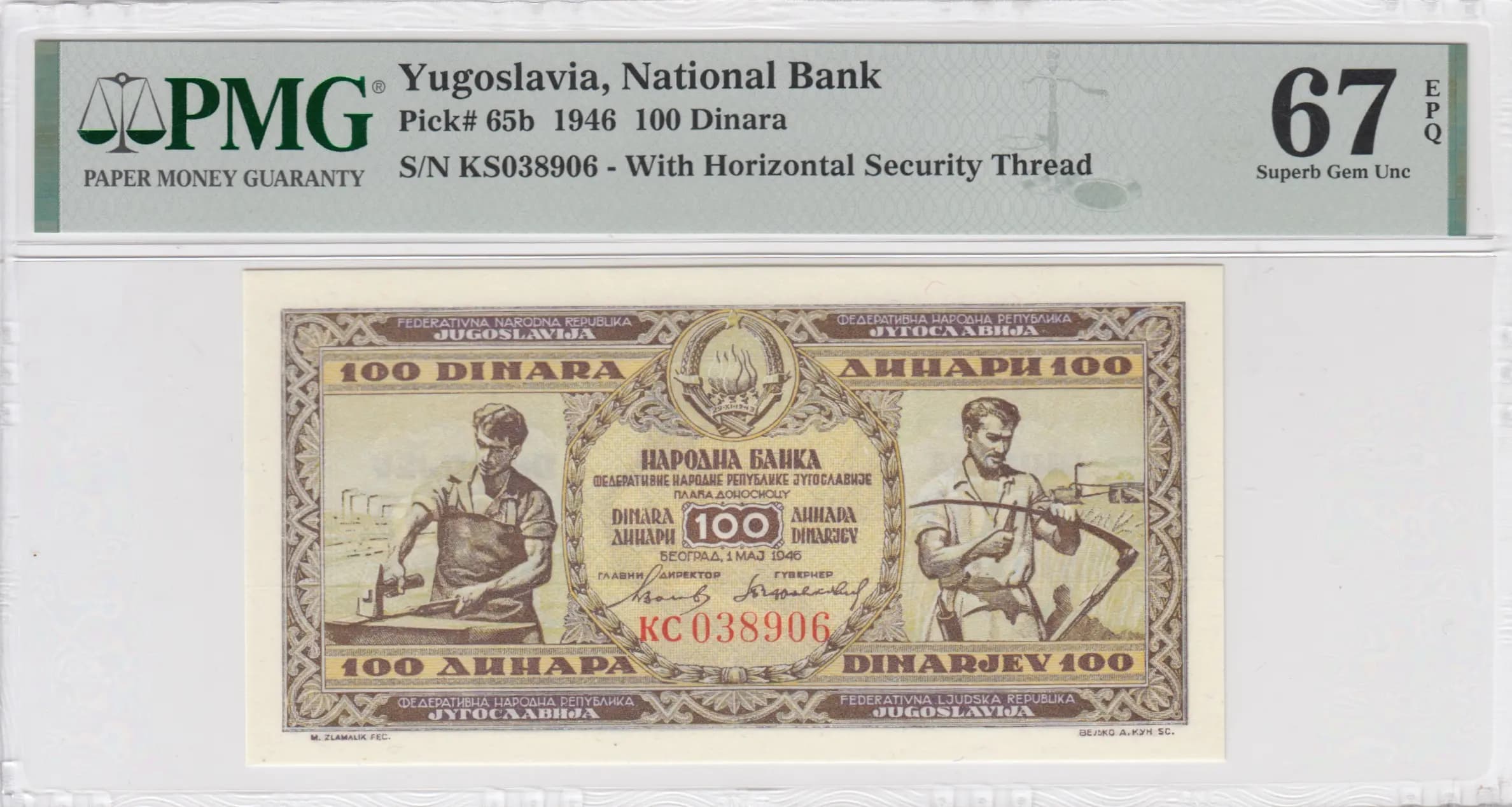
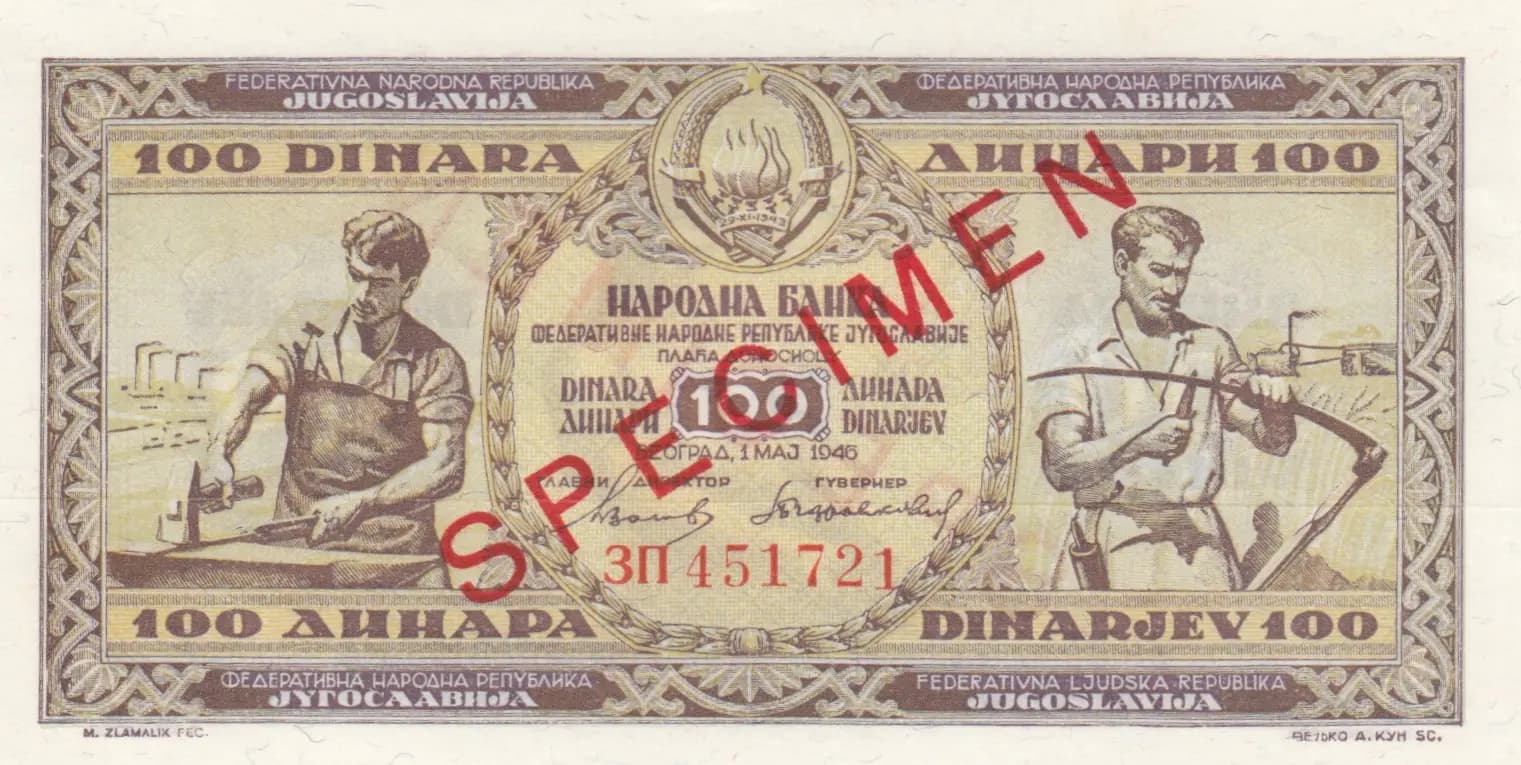
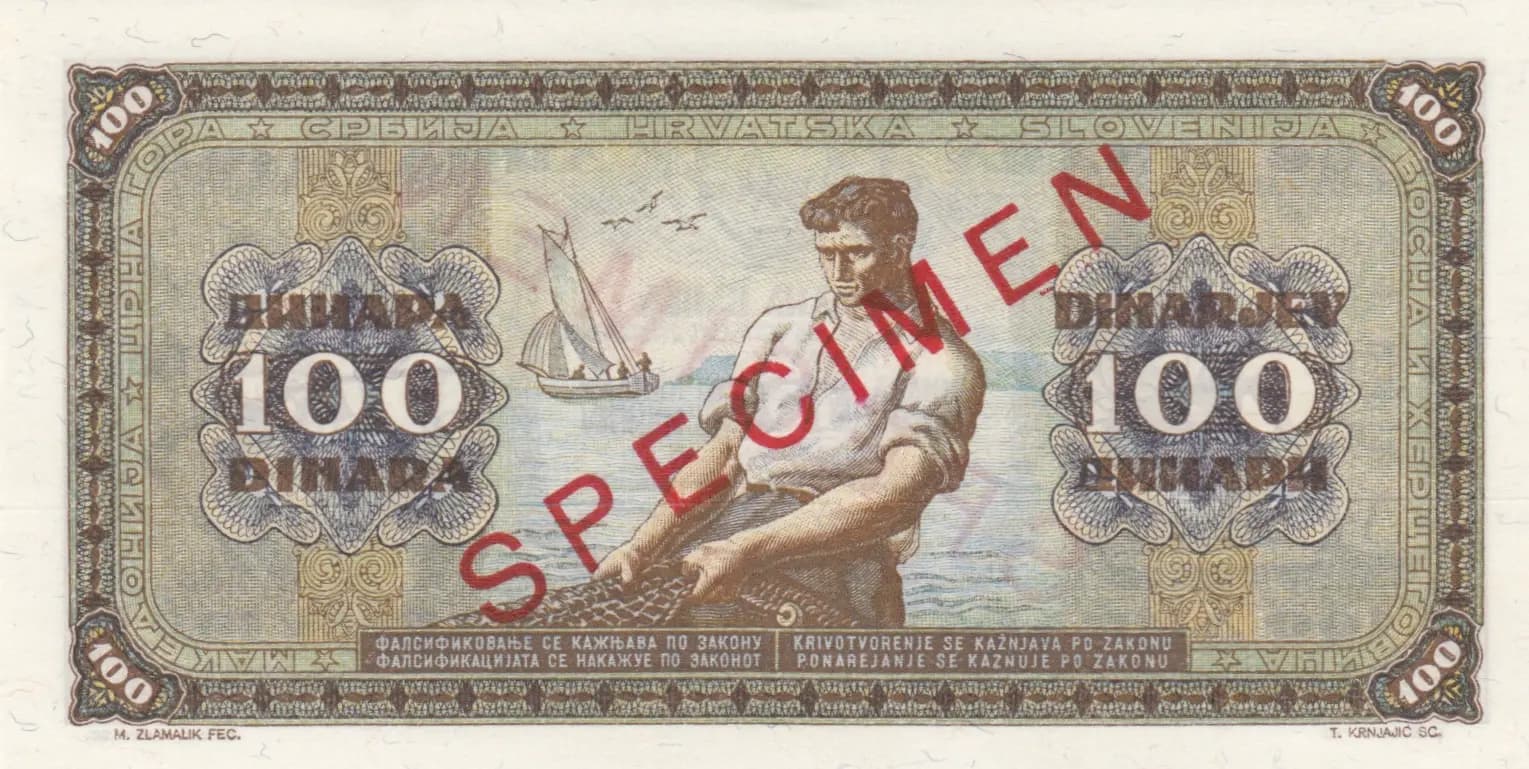
This is a 1946 Yugoslavia 100 dinara specimen note (Pick P-65bs) in uncirculated condition, featuring exceptional Art Deco design with allegorical figures representing industrial labor and commerce. The front depicts a blacksmith and farmer flanking the national emblem, while the reverse showcases a classical figure (Mercury or similar) gesturing toward a sailing ship, symbolizing Yugoslavia's maritime and commercial aspirations in the early post-war period. The large red SPECIMEN overprint confirms this is a non-circulating reference note, with sharp, pristine engraving throughout and no visible wear.
Common. The eBay price history shows UNC specimens trading consistently in the $15–$30 range from 2009–2020, with a peak of $29 in 2020 and recent PMG-graded examples reaching $50–$89 only when achieving higher technical grades (PMG 66–67). A catalog valuation of $80 for UNC reflects collector interest but not scarcity; the regular production volume of this standard issue, combined with modest secondary market demand, places it firmly in the common category. Specimen notes with red overprints are slightly more collectible than circulation notes but remain readily available.
This note was issued on May 1, 1946, by the Narodna Banka Federativne Narodne Republike Jugoslavije (National Bank of the Federative People's Republic of Yugoslavia), representing the newly formed socialist federal state under Tito. The allegorical imagery—blacksmith, farmer, and classical merchant—reflects the regime's ideological emphasis on labor, agricultural production, and rebuilding Yugoslavia's economy following World War II devastation. The maritime symbolism acknowledges Yugoslavia's important Adriatic shipping and fishing industries, key components of the nation's economic recovery strategy.
The obverse presents a triumphalist post-war composition: on the left, a muscular blacksmith laboring at an anvil, representing industrial reconstruction; on the right, a farmer with tools symbolizing agricultural renewal. Between them stands the Yugoslav state emblem—a torch or flame surrounded by laurel wreaths—indicating victory and socialist achievement. The entire design is framed by intricate Art Deco geometric borders with fine line work. The reverse features a classical allegorical figure (likely Mercury, patron of commerce and trade) in draped clothing, seated or reclining and gesturing toward a sailing vessel on the sea—symbolizing Yugoslavia's maritime commerce and Adriatic fishing heritage. Corner ornaments contain the denomination in cartouches. Both sides employ exceptional fine-line engraving with decorative security borders, typical of 1940s Central European banknote production.
{"front":{"FEDERATIVNA NARODNA REPUBLIKA JUGOSLAVIJA":"Federative People's Republic of Yugoslavia","100 DINARA / 100 ДИНАРА":"100 dinara","НАРОДНА БАНКА":"People's Bank","GRAD. 1 MAJ 1946":"Dated: May 1, 1946","DINARJEV":"dinars (genitive plural form)","ЗП 451721":"Serial number","M. ZLAMALIK FEC.":"M. Zlamalik engraved [this]","БЕЛКО А. КУН ЗС.":"Printer's mark (Cyrillic)","SPECIMEN":"Specimen (English overprint)"},"back":{"100 / DINAREK":"100 dinars","HRVATSKA":"Croatia","SLOVENIJA":"Slovenia","FALSIFIKOVANJE SE KAŽNJAVA PO ZAKONU":"Counterfeiting is punished by law (repeated in Latin and Cyrillic)","M. ZLAMALIK FEC.":"M. Zlamalik engraved [this]","T. KRNJAUC SC.":"T. Krnjajuc engraved/sculpted [this]","SPECIMEN":"Specimen (English overprint)"}}
Intaglio engraving (recess printing), the standard technique for banknote production of this era. The fine line detail, sharp edge definition on all pictorial elements, and the characteristic intaglio 'bite' visible in the border patterns indicate professional security printing by a major European banknote firm. The engravers' marks (M. Zlamalik on both sides, T. Krnjauc on reverse) and printer attribution suggest production by an established Central European security printer, likely Banknote Corporation or similar facility contracted by the Yugoslav National Bank.
This is catalogued as Pick P-65bs, indicating it is the specimen variant (suffix 's' = specimen overprint) of a three-variant series (P-65a, P-65b, P-65c noted in PMG population data). The 'b' designation suggests this is the second major variety within the series, possibly differentiated by signature, printer marks, or serial number format. The red SPECIMEN overprint and serial number ЗП 451721 are diagnostic features of specimen notes issued for reference and bank distribution rather than circulation. The presence of both Latin and Cyrillic script reflects Yugoslavia's multilingual, multi-ethnic federation structure.