100 dinara 1946
Market Prices
13 salesAbout This Note
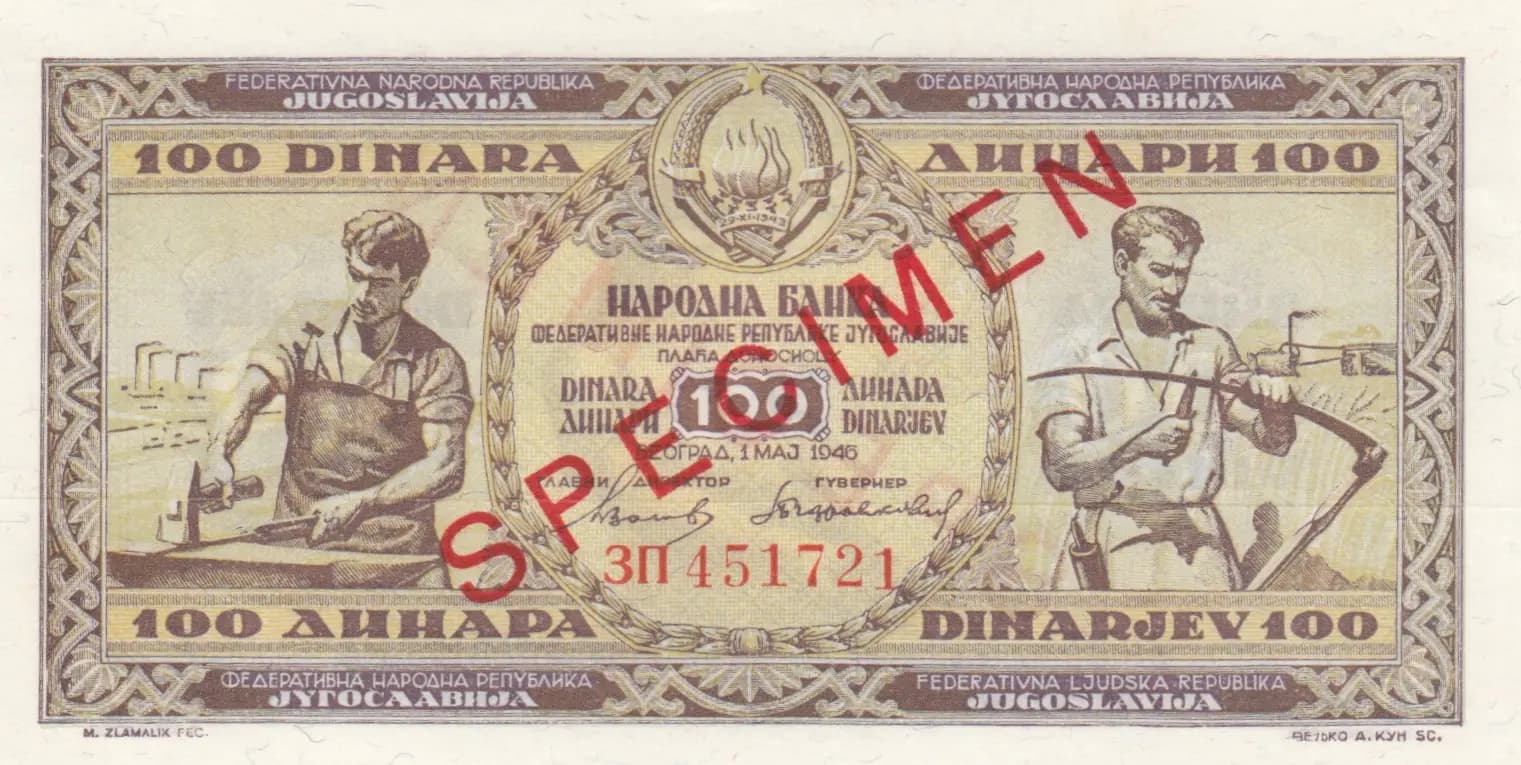
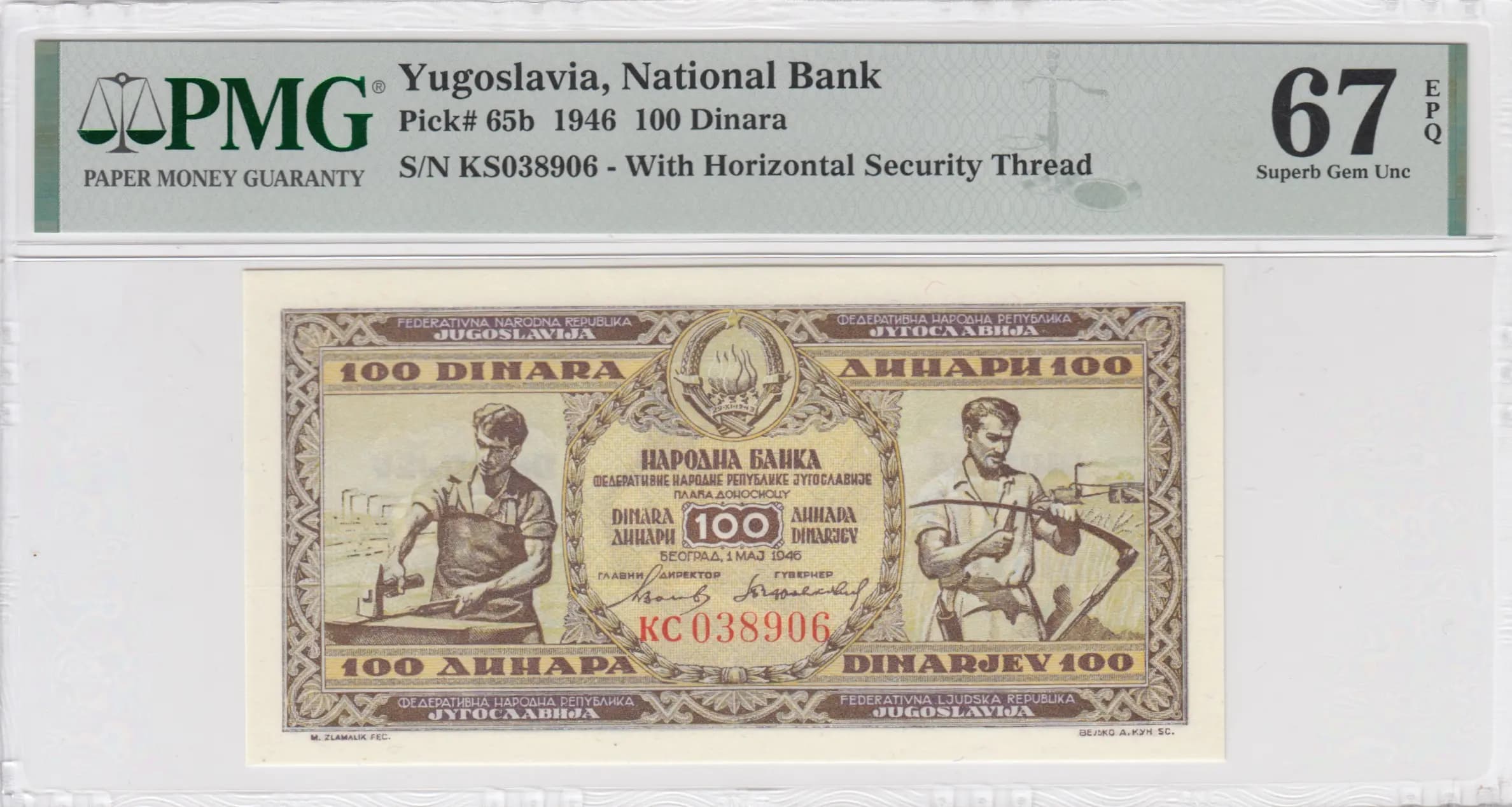
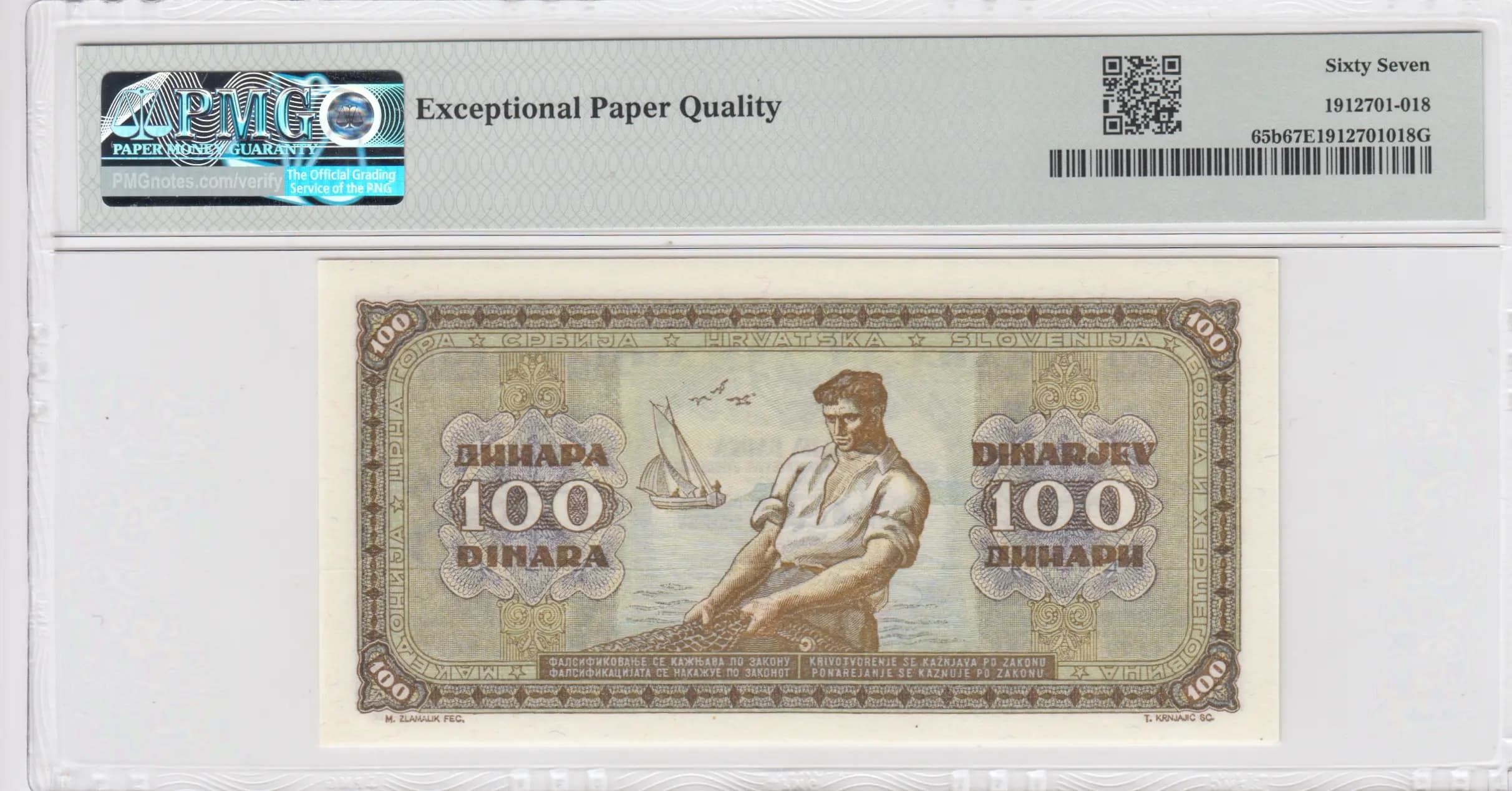
This is an exceptional PMG 67 EPQ example of the 1946 Yugoslav 100 dinara note, presenting pristine condition with sharp, clear printing throughout and no visible wear, creases, or defects. The note features striking allegorical imagery celebrating labor and industry—a blacksmith at the forge on the obverse and a fisherman on the reverse—reflecting the post-WWII socialist ideals of the newly formed Federal People's Republic of Yugoslavia. This particular specimen represents the finest condition examples seen on the secondary market, making it highly desirable to collectors of Yugoslav currency and early People's Republic banknotes.
Common. Despite its historical significance as the first issue of the post-WWII Yugoslav state, this note is widely available in numismatic markets. Secondary market data shows consistent sales at modest prices: PMG 65-66 examples typically sell for $40-70, UNC notes for $15-36, and lower grades for under $10. The apparent regular print run and survival rate in circulation indicate this was a standard issue rather than a limited production. The PMG 67 EPQ grade represents an exceptional condition premium over typical examples rather than indicating scarcity.
Issued on May 1, 1946—International Workers' Day—this banknote commemorates the establishment of the Federal People's Republic of Yugoslavia under Josip Broz Tito following World War II. The deliberate choice of May 1st as the issue date and the prominent depiction of workers (blacksmith, farmer, and fisherman) reinforces the socialist ideology of the new regime, celebrating labor across industrial, agricultural, and maritime sectors. The inclusion of "Serbia * Croatia * Slovenia" on the reverse emphasizes the federal unity of the Yugoslav republics.
The obverse presents a cream and brown composition dominated by two male workers symbolizing socialist labor: a blacksmith positioned at left working at a forge with industrial elements visible in the background, and a farmer or construction worker at right with tools. The Yugoslav coat of arms—featuring a flame or torch symbol—is centrally placed above these figures, emphasizing state authority. Ornamental wreaths and geometric borders frame the composition in brown tones with gold underprinting. The reverse depicts an allegorical male figure in classical style, reclining or seated in a contemplative pose, representing maritime industry; a sailing vessel appears in the background on water. Double-headed eagle emblems flank the top corners, and the denomination is contained within ornamental cartouches on both sides. The multilingual inscriptions in both Latin and Cyrillic scripts reflect the multiethnic character of the federation.
FRONT: 'Federativna Narodna Republika Jugoslavija' (Federative People's Republic of Yugoslavia) / 'Narodna Banka' (National Bank) / '100 Dinara' / 'Динара 100' (Dinara 100) / 'Динари 100' (Dinari 100) / 'Динарjev 100' (Dinars 100) / Serial number 'KC 038906' / 'Beograd 1 Maj 1946' (Belgrade 1 May 1946) / 'M. Zlamalik fec.' (Artist/Engraver M. Zlamalik) / 'Bjelsko-Aachn sc.' (Printer: Bjelsko-Aachn). BACK: '100 Dinara' / 'Дinarjev 100' (Dinars 100) / 'Srbija * Hrvatska * Slovenija' (Serbia * Croatia * Slovenia) / 'M. Zlamalik fec.' (Artist/Engraver M. Zlamalik) / 'L. Krnaric sc.' (Printer: L. Krnaric).
Engraved intaglio printing on security-paper stock with a visible horizontal security thread. The note was engraved by M. Zlamalik with printing/secondary engraving marks by Bjelsko-Aachn (obverse) and L. Krnaric (reverse), indicating professional security printer production. The exceptional sharpness and clarity of lines, fine detail rendering, and precise color registration visible in this PMG 67 specimen demonstrate the high quality of Yugoslav intaglio printing standards of the period.
This specimen is cataloged as Pick 65b, one of three documented variants (P-65a, P-65b, P-65c) of the 100 dinara 1946 issue. The serial number prefix 'KC 038906' and the date '1 Maj 1946' confirm this as a first-year-of-issue example from the May 1, 1946 release. Distinction between varieties typically relates to signature variants, printer marks, or security thread differences; the 65b designation indicates this specific combination of engraver and printer marks.