100 dinara 1941
Market Prices
2 salesAbout This Note
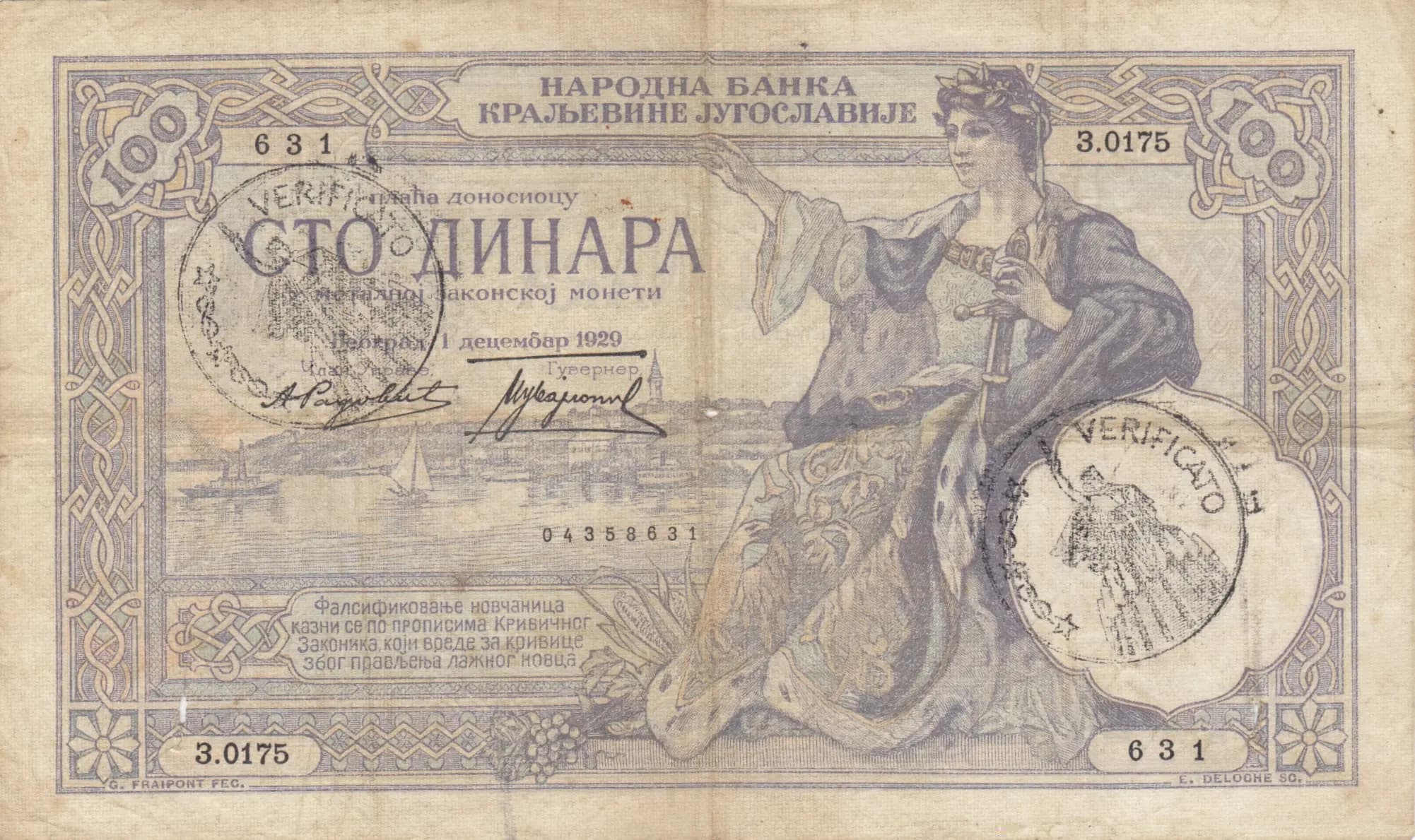
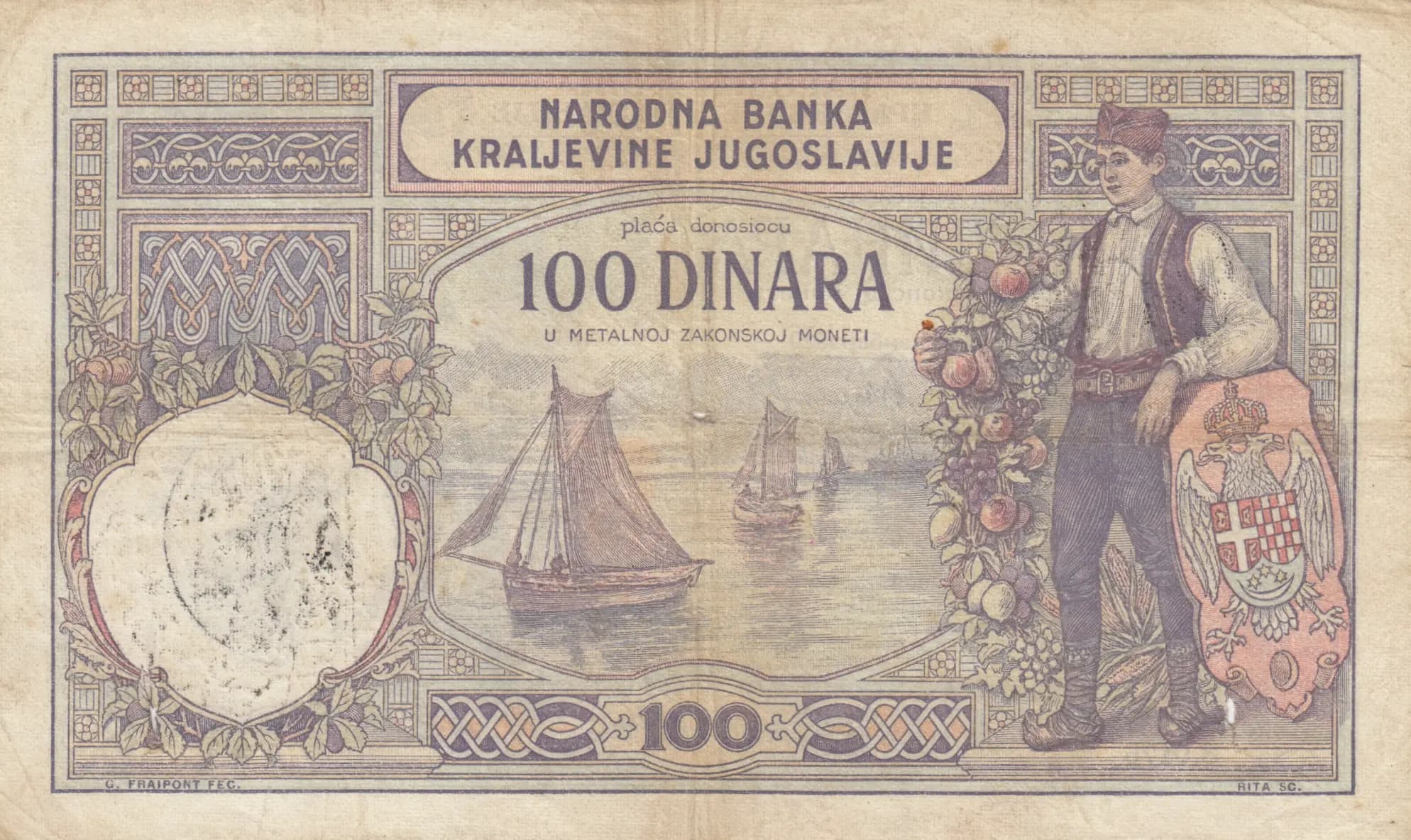
This 100 Dinara note from 1941 represents an interesting transitional issue during WWII, featuring allegorical figures representing Yugoslav virtues alongside maritime imagery reflecting the nation's coastal heritage. The note exhibits heavy circulation wear consistent with its F (Fair) grade, showing significant foxing, creases, and discoloration throughout both sides, yet the ornate engraved borders and detailed portraits remain discernible. As an Italian Armed Forces issue during the occupation period, this note carries historical significance beyond its modest catalog value.
Common. eBay market data shows recent sales in the $1.99-$11.61 range for VF examples, and the 2008 catalog value of $8 for F grade indicates steady, modest demand typical of common occupation-period currency. The note was clearly produced in significant quantities for circulation during the Italian occupation period. While historically interesting, the print run was substantial enough to keep this note common in the current market.
Issued in 1941 by Italian Armed Forces during the occupation of Yugoslavia in World War II, this banknote represents a complex period when the Kingdom of Yugoslavia was fragmented under Axis control. The dual maritime imagery (sailboats depicted on both obverse and reverse) reflects Yugoslavia's pre-war national identity and Adriatic heritage, while the allegorical figures—a woman with cornucopia on the obverse and a man with agricultural produce on the reverse—symbolize prosperity and bounty, ironically issued during wartime occupation. This note type was part of the occupation currency system and has become a sought-after artifact of this turbulent historical period.
This banknote showcases classical allegorical design typical of interwar and WWII-era Yugoslav currency. The obverse features a seated female figure (personifying prosperity or national virtue) positioned at right, holding a cornucopia, set against a background maritime scene with sailboats. The reverse depicts a male figure in traditional Serbian folk costume (vest with embroidered details) clutching grape vines, representing agricultural wealth, also with a central maritime harbor scene. Both sides are framed with ornate geometric and floral decorative borders serving as engraved security features. Heraldic coat of arms with crown emblems appear on both sides. The watermark features Karageorge (Serbian national hero), visible in circular seals. Purple, pink, and tan inks dominate the color scheme.
Front Side: 'NARODNA BANKA KRALJEVINE JUGOSLAVIJE' (National Bank of the Kingdom of Yugoslavia); '100 DINARA' (100 Dinars); 'U METALNOJ ZAKONSKOJ MONETI' (In metal legal currency); 'G. FRAIPOINT FEC.' (G. Fraipoint engraved this); 'RITA SC.' (Rita sculpted/engraved this). Reverse Side: 'NARODNA BANKA KRALJEVINE JUGOSLAVIJE' (National Bank of the Kingdom of Yugoslavia); '100 DINARA' (100 Dinars); 'plaća donošiocu' (Pays to bearer); 'G. FRAIPORT FEC.' (G. Fraiport engraved this); 'RITA SC.' (Rita sculpted/engraved this).
Intaglio engraving on banknote paper, evidenced by the fine detail work, sharp lines in decorative borders, and the depth of impression visible throughout both sides. The artist signatures 'G. Fraipoint' (engraver) and 'RITA' (sculptor) appear on the note, indicating high-quality security engraving typical of official currency production during this period. The ornate border patterns and detailed portraiture are characteristic of 1940s security printing standards.
PMG cataloging recognizes variants P-R13A and P-R13b for this base Pick number P-R13. The visual analysis does not reveal sufficient detail of serial number prefixes, signature variations, or overprint characteristics to definitively identify which specific variety this particular note represents. Collectors should examine serial number formatting and any subtle printing variations to distinguish between cataloged varieties. The referenced 'handstamp on p27' in the realbanknotes.com data suggests variant distinctions may include presence or absence of handstamps.