100 dinara 1963
Market Prices
21 salesAbout This Note
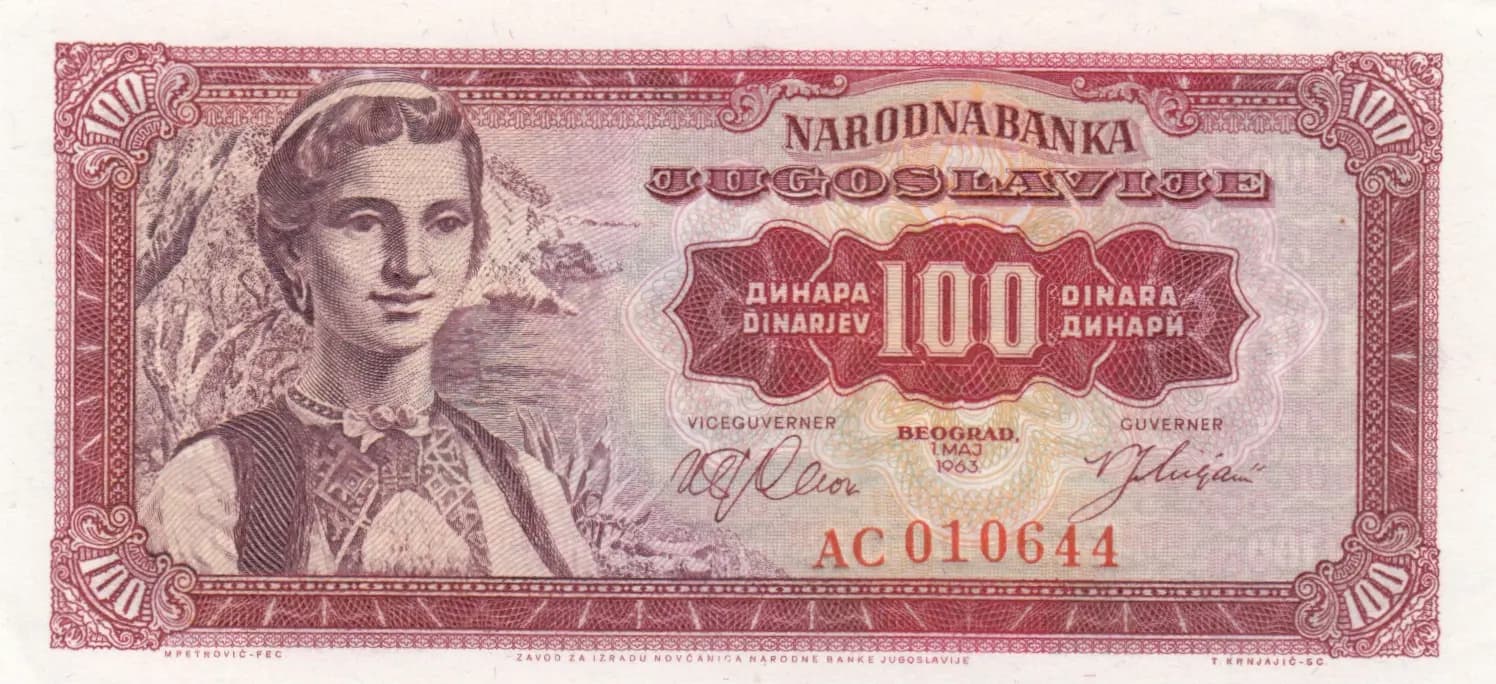
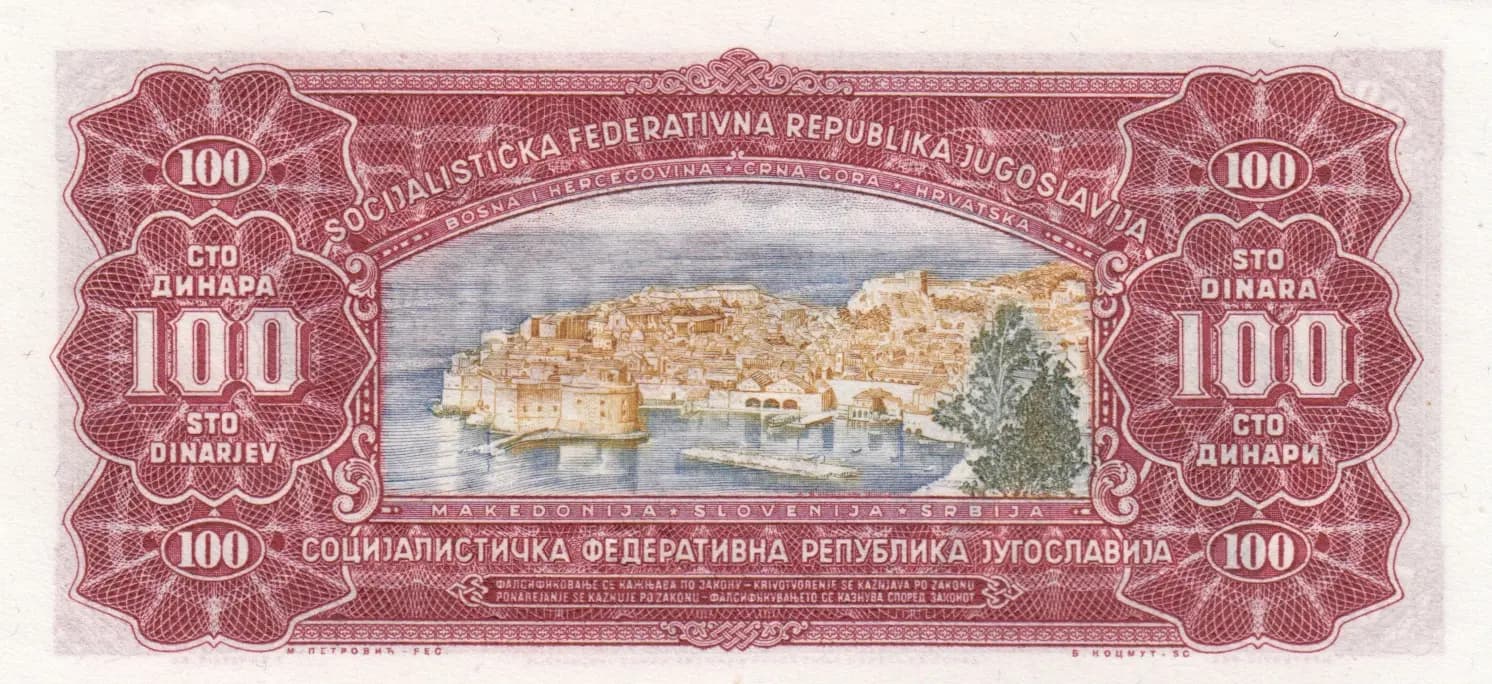
This is an uncirculated example of Yugoslavia's 1963 100 dinara note (Pick 73), featuring a striking portrait of a woman in traditional Konavle costume on the obverse and a detailed engraving of Dubrovnik's walled old town on the reverse. The note displays pristine condition with vibrant burgundy and mauve coloring, crisp intaglio printing, and no signs of wear, creasing, or circulation. This represents a classic example of early Socialist Yugoslavia's regional cultural banknotes, combining folk heritage imagery with Mediterranean landmarks.
Common. This note was part of a regular circulation issue of the Narodna Banka Jugoslavije and remains widely available to collectors. Secondary market data confirms abundant supply: UNC examples have consistently sold in the $1.25–$3.99 range over the past 15 years on eBay, with even premium graded examples (PMG 66) typically fetching under $18. Print runs for this denomination in 1963 were substantial. No historical recall or short-run status is documented. The 2019 catalog value of $3 UNC further supports common classification.
Issued on May 1, 1963, by the Narodna Banka Jugoslavije, this note reflects the Socialist Federative Republic of Yugoslavia's emphasis on national unity through cultural representation across its constituent republics. The obverse portrait celebrates Konavle, a region in southern Croatia known for its distinctive folk traditions, while the reverse depicts Dubrovnik (Ragusa), the historic Adriatic port city and symbol of Dalmatian heritage. Together, these images embodied Yugoslavia's attempt to balance regional ethnic identity with socialist federal ideals during the Tito era.
The obverse features a three-quarter portrait of a woman from Konavle in traditional regional costume, positioned at the left side of the note, wearing an ornate lace headdress and embroidered garments characteristic of southern Croatian folk dress. The woman's portrait serves as the primary security device and cultural statement. The reverse presents a detailed landscape engraving of Dubrovnik's fortified old town, showing the characteristic medieval walled city architecture with densely packed buildings cascading down a hillside to the waterfront, featuring cypress trees in the Mediterranean setting, and fortress walls representing the city's defensive heritage. Both sides employ identical baroque-inspired ornamental borders with rosette patterns and decorative cartouches housing the denomination in all four corners. The overall design reflects 1960s Yugoslav aesthetic principles combining folk culture with nationalist pride.
FRONT SIDE: 'Narodna Banka Jugoslavije' (National Bank of Yugoslavia) | '100' / 'Dinara' / 'Dinarjev' / 'Dinari' (100 Dinars in various language forms) | 'Beograd, 1 Maj 1963' (Belgrade, May 1, 1963) | 'Guverner' (Governor) and 'Viceguverner' (Vice Governor) signature lines | 'Zavod za Izradu Novčanica Narodne Banke Jugoslavije' (Facility for the Printing of Currency of the National Bank of Yugoslavia). BACK SIDE: 'Socijalistička Federativna Republika Jugoslavija' (Socialist Federative Republic of Yugoslavia) | Regional republics listed: 'Bosna i Hercegovina · Crna Gora · Hrvatska · Makedonija · Slovenija · Srbija' (Bosnia and Herzegovina · Montenegro · Croatia · Macedonia · Slovenia · Serbia) | '100' / 'Sto Dinara' / 'Sto Dinari' (One Hundred Dinars) | 'Ponaredjanje se kaznjuje Pozakonom · Falsifikovanje će kazniva spored Zakonom' (Counterfeiting is punishable by law).
Intaglio printing (engraved), a premium anti-counterfeiting method employing fine line work and complex border designs. The Zavod za Izradu Novčanica (Currency Printing Facility) of the National Bank of Yugoslavia produced this note. Multiple color layers (burgundy, mauve, cream, gray, blue, tan, and green) were applied in sequence. The fine detail visible throughout—particularly in the landscape engraving of Dubrovnik and the portrait on the obverse—demonstrates skilled engraving by M. Petrović (front engraver, 'FEC') and B. Kočut (back engraver, 'SC'), with T. Ermajac credited on the front design.
This example displays serial number 'AC 010644', consistent with the standard issue series. The note is dated 'Beograd, 1 Maj 1963' (Belgrade, May 1, 1963). No overprints, surcharges, or replacement markers are visible. The signature lines for Guverner and Viceguverner are blank/printed in standard fashion typical of the 1963 issue. No major varieties (such as color variants, watermark types, or prefix changes) are evident in this specimen. This represents the standard variety of Pick 73.