100 dinara 1955
Market Prices
31 salesAbout This Note
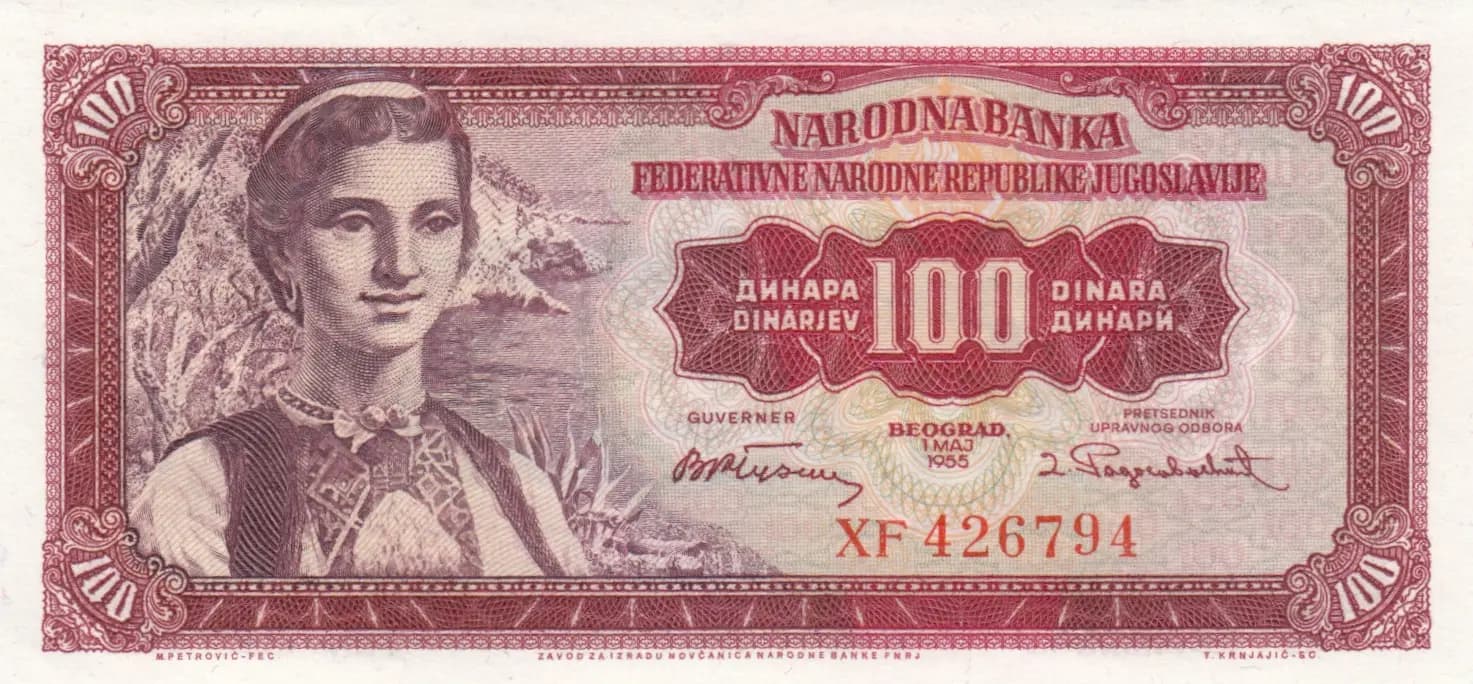
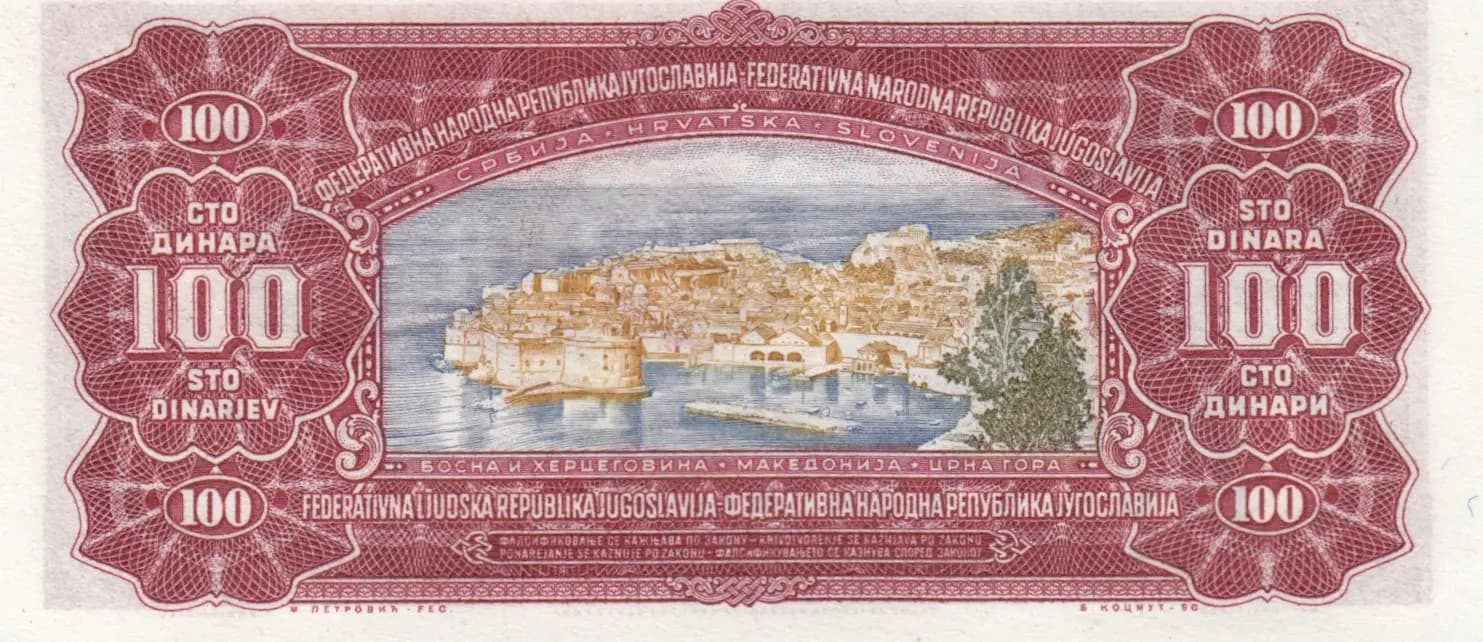
This is an uncirculated example of the 1955 Yugoslav 100 dinara note (Pick P-69), featuring a woman in traditional Konavle folk costume on the obverse and a detailed engraved view of Dubrovnik's fortified medieval walls on the reverse. The note displays pristine condition with sharp printing, vibrant mauve and burgundy coloring, and exhibits no signs of wear, creasing, or damage. This is a significant early post-war Yugoslav issue from the Federal People's Republic period, representing important cultural and geographic imagery of the newly-unified Yugoslav state.
Common. eBay market data shows consistent sales of this Pick number across multiple condition grades (VF through UNC) over an extended period (2011-2025), with UNC examples selling for $4.76-$4.99 in 2011-2012, indicating substantial availability. More recent PMG-graded sales of higher grades (PMG 66-67) have ranged $12-$38, but the large number of sales transactions and low baseline prices for circulated examples confirm this as a standard circulation issue with a large print run. No evidence of scarcity, recall, or restricted distribution.
Issued on 1 May 1955 by the Narodna Banka Federativne Narodne Republike Jugoslavije, this note reflects Yugoslavia's post-WWII identity during the Tito era. The reverse depicts Dubrovnik (Ragusa), the historic Adriatic port city symbolizing Yugoslavia's maritime heritage and cultural richness, while the obverse portrays a woman in traditional Konavle costume, celebrating the diverse folk traditions across the federation's republics (Bosnia and Herzegovina, Macedonia, Montenegro, Serbia, Croatia, and Slovenia as enumerated on the reverse).
The obverse features a portrait of a woman from Konavle (a region in southern Croatia) positioned at the left, wearing authentic traditional national costume including an ornate white lace headdress (likely a traditional Croatian folk headdress) and embroidered garment with elaborate embellishment. The reverse depicts a detailed engraved landscape of Dubrovnik/Ragusa as viewed from the Adriatic, showing the distinctive medieval stone fortification walls and defensive towers on a peninsula, with a cypress tree rising prominently on the right side and mountainous coastline in the background. Both sides feature ornamental corner designs with scrollwork, decorative border patterns in mauve and burgundy, and multiple denomination cartouches. The note exemplifies the design philosophy of Yugoslav currency under Tito—celebrating regional cultural diversity (folk costume) alongside unified national symbols (the historic Dubrovnik fortress representing shared heritage and maritime significance).
FRONT SIDE: 'Narodna Banka Federativne Narodne Republike Jugoslavije' (National Bank of the Federal People's Republic of Yugoslavia); 'Dinara' / 'Dinarjev' (Dinars — in multiple linguistic variants); '100' (denomination); '1 MAJ 1955' (1 May 1955); 'Guverner' (Governor); 'Društnik Upravnog Odbora' (Member of the Board of Management); 'Beograd' (Belgrade); 'Zavod za Izradu Novčanica Narodne Banke FNRJ' (Department for Production of Banknotes of the National Bank of FNRY); engraver mark 'T. KRNJAIĆ - SG'; printer mark 'PRETOVIĆ - PEČ'; serial number 'XF426794'. BACK SIDE: '100' / 'STO DINARA' (One Hundred Dinars); 'Dinarjev' / 'Dinarji' (Dinars in Slovene and Serbian variants); 'Federativna Narodna Republika Jugoslavija' (Federal People's Republic of Yugoslavia); 'Bosna i Hercegovina • Makedonija • Crna Gora' (Bosnia and Herzegovina • Macedonia • Montenegro); 'Srbija • Hrvatska • Slovenija' (Serbia • Croatia • Slovenia); printer mark 'KOLMŠI - PEČ'.
This note was produced using intaglio (engraved) printing by the Zavod za Izradu Novčanica (Department for Production of Banknotes) of the National Bank in Belgrade. The visual evidence of intricate engraved patterns, fine line work throughout the border designs, complex background patterns, and sharp detail reproduction is characteristic of intaglio/engraved printing. The multi-color appearance suggests separate color plates were used in the intaglio process. Engraver T. Krnjaić is credited on the obverse ('T. KRNJAIĆ - SG'), indicating the note's sophisticated artistic production.
This specific example bears the serial number prefix 'XF', which may indicate a particular printing batch or series. The note is from the initial 1 May 1955 issue date and bears the signatures/marks of the engraver T. Krnjaić and printer marks 'PRETOVIĆ - PEČ' and 'KOLMŠI - PEČ' on the obverse and reverse respectively. The catalogue reference notes a related but distinct later issue by Narodna Banka Jugoslavije (Pick P-73), which represents a later issuing authority variant. No major overprints or security variants are evident in the visual analysis of this UNC example.