100 dinara 1929
Market Prices
52 salesAbout This Note
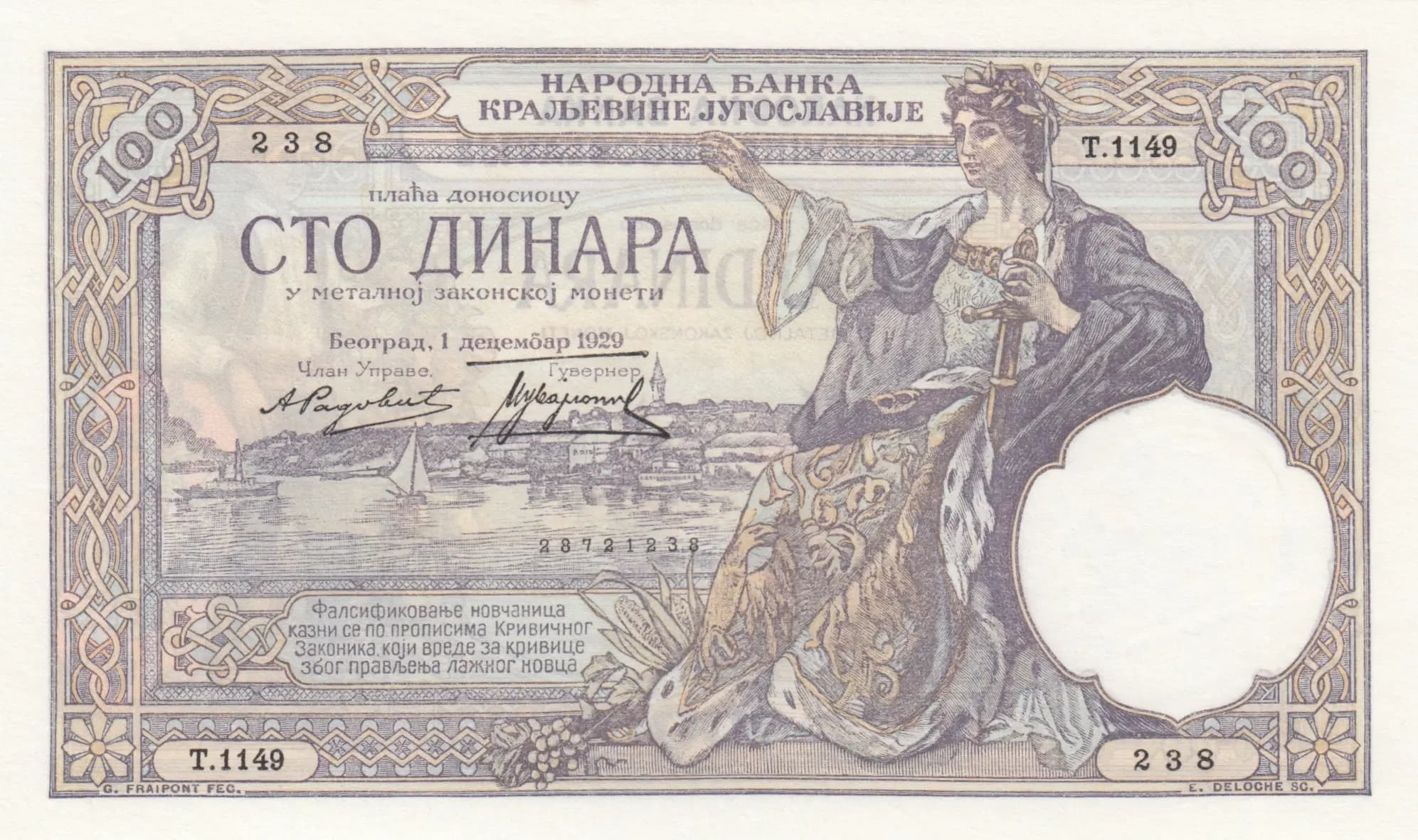
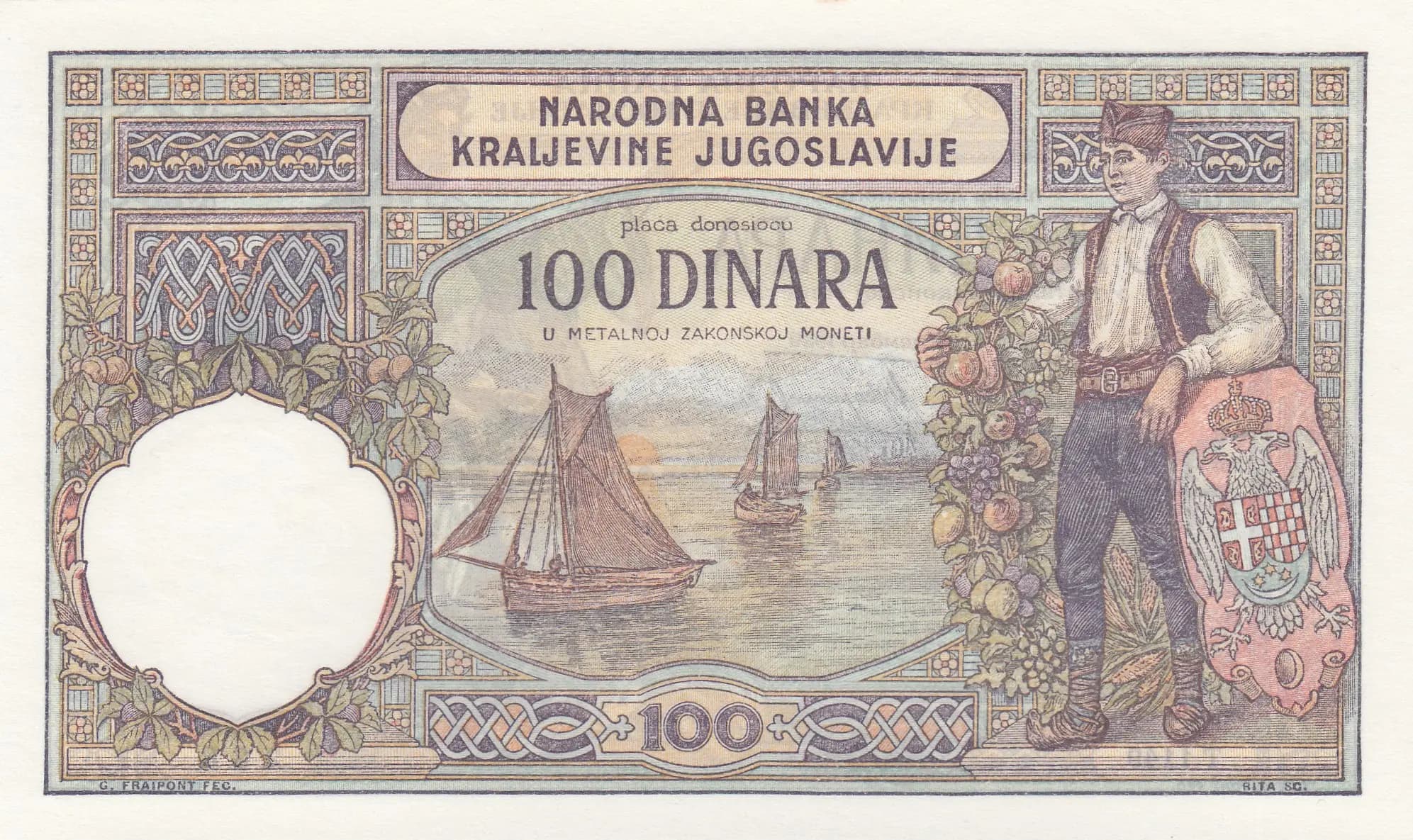
This is a beautifully preserved example of Yugoslavia's 100 dinara note from December 1, 1929, issued by the National Bank of the Kingdom of Yugoslavia. The note displays exceptional uncirculated condition with vibrant purple, gold, and cream coloring throughout, featuring allegorical figures representing Serbia and prosperity alongside maritime and agricultural imagery. The ornate geometric borders, clear inscriptions in Cyrillic and Latin scripts, and intact security features make this an attractive specimen for collectors of early Yugoslav currency.
Common. This is a standard circulation-issue note from the National Bank of the Kingdom of Yugoslavia, and the 1929 100 dinara denomination was produced in significant quantities for the period. The eBay price history provided demonstrates consistent availability at modest valuations—uncirculated examples have sold for as little as $2.76 to $20 in recent years, with most graded examples (PMG 64-67) selling in the $25-$150 range depending on grade. The large volume of auction transactions over the past 15+ years indicates robust supply in the secondary market. While this note is historically significant and aesthetically pleasing, it does not qualify as scarce or rare.
This note was issued during the early period of the Kingdom of Yugoslavia, just over a decade after the kingdom's formation in 1918 from the union of South Slavic territories. The front features a classical female allegory representing Serbia overlooking a waterfront cityscape (Belgrade), while the reverse depicts agricultural abundance (a man with fruits and grapes) alongside maritime commerce (multiple sailing vessels), symbolizing the economic foundations of the newly unified South Slavic state. The December 1, 1929 issue date places this note during a period of economic consolidation before the global financial crisis.
The front of the note features a classical female allegorical figure in flowing robes positioned on the right side, representing Serbia or the Serbian nation, holding a staff or scepter. The left-center vignette depicts Belgrade's waterfront cityscape with architectural structures visible across a body of water, with sailing boats present in the scene. The reverse features a classical male allegorical figure in traditional Slavic vest and dress, positioned on the right, holding abundant agricultural products including grapes, fruits, and wheat, symbolizing agricultural prosperity. The reverse's central vignette shows a dynamic maritime scene with multiple fully-rigged sailing vessels on open water, representing commercial maritime activity and trade. Both sides are framed by ornate geometric and floral border patterns in interlaced designs. A prominent coat of arms featuring a double-headed eagle with a shield bearing the Croatian checkerboard pattern (Šahovnica) appears on the reverse, emphasizing the multinational character of Yugoslavia. Large circular white areas on both sides serve as security features or watermark areas.
FRONT SIDE: 'НАРОДНА БАНКА КРАЉЕВИНЕ ЈУГОСЛАВИЈЕ' (National Bank of the Kingdom of Yugoslavia) / 'СТО ДИНАРА' (One Hundred Dinars) / 'у металној законској монети' (in metallic legal currency) / 'Београд, 1 децембар 1929' (Belgrade, December 1, 1929) / 'Члан Управе' (Board Member) / 'Guvernер' (Governor) / 'плаћа доносиоцу' (payable to bearer) / 'Фалсификување новчаница казни се по прописима Кривичног законика који важи за кривице због прављења лажног новца' (Counterfeiting banknotes is punished according to the provisions of the Criminal Code that applies to crimes of making counterfeit money) / Serial marks: 238, T.1149, 2872123 8. BACK SIDE: 'NARODNA BANKA KRALJEVINE JUGOSLAVIJE' (National Bank of the Kingdom of Yugoslavia, in Latin script) / 'placa donosiocn' (payable to bearer) / '100 DINARA' (100 Dinars) / 'U METALNOJ ZAKONSKOJ MONETI' (in metallic legal currency) / 'G. FRAIPORT FEC.' (G. Fraiport engraved/made this) / 'RIVA SC.' (Riva engraver/printer mark).
This note was produced using intaglio (engraved) printing, the standard security printing method for banknotes of this era. The fine line work visible in the decorative borders, the detailed rendering of the allegorical figures, and the crisp registration of colors (purple, gold/tan, cream, and gray) are characteristic of high-quality intaglio production. The engraver signatures 'G. FRAIPORT FEC.' and 'RIVA SC.' on the reverse indicate involvement of these craftsmen in the design and production process. The printer was likely a specialized European security printing house, consistent with Yugoslav banknote production practices of the period.
This note is cataloged as Pick P-27b, indicating a known variant within the 100 dinara 1929 series. The primary variety distinction relates to P-27a (issued by the Kingdom of Serbs, Croats and Slovenes on November 30, 1920) versus P-27b (issued by the National Bank of the Kingdom of Yugoslavia on December 1, 1929). The observed specimen clearly bears the December 1, 1929 date and displays the 'Narodna Banka Kraljevine Jugoslavije' issuer text, confirming its identity as P-27b. Serial number T.1149 and the number 238 with serial 2872123 8 are consistent with the standard printing run for this issue. No additional overprints or substitution marks are visible.