10 dinara 1965 specimen
Market Prices
3 salesAbout This Note
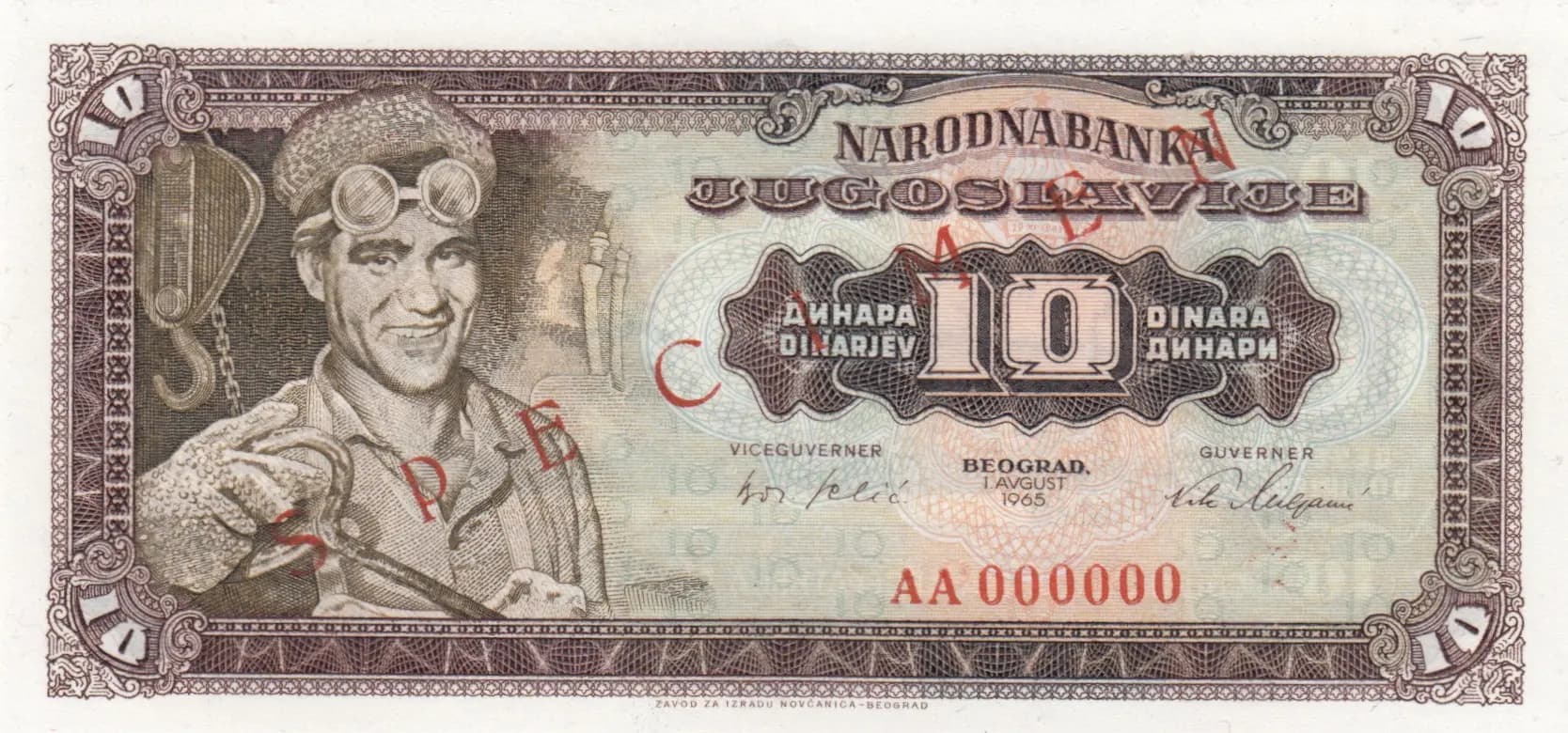
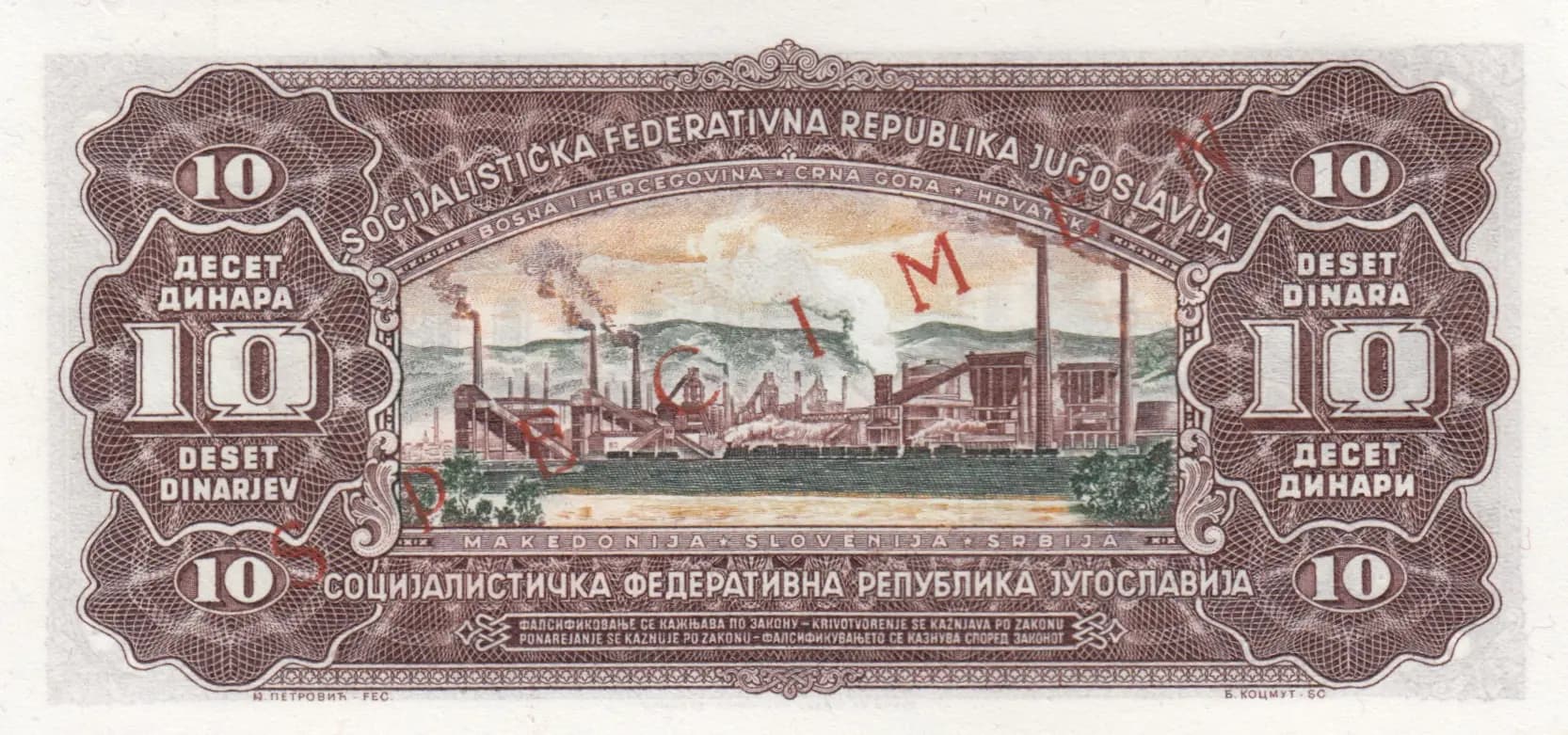
This is a striking 1965 Yugoslav 10 dinara specimen note featuring a portrait of steelworker Arif Heralić on the obverse and the Zenica steel mill on the reverse. The note displays excellent uncirculated condition with sharp, clear printing and vibrant brown and multicolor tones throughout, along with clearly visible red specimen markings ('P' and 'M'). As a specimen note from Yugoslavia's early socialist period, it represents an important transitional era in the country's monetary history and showcases the regime's emphasis on industrial labor and national pride.
Common. This is a specimen note from a standard series issued by a major central bank in significant quantities. The eBay transaction history shows multiple sales in the $14-41 range, with 2019 catalog values of $40 UNC, indicating steady but modest collector demand. Specimen notes from established series are regularly traded and widely available in the numismatic market. The lack of any documented scarcity, short print run, or recall history, combined with affordable market prices, indicates this variety is common.
Issued on August 1, 1965, by the National Bank of Yugoslavia (Narodna Banka Jugoslavije), this note reflects the socialist ideology of the Socialist Federal Republic of Yugoslavia under Josip Broz Tito. The depicted imagery—a steelworker and the Zenica steel mill—exemplifies the communist state's glorification of industrial labor and heavy manufacturing as symbols of national progress and modernization. The multilingual inscriptions in both Latin and Cyrillic scripts represent the federation's attempt to acknowledge its constituent republics (Serbia, Croatia, Bosnia and Herzegovina, Slovenia, Macedonia, and Montenegro).
The obverse features a portrait of Arif Heralić, a celebrated Yugoslav steelworker, positioned on the left side wearing work clothing with characteristic goggles pushed up on his forehead, depicted in a three-quarter facing view with a slight smile. The reverse showcases an industrial landscape scene of the Zenica steel mill complex in Bosnia, depicted with multiple smokestacks emitting smoke, factory buildings, and mountains in the background, symbolizing Yugoslavia's industrial development. Both sides are framed by elaborate ornamental borders featuring intricate scrollwork, filigree patterns, and decorative cartouches containing the denomination. The note measures 143 x 66mm and employs a predominantly brown color palette with multicolor underprinting in beige, tan, green (vegetation), and orange/yellow tones for the industrial scene. The serial number appears in the format 'AA 000000' as a specimen.
FRONT SIDE: 'Narodna Banka Jugoslavije' (National Bank of Yugoslavia) / '10 Dinara / Dinarjev' (10 Dinars, in multiple language variants) / 'Vicegovernер / Guverner' (Vice-Governor / Governor signatures) / 'Beograd' (Belgrade) / 'I Avgust 1965' (1 August 1965) / 'Zavod za Izradu Novčanica - Beograd' (Note Printing Works - Belgrade). BACK SIDE: '10 / Deset Dinara / Dinarjev' (10 / Ten Dinars, multiple variants) / 'Socijalistička Federativna Republika Jugoslavija / Социјалистичка Федеративна Република Југославија' (Socialist Federal Republic of Yugoslavia, Latin and Cyrillic) / 'Makedonija • Slovenija • Srbija / Босна и Херцеговина • Црна Гора • Хрватска' (Macedonia • Slovenia • Serbia / Bosnia and Herzegovina • Montenegro • Croatia) / 'Krivotvorenje se kažnjava po zakonu / Фалсификување се казнува по закону' (Counterfeiting is punishable by law, Latin and Cyrillic) / Printer and engraver marks.
Intaglio engraving combined with multicolor letterpress/offset printing, executed by the Zavod za Izradu Novčanica (Note Printing Works) in Belgrade. The visual analysis reveals sophisticated fine line work, detailed engraving throughout, and complex decorative patterns characteristic of security engraving from this period. The security features include intricate border patterns, fine line shading in the landscape scene, and ornamental cartouche designs. This is consistent with mid-1960s Yugoslav note production standards.
This is cataloged as Pick-78s, the 's' suffix indicating it is a specimen note (rather than a circulation issue, Pick-78). The specimen designation is confirmed by the visible red 'P' and 'M' markings across the note. The serial number format 'AA 000000' is typical of specimen notes. No significant varieties within the specimen classification are noted in available references, though signature varieties may exist among specimen printings. The issue date of 1 August 1965 is consistent with catalog records.