10 dinara 1941
Market Prices
3 salesAbout This Note
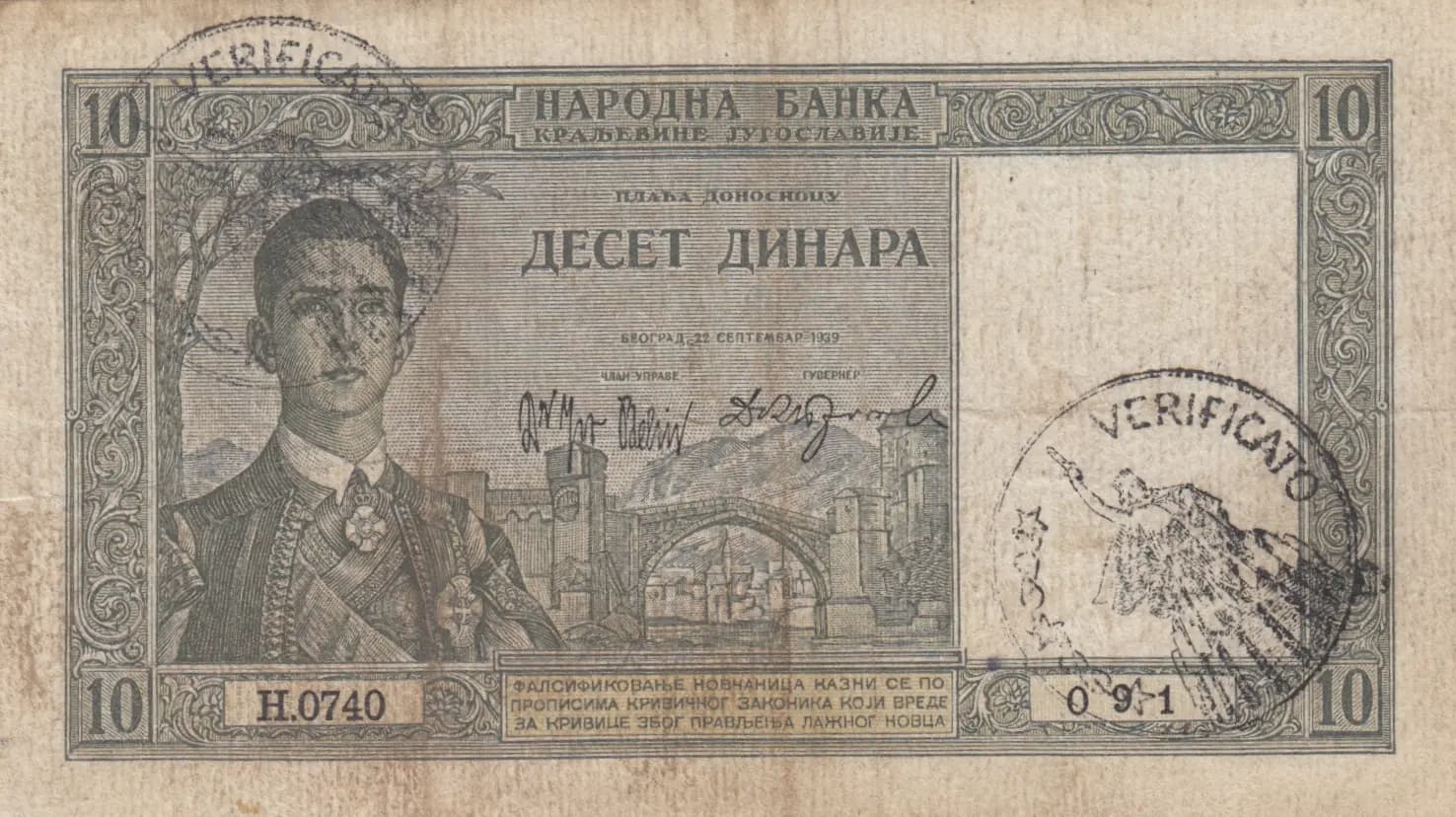
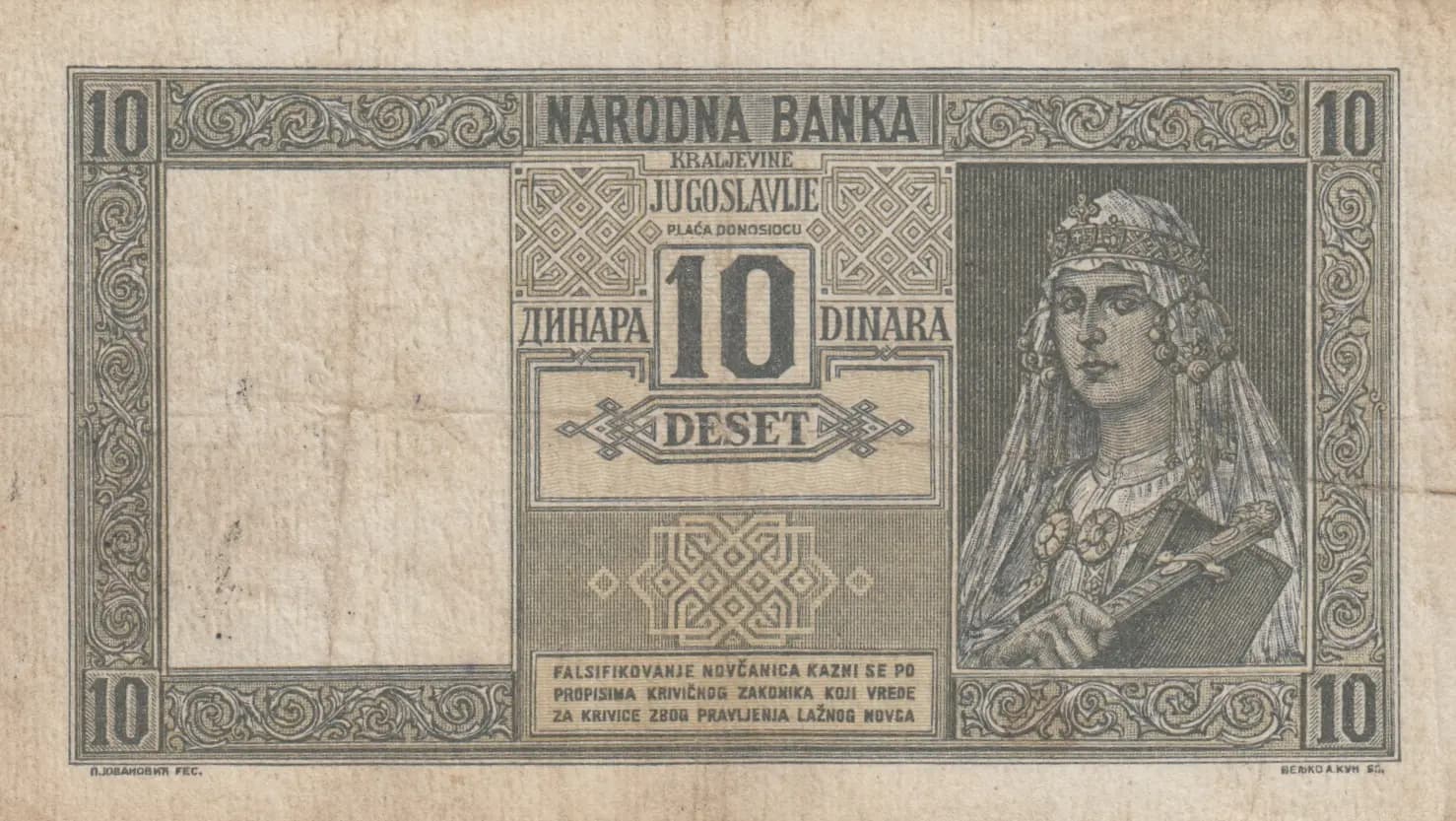
This is a 10 dinara banknote from 1941 issued by Italian Armed Forces occupying Yugoslavia, graded in Fair condition. The note features a military officer in formal dress uniform with medals on the obverse and a woman in traditional Yugoslav national costume on the reverse, both rendered in black and beige tones with ornate engraved borders. Despite visible aging, foxing, and circulation wear, the note retains clear inscriptions and fine engraved details characteristic of interwar Yugoslav currency design.
Common. The eBay transaction history shows regular sales at modest prices ($3.25-$7 for Fair/VF grades in recent decades), indicating steady supply and collector demand at low valuations. The 2008 catalog value of $4.50 for F-grade aligns with typical common banknote pricing. As a regional occupation currency issued in presumably substantial quantities during the 1941 Italian occupation period, this note was widely circulated and preserved, resulting in frequent availability in the numismatic market.
Issued during the 1941 Italian occupation of Yugoslavia following the April War, this banknote represents a transitional period when Italian military authorities administered currency in occupied territories. The front portrait likely depicts King Peter II or a Yugoslav military figure, while the reverse woman in national costume symbolizes Yugoslav cultural identity—imagery retained from the original 1939 National Bank design despite the occupying power's control. The September 22, 1939 date on the note indicates it was based on pre-war Yugoslav currency stock or design templates, later overprinted or utilized by Italian occupation authorities.
The obverse features a three-quarter portrait of a high-ranking military officer wearing formal dress uniform adorned with medals and decorations, positioned on the left side. The central vignette depicts a historic European cityscape with classical architecture, prominently featuring a building with an arched structure—likely representing Belgrade or another significant Yugoslav city. Ornate scrollwork borders with classical motifs frame the entire note, with heraldic eagles visible in the corners serving as nationalist symbols. The reverse displays a portrait of a woman in elaborate traditional Yugoslav folk costume with an ornate headdress, decorative veil, and beaded necklace, positioned on the right side. The center features the denomination '10' in a decorative cartouche surrounded by geometric patterns with interlocking diamond and lattice motifs reflecting traditional Yugoslav design elements. Both sides employ fine-line engraving with symmetrical classical borders.
FRONT: 'Narodna Banka Kraljevine Jugoslavije' (National Bank of the Kingdom of Yugoslavia); 'Piača Donosiocu' (Payable to Bearer); 'Deset Dinara' (Ten Dinars); 'Beograd, 22 Septembar 1939' (Belgrade, 22 September 1939); 'H.0740' (serial number); 'O'9-1' (reference designation); Warning text: 'Falsifikovanje novčanica kazni se po propisima krivičnog zakonika koji važi za kraljevine zbor pratiljenoga laičnog novca' (Counterfeiting banknotes is punished according to criminal code provisions applicable to the kingdom for currency counterfeiting crimes). BACK: 'Narodna Banka Kraljevine Jugoslavije' (National Bank of the Kingdom of Yugoslavia); 'Piača Donosiocu' (Payable to Bearer); 'Deset Dinara' (Ten Dinars); Similar counterfeiting warning; 'П. Јованович Фес.' (P. Jovanovic Fes.—engraver/artist signature); 'Берка и куд бл.' (Printing house information in Cyrillic).
Intaglio (engraved) printing on cotton-blend banknote paper, characteristic of interwar Yugoslav currency production. The fine parallel lines, intricate scrollwork, and detailed portraiture visible throughout are consistent with high-security steel-plate engraving. Based on the Cyrillic printer attribution and the period, this was likely produced by a Central European security printer, possibly Beršteiner & Co or similar Austro-Hungarian successors that supplied Yugoslav currency. The multiple engraved layers of borders and geometric patterns provided security through design complexity, standard for 1930s-40s era banknotes.
This note is cataloged as P-R10 (Pick catalog regional designation), indicating it is specifically the 1941 Italian occupation issue. The serial number prefix 'H.0740' and reference designation 'O'9-1' visible in the images represent the printer's batch coding. The engraver signature 'П. Јованович Фес.' (P. Jovanovic) appears on the reverse. Known varieties for this Pick number include different serial number prefixes and potentially different printer marks, though the visual analysis shows this to be a standard example. No overprints or extraordinary varieties are evident in the observed images.