10 dinara 1978
Market Prices
8 salesAbout This Note
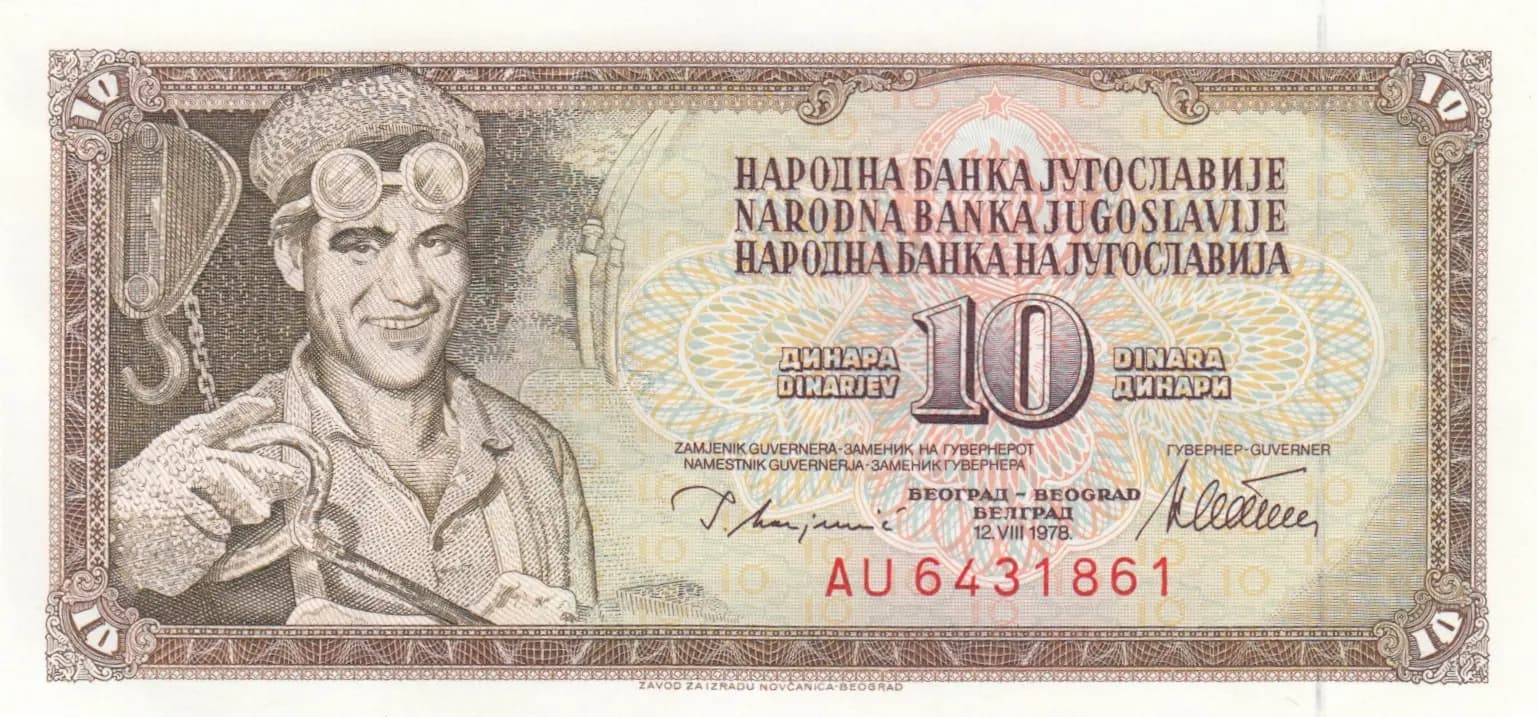
This is an exceptional example of the 1978 Yugoslav 10 dinara note (P-87a) in uncirculated condition, featuring a striking portrait of steelworker Arif Heralić wearing distinctive work goggles on his forehead. The note exhibits crisp, vibrant printing with no signs of wear, circulation, or handling, displaying the elaborate ornamental borders and fine engraved details characteristic of Yugoslav currency design. The multilingual inscriptions in Cyrillic and Latin scripts reflect Yugoslavia's federal structure during the socialist era.
Common. The 1978 10 dinara note is a regular issue from Yugoslavia's relatively long-lived socialist period. eBay market data shows multiple sales of this note in UNC condition at prices ranging from $0.99 to $1.90 (raw uncirculated examples), with even PMG-graded examples (PMG 65-66) selling for $9.58-$13.50. The 2019 catalog value for UNC condition is listed at $0.75. These modest prices and regular availability in the secondary market indicate this is a common circulation note with no scarcity premium.
Issued by the Narodna Banka Jugoslavije in 1978, this note commemorates the Yugoslav socialist state's celebration of workers and industrial achievement through the prominent depiction of steelworker Arif Heralić. The reverse inscription 'Socialistička Federativna Republika Jugoslavija' (Socialist Federative Republic of Yugoslavia) emphasizes the nation's federal socialist system, while the multilingual presentation in Serbian, Macedonian, and other variants reflects the republic's ethnic and linguistic diversity during the Tito era.
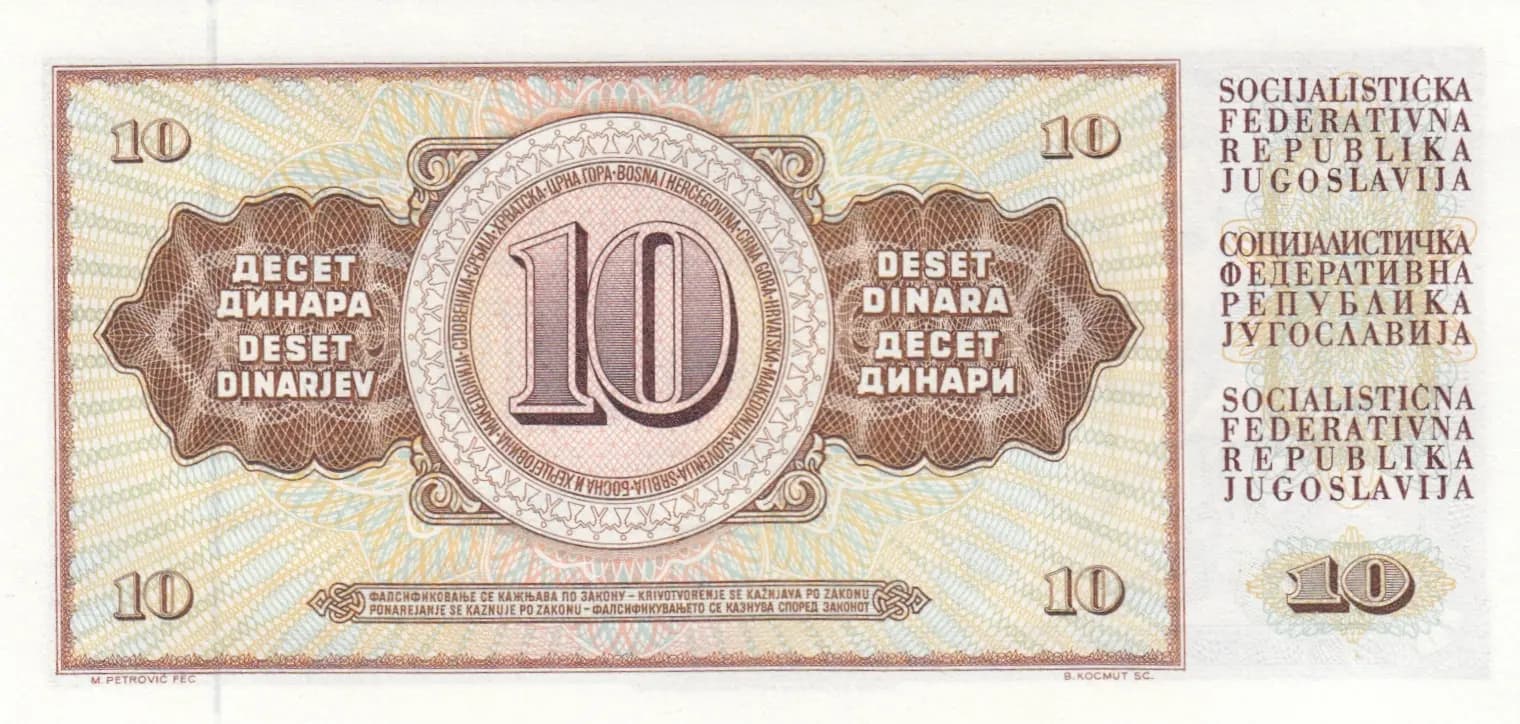
The obverse features a dignified three-quarter portrait of Arif Heralić, a prominent Yugoslav steelworker, positioned at the left side wearing work clothing with characteristic goggles resting on his forehead—a symbolic reference to his industrial labor. The portrait is rendered in fine engraved lines with sepia and brown tones against a cream and beige background. Elaborate ornamental borders with scrollwork and geometric patterns frame the entire note, featuring scalloped corner designs and intricate decorative bands. The denomination '10' appears prominently in the center-right area in decorative frames. The reverse displays a large circular medallion containing the numeral '10' surrounded by concentric decorative rings and elaborate ornamental frames on both left and right sides. The background features a fine mesh pattern in beige and cream with brown accents, creating a sophisticated, symmetrical design. All text appears in multiple language variants (Cyrillic Serbian, Latin Serbian, and Macedonian) reflecting Yugoslavia's federal structure.
FRONT SIDE: 'Narodna Banka Jugoslavije' / 'Народна Банка Југославије' (National Bank of Yugoslavia); 'Narodna Banka na Jugoslavija' / 'Народна Банка НА ЈУГОСЛАВИЈА' (Macedonian variant); 'Динара' / 'Динари' / 'Dinarjev' / 'Dinarov' (Dinars - various language forms); 'Zamjenik Guvernera' / 'Zamenik Gubernerja' (Vice Governor); 'Guberner' / 'Guverner' (Governor); 'Beograd' / 'Белград' (Belgrade); Date: '12.VIII.1978' (12 August 1978); Serial number: 'AU6431861'. BACK SIDE: 'Socialisticka Federativna Republika Jugoslavija' / 'Социјалистичка Федеративна Република Југославија' (Socialist Federative Republic of Yugoslavia); 'Sociјalистична Федеративна Република Југославија' (Macedonian variant); 'Deset Dinarja' / 'Десет Динара' / 'Десет Динари' / 'Deset Dinarjev' (Ten Dinars - various language forms); Artist/engraver credits: 'М. Петровић Феч' (M. Petrović Fech) and 'В. Космут' (V. Kosmut); Security warning: 'Falsifikovanje se kažnjava po zakonu' / 'Krivotvorjenje se kaznjava po zakonu' / 'Falsifikuvanjeto se kaznjava spored zakonot' (Counterfeiting is punishable by law).
This note was produced using traditional intaglio (engraving) printing by Zavod za Izradu Novčanica (Banknote Printing Works) in Belgrade, as was standard for Yugoslav currency of this era. The fine line work visible in the portrait, the intricate decorative borders, and the complex geometric patterns throughout are characteristic of high-security intaglio printing. The multicolor underprint and the fine mesh background patterns demonstrate advanced security printing techniques employed to prevent counterfeiting, with multiple engraved plates used to achieve the layered color effects.
This specific example is dated 12.VIII.1978 with serial number AU6431861. The Pick catalog lists both 1978 and 1981 dates for this design. The 'AU' serial number prefix and the specific signatures visible on this note (indicated by the two-line signature title at left) may represent a particular signature variety, though without access to comprehensive Serbian signature records, the specific signatory identities cannot be definitively determined from the visual analysis alone. The note represents the standard P-87a variety; P-87 variants typically differ by signature or printing authority rather than design changes.