10 dinara 1968
Market Prices
8 salesAbout This Note
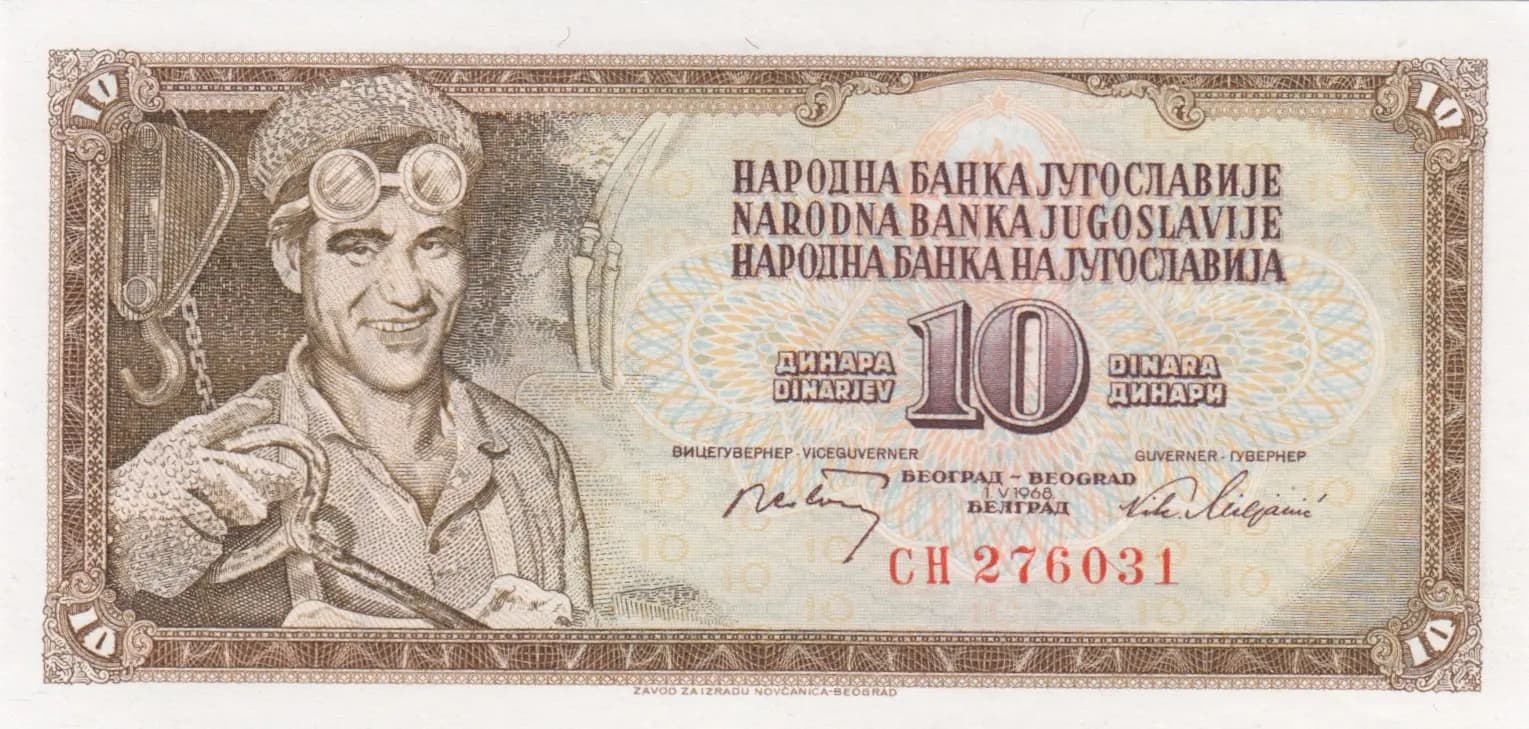
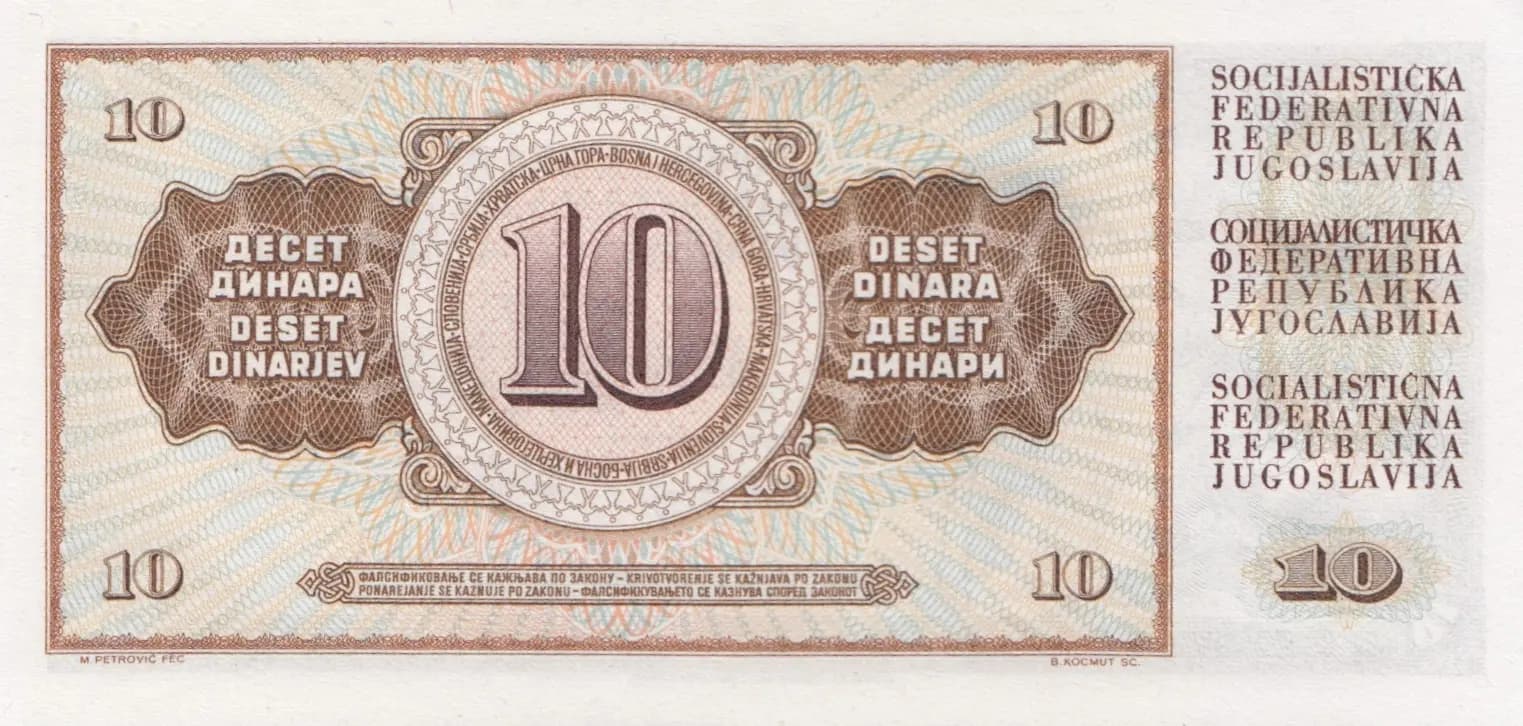
This is a striking 1968 Yugoslav 10 dinara note in uncirculated condition, featuring the iconic portrait of steelworker Arif Heralić on the obverse—a symbol of Yugoslav socialist industrial achievement. The note displays masterful fine-line engraving throughout with elaborate ornamental borders and period-appropriate color palette of brown and tan tones. The reverse showcases a prominent circular medallion containing the denomination, exemplifying the careful craftsmanship of Yugoslav state currency production during the height of Tito's socialist federation.
Common. The eBay price data provided shows UNC examples selling for $0.99 to $2.59 across 2013-2020, with even PMG 67 graded examples trading for $14.99-$30 in 2020-2023. Current catalogue values (2019) list UNC at $25, indicating a relatively modest collector value. As a regular-issue banknote from a major federal issuer with no indicated print-run restrictions or recall history, and given the sustained low market prices even in premium grades, this note is definitively common in the collector market.
Issued on 1 May 1968 (International Workers' Day) by the National Bank of Yugoslavia, this banknote deliberately celebrates socialist labor through its depiction of a steelworker, reflecting the Titoist regime's emphasis on industrial progress and the dignity of the working class. The trilingual inscriptions in Serbian (both Cyrillic and Latin) and Macedonian underscore Yugoslavia's federal structure as a multinational socialist state. The date 1966 appearing on the note (the engraving date) and the Belgrade printer attribution document the peak period of Yugoslav monetary stability under centralized national banking.
The obverse features Arif Heralić, a celebrated Yugoslav steelworker and symbol of socialist labor achievement, positioned on the left side wearing work clothing with goggles pushed up on his forehead and holding a tool. The portrait is rendered in fine engraved detail with naturalistic modeling. The right side displays large numerals '10' surrounded by ornamental cartouches containing denomination text in three languages, all enclosed within an elaborate scrollwork border with intricate corner ornaments typical of mid-20th century Central European currency design. The reverse centers on a prominent circular medallion housing the numeral '10' within a decorative border featuring a repeating geometric pattern. Denomination text appears in white on dark ornamental cartouches flanking the central medallion, with subtle wave-pattern background elements completing the design. The overall composition reflects the formal, carefully-composed aesthetic of Yugoslav state currency under the National Bank's design standards.
OBVERSE: 'Narodna Banka Jugoslavije' / 'Narodna Banka na Jugoslavija' (National Bank of Yugoslavia in Serbian and Macedonian); 'Dinamra' / 'Dinarjev' / 'Dinari' (Dinara/Dinars in three variants); '10' (denomination); 'Viceguverner' / 'Guverner' (Vice Governor/Governor titles); 'Beograd' / 'Belgrad' (Belgrade); '1966' (engraving date); 'Zavod za Izradu Novčanaca - Beograd' (Currency Production Plant - Belgrade); Serial number 'СН2760931'. REVERSE: 'Deset Dinara' / 'Десет Динара' / 'Десет Динари' (Ten dinars in Serbian Latin, Serbian Cyrillic, and Macedonian); '10' (denomination in ornamental medallion); 'Socijalistička Federativna Republika Jugoslavija' / 'Socialistička Federativna Republika Jugoslavija' (Socialist Federative Republic of Yugoslavia); 'М Петровић Јеч' / 'В. Космут Зг' (engravers M. Petrović Jech and V. Kosmut Zg); 'Falsifikovanje se kaznjava po zakonu' / 'Falsifikuvanye se kaznuva po zakonu' (Counterfeiting is punishable by law); 'Popravljanje se kaznuje po zakonu' / 'Popravjanye se kaznuvanye po zakonu' (Alteration is punishable by law).
Intaglio engraving (line engraving) on a multicolor underprint base, as evidenced by the fine-line patterns visible throughout both sides, the dimensional quality of the portrait rendering, and the intricate ornamental borders characteristic of security printing. Produced by the Zavod za Izradu Novčanaca (Currency Production Plant) in Belgrade, Yugoslavia's state security printer. The multicolor underprint technique combined with engraved overprinting was standard Yugoslav practice for this denomination and period.
Pick catalog P-82b designation indicates this is the 'b' variety variant. The visible serial number 'СН2760931' with Cyrillic prefix is consistent with Yugoslav serial number practices. The 1966 engraving date on a 1968-issued note is standard for this series. The visual analysis notes 'Serial number like number 80b,' confirming the P-82b classification. No overprints, security features variants, or signature variations are apparent. Similar later notes dated 1978 and 1981 are catalogued separately as P-87 per the external reference.