10 dinara 1944
Market Prices
19 salesAbout This Note
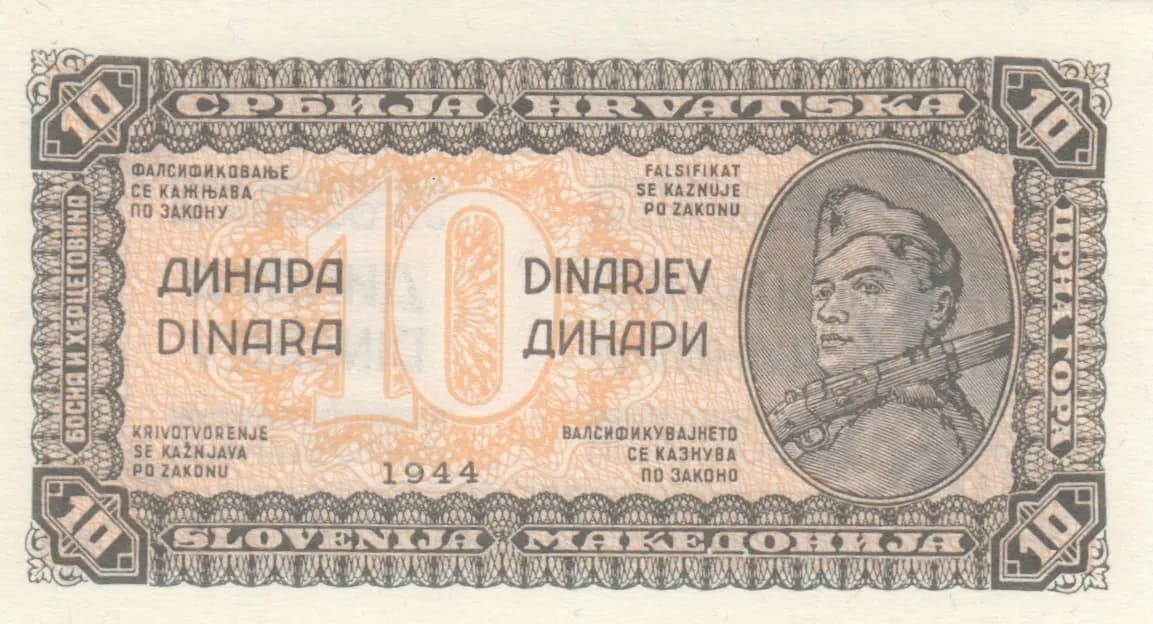
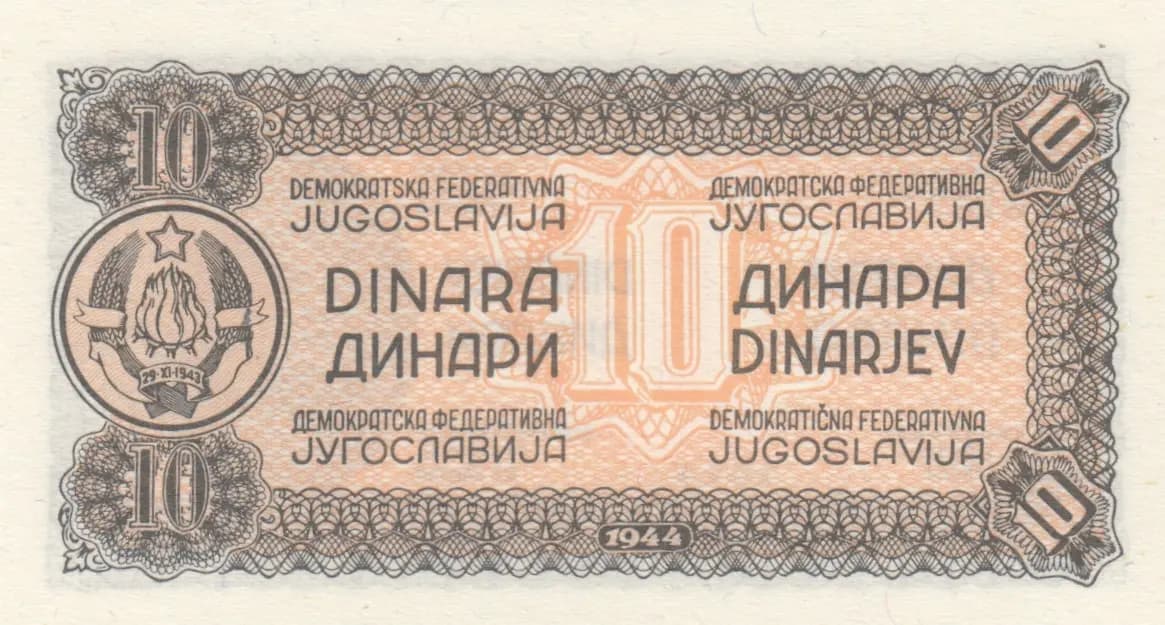
This is a pristine uncirculated example of the 1944 Yugoslav 10 dinara note (Pick P-50a), featuring a striking portrait of a Partisan soldier in military uniform on the obverse rendered in fine black engraving against an orange underprint. The reverse displays the circular coat of arms of the Democratic Federative Republic of Yugoslavia with a flame and star motif, dated 28 XI 1943, commemorating the establishment of the partisan government. The note exhibits exceptional condition with clean, even coloration, sharp definition, and no signs of circulation or aging.
Common. Historical eBay auction data shows consistent sales activity across multiple condition grades from 2013-2023, with UNC examples selling between $2.25 and $12.55, well within the range of common, frequently-traded banknotes. The 2016 catalog value of $25 for UNC condition is modest. The note was issued during an active period of currency circulation and no evidence suggests limited print runs or recalls. Despite its historical significance, circulation was sufficient to make examples readily available to collectors.
Issued in 1944 by the Democratic Federal Republic of Yugoslavia during the final stages of World War II, this banknote represents the currency of the Partisan-controlled territory under Josip Broz Tito. The portrait depicts a Partisan soldier—identified as Milivoje Rodić, who later became a colonel in the Yugoslav army—symbolizing the military struggle against Axis occupation. The reverse's date of 28 November 1943 marks the establishment of the Anti-Fascist Council of the Peoples' Liberation of Yugoslavia (AVNOJ), the wartime legislative body that would form the basis of the post-war socialist state.
The obverse features an ornate engraved border with repeating geometric and decorative patterns framing the composition. The denomination '10' appears in large numerals in orange/tan color positioned in the center-left and upper-right corners. The dominant visual element is a three-quarter portrait of Milivoje Rodić, a Partisan military officer, depicted in profile facing left wearing a military cap and uniform, rendered in black and white fine-line engraving characteristic of high-quality currency production. The reverse mirrors the decorative border treatment and features a circular coat of arms centered on the left side, displaying a torch or flame symbol with a five-pointed star above it, incorporating the date '28 XI 1943' below the emblem. Both sides employ dual-script typography in Cyrillic and Latin characters, reflecting Yugoslavia's multilingual federation including Serbian, Macedonian, and other South Slavic languages.
FRONT: 'DINARA' (Serbian Latin) / 'ДИНАРА' (Serbian Cyrillic) - Dinara (singular); 'DINARJEV' (Serbian Latin) / 'ДИНАРИ' (Serbian Cyrillic) - Dinars (plural); 'FALSIFIKOVANJE СЕ КАЗЊАВА ПО ЗАКОНУ' (Serbian Cyrillic) / 'FALSIFIKAT SE KAZNJUJE PO ZAKONU' (Serbian Latin) / 'KRIVOTVORENJE SE KAZNJAVA PO ZAKONU' (Serbian Latin) / 'VALŠIFIKOVANJE СЕ КАЗНУВА ПО ЗАКОНУ' (Serbian/Macedonian Cyrillic) - All variants meaning 'Counterfeiting is punished by law'; '1944' - Year of issue; 'SLOVENIJA MAKEDONIJA' - Slovenia Macedonia. BACK: 'DEMOKRATSKO FEDERATIVNO JUGOSLOVIJA' (Serbian Latin) / 'ДЕМОКРАТСКО ФЕДЕРАТИВНА ЈУГОСЛАВИЈА' (Serbian Cyrillic) - Democratic Federative Yugoslavia; 'DINARA' / 'ДИНАРА' and 'DINARJEV' / 'ДИНАРИ' - Dinara/Dinars; '28 XI 1943' - Date of AVNOJ establishment; '1944' - Year of issue.
Steel engraving (intaglio printing), the standard method for high-security currency of the period. The fine line work visible in the decorative borders, the detailed portrait engraving, and the ornate corner ornaments are characteristic of engraved plates. The precise registration and uniform color application indicate professional security printer production, consistent with government-issued wartime currency of Yugoslavia.
Pick P-50a represents the standard 1944 issue of the 10 dinara note of the Democratic Federal Republic of Yugoslavia. No variations in serial number prefixes, printer marks, or significant overprints are apparent from the visual analysis. The dual-script inscriptions (Cyrillic and Latin) represent the standard design accommodating Yugoslavia's federated republics. The date '28 XI 1943' on the reverse is a fixed design element, not a variable date, marking the constitutional establishment of the AVNOJ government.