1 lira 1944
Market Prices
3 salesAbout This Note
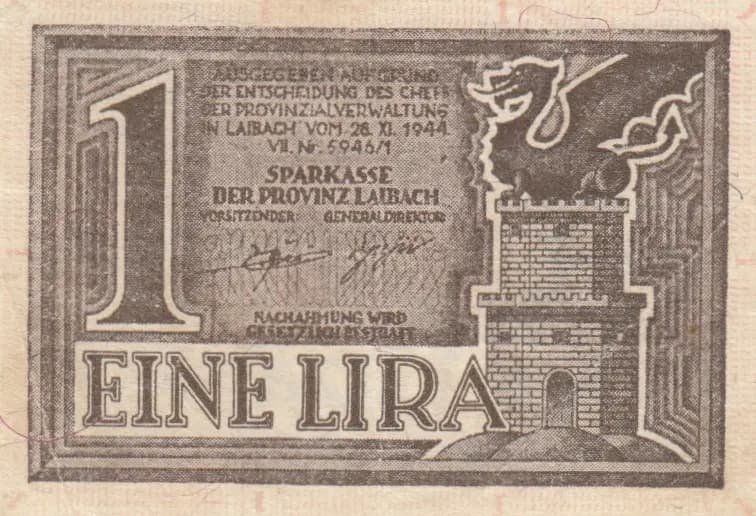
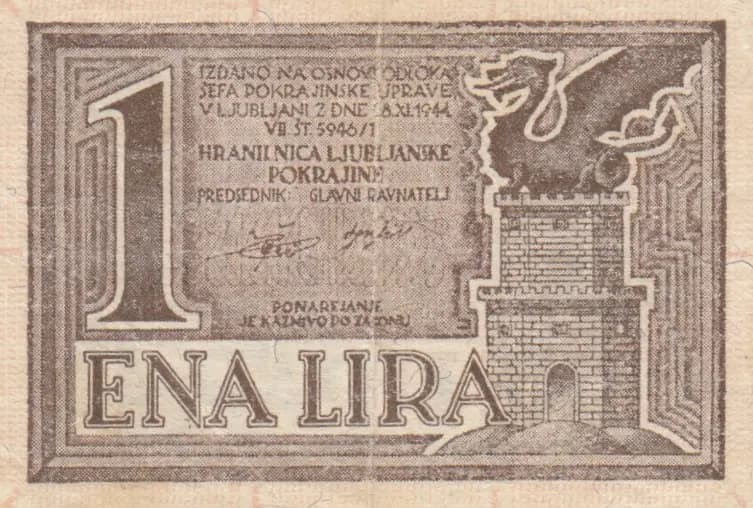
This is a 1 Lira regional banknote issued by Hranilnica Ljubljanske Pokrajine (Ljubljana Provincial Savings Bank) in 1944, graded EF. The note features a distinctive fortified tower illustration on the right side and displays text in both German and Slovenian, reflecting the complex political situation of Ljubljana during WWII. Despite visible aging with foxing and creasing typical of 1940s currency, the note retains good definition in its ornate border design and fine line work.
Common. This regional banknote from occupied Slovenia was issued in sufficient quantities for circulation and survives readily in the collector market. eBay transaction data supports this assessment, with comparable examples in EF condition selling for approximately $34-62 in recent years, and catalog values from 2008 listing EF at only $6. The note was not recalled or produced in limited quantities, and multiple specimens appear regularly in the secondary market.
This banknote was issued during the Nazi occupation of Slovenia (the Provinces of Ljubljana), when the region was administered as a German protectorate. The dual-language inscriptions—German and Slovenian—reflect the occupying regime's administrative structure, with the German version (Sparkasse der Provinz Laibach) and Slovenian version (Hranilnica Ljubljanske Pokrajine) appearing on the same note. The fortified tower likely represents a regional landmark significant to Ljubljana's identity, while the June 28, 1944 issuance date places this note in the final year of WWII occupation.
The 1 Lira note features a classical design dominated by a large serif numeral '1' positioned on the left side. The primary design element is a fortified tower with crenellations and castle-like architecture rendered on the right portion of the note, likely representing a defensive structure associated with Ljubljana or the Slovenian region. Ornamental flourishes and curved decorative elements occupy the top right corner, while a comprehensive decorative border frame surrounds the entire note. The design employs fine line work throughout, characteristic of security printing of the period. The note is printed in brown, tan, and beige tones with black ink for inscriptions, giving it the aged patina typical of 1940s currency. No portraits appear on this note; instead, the emphasis is on architectural and ornamental design elements that reflect the regional administrative character of the issuer.
FRONT (German version): 'SPARKASSE DER PROVINZ LAIBACH' (Savings Bank of the Province of Ljubljana); 'EINE LIRA' (One Lira); 'AUSGEGEBEN AUF GRUND DER ENTSCHEIDUNG DES CHEFS DER PROVINZIALVERWALTUNG IN LAIBACH VON 28.VI.1944 VI.NR. 5946/4' (Issued on the basis of the decision of the Chief of Provincial Administration in Ljubljana of 28.VI.1944 VI.No. 5946/4); 'LEITER DER GENERALDIREK' (Director of General Administration); 'NACHAHMUNG WIRD STRAFBAR' (Counterfeiting will be punished). FRONT (Slovenian version): 'HRANILNICA LJUBLJANSKE POKRAJINE' (Ljubljana Provincial Savings Bank); 'ENA LIRA' (One Lira); 'IZDANO NA OSNOVI ODLOKE SEFA POKRAJINSKE UPRAVE V LJUBLJANI Z DNE AXII.1944 VII.ST. 5946/1' (Issued on the basis of the decision of the Chief of Provincial Administration in Ljubljana from AXII.1944 VII.No. 5946/1); 'PREDSEDENIK GLAVNI RAVATELI' (President Main Administrator); 'PONAREJANIT JE KAZNOVANIO' (Counterfeiting is punishable).
This note was produced using letterpress/intaglio printing techniques, as evidenced by the crisp, fine line work visible in the border decorations and ornamental elements. The consistent tone in the tower illustration and the precise serif typography indicate professional security printing standards of the 1940s era. The printer for this specific Pick number (P-R17) is not definitively identified in standard references, but production would have been under German occupation authorities.
Two distinct varieties are documented for this denomination: a German-language version (Sparkasse der Provinz Laibach) and a Slovenian-language version (Hranilnica Ljubljanske Pokrajine). Both varieties feature identical design elements but with inscriptions in their respective languages, reflecting the bilingual administrative structure of the occupied territory. The issue decree date format varies slightly between versions (VI.NR. 5946/4 for German, VII.ST. 5946/1 for Slovenian), suggesting separate print runs or administrative registrations. The Slovenian variety may be slightly more desirable to collectors of Yugoslav and regional currency.