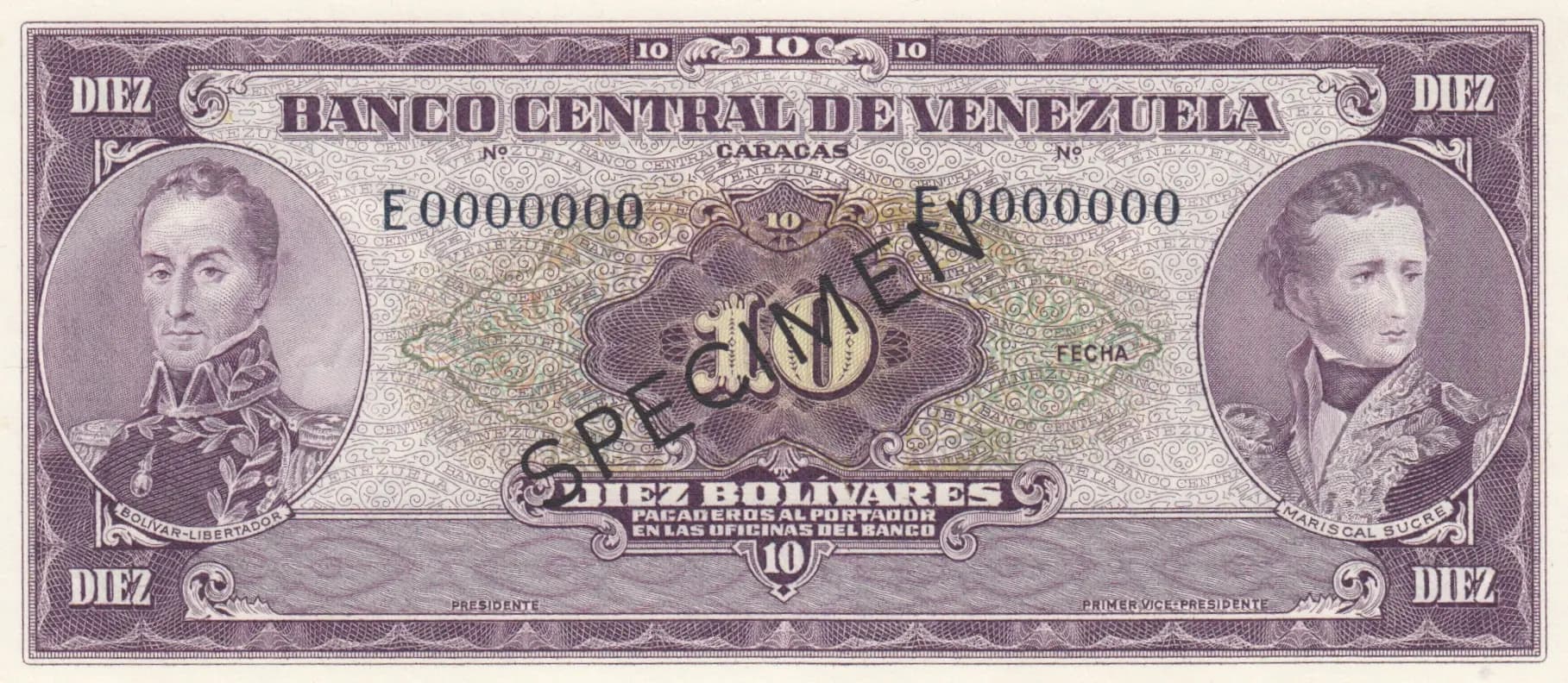
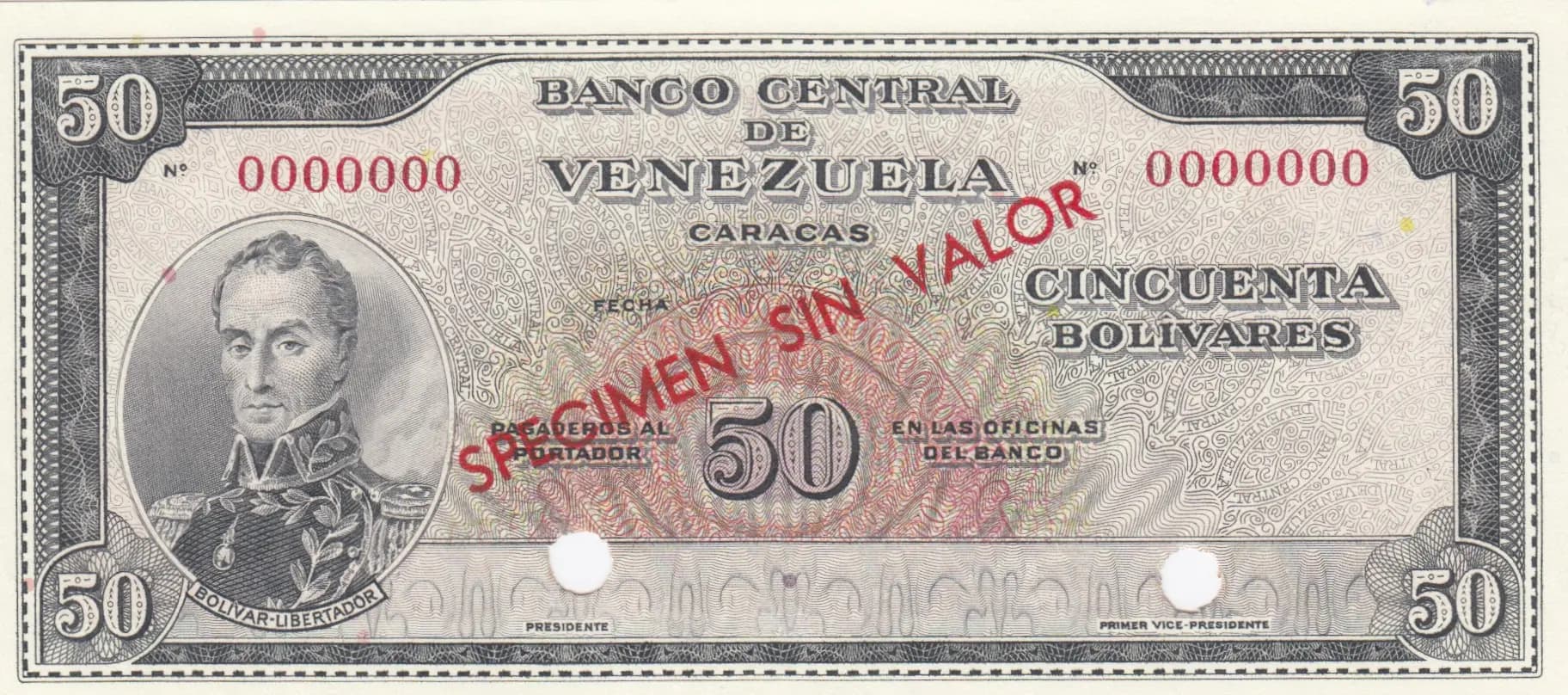
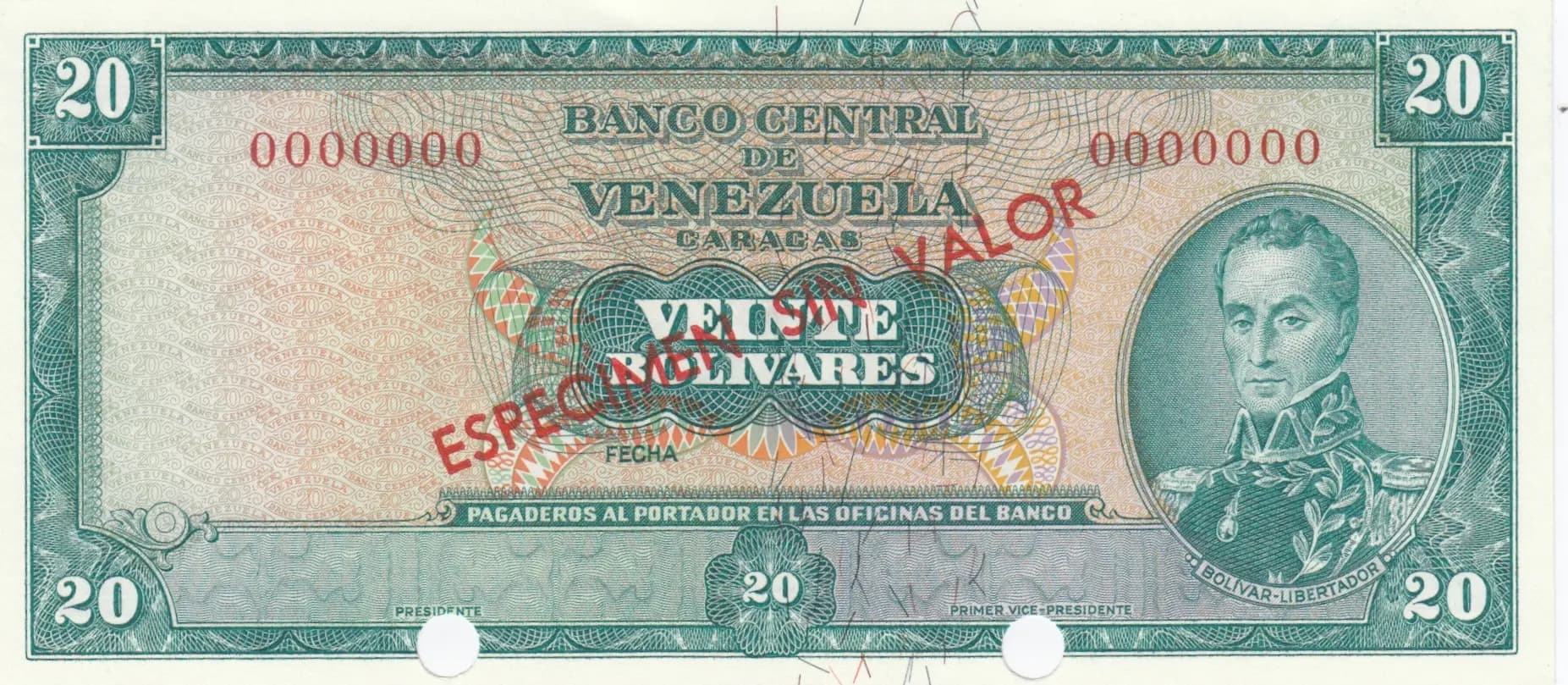
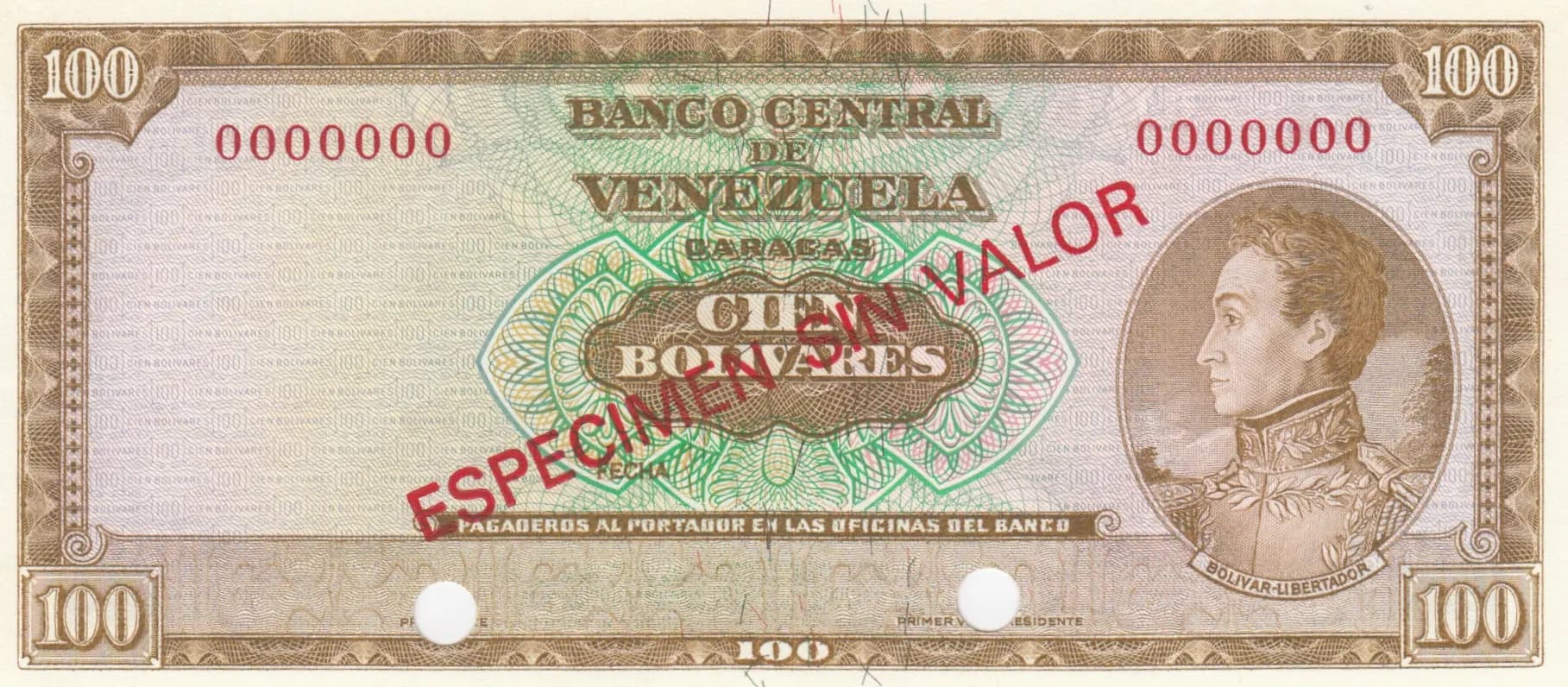
50 bolivares 1972 specimen
Market Prices
1 saleAbout This Note
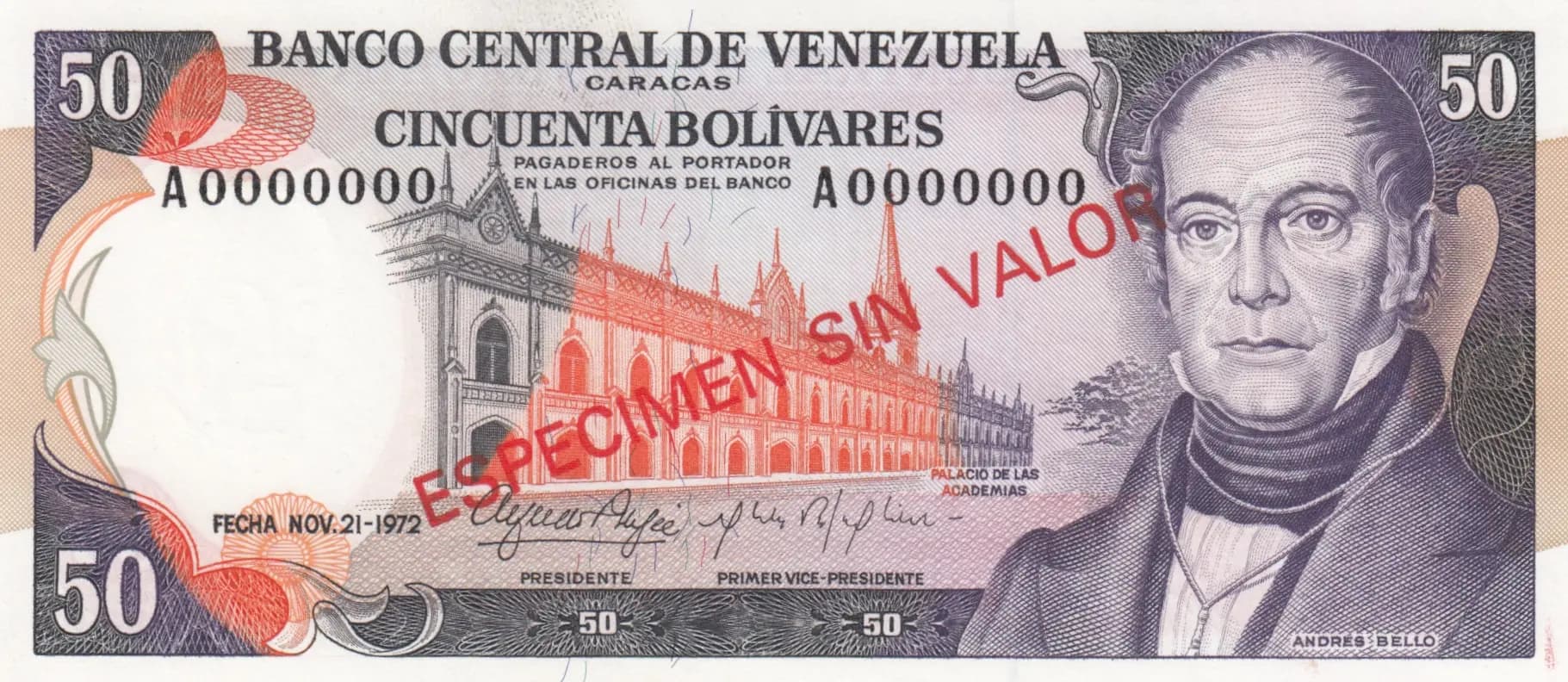
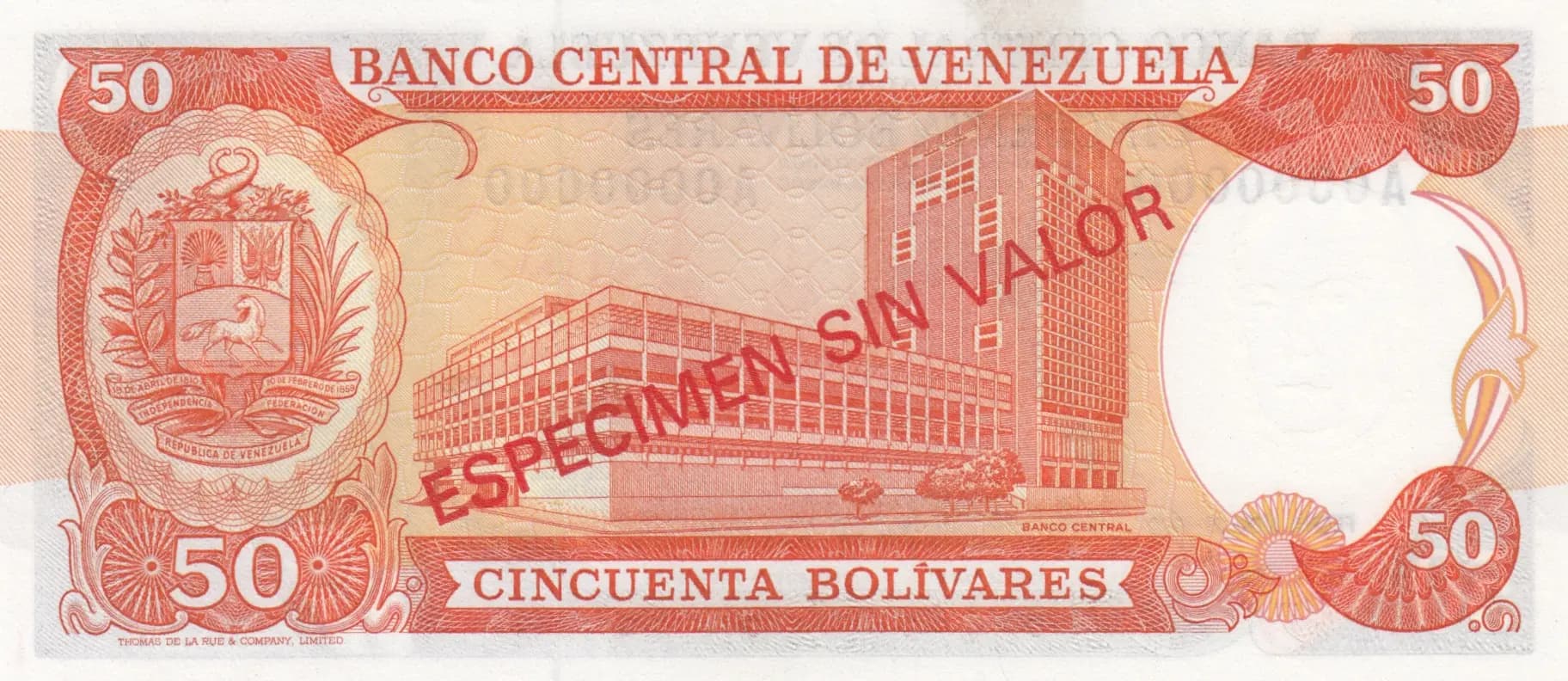
A Venezuelan 50 Bolívares specimen banknote from November 21, 1972, printed by Thomas de la Rue in uncirculated condition. This note features a striking purple, orange, and multicolor design with a portrait of Andrés Bello on the right and the Palacio de las Academias dominating the center, while the reverse displays Venezuela's coat of arms and the Central Bank building. The red diagonal 'ESPECIMEN' overprint confirms this as a specimen issue, making it a non-circulating promotional example from the Banco Central de Venezuela.
Common. This specimen note carries catalog values of $15 UNC according to 2019 numismatic pricing guides, and eBay market data shows similar circulated examples (VF grade) selling for approximately $1-4 in recent transactions. The print run for this standard issue was substantial, and specimen examples, while not circulated, were produced in reasonable quantities for banking and promotional purposes. No evidence of scarcity, recall, or limited availability exists for Pick P-54as.
This 1972 banknote was issued during a period of economic stability in Venezuela under the administration of President Carlos Andrés Pérez, whose term (1969-1974) coincided with oil revenue growth. The note honors Andrés Bello, the renowned Venezuelan intellectual and founding rector of the Universidad de Chile, whose portrait appears alongside the Palacio de las Academias—a symbol of Venezuela's cultural and educational institutions. The inclusion of the newly modernized Central Bank building on the reverse reflects Venezuela's institutional development during this era of petroleum-driven prosperity.
The obverse features a formal portrait of Andrés Bello (1781-1865), the Venezuelan philosopher, poet, and statesman, rendered in purple-toned engraving in three-quarter profile facing left, dressed in 19th-century formal attire with high collar. The central focal point is the Palacio de las Academias (Palace of the Academies) in Caracas, depicted as an ornate neoclassical building with multiple spires and architectural details, symbolizing Venezuela's commitment to education and culture. Decorative floral motifs in orange and red appear on the left margin, with shell-like ornamental patterns in the corners. The reverse displays the National Coat of Arms of Venezuela prominently on the left, featuring a horse at the top and divided sections containing agricultural symbols (wheat), national flag elements, and laurel wreaths, signifying national sovereignty and prosperity. The Central Bank building is rendered in the center-right as a modern multi-story administrative structure in architectural line drawing style. The color scheme transitions from purple and dark blue on the obverse to predominantly orange, red, and cream tones on the reverse.
FRONT SIDE: 'Banco Central de Venezuela' (Central Bank of Venezuela), 'Caracas' (city name), 'Cincuenta Bolívares' (Fifty Bolivares), 'Pagaderos al Portador en las Oficinas del Banco' (Payable to bearer at the bank offices), 'Fecha Nov. 21-1972' (Date November 21, 1972), 'Palacio de las Academias' (Palace of the Academies), 'Andrés Bello' (historical figure name), 'Presidente' (President), 'Primer Vice-Presidente' (First Vice-President), 'Especimen' (Specimen), serial number 'A 0000000', denomination '50'. BACK SIDE: 'Banco Central de Venezuela' (Central Bank of Venezuela), 'Cincuenta Bolívares' (Fifty Bolivares), 'Banco Central' (Central Bank), 'Thomas de la Rue & Company, Limited' (printer attribution), 'Especimen' (Specimen), denomination '50'.
Intaglio (engraved) banknote printing executed by Thomas de la Rue & Company, Limited, London. The fine line engraving is evident throughout both sides, particularly visible in the detailed portrait of Andrés Bello, the intricate architectural rendering of the Palacio de las Academias and Central Bank building, and the complex heraldic work of the coat of arms. The multicolor printing employs separate plates for different color zones (purple, orange, red, blue), a standard technique for security banknotes of this era. The precise registration and crisp line definition are characteristic of de la Rue's work during the 1970s.
This is cataloged as Pick P-54as, the specimen variant of the standard P-54 issue. The specimen designation is confirmed by the red diagonal 'ESPECIMEN' overprint visible on both sides and the serial number format showing repeating zeros (A 0000000), which is standard for specimen notes. The printer attribution 'Thomas De La Rue & Company, Limited' is inscribed on the reverse. Serial number prefix 'A' is noted in the catalog data. The issue date of November 21, 1972 is printed on the obverse. No significant varieties are documented for this Pick number beyond standard specimen vs. circulating issue distinctions.