10 bolivares 1961 specimen
Market Prices
About This Note
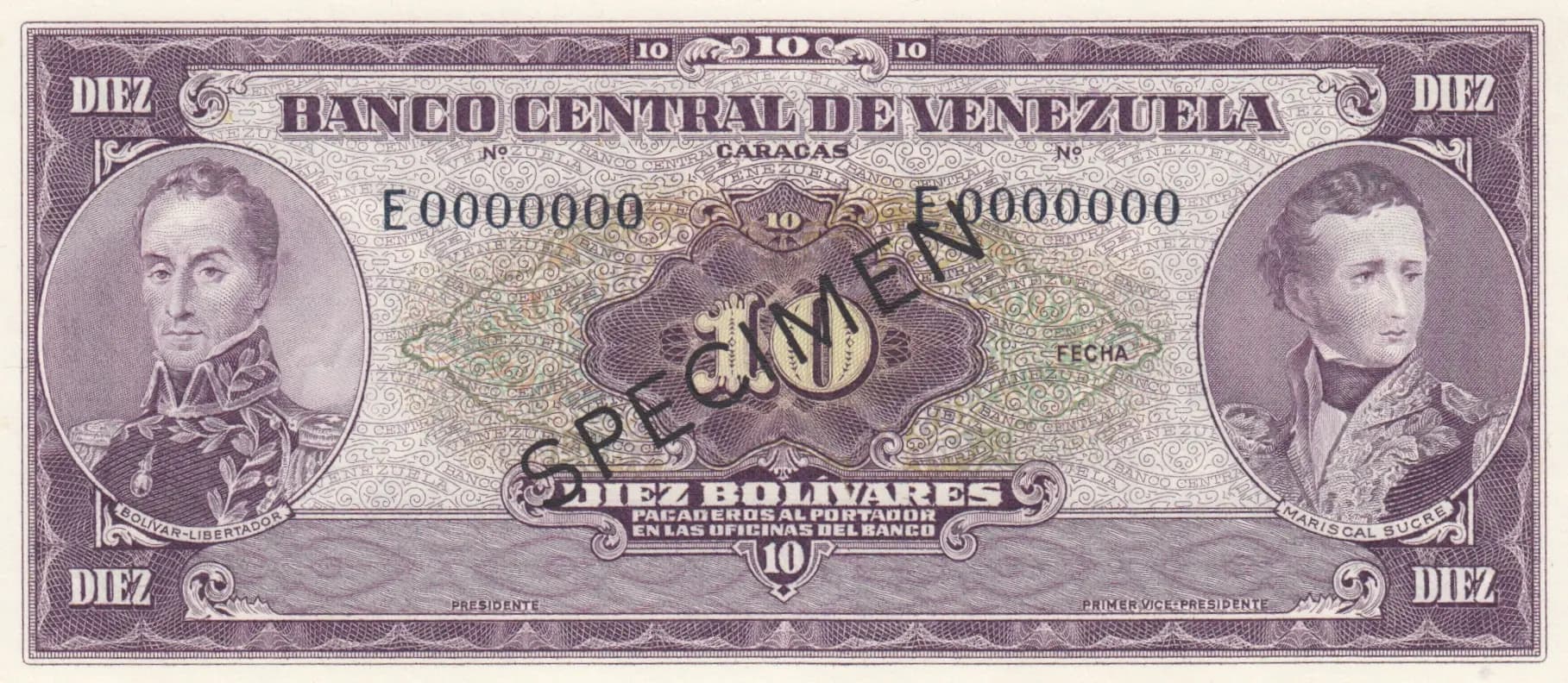
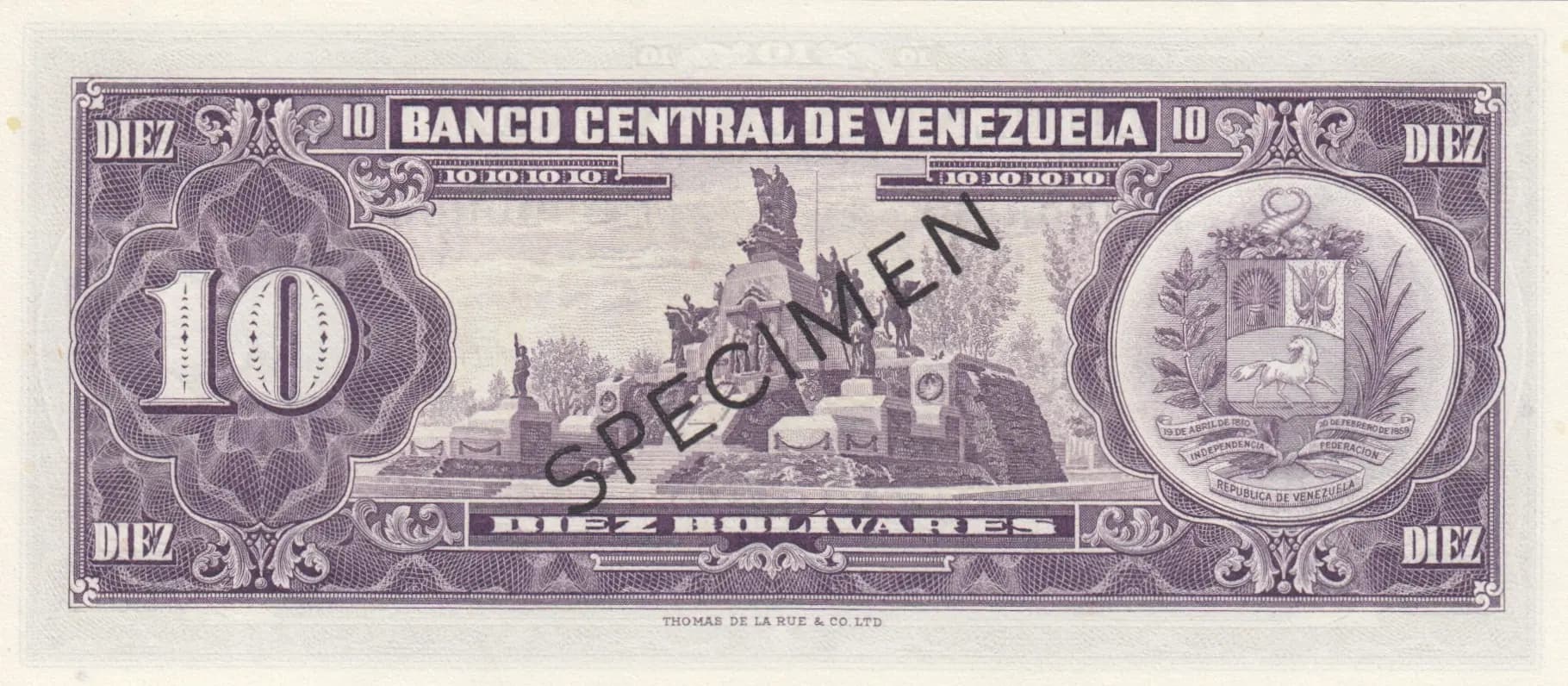
This is a 1961 Venezuelan 10 Bolívares specimen note (Pick P-42s) in uncirculated condition, featuring the iconic purple/mauve color scheme characteristic of this issue. The note displays dual portraits of Simón Bolívar (left) and Antonio José de Sucre (right) on the obverse, with a commemorative monument scene on the reverse—all rendered in fine intaglio detail by Thomas De La Rue. The black diagonal 'SPECIMEN' overprint confirms this as a non-circulating proof or sample note, making it a desirable item for collectors of Venezuelan currency and historical banking artifacts.
Common. While this is a specimen note (a non-circulating proof), specimen versions of standard-issue banknotes are typically produced in reasonable quantities for archival and distribution purposes and are not inherently rare. The eBay market data provided shows significant price variation ($0.99 to $453.38 USD for UNC grades), indicating an oversupplied secondary market with many examples in circulation among collectors. The 2019 catalog value of $12.50 USD for UNC specimens is modest. The widespread availability of this note in numismatic channels and the low floor prices confirm it as a common specimen issue rather than a scarce or rare variety.
This note was issued by the Banco Central de Venezuela on June 6, 1961, during a period of relative economic stability in Venezuela following the end of the Pérez Jiménez dictatorship. The dual portraits honor Simón Bolívar (the Libertador who freed northern South America) and Antonio José de Sucre (his trusted marshal and successor), reflecting the nation's pride in its independence legacy. The reverse depicts the Monument to the Motherland at the Carabobo Fields, commemorating the 1821 Battle of Carabobo, a crucial victory in Venezuela's war of independence—imagery that reinforced national identity during this transitional democratic period.
The obverse features a symmetrical design with two prominent portrait medallions in oval frames: Simón Bolívar (1783–1830), the Libertador and founding figure of multiple South American republics, on the left in high-collared military uniform; and Antonio José de Sucre (1795–1830), Bolívar's most capable general and first president of Bolivia, on the right in formal military dress. The center contains ornamental scrollwork and the denomination '10' in multiple locations. The reverse depicts the Monument to the Motherland (Monumento a la Patria) at the Carabobo Fields near Valencia, Venezuela—a significant historical landmark commemorating the crucial 1821 battle that secured Venezuelan independence. The Venezuelan coat of arms appears in a heraldic circular frame on the right side of the reverse. The entire design employs elaborate intaglio engraving with fine decorative borders, scrollwork, and line work throughout.
FRONT: 'BANCO CENTRAL DE VENEZUELA' (Central Bank of Venezuela), 'CARACAS' (city location), 'DIEZ BOLIVARES' (Ten Bolivares), 'BOLIVAR-LIBERTADOR' (Bolívar the Liberator), 'MARICAL SUCRE' (Marshal Sucre), 'PAGADEROS AL PORTADOR EN LAS OFICINAS DEL BANCO' (Payable to bearer at the bank offices), 'PRESIDENTE' (President), 'PRIMER VICE-PRESIDENTE' (First Vice-President), 'FECHA' (Date), 'DIEZ' (Ten), 'SPECIMEN' (Specimen—non-circulating). BACK: 'BANCO CENTRAL DE VENEZUELA' (Central Bank of Venezuela), 'REPUBLICA DE VENEZUELA' (Republic of Venezuela), 'DIEZ BOLIVARES' (Ten Bolivares), 'DIEZ' (Ten), 'THOMAS DE LA RUE & CO LTD' (printer attribution), 'SPECIMEN' (Specimen—non-circulating).
Intaglio (line engraving) printing executed by Thomas De La Rue & Co Ltd of London, the world's premier security banknote printer of the era. The fine detail work visible in the portrait medallions, the monument scene, the coat of arms, and the ornate scrollwork throughout the note are characteristic of high-security intaglio production. The black 'SPECIMEN' overprint was applied after printing as a standard security measure for non-circulating proof notes.
This is cataloged as Pick P-42s (specimen variant). The visual analysis confirms the characteristic features of this variety: the Series E-J designation, the 7-digit serial number with 'E' prefix (visible as 'E0000000' on specimen examples), the black diagonal 'SPECIMEN' overprint, and printer attribution to Thomas De La Rue & Co Ltd. The note exhibits the purple/mauve color scheme and dual-portrait design consistent with the standard P-42 issue. No evidence of further sub-varieties (such as signature variants) is apparent from the specimen note's standardized format. PMG records indicate P-42a as a cataloged variant, though the relationship between P-42s (specimen) and P-42a is not detailed in the available data.