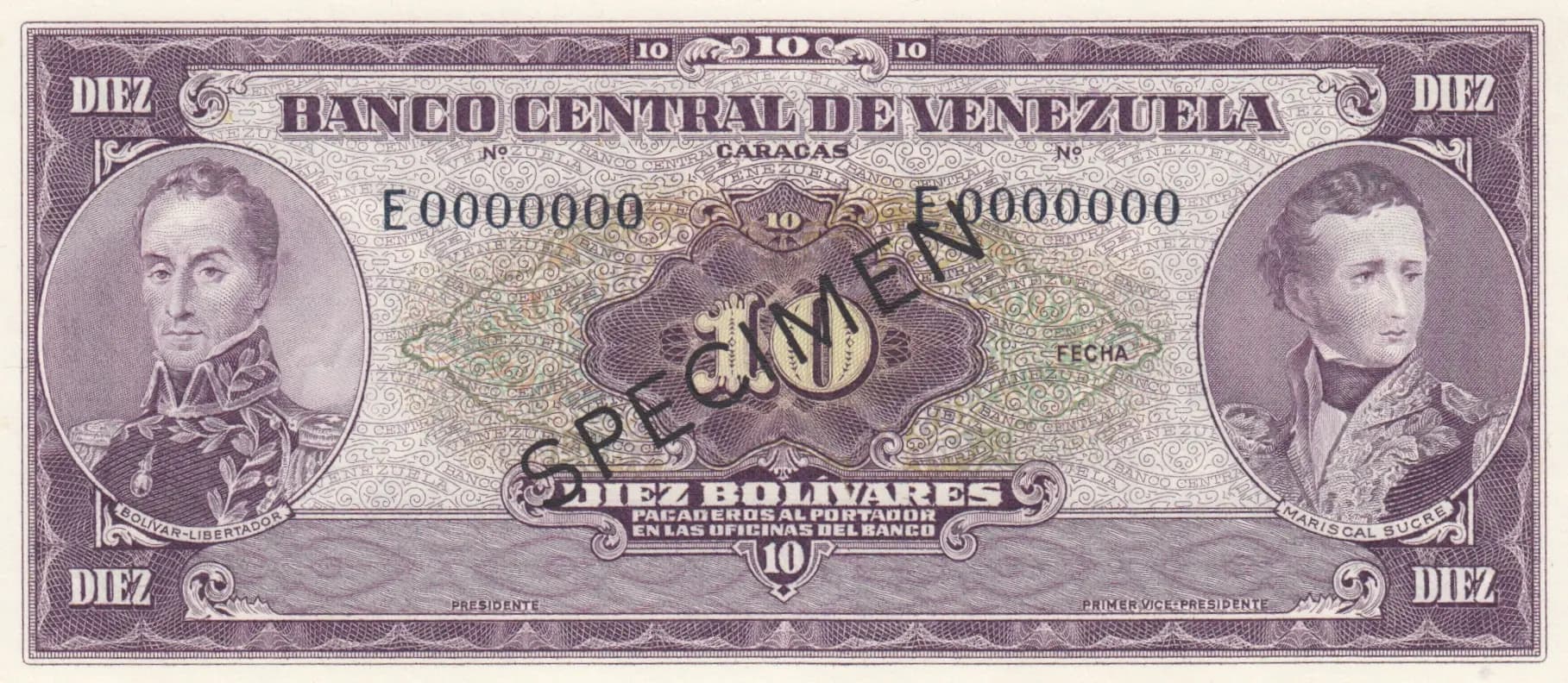
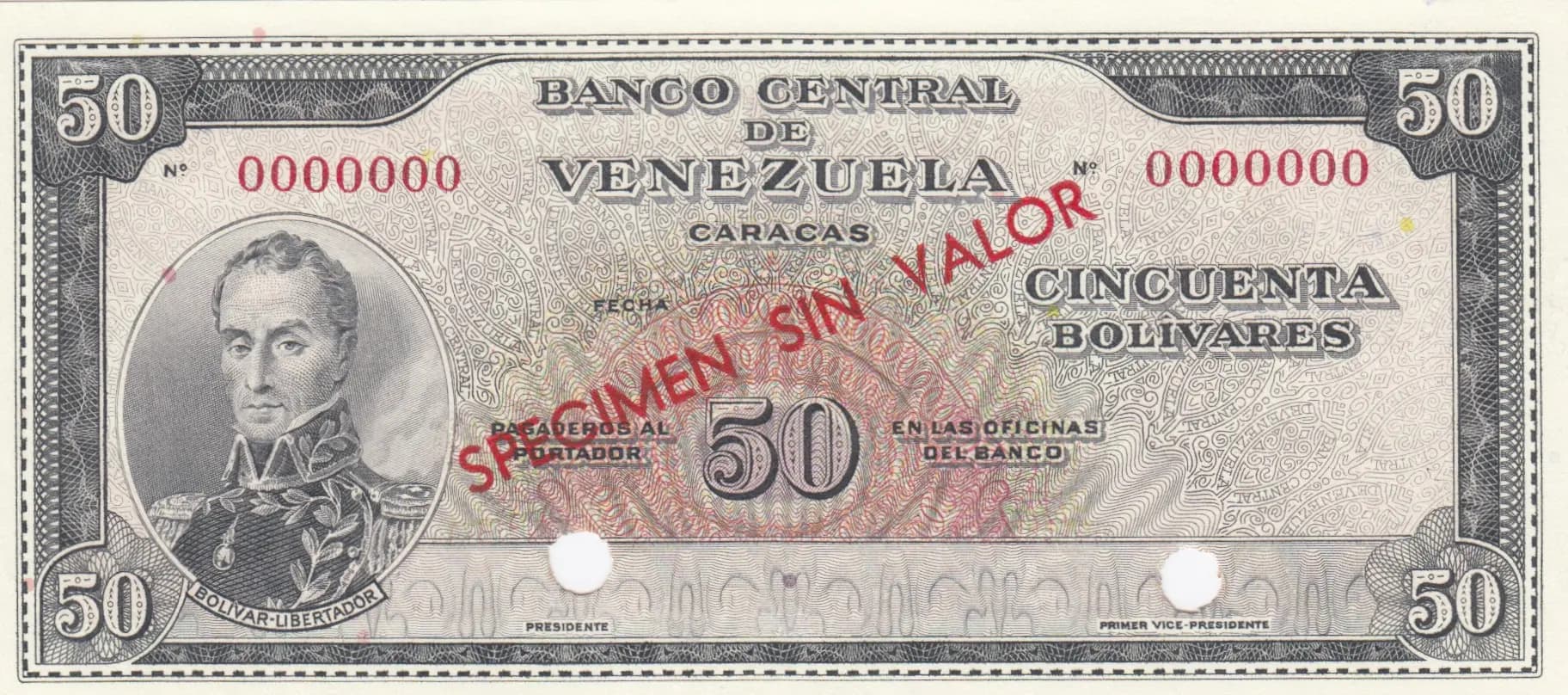
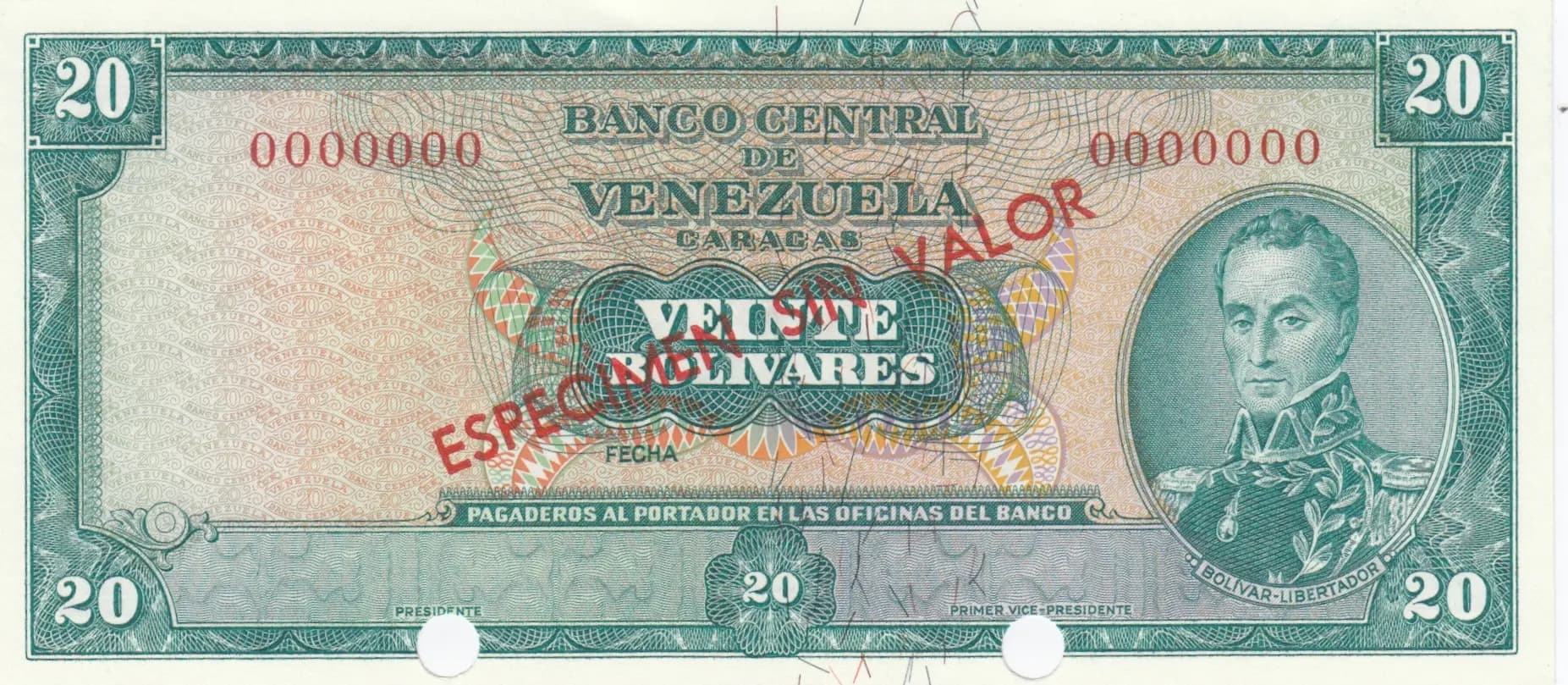
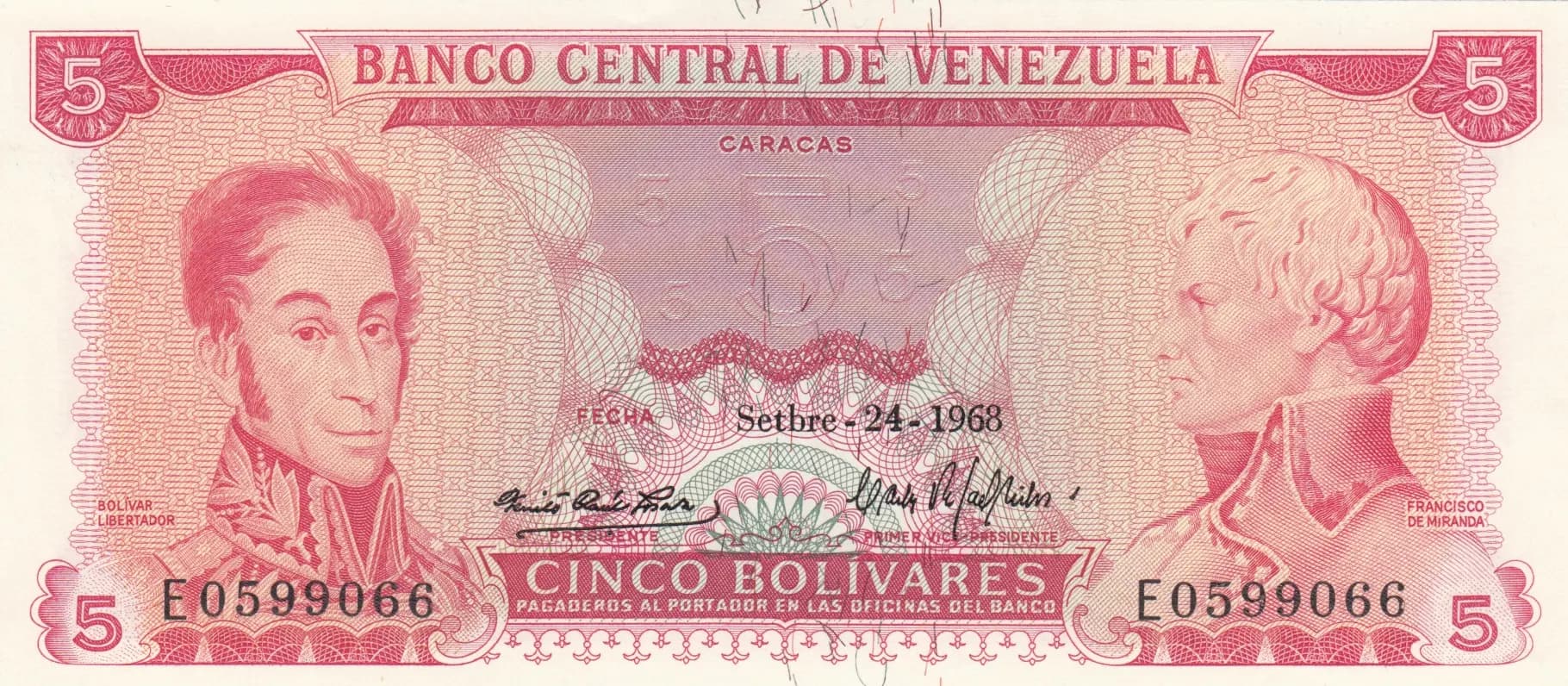
100 bolivares 1963-73 specimen
Market Prices
About This Note
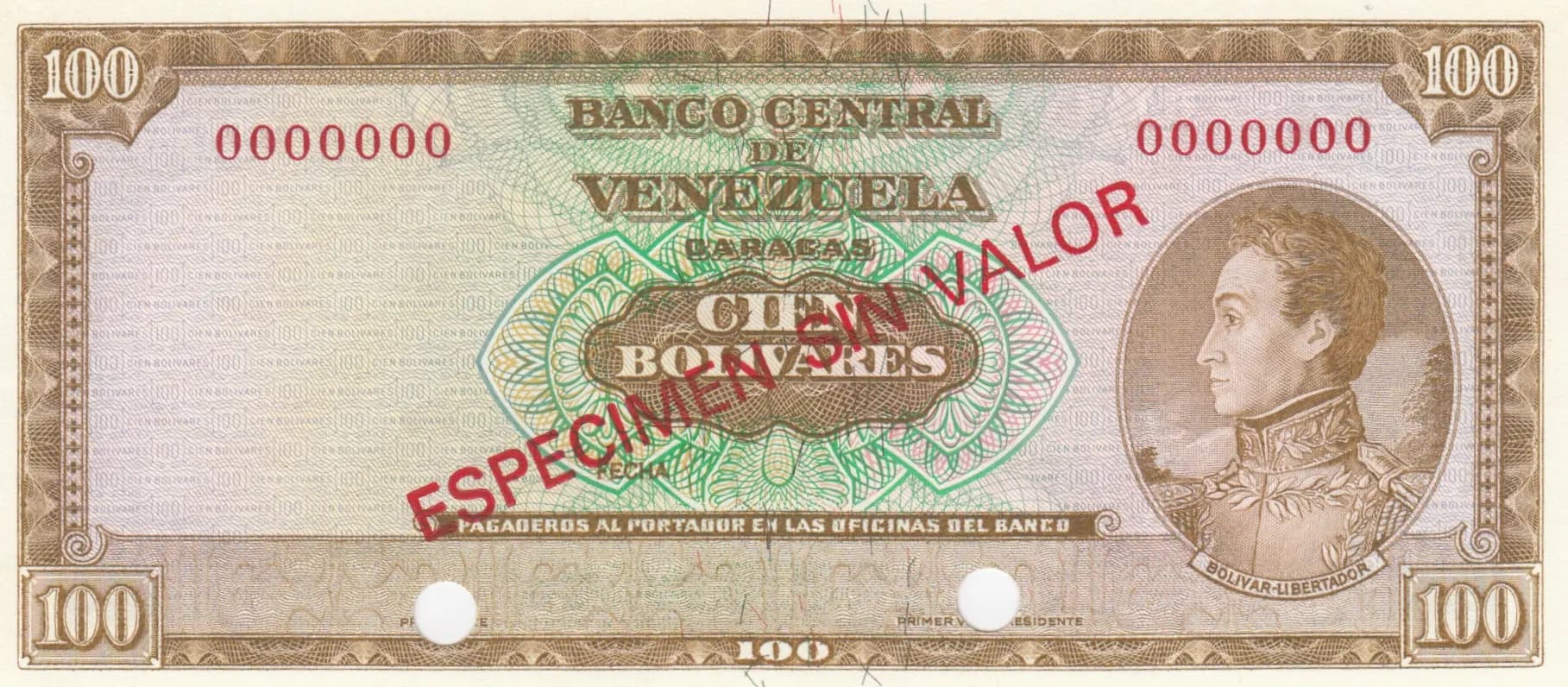
This is a stunning UNC specimen example of the Venezuelan 100 Bolívares from the 1963-73 series, printed by Thomas de la Rue and featuring the iconic portrait of Simón Bolívar in military dress. The note exhibits the characteristic brown, green, and cream color palette with elaborate geometric vignettes and ornamental borders typical of this era's Central Bank of Venezuela issues. As a specimen note with two circular punch holes and red 'ESPECIMEN SIN VALOR' overprints, this piece has never circulated and shows only minor age-related patina, making it an excellent example for collectors of Venezuelan currency or South American numismatic material.
Common. This is a regular-issue specimen from a substantial print run spanning a decade (1963-1973). Market data from realbanknotes.com shows UNC specimens selling between $95-$320 USD on eBay, with 2019 catalog values at $40 for UNC condition, consistent with common-grade pricing. Specimen notes are produced in significant quantities for distribution to banks, collectors, and institutions and are not considered rare despite their non-circulating status. The serial number prefix M-N and the consistent availability of examples at modest market prices confirm this is a commonly encountered variety.
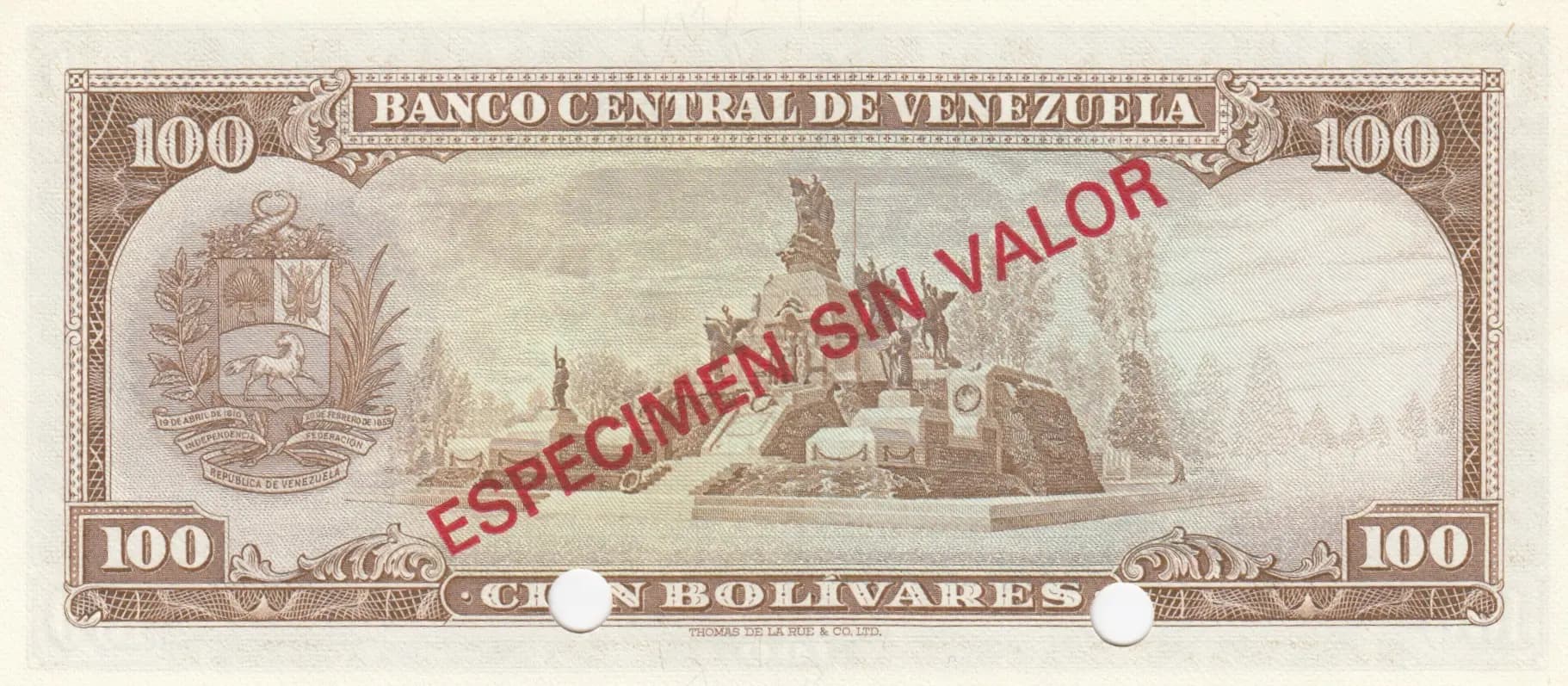
Issued during a period of relative monetary stability in Venezuela under the administration of the Banco Central de Venezuela (established 1940), this 1963-73 series commemorated the nation's revolutionary heritage through its prominent depiction of Simón Bolívar, the 'Libertador' (Liberator) and founder of Venezuela. The reverse features the Monument to the Battle of Carabobo, a crucial 1821 victory in the South American wars of independence, alongside the Venezuelan national coat of arms, reinforcing the state's connection to its independence legacy and Bolívar's revolutionary campaigns.
The obverse features a right-facing profile portrait of Simón Bolívar in full military regalia with ornate collar and decorative uniform details, identified by the label 'BOLIVAR-LIBERTADOR.' The portrait is flanked by elaborate geometric vignettes composed of concentric circular and oval patterns rendered in fine detail work, with ornamental corner designs in all four corners creating an intricate frame. The reverse displays the Monument to the Battle of Carabobo, depicted as a multi-figure sculptural installation with statuary and architectural elements commemorating Venezuela's independence struggle. The Venezuelan national coat of arms appears in the lower left of the reverse, featuring a shield with landscape elements. Throughout both sides, fine ornamental border patterns and line work in brown and cream tones provide the classical security-print aesthetic characteristic of Thomas de la Rue's production standards.
{"front":{"100":"100 (denomination numerals)","BANCO CENTRAL DE VENEZUELA":"Central Bank of Venezuela","CIEN BOLIVARES":"One Hundred Bolívares","ESPECIMEN":"Specimen","BOLIVAR-LIBERTADOR":"Bolívar-Liberator","PAGADEROS AL PORTADOR EN LAS OFICINAS DEL BANCO":"Payable to bearer at the bank's offices"},"back":{"100":"100 (denomination numerals)","BANCO CENTRAL DE VENEZUELA":"Central Bank of Venezuela","CIEN BOLIVARES":"One Hundred Bolívares","ESPECIMEN SIN VALOR":"Specimen without value","REPUBLICA DE VENEZUELA":"Republic of Venezuela","THOMAS DE LA RUE & CO LTD.":"Thomas De La Rue & Co Ltd (printer attribution)"}}
Intaglio engraving and letterpress printing, executed by Thomas de la Rue & Co Ltd, London—the world's premier security printer during this period. The fine detail work visible in the geometric vignettes, portrait rendering, and ornamental borders is characteristic of intaglio processes, while the sharp, crisp inscription lettering and specimen overprints reflect precision letterpress application. The multi-color underprint and layered color registration (browns, greens, creams, and red) suggest the use of multiple pass printing techniques typical of high-security banknote production of the 1960s.
This note is identified as a specimen variety (Pick 48s) distinguished by: (1) Two circular punch holes through the note, a standard specimen marking to prevent accidental circulation; (2) Red diagonal 'ESPECIMEN' overprint on the obverse and 'ESPECIMEN SIN VALOR' (Specimen without value) on the reverse; (3) Serial number fields marked with red zeros (0000000) rather than issued serial numbers. The serial number prefix M-N is noted in catalog references. This represents the standard specimen production variety for the 1963-73 100 Bolívares issue; no significant sub-varieties are documented for this pick number.