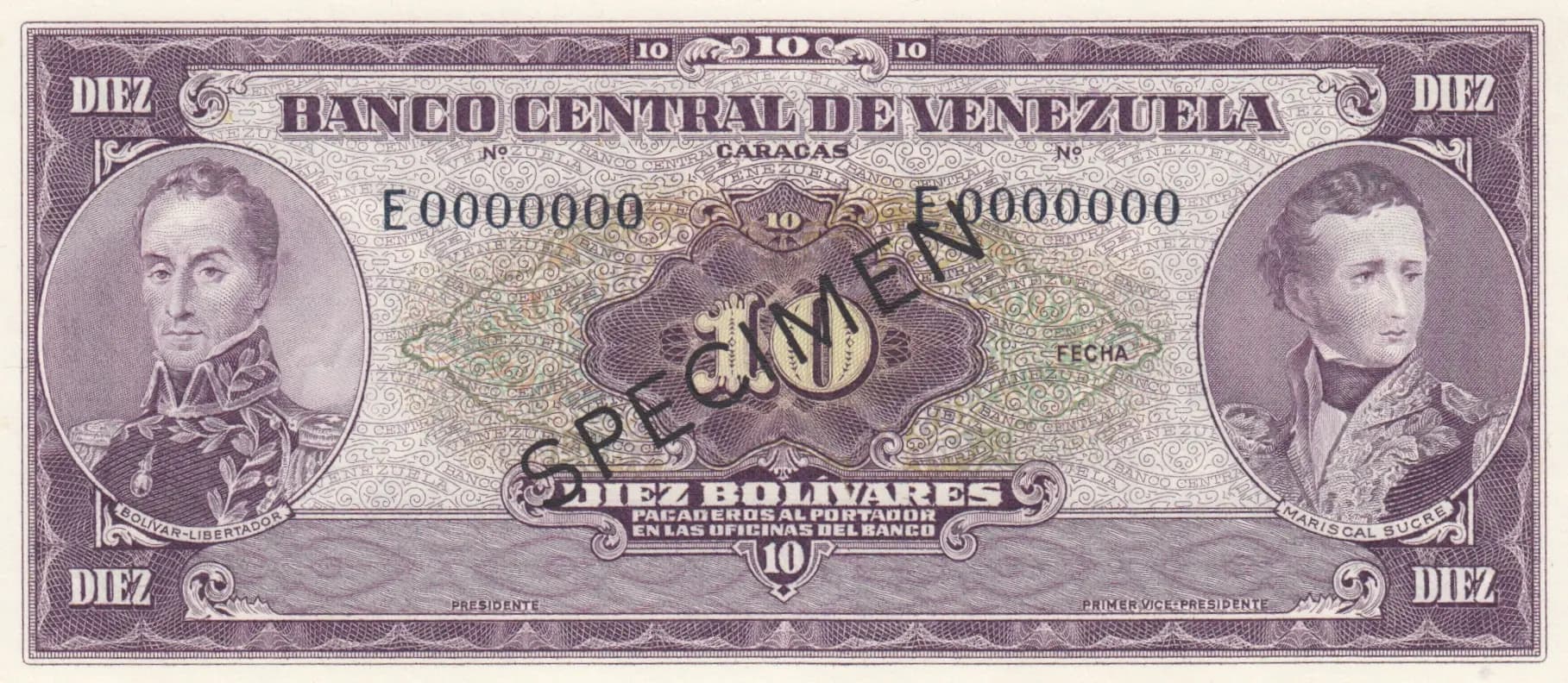
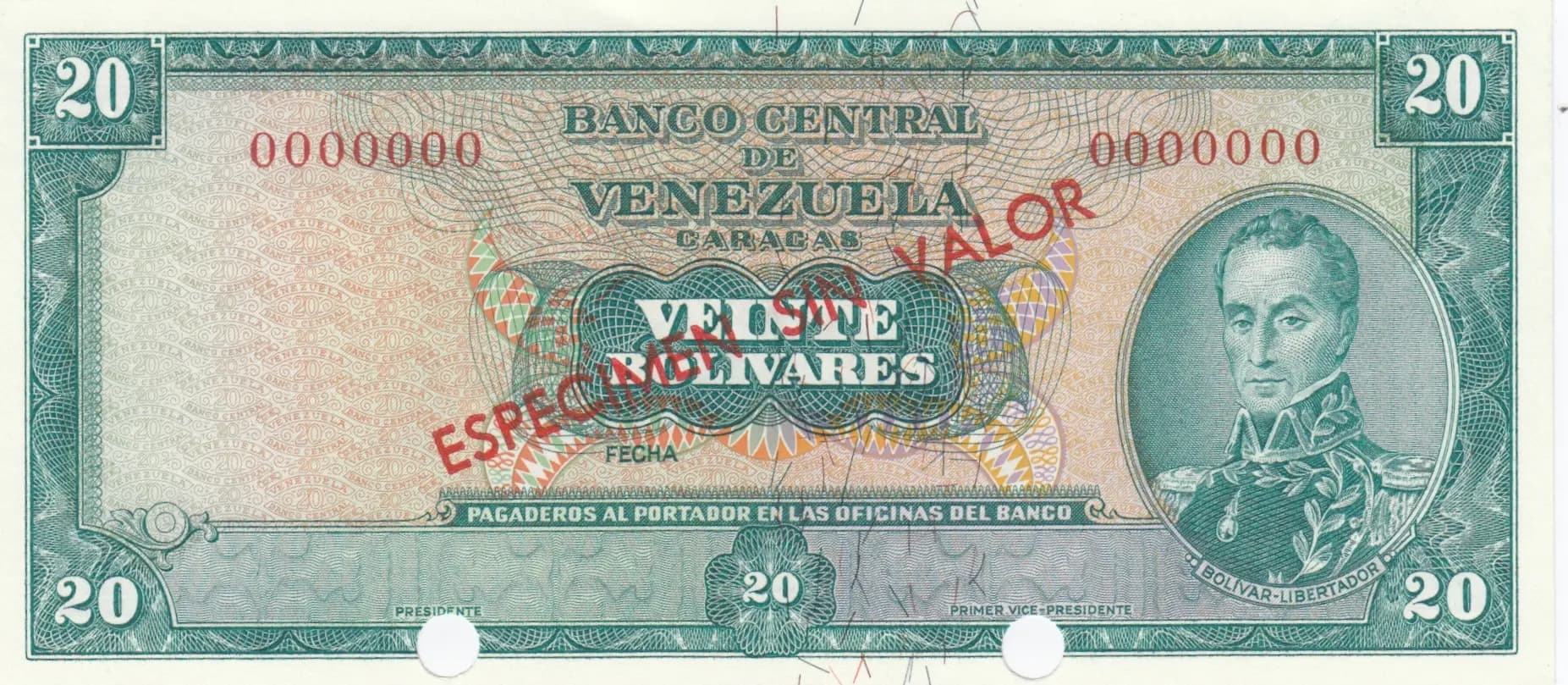
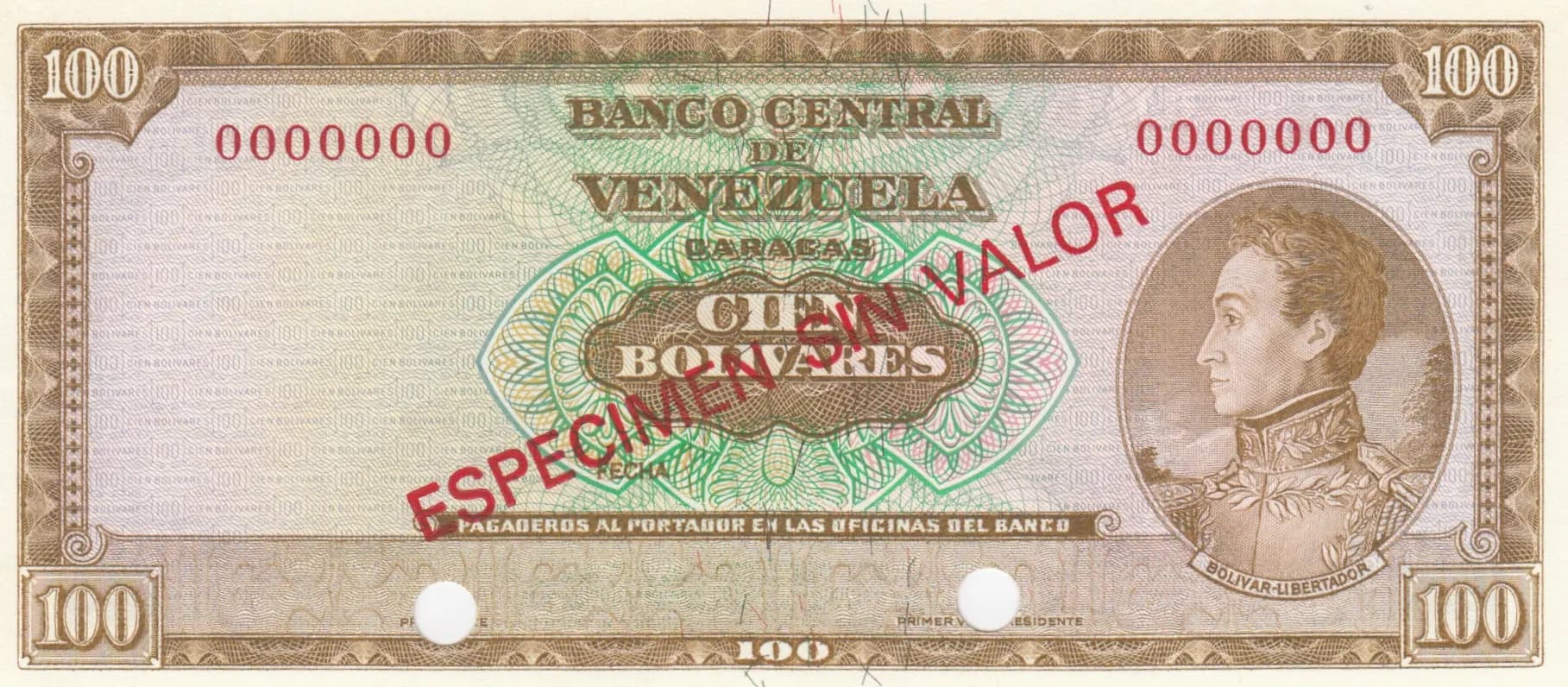
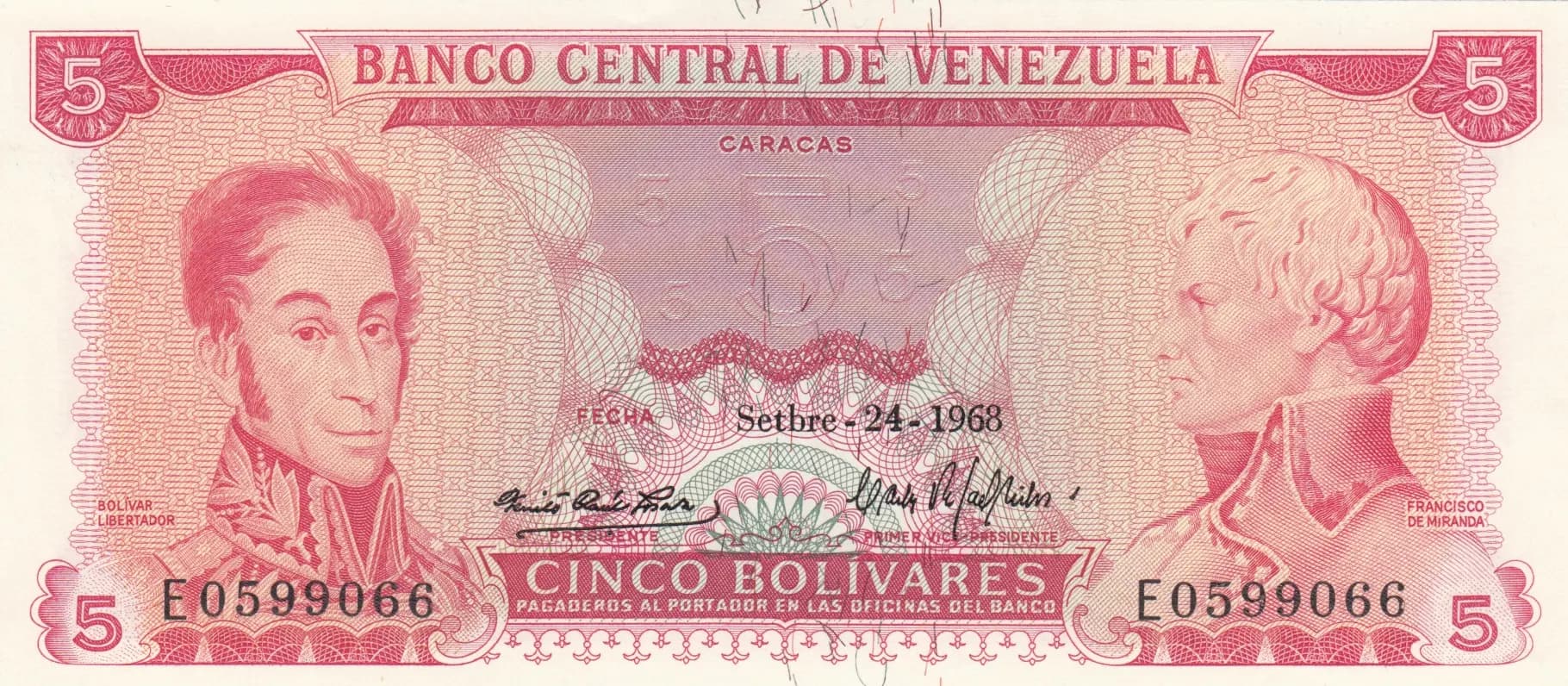
50 bolivares 1961 specimen
Market Prices
About This Note
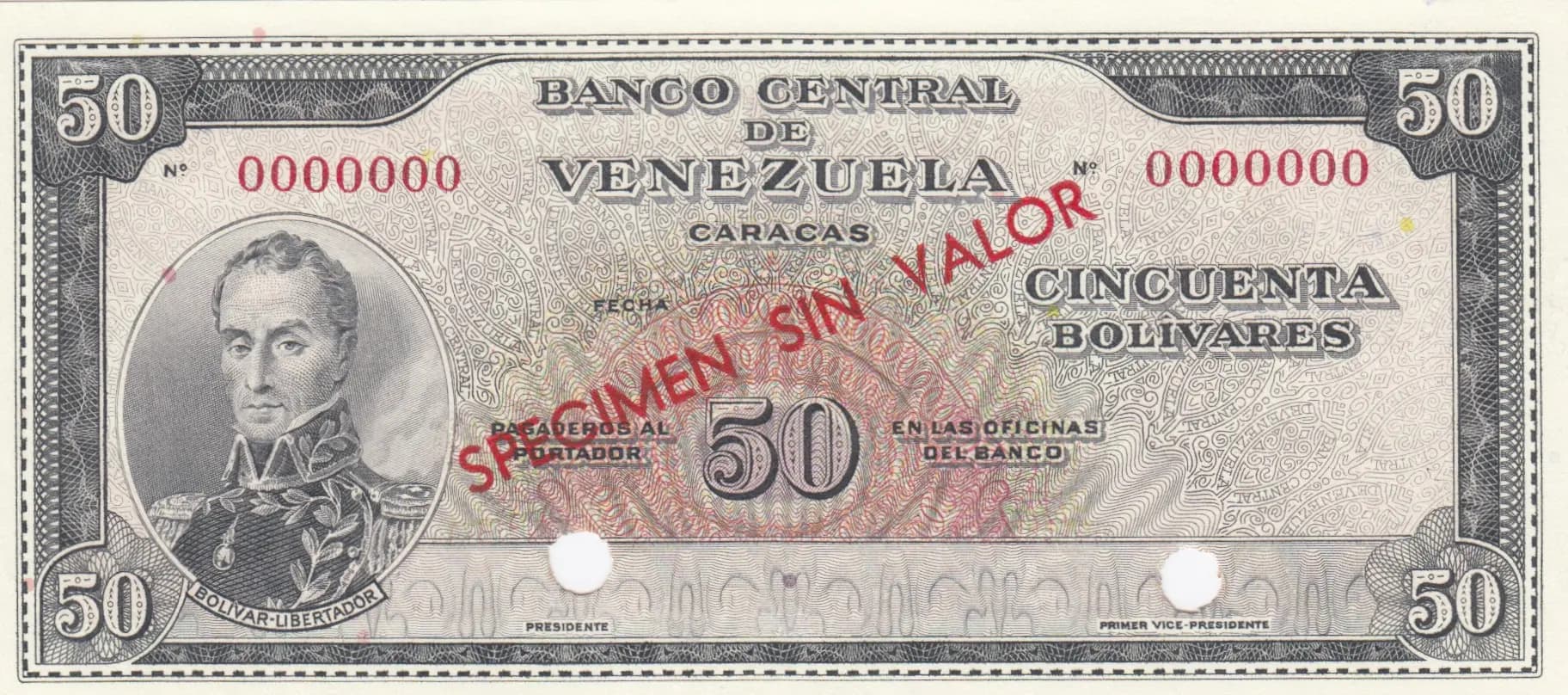
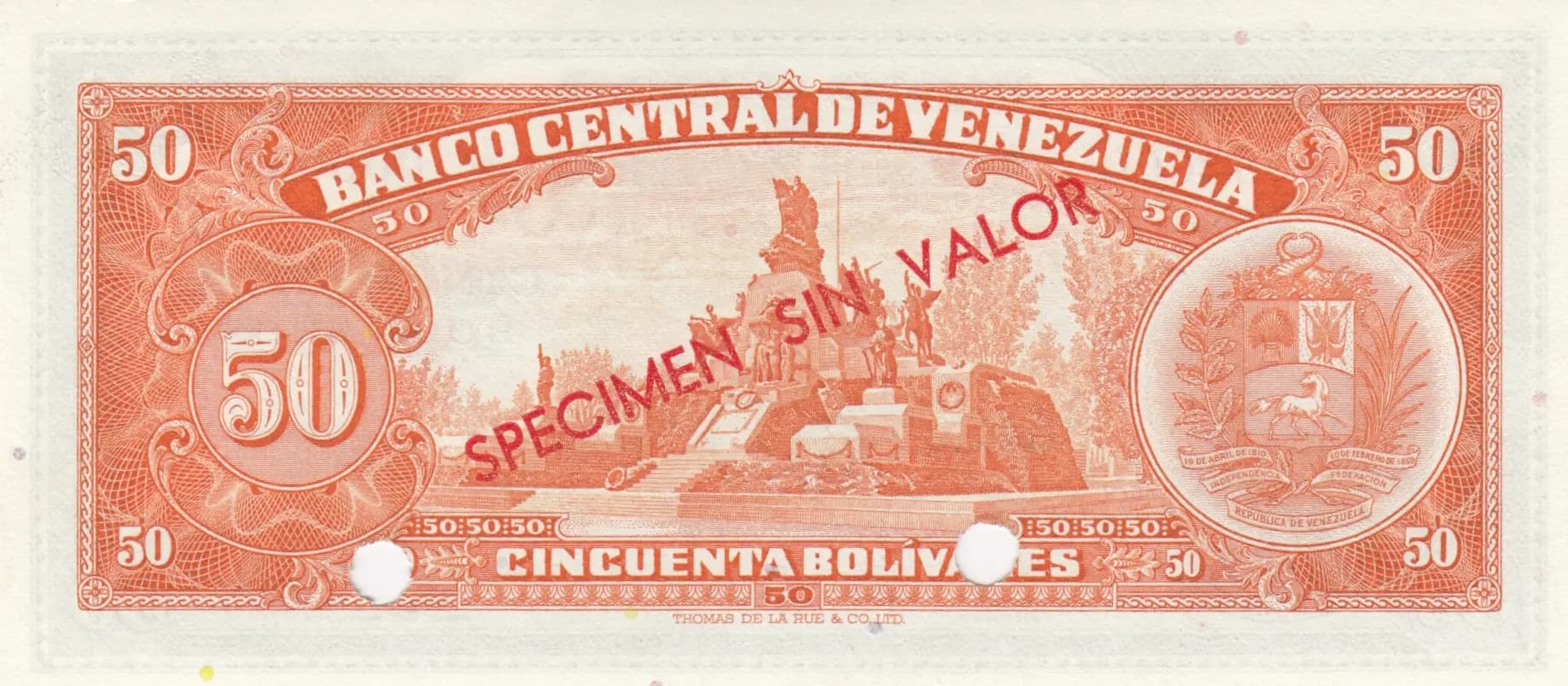
This is a Venezuelan 50 Bolivares specimen note from 1961, issued by the Banco Central de Venezuela and printed by Thomas de la Rue in London. The note exhibits exceptional uncirculated condition with crisp detail throughout, featuring a striking portrait of Simón Bolívar in military dress on the obverse and the Monument to the Motherland on the reverse rendered in characteristic coral-red and orange tones. As a specimen note, it bears the distinctive red diagonal 'SPECIMEN SIN VALOR' (Specimen Without Value) overprint and punched holes typical of central bank distribution pieces, making it an interesting historical artifact of early Venezuelan currency design rather than a circulating piece.
Common. While specimen notes are generally less common than circulating issues due to their limited intended distribution, this particular Pick number (P-44s) appears frequently in market channels with multiple eBay listings showing variable pricing ($0.99 to $454.09 USD for UNC examples), and a 2019 catalogue value of $75 in UNC condition. The wide price variance suggests inconsistent collector demand rather than scarcity. Thomas de la Rue specimen notes from the 1960s-1970s period are typically produced in modest quantities for central bank archives and distribution to other institutions, but Venezuelan banknotes from this era were not subject to recalls or short production runs that would create rarity. The note's collector value derives primarily from its historical interest and specimen status rather than scarcity.
This 1961 specimen represents the Banco Central de Venezuela's mid-20th century banknote series, a period of relative stability under President Rómulo Betancourt's democratic government following the fall of the Pérez Jiménez dictatorship in 1958. The prominence of Simón Bolívar as the primary portrait reflects Venezuela's deep historical reverence for its independence hero and namesake of the currency. The Monument to the Motherland (Monumento a la Patria) depicted on the reverse, located in Carabobo Fields, commemorates the decisive 1821 Battle of Carabobo, which secured Venezuelan independence—a fitting symbol for a nation rebuilding its democratic institutions.
The obverse features a left-facing portrait of Simón Bolívar, the South American military and political leader, depicted in formal military dress uniform with medals and decorations, identified by the caption 'BOLÍVAR-LIBERTADOR.' The note employs predominantly black and gray tones with cream-colored underprint, creating an elegant monochromatic effect enhanced by the intricate geometric and ornamental border work typical of Thomas de la Rue's fine engraving style. The reverse displays the Monumento a la Patria at Carabobo Fields as a central architectural landmark, rendered in warm coral-red and orange hues that distinguish it from the front's cooler palette. The Venezuelan coat of arms appears in a circular medallion on the right side of the reverse. Both sides incorporate the denomination '50' in decorative cartouches at the corners, and the entire design is framed by elaborate scrollwork and fine-line patterns characteristic of high-security banknote production of the era.
FRONT SIDE: 'BANCO CENTRAL DE VENEZUELA' (Central Bank of Venezuela); 'CARACAS' (city of issue); 'CINCUENTA BOLIVARES' (Fifty Bolivares); 'SPECIMEN SIN VALOR' (Specimen Without Value); 'RECUERDOS AL PORTADOR' (Remember to the Bearer); 'EN LAS OFICINAS DEL BANCO' (In the Offices of the Bank); 'BOLÍVAR-LIBERTADOR' (Bolívar-Liberator); 'PRESIDENTE' (President); 'PRIMER VICE-PRESIDENTE' (First Vice-President); '50' (denomination numerals). BACK SIDE: 'BANCO CENTRAL DE VENEZUELA' (Central Bank of Venezuela); 'CINCUENTA BOLIVARES' (Fifty Bolivares); 'SPECIMEN SIN VALOR' (Specimen Without Value); 'THOMAS DE LA RUE & CO. LTD.' (printer attribution); '50' (denomination numerals).
Intaglio engraving (copperplate/steel plate printing), the standard security printing method employed by Thomas de la Rue & Co., Ltd., London. This technique is evidenced by the fine line work, sharp detail clarity, and complex decorative patterns visible throughout both sides of the note. The multicolor printing on the obverse (black on cream/beige underprint) and the distinctive coral-red/orange tones on the reverse demonstrate the multiple-pass color registration typical of Thomas de la Rue's banknote production. The specimen overprint in red was applied as an additional security marking during specimen preparation.
This is specifically the 1961 specimen variety (P-44s per Pick catalogue). The visual analysis indicates serial number prefix patterns of H-J and J-K on circulation examples, though specimen notes typically display '0000000' or similar placeholder numerals as observed here. The note was issued in both 1961 and 1963 according to external catalog references, suggesting the same design plate remained in use across both years. The red 'SPECIMEN SIN VALOR' diagonal overprint and punched hole cancellation are standard specimen markings for this issue. No additional varieties (signatures, date variations, or security feature differences) are apparent from the images provided.