20 bolivares 1967-74 specimen
Market Prices
3 salesAbout This Note
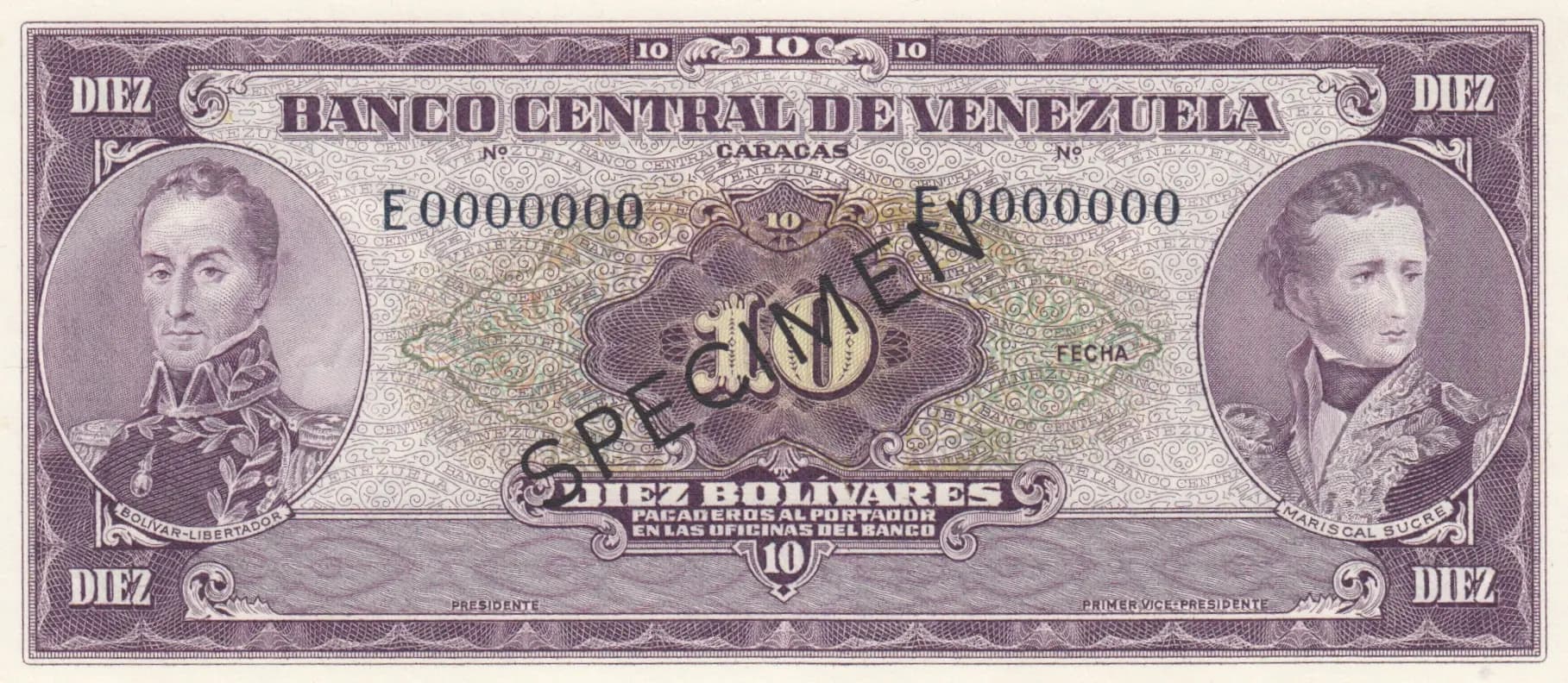
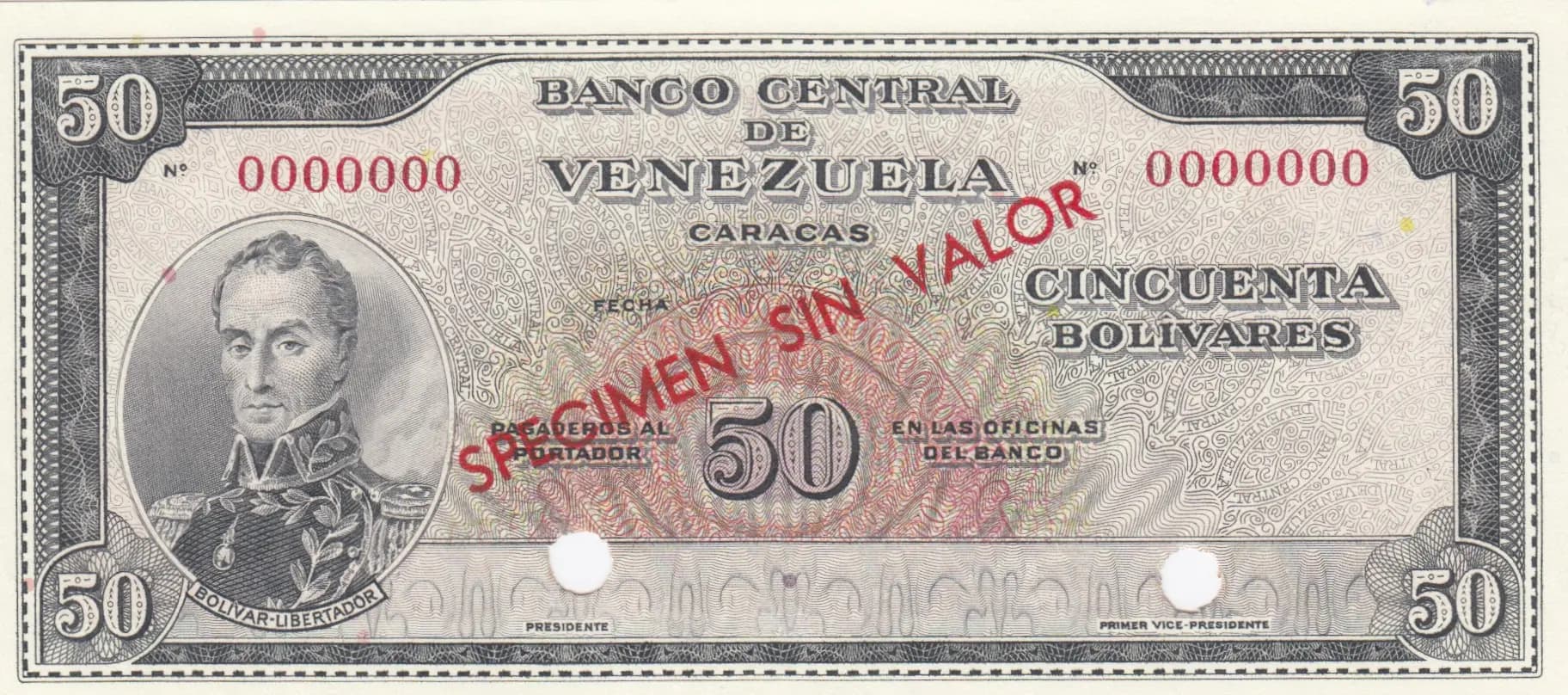
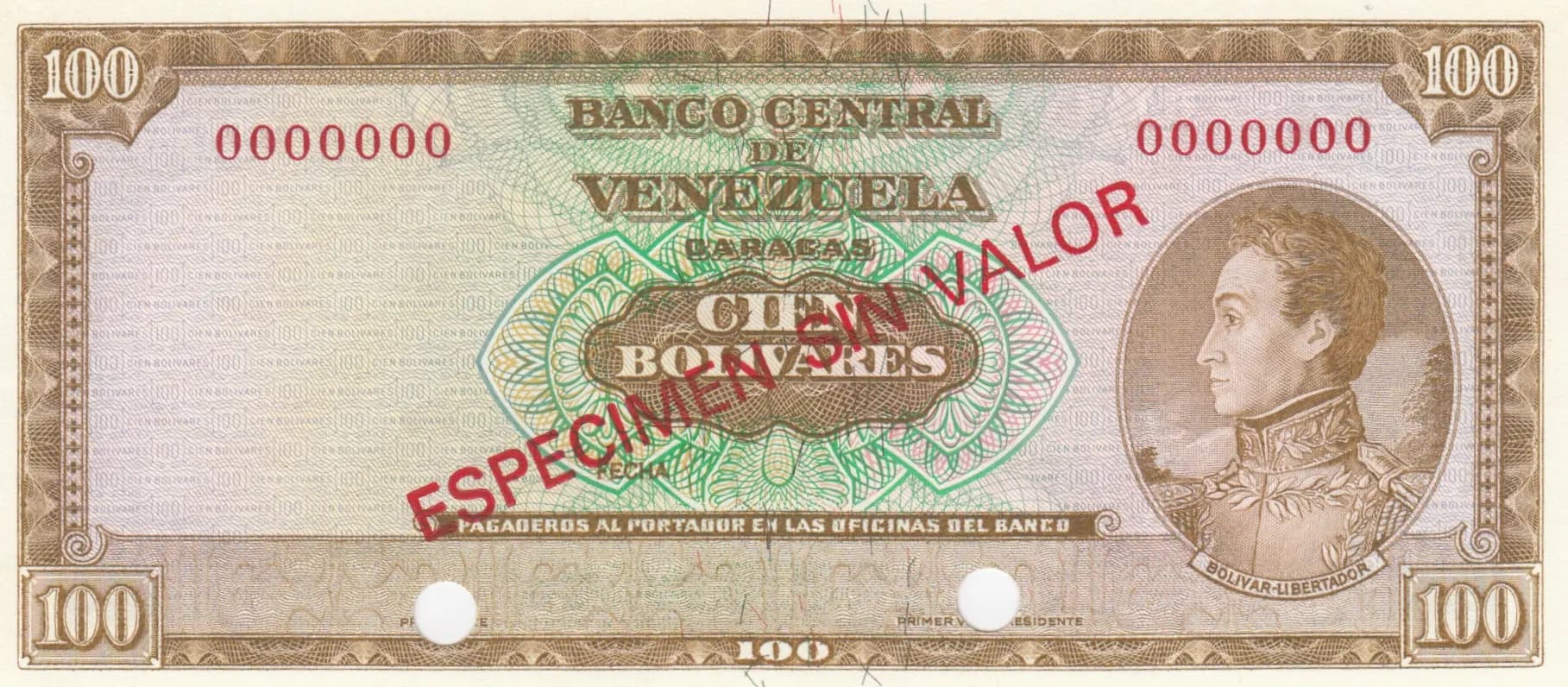
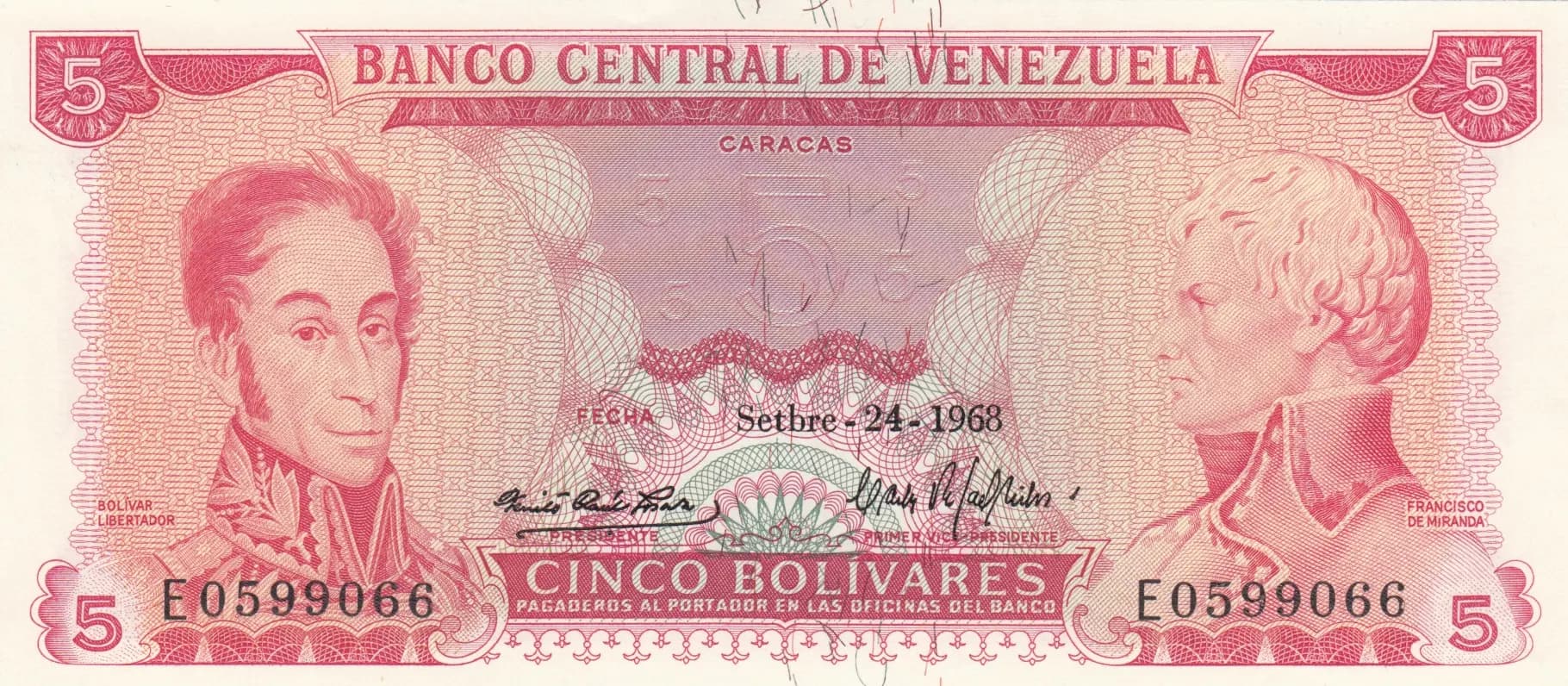
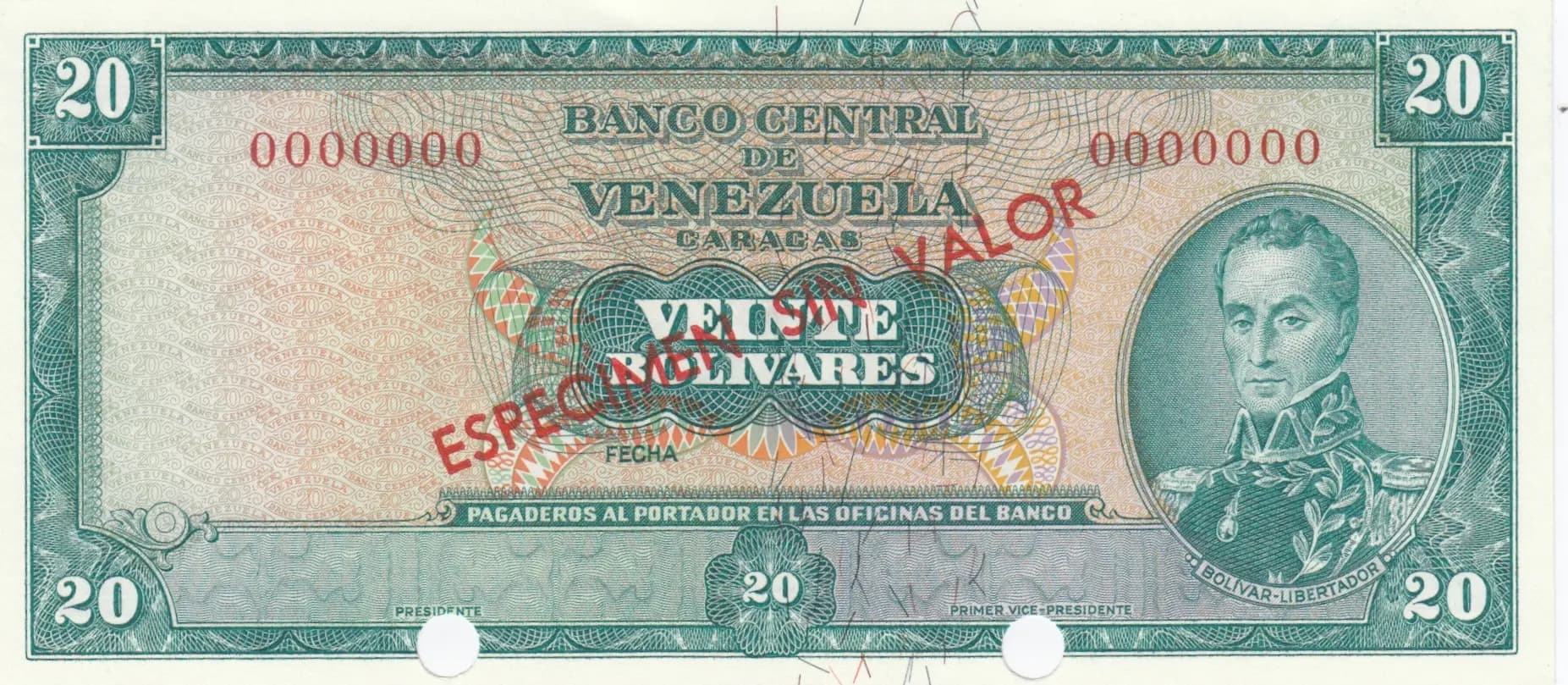
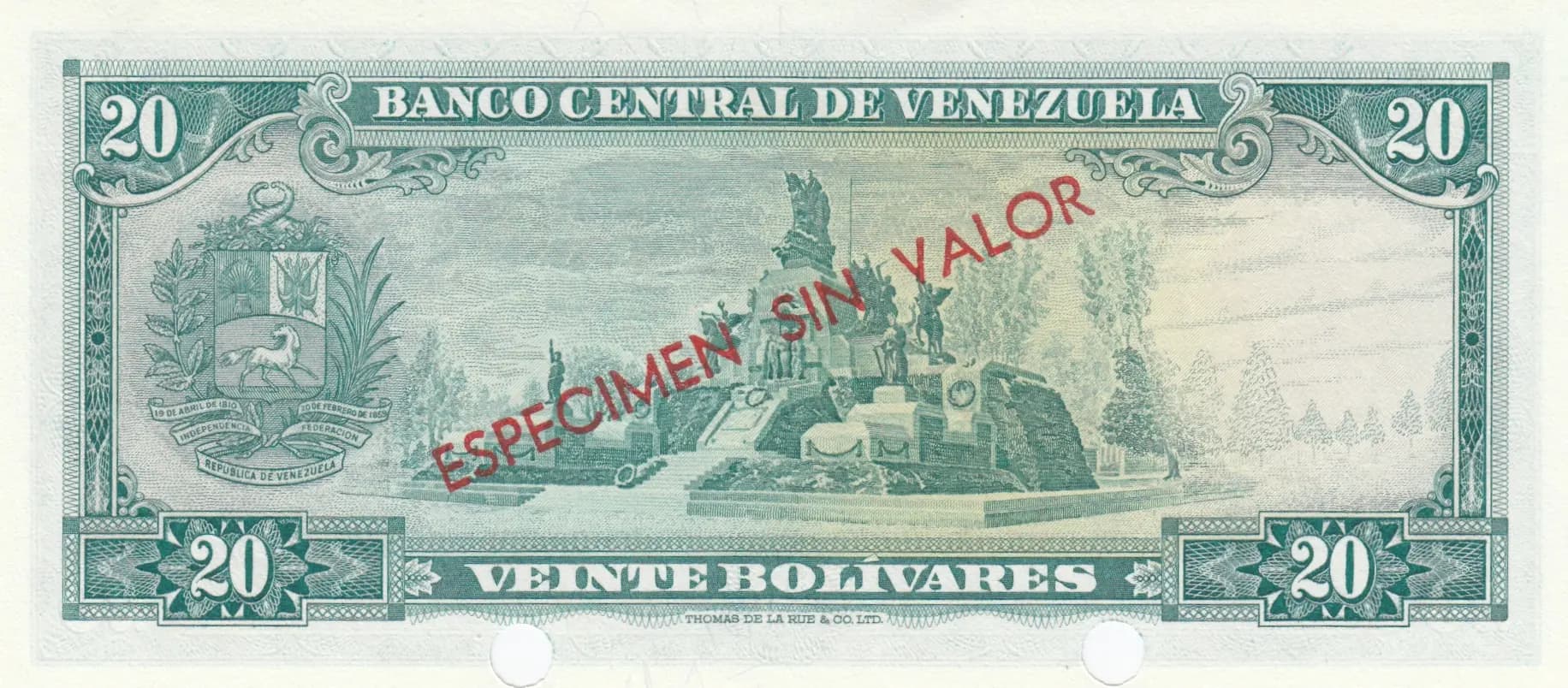
This is an uncirculated specimen of the 1967-1974 20 Bolívares note from Venezuela's Banco Central, printed by Thomas de la Rue in London. The note displays exceptional quality with vibrant teal and cream coloring, featuring a striking portrait of Simón Bolívar in military dress on the obverse and a monumental landscape scene commemorating the Battle of Carabobo on the reverse. As a specimen note marked "ESPECIMEN SIN VALOR" with characteristic punch holes and red overprints, it represents an important reference piece from Venezuela's mid-20th century currency.
Common. This note from the 1967-1974 series represents a standard issue from Venezuela's Banco Central with substantial print runs typical of a frequently-circulating denomination during a two-decade issuance period. Market data shows specimen examples selling in the $7.50-$20 USD range, with 2019 catalog values placing UNC specimens at $20. The availability of multiple eBay sales over several years and the existence of comprehensive catalog records confirm this is not a scarce issue. Specimen notes are less common than circulated examples but do not command premium pricing characteristic of rare issues.
This note was issued during a period of relative monetary stability in Venezuela under the administration of the Banco Central de Venezuela, established in 1940. The imagery prominently features Simón Bolívar, the legendary military leader and founding father of Venezuela, and commemorates the Battle of Carabobo (1821), a decisive victory in Venezuela's independence struggle. The Monument to the Motherland depicted on the reverse reflects the nation's celebration of its independence and federated republican structure during the 1960s-70s.
The obverse features a left-facing profile portrait of Simón Bolívar, the Venezuelan liberator and military strategist, rendered in fine engraving within an oval frame positioned at right. He is depicted in formal military dress uniform with decorative chest insignia and decorations. The note employs an ornate border design in teal with repeating geometric patterns and decorative medallions. The reverse displays an elaborate engraved landscape scene of the Monument to the Motherland at the Carabobo Fields, depicting a monumental sculptural grouping with multiple commemorative figures on an elevated platform, surrounded by landscaping with trees and foliage. The left side features a heraldic coat of arms containing shield elements with text cartouches reading 'INDEPENDENCIA' and 'FEDERACION,' representing core Venezuelan republican values. Decorative scrollwork and laurel wreaths complete the design in the corners.
FRONT: 'BANCO CENTRAL DE VENEZUELA, CARACAS' (Central Bank of Venezuela, Caracas); 'VEINTE BOLIVARES' (Twenty Bolivares); 'ESPECIMEN' (Specimen); 'BOLIVAR-LIBERTADOR' (Bolívar-Liberator); 'PAGADEROS AL PORTADOR EN LAS OFICINAS DEL BANCO' (Payable to bearer at the offices of the bank); signature titles including 'PRESIDENTE' (President) and 'PRIMER VICE-PRESIDENTE' (First Vice-President). BACK: 'BANCO CENTRAL DE VENEZUELA' (Central Bank of Venezuela); 'VEINTE BOLIVARES' (Twenty Bolivares); 'ESPECIMEN SIN VALOR' (Specimen without value); 'THOMAS DE LA RUE & CO. LTD.' (printer attribution); 'REPUBLICA DE VENEZUELA' (Republic of Venezuela); 'INDEPENDENCIA' (Independence) and 'FEDERACION' (Federation) within heraldic elements.
Intaglio (copperplate) engraving, executed by Thomas de la Rue & Company Ltd. of London, one of the world's premier security printers. The fine-line engraving is evident in the intricate geometric patterns, portrait detailing, landscape scene complexity, and heraldic elements. Red specimen overprints and serial numbers were applied by letterpress or similar overstrike method. Two circular punch holes were mechanically applied post-printing as part of the specimen marking protocol.
This is identified as Pick P-46s (specimen variety, indicated by 's' suffix). Serial number prefix H-J range confirms this variety. The red 'ESPECIMEN' and 'ESPECIMEN SIN VALOR' overprints are standard for specimen releases. The note shows the standard two circular punch holes characteristic of specimen-marked notes released for banking institutions and collectors. No unusual die varieties, signature combinations, or printing errors are evident from the visual analysis. This represents the standard specimen variety of the P-46 type from the 1967-1974 issuance period.