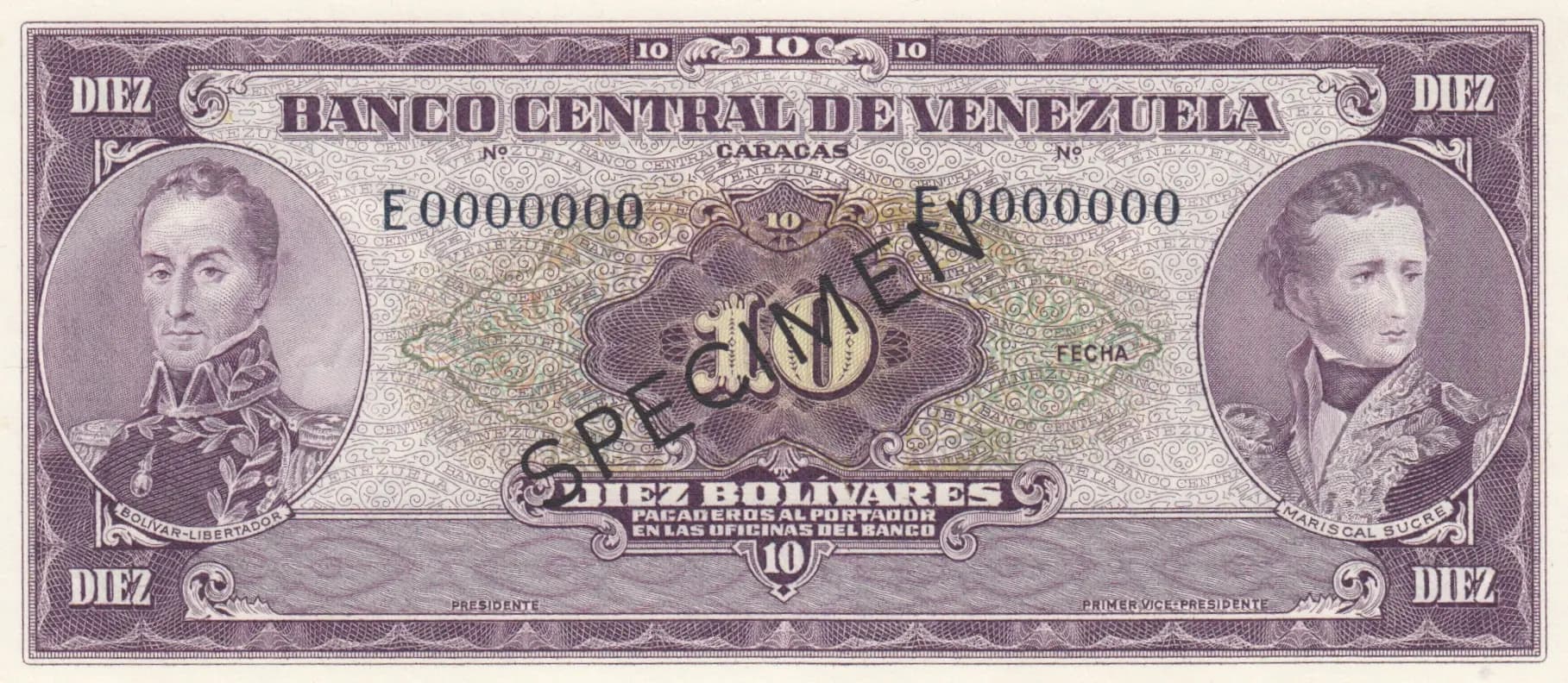
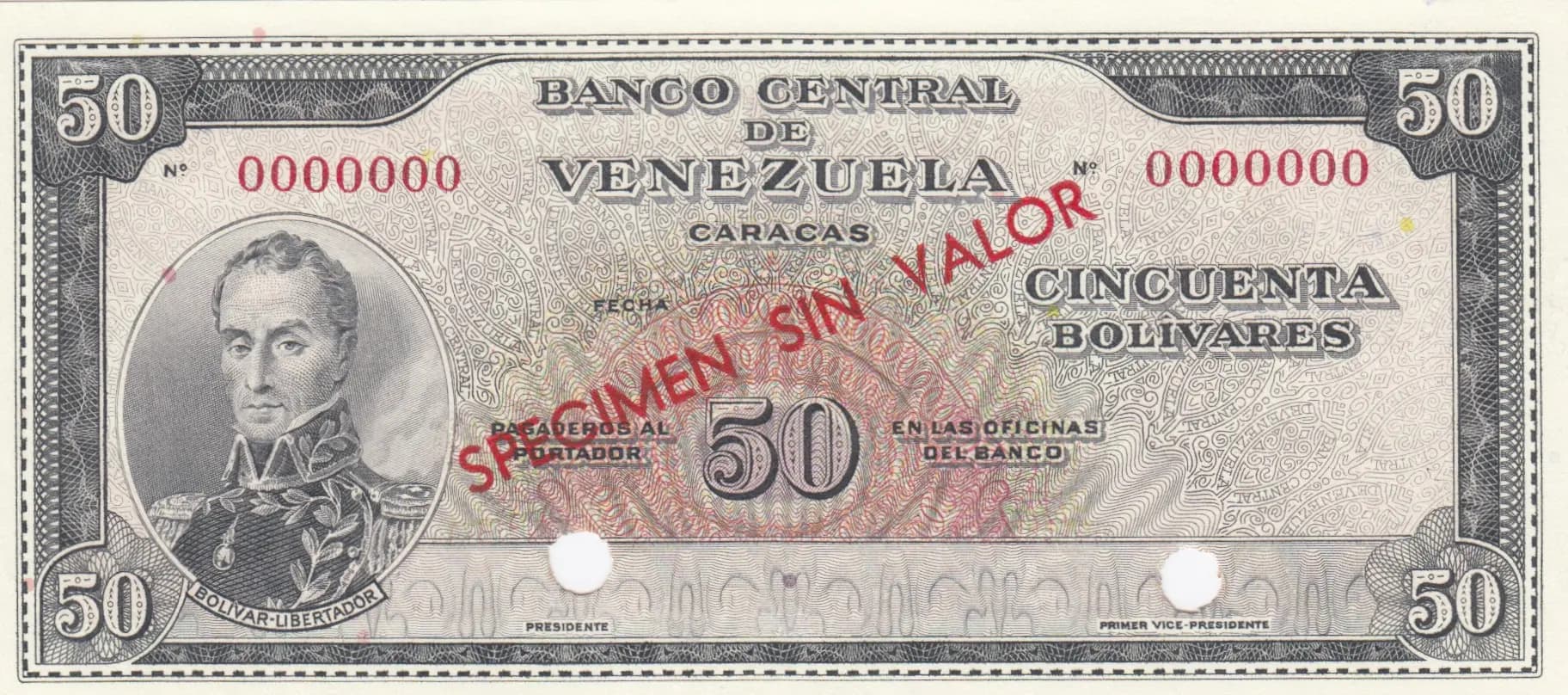
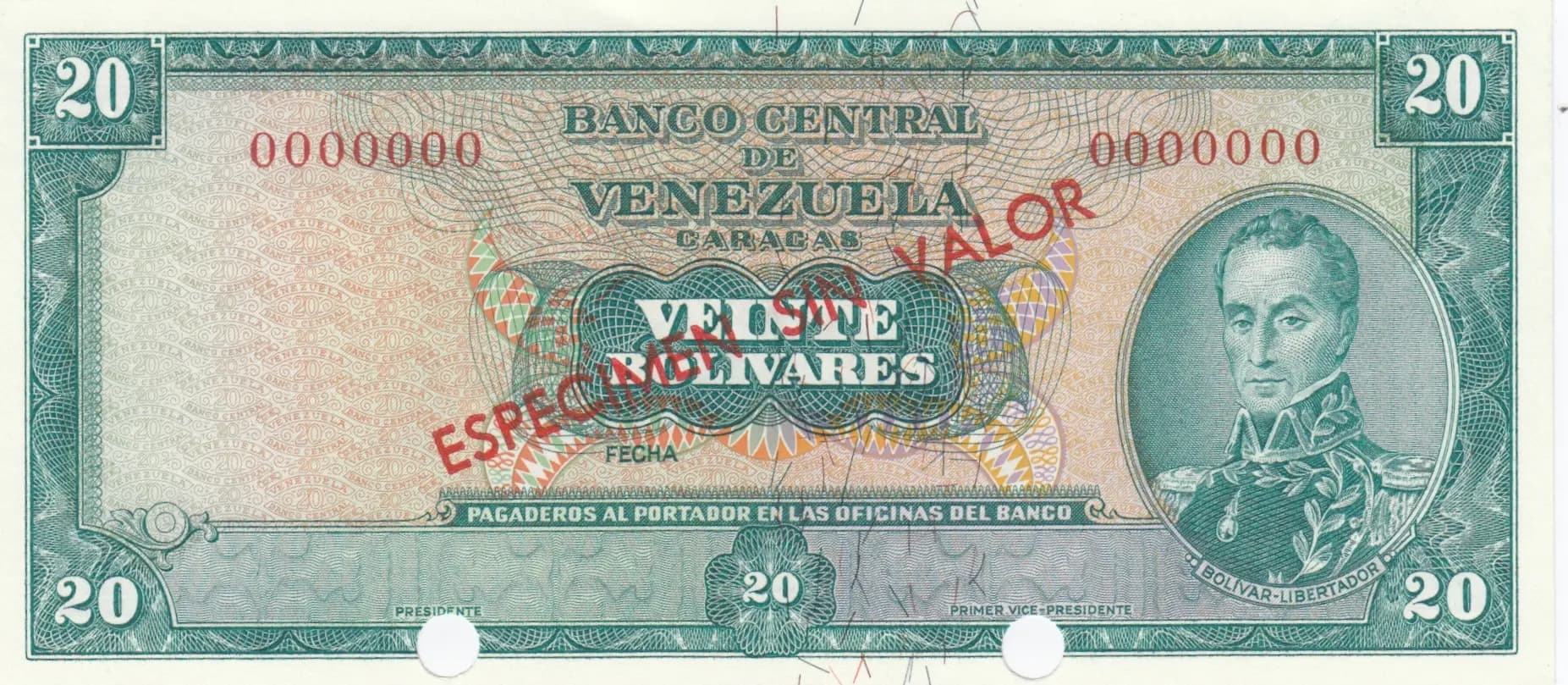
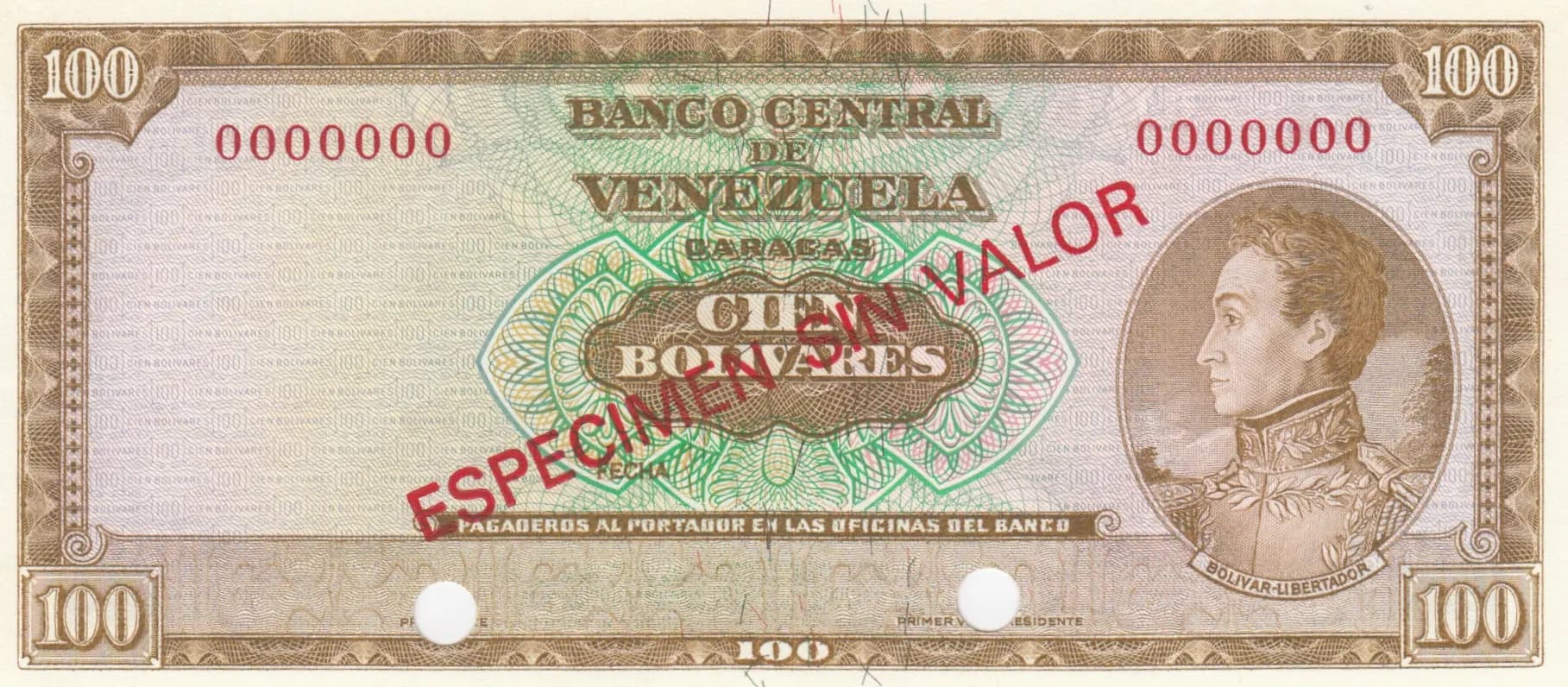
100 bolivares 1980 specimen
Market Prices
About This Note
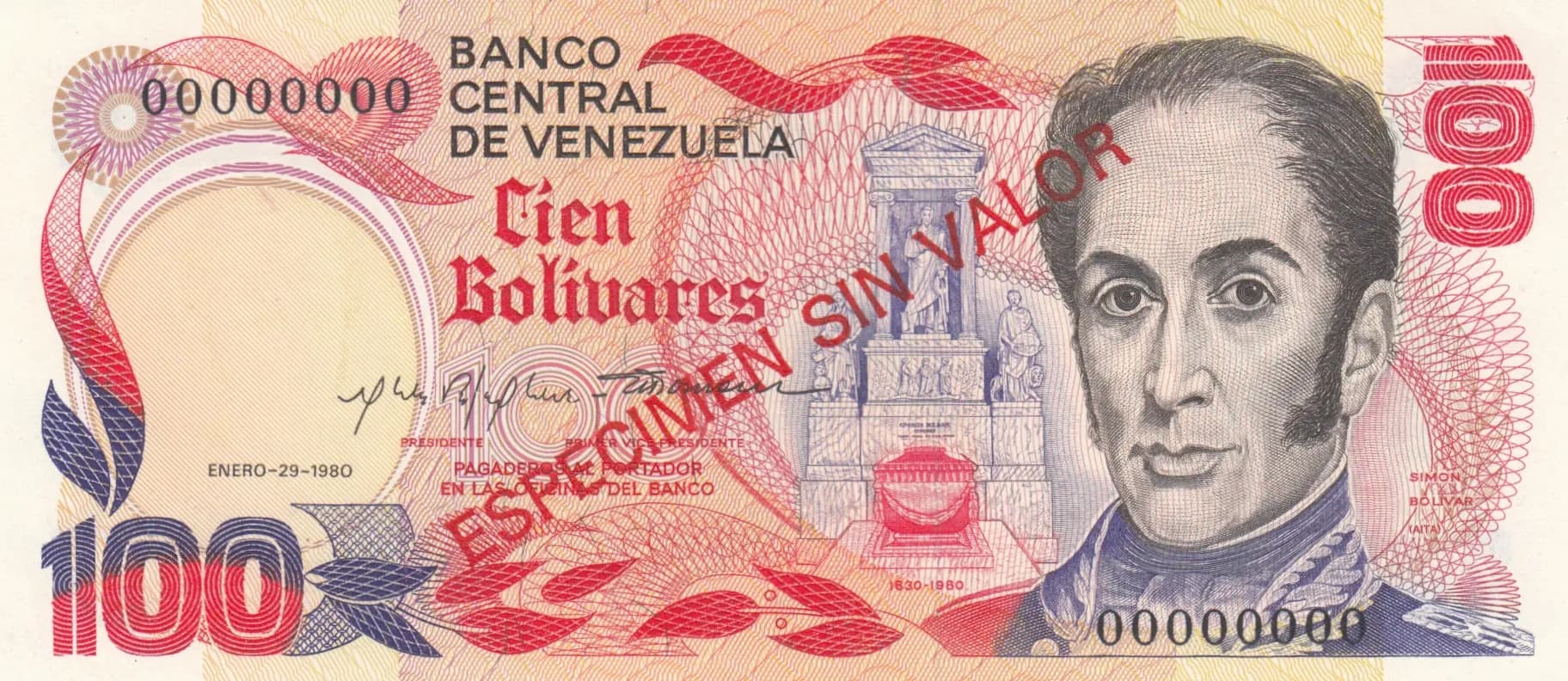
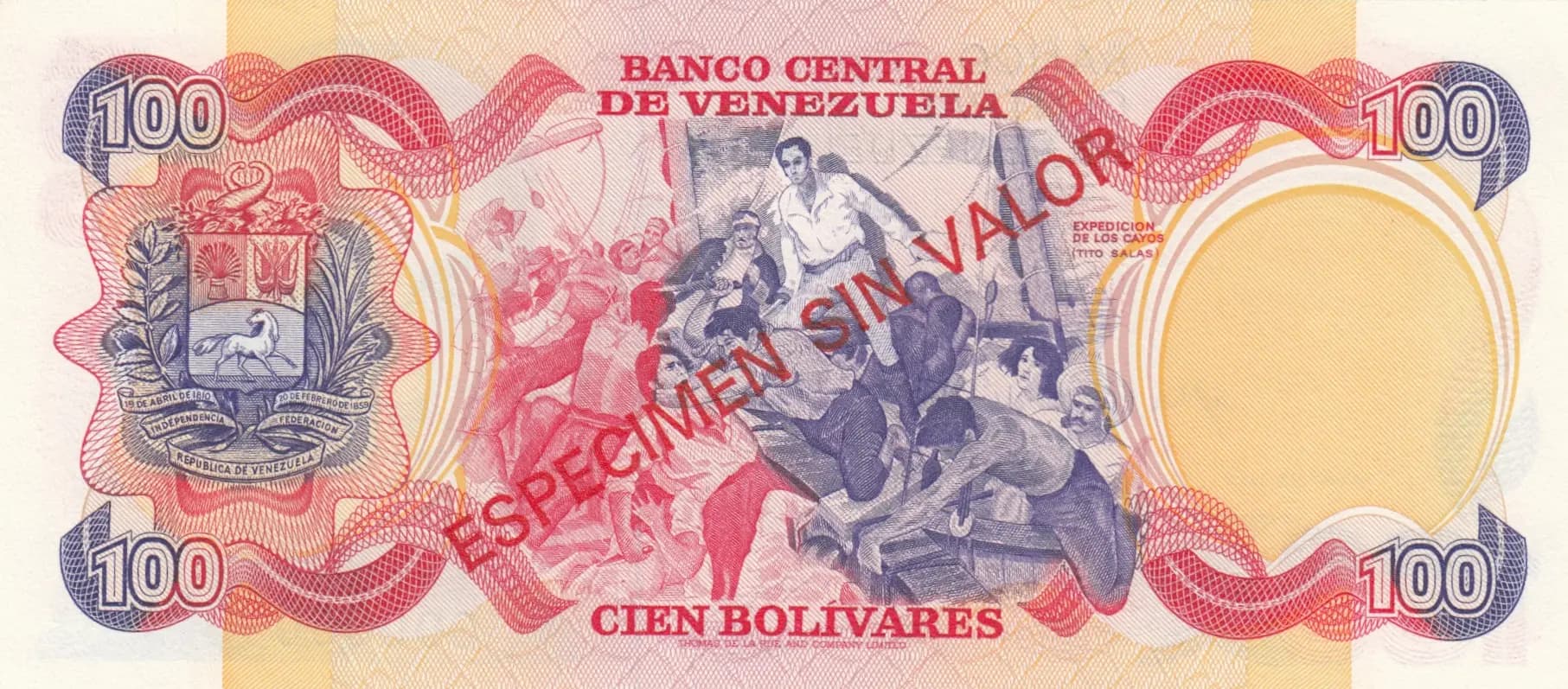
This is an uncirculated 1980 Venezuelan 100 Bolívares specimen note commemorating the 150th anniversary of Simón Bolívar's death. The note exhibits pristine condition with sharp, detailed engraving throughout, featuring Bolívar's portrait and his tomb on the obverse, and Tito Salas' famous 'Expedition of the Cays' historical scene on the reverse. The red 'ESPECIMEN SIN VALOR' overprint confirms this is a non-circulating reference specimen, making it a desirable item for collectors of Venezuelan currency and historical commemorative notes.
Common. While this is a specimen note (non-circulating reference issue), the eBay market data provided shows consistent pricing in the $5–$60 range depending on condition, with most examples trading between $10–$30 for UNC grades. The 2019 catalogue value of $15 USD for UNC specimens further confirms this is not a scarce issue. Specimen notes are typically produced in moderate quantities for distribution to banks, governments, and collectors, and this 1980 Venezuelan issue appears to have had adequate surviving examples in the market.
Issued on January 29, 1980, this note commemorates the 150th anniversary of the death of Simón Bolívar (1783-1830), the Venezuelan military and political leader who liberated much of South America from Spanish colonial rule. The obverse prominently features Bolívar in formal military dress with his mausoleum, while the reverse depicts the 'Expedition of the Cays'—a pivotal moment in Bolívar's revolutionary campaigns—as rendered by Venezuelan artist Tito Salas. This commemorative issue reflects Venezuela's national pride in honoring its founding father during a period of relative economic stability in the nation.
The obverse features a right-facing portrait of Simón Bolívar in formal 19th-century military dress uniform positioned on the right side, with his monumental tomb depicted in the center-right background. The composition is framed by elaborate guilloche patterns, decorative rosettes, and an ornamental winged emblem at the top center. The color palette consists of red, pink, cream, and blue tones on a multicolored security-printed underprint. The reverse displays the Venezuelan national coat of arms (featuring a shield with three horizontal stripes, a prancing horse, cornucopia, and other heraldic symbols) enclosed in an ornamental laurel wreath on the left, while the central composition showcases Tito Salas' acclaimed historical painting 'Expedición de los Cayos,' depicting figures in period costume engaged in a maritime expedition scene, set against a rocky coastal landscape. Both sides feature decorative wave patterns and rosette designs framing the margins, with denomination numerals '100' positioned in corners within circular security rosettes.
FRONT SIDE: 'BANCO CENTRAL DE VENEZUELA' (Central Bank of Venezuela) — 'cien Bolívares' (one hundred Bolivares) — 'SPECIMEN' / 'SIN VALOR' (Specimen / Without Value) — 'ENERO-29-1980' (January 29, 1980) — '100' (denomination) — 'PRESIDENTE PAGADOR O VICEPRESIDENTE EN LA ORDEN DEL BANCO' (President Payer or Vice President at the Order of the Bank). BACK SIDE: 'BANCO CENTRAL DE VENEZUELA' (Central Bank of Venezuela) — 'CIEN BOLIVARES' (One Hundred Bolivares) — '100' (denomination) — 'SPECIMEN' / 'SIN VALOR' (Specimen / Without Value) — 'REPÚBLICA DE VENEZUELA' (Republic of Venezuela) — 'EXPEDICION DE LOS CAYOS (TITO SALAS)' (Expedition of the Cays [by Tito Salas]).
This note was produced using steel engraving and intaglio printing techniques, characteristic of high-security banknote production. The printer was Thomas de la Rue (TDLR), London, one of the world's premier security printing firms. The extensive use of fine-line guilloche patterns, intricate filigree backgrounds, and detailed engraved portraiture and historical scenes are hallmarks of intaglio printing. The multi-color security underprint and complex overprinting of the 'SPECIMEN SIN VALOR' text demonstrate the sophisticated anti-counterfeiting measures employed by this specialist printer.
This is catalogued as Pick P-59s, the specimen variety of the base P-59 note. The 's' designation indicates specimen status, confirmed by the red overprint 'ESPECIMEN SIN VALOR' visible on both obverse and reverse. The visual analysis shows serial number prefix 'A' with specimen zeroes (00000000), consistent with standard specimen note production practices. The PMG population report indicates only one variant (P-59a) is catalogued by PMG for this base Pick number, suggesting limited professional grading activity on circulation examples. No variations in signatures, dates, or other diagnostic features distinguishing multiple varieties within the specimen type are evident from the visual analysis.