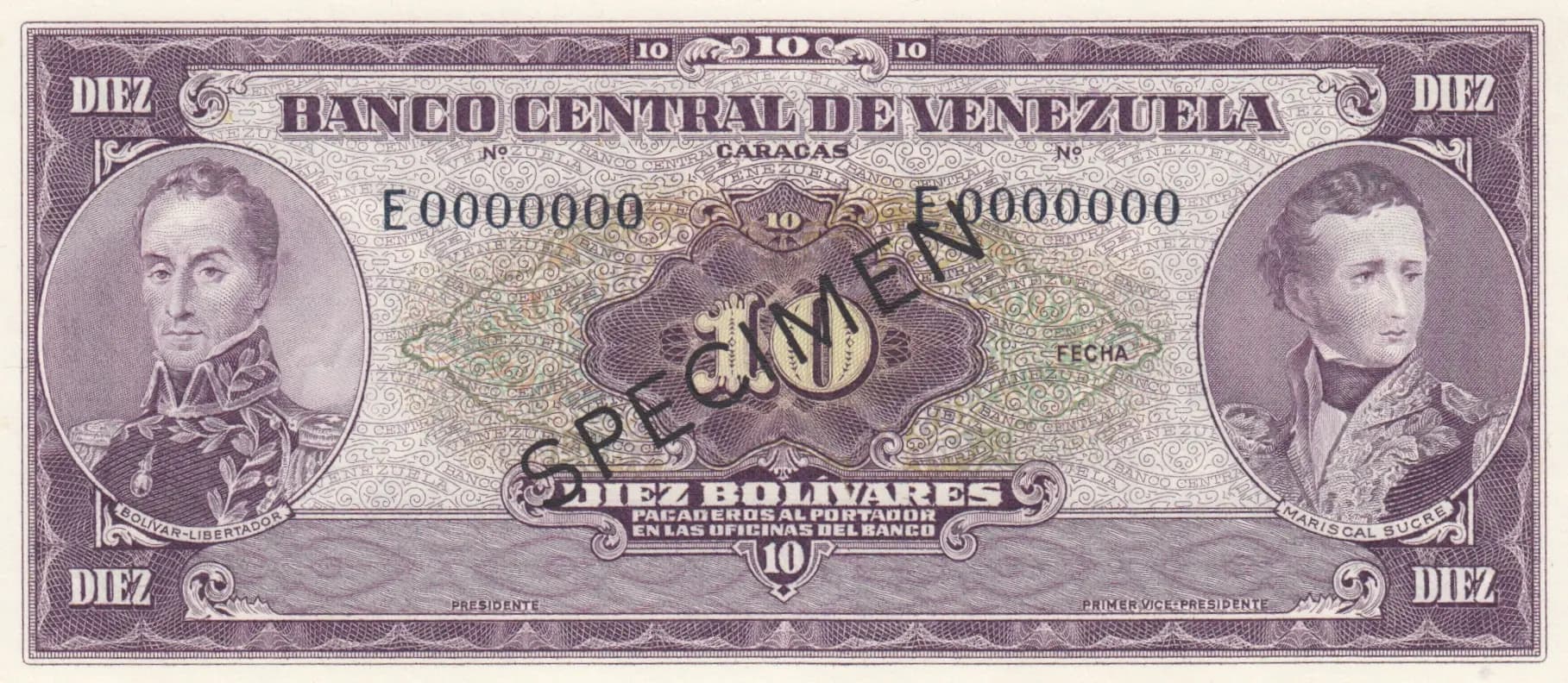
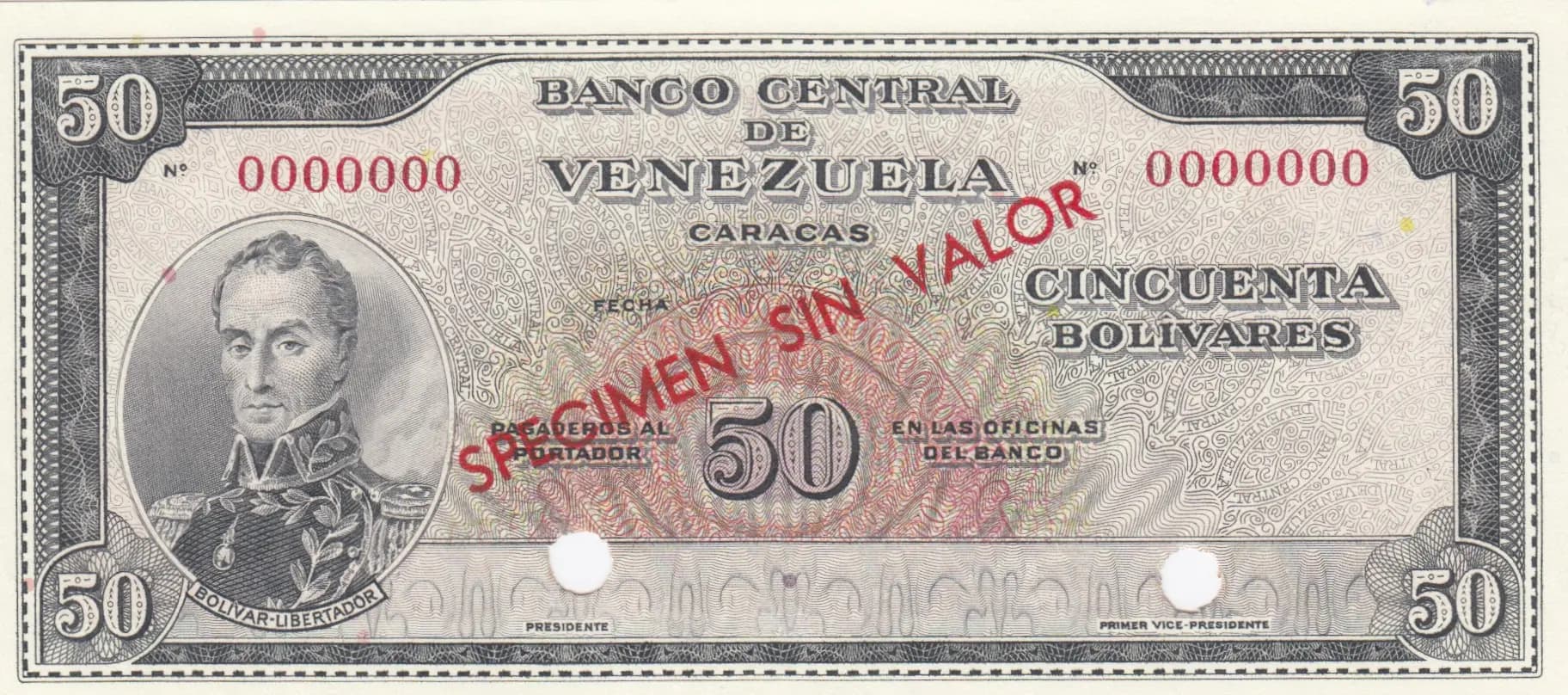
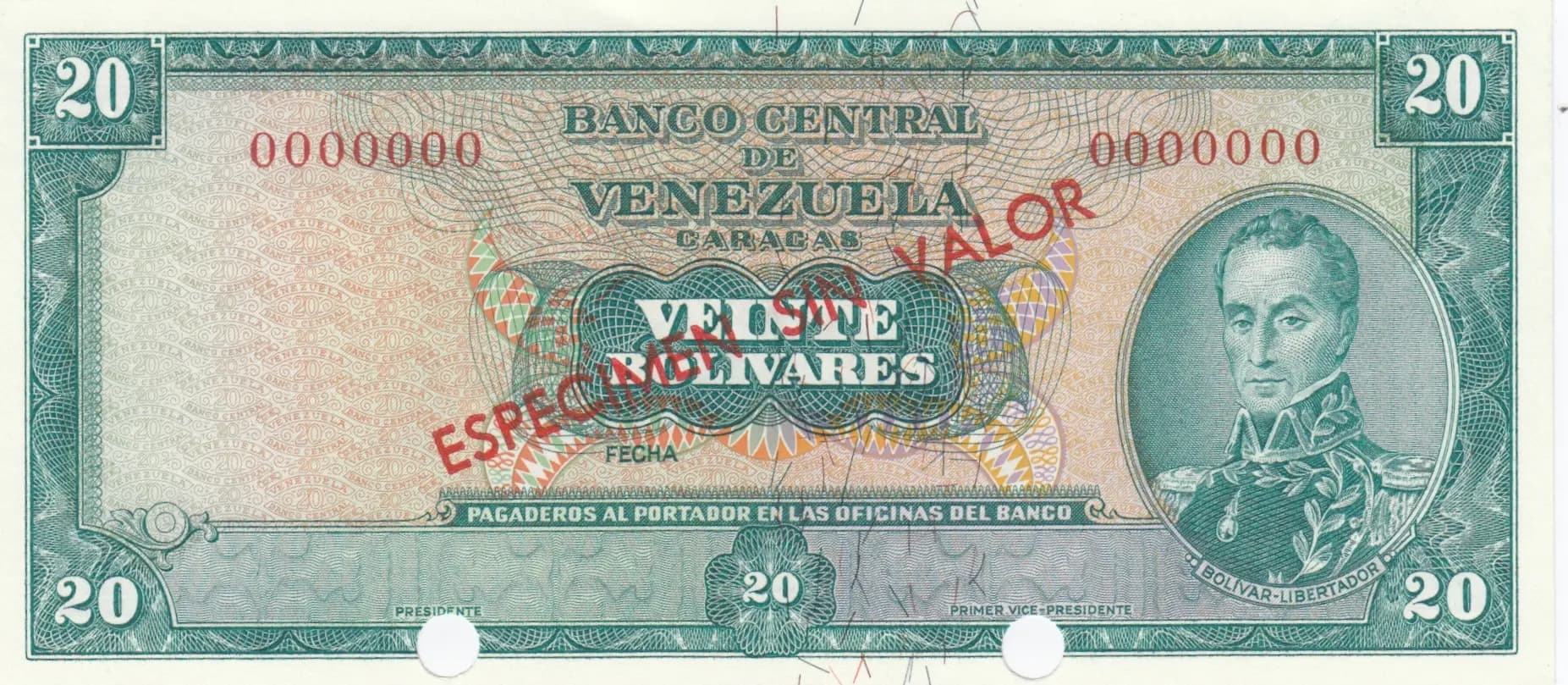
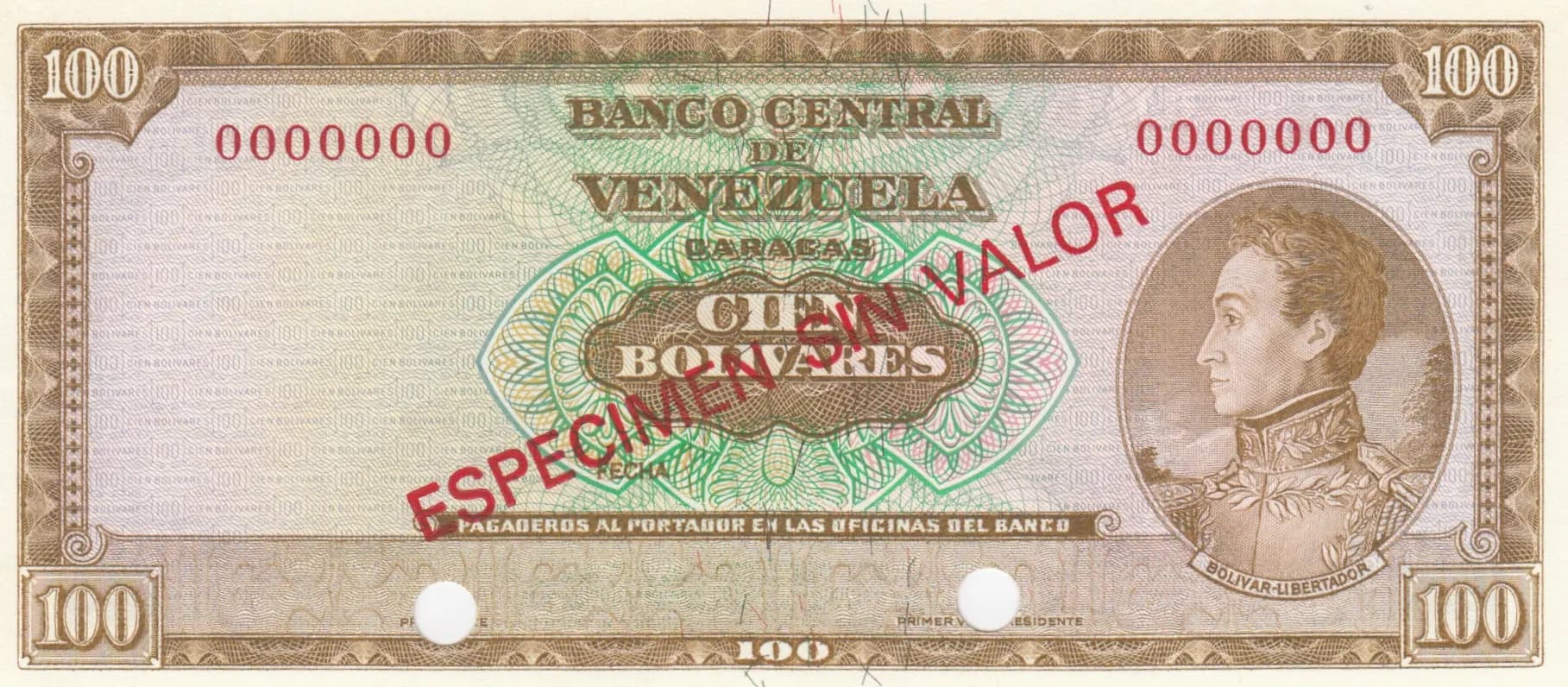
100 bolivares 1971 specimen
Market Prices
2 salesAbout This Note
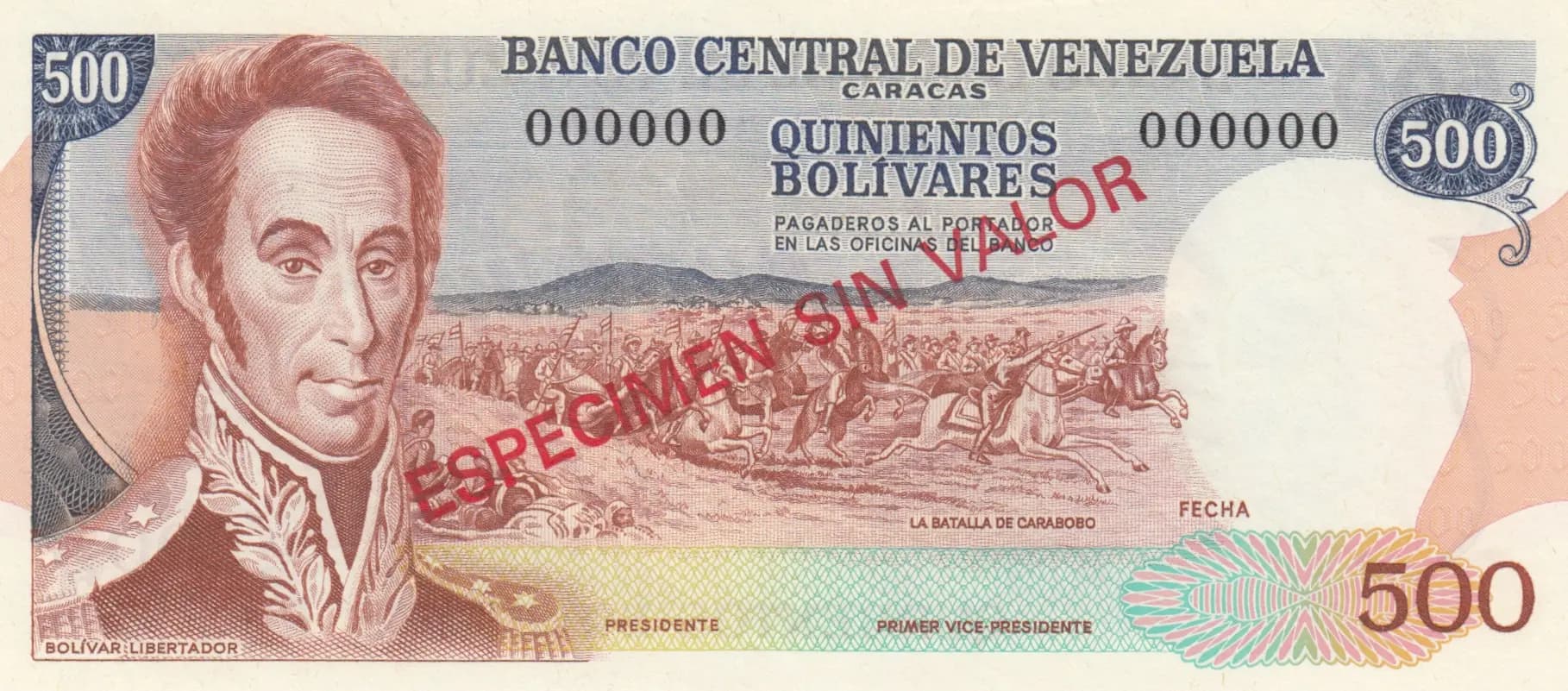
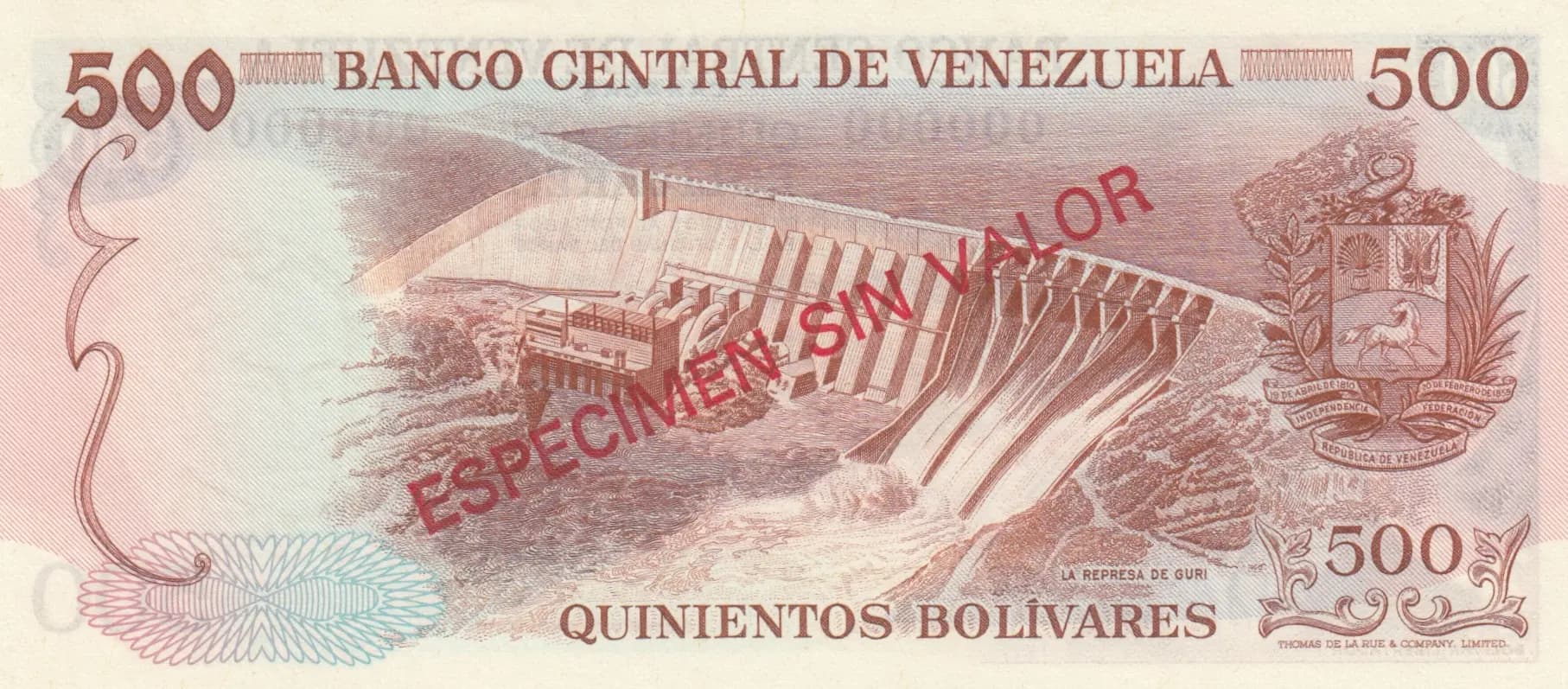
A striking 500 Bolivares specimen note from 1971, issued by Banco Central de Venezuela and printed by Thomas De La Rue. The obverse features a detailed portrait of Simón Bolívar in military dress with the iconic Battle of Carabobo depicted in the center background, while the reverse showcases the impressive Guri hydroelectric dam. This specimen note, marked with red 'ESPECIMEN' overprint and bearing the specimen serial format, is in uncirculated condition with sharp engraving and vivid multicolor printing (brown, blue, tan, and burgundy), making it a significant example of Venezuelan monetary design from the early 1970s.
Common. While specimen notes command a premium over circulation issues, the 2019 catalog value of $22.50 for UNC circulation notes of this Pick number indicates a substantial print run. The eBay market data shows recent sales of regular specimens in the $89-$2,175 range depending on condition grade (AUNC vs. PMG 64 graded), suggesting steady collector availability. Specimen notes from this 1971-1972 issue series do not appear to have been produced in severely limited quantities, and this particular note, while not circulated, is representative of institutional specimen distribution rather than a rare, short-run issue. No evidence of recall or withdrawal from issue.
This note commemorates two pivotal elements of Venezuelan national identity: Simón Bolívar, the 'Libertador' who led independence movements across South America, and the Battle of Carabobo (1821), which secured Venezuelan independence from Spanish colonial rule. The reverse's prominent depiction of the Guri Dam reflects Venezuela's mid-20th century focus on modernization and hydroelectric development as a cornerstone of national progress and economic sovereignty. The 1971 issuance date places this note within the period of Venezuela's oil boom era, when the nation's petroleum wealth was funding major infrastructure projects like the Guri facility.
The obverse depicts Simón Bolívar (1783-1830), Venezuelan military leader and 'Libertador' of northern South America, rendered in detailed engraving in three-quarter military dress with formal 18th/19th century military regalia including decorative collar insignia and star emblems. The background features a dynamic historical battle scene identified as 'La Batalla de Carabobo' (June 24, 1821), showing cavalry and infantry soldiers in combat with mountainous landscape, symbolizing the decisive struggle for Venezuelan independence. Decorative elements include circular national seals in the top corners, ornamental feather or palm frond designs on the right edge, and fine guilloche patterns throughout. The reverse features the Guri Dam (Represa de Guri), one of the world's largest hydroelectric facilities, with its distinctive spillway structure set within a mountainous landscape with water in the foreground. The Venezuelan coat of arms is positioned on the right side, with matching decorative guilloche patterns and corner ornaments. The color palette of red/burgundy, blue-gray, tan/beige, and cream creates strong visual contrast characteristic of De La Rue's high-security currency design.
FRONT: 'BANCO CENTRAL DE VENEZUELA' (Central Bank of Venezuela) / 'CARACAS' (city of issue) / '500' and 'QUINIENTOS BOLÍVARES' (Five Hundred Bolivares - denomination) / 'BOLÍVAR-LIBERTADOR' (Bolívar the Liberator - identifying the portrait) / 'LA BATALLA DE CARABOBO' (The Battle of Carabobo) / 'PAGADEROS AL PORTADOR EN LAS OFICINAS DEL BANCO' (Payable to bearer at the Bank's offices) / 'PRESIDENTE' and 'PRIMER VICE-PRESIDENTE' (Presidential signature lines) / 'FECHA' (Date field) / 'ESPECIMEN' (Specimen - red overprint). BACK: 'BANCO CENTRAL DE VENEZUELA' (Central Bank of Venezuela) / '500' and 'QUINIENTOS BOLÍVARES' (Five Hundred Bolivares) / 'LA REPRESA DE GURI' (The Guri Dam) / 'THOMAS DE LA RUE & COMPANY, LIMITED' (printer identification) / 'ESPECIMEN' (Specimen - red overprint).
Intaglio (line engraving) combined with multicolor offset lithography for the background underprint. The fine line engraving is evident throughout both obverse and reverse, particularly in the detailed portrait of Bolívar, the battle scene, the dam structure, and all ornamental elements. The multicolor background underprint (visible as the tan, blue-gray, and cream base colors) was applied via lithographic process prior to intaglio overprinting. The specimen marking 'ESPECIMEN SIN VALOR' in red represents an additional overprint. Printer: Thomas De La Rue & Company, Limited, London—the world's premier currency security printer at the time, known for producing high-security banknotes with complex intaglio designs.
This is Pick-56s (the 's' designating specimen status). The obverse serial number format shows '000000' with serial number prefix 'A' as noted in the reference data, consistent with Venezuelan specimen issue protocols of the period. The red 'ESPECIMEN SIN VALOR' overprint is the defining characteristic of this specimen variety, distinguishing it from circulation issues (Pick-56). The note is dated 1971 as indicated by the catalog; a 1972-dated variety may exist within the same Pick designation. No maker's mark or additional secret marks are evident in the visual analysis. The specimen format with canceled serial (000000) confirms this was not intended for circulation and represents the standard specimen distribution to banks and collectors.