100 bolivares 1972 specimen
Market Prices
About This Note
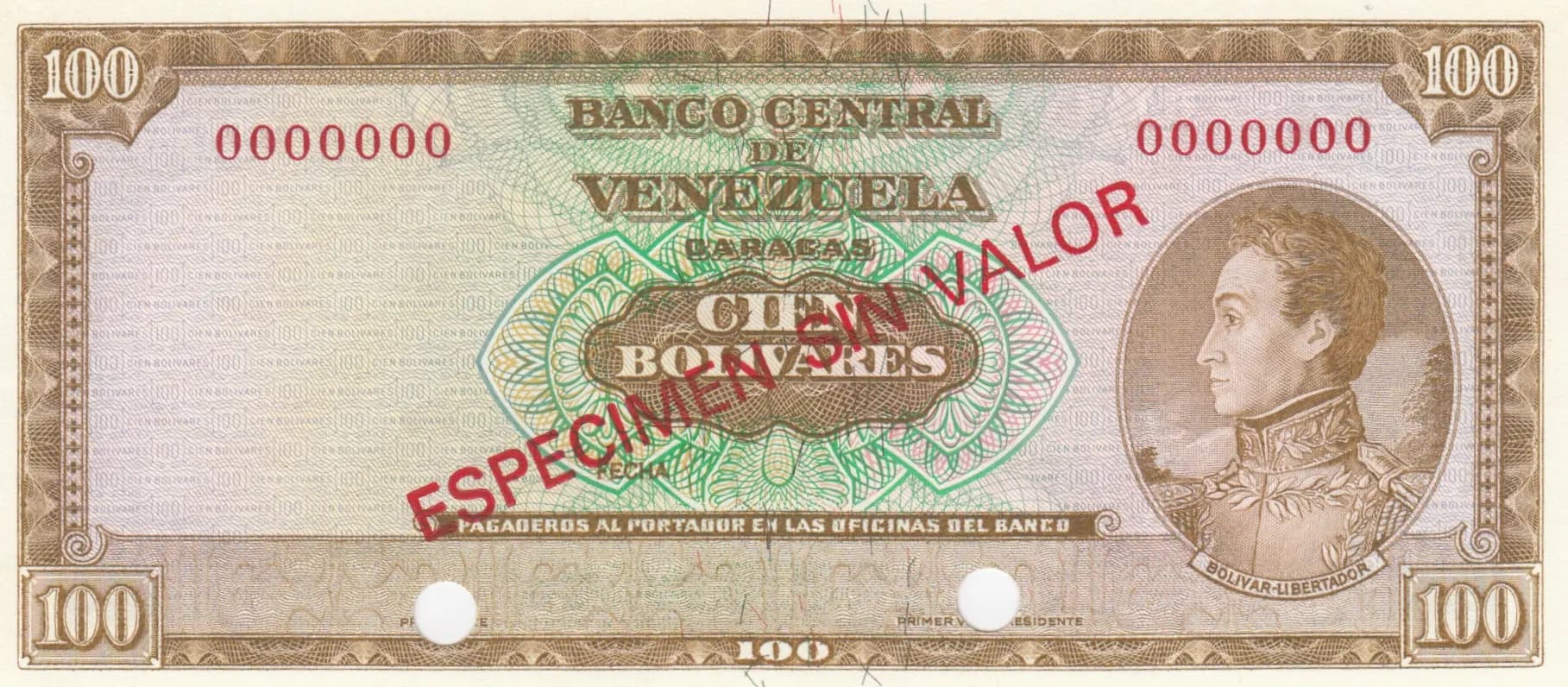
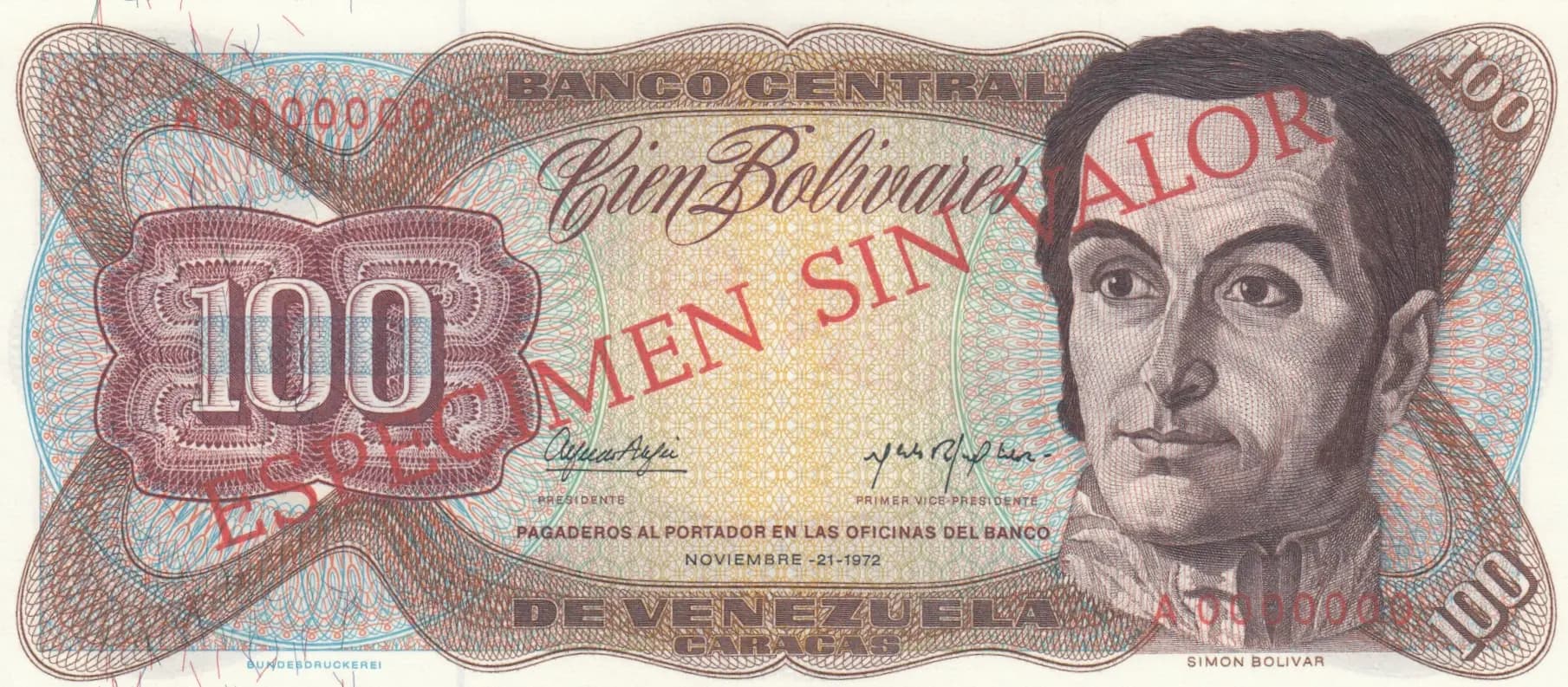
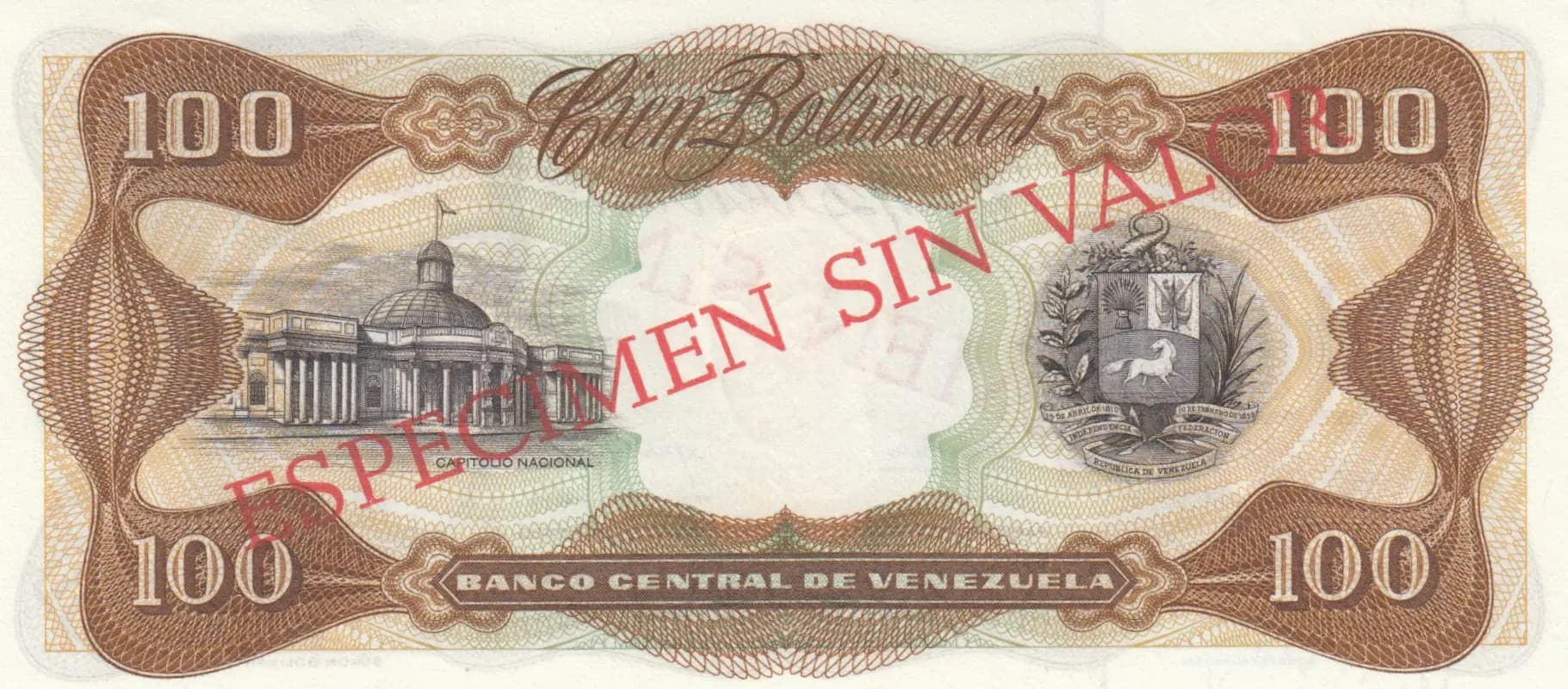
This is a 1972 specimen note of 100 Venezuelan Bolívares issued by the Banco Central de Venezuela, printed by Bundesdruckerei Berlin. The note displays excellent condition with intricate brown, blue, and red multicolor printing, featuring a portrait of Simón Bolívar on the obverse and the neoclassical Capitolio Nacional on the reverse. The diagonal red 'ESPECIMEN SIN VALOR' overprint clearly identifies this as a non-circulating specimen with museum or collection significance rather than monetary value.
Common. This is a specimen note from a regular issue with a standard print run during 1972-1981. The catalog reference price of $65 UNC (2019) and eBay listings ranging from $6.50 to $93.47 (with most standard grades between $7-$40) indicate normal market availability. Specimen notes, while not circulated, were produced in reasonable quantities as proofs and distribution samples, making them far more common than true error notes or limited mintage pieces. The abundance of comparable sales data confirms this is a standard specimen from a well-documented series.
This 1972 specimen note commemorates Venezuela's national heritage through its iconography: Simón Bolívar, the revolutionary leader who liberated multiple South American nations from Spanish colonial rule, appears as the primary portrait, while the Capitolio Nacional represents Venezuela's democratic institutions and governmental authority. The note was issued during a period of economic stability in Venezuela under the presidency of Carlos Andrés Pérez, before the tumultuous economic crises that would later affect the country's currency.
The obverse features a three-quarter profile portrait of Simón Bolívar facing left, positioned on the right side of the note, rendered in high-quality engraved detail wearing formal attire. The denomination '100' is housed in an ornate decorative cartouche on the left. The reverse showcases the Capitolio Nacional, a neoclassical domed government building with columned portico, positioned on the left side, with the Venezuelan coat of arms on the right featuring a shield with the national heraldic symbol (likely a white horse representing freedom) flanked by palm fronds and other national emblems. Both sides are bordered by intricate guilloche and geometric patterns in brown, tan, and complementary colors, with fine-line security printing throughout the background.
FRONT: 'BANCO CENTRAL' (Central Bank), 'Cien Bolivares' (One Hundred Bolivares), 'ESPECIMEN SIN VALOR' (Specimen Without Value), 'PAGADEROS AL PORTADOR EN LAS OFICINAS DEL BANCO' (Payable to Bearer at the Offices of the Bank), 'NOVIEMBRE -21-1972' (November 21, 1972), 'SIMON BOLIVAR' (Simon Bolivar), 'PRESIDENTE' (President), 'PRIMER VICE-PRESIDENTE' (First Vice-President), '100' (One Hundred). BACK: 'CAPITOLIO NACIONAL' (National Capitol), 'REPÚBLICA DE VENEZUELA' (Republic of Venezuela), 'BANCO CENTRAL DE VENEZUELA' (Central Bank of Venezuela), 'ESPECIMEN SIN VALOR' (Specimen Without Value), '100' (One Hundred).
This specimen note was produced using intaglio engraving (also called line engraving or copperplate printing), the standard security printing method for banknotes. The Bundesdruckerei (BDDK) of Berlin, one of the world's premier security printers, executed the work, as evidenced by the fine detail in the portrait engraving, the intricate guilloche border patterns, and the sophisticated background security line work visible in both the visual analysis and historical catalogs. The multicolor printing was achieved through multiple engraved plates layered in brown, blue, red, tan, and green inks.
This is cataloged as Pick P-55as (specimen variant), with the 's' suffix indicating specimen status. The visual analysis confirms the standard variety characteristics: red 'ESPECIMEN SIN VALOR' overprint, dark brown and brown-violet multicolor design, Simon Bolívar watermark, BDDK printer attribution, and red serial number with A-D prefix range. PMG records indicate one primary specimen variant (P-55s1) for this Pick number. The specimen designation and lack of monetary validity represent the key distinction from regular circulation issues (P-55).