10 shillings 1966
Market Prices
8 salesAbout This Note
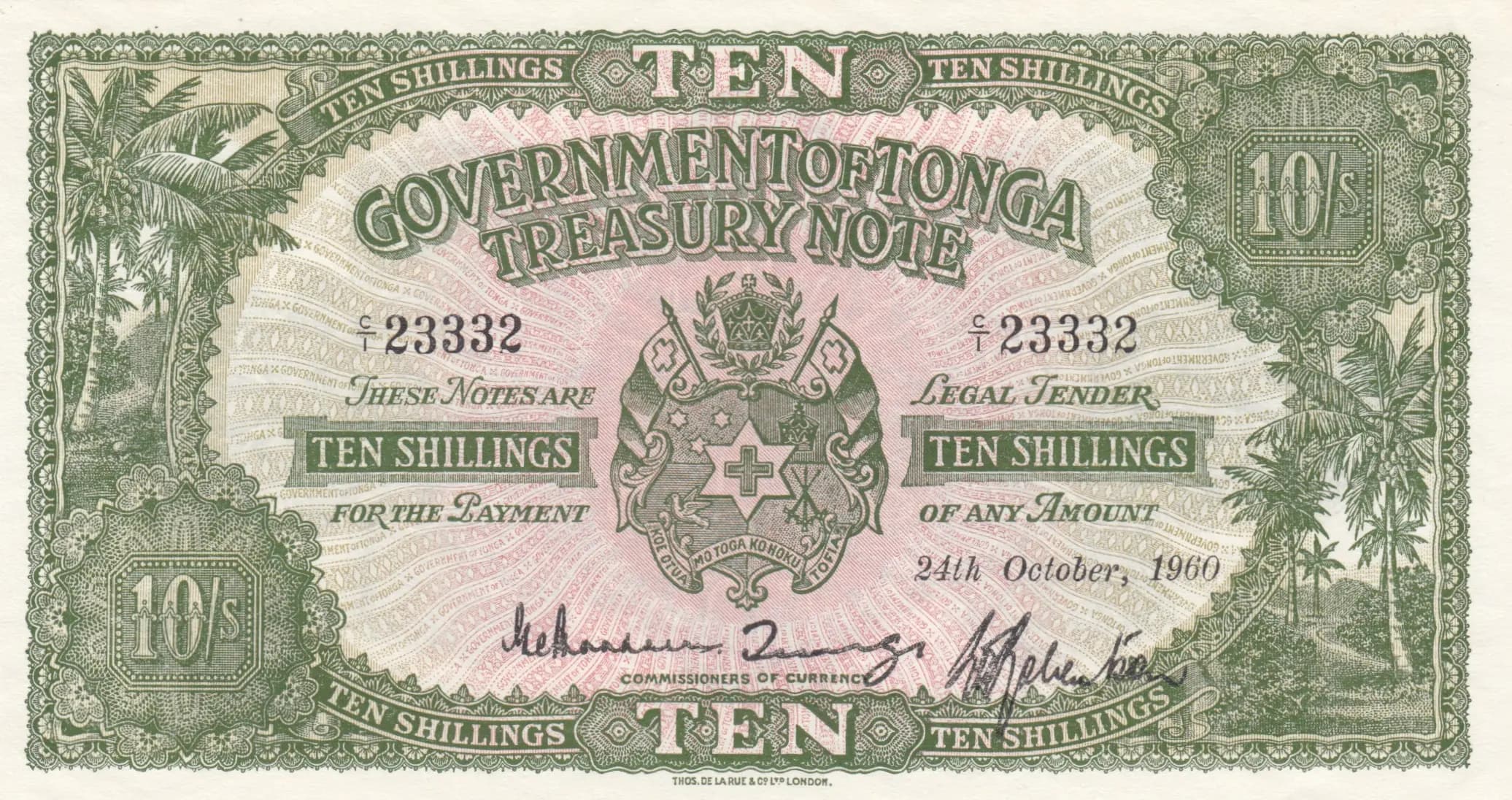
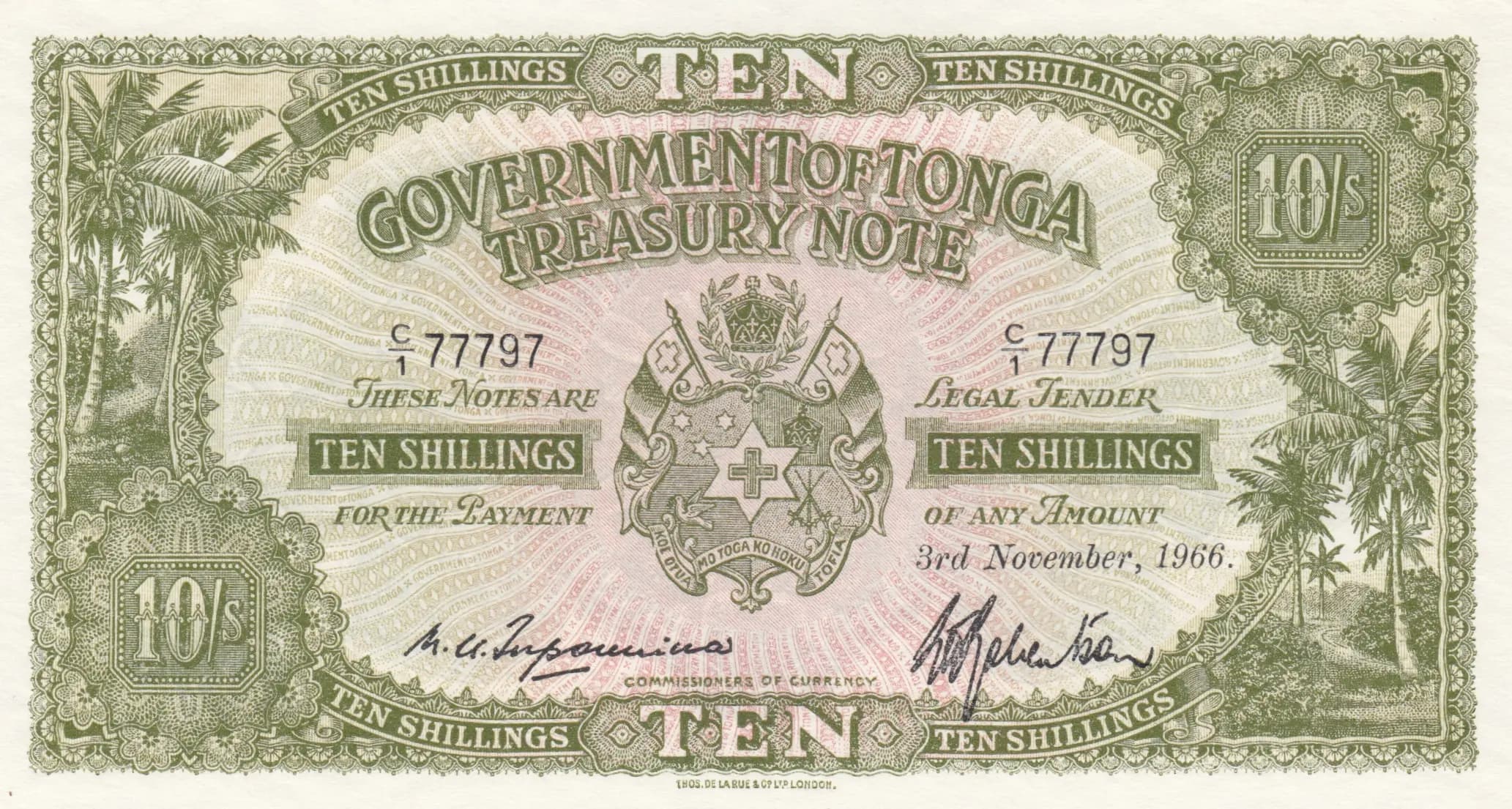
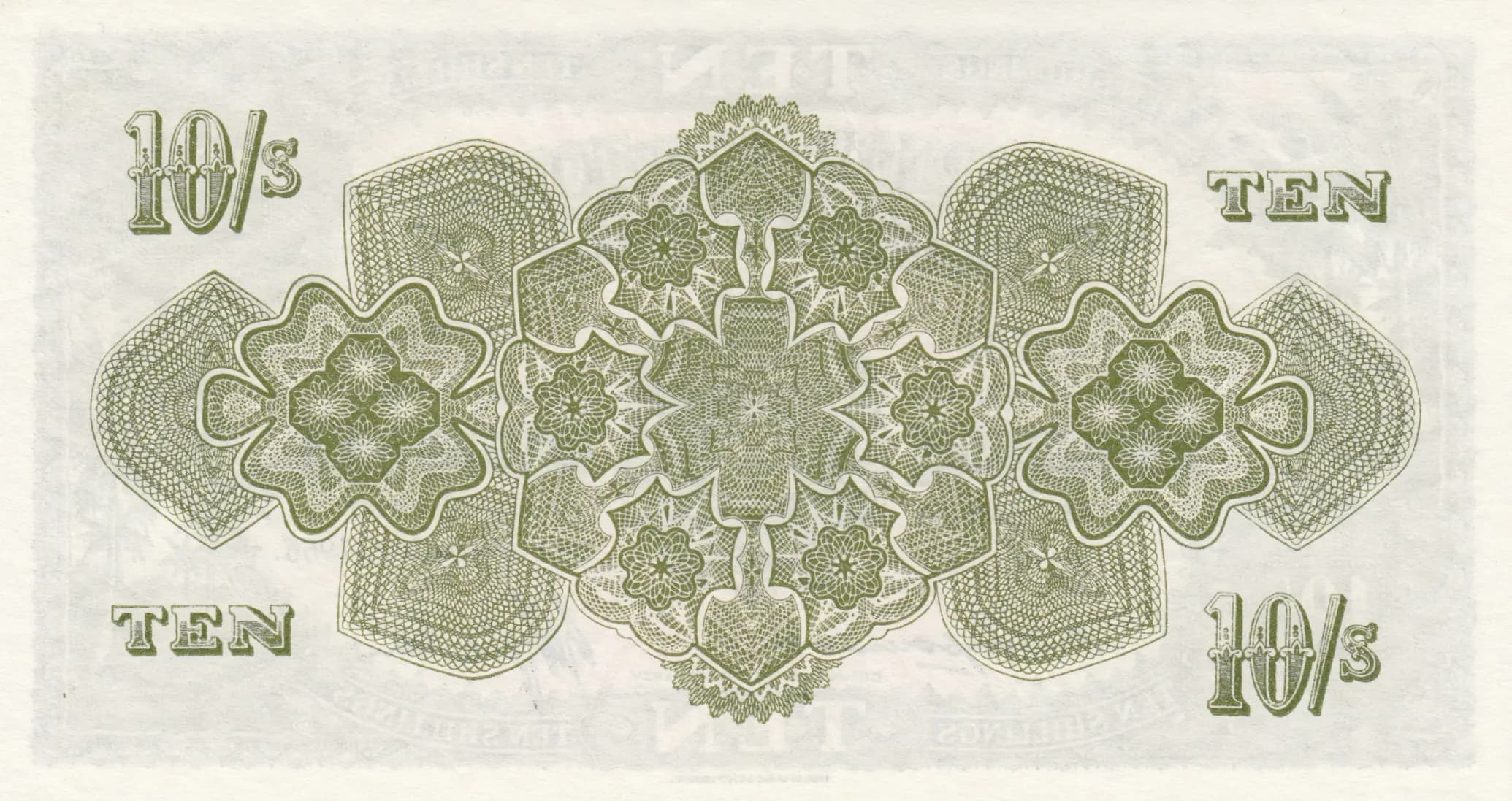
This is an uncirculated 1966 Government of Tonga Treasury Note for 10 shillings, featuring an elegant design centered on the coat of arms of Tonga with crossed flags and a crown. The note displays exceptional preservation with crisp, clean surfaces and vibrant green and pink/red multicolor printing on a cream background. The intricate ornamental borders with palm tree motifs and the reverse's elaborate mandala-like geometric pattern demonstrate fine craftsmanship by Thomas de la Rue, making this an attractive example of mid-20th-century Pacific island currency.
Common. The 1966 Tongan 10 shillings (P-10e) is a regularly encountered issue in the market. eBay transaction data shows consistent sales activity across multiple grades (PMG 55–66), with UNC examples cataloging at $85 (2019 valuation) and recent sales ranging from $64–$201.50 depending on exact grade and market timing. These price points and the consistent availability indicated by multiple sales over several years confirm this as a common note, not scarce or rare. The 1966 issue date represents the final year of this denomination's production before Tonga's currency transition, but sufficient quantities were printed to ensure ready availability in the collector market.
Issued on 3rd November 1966, this note represents Tonga's currency during the latter years of the colonial period, just as the kingdom was approaching independence (achieved in 1970). The coat of arms at the center—featuring crossed flags and a crown—symbolizes Tonga's status under the Tongan monarchy and British Commonwealth influence during this era. The ornamental design with palm trees reflects the island nation's cultural identity and tropical geography, while the designation as a 'Treasury Note' indicates its status as government-backed legal tender during this transitional period.
The obverse features the central coat of arms of Tonga, composed of a shield with geometric patterns beneath a crown, flanked by crossed flags symbolizing the nation's sovereignty and Commonwealth connections. Ornamental borders frame the design on both sides, incorporating stylized palm tree motifs that reference Tonga's tropical island setting. Two authorized signatures appear below the coat of arms, representing the officials authorizing the note's issue. The reverse presents an elaborate symmetrical ornamental design of geometric and floral patterns arranged in a mandala-like configuration with a central cross motif, serving both aesthetic and anti-counterfeiting purposes. The denomination '10/s' (10 shillings) appears in all four corners and center positions across both sides.
Front side: 'GOVERNMENT OF TONGA TREASURY NOTE' (main issuer designation); 'TEN SHILLINGS' (denomination, appears at top center and corners); 'THESE NOTES ARE LEGAL TENDER' (legal tender declaration); 'TEN SHILLINGS FOR THE PAYMENT OF ANY AMOUNT' (full denomination and use statement); '3rd November, 1966' (issue date); 'COMMISSIONERS OF CURRENCY' (authorizing body); 'C 77797' (serial number); '10/s' (abbreviated denomination). Back side: 'TEN' (denomination word, top center); '10/s' (abbreviated denomination in top left and right corners). All inscriptions are in English, the official language of Tonga during this period.
This note was produced by Thomas de la Rue (TDLR), London, using multi-color offset lithography, as evidenced by the precise layering of green, pink/red, and cream inks with fine line work throughout. The intricate ornamental borders, detailed geometric patterns, and sharp definition of the coat of arms elements are characteristic of de la Rue's advanced security printing techniques employed during the 1960s. The fine line work and complex color registration visible in both the front arms and reverse mandala design would have provided security features difficult to replicate with contemporary counterfeiting methods.
This note is identified as Pick P-10e, one of four cataloged variants for the base 10 shillings denomination (P-10a, P-10c, P-10d, P-10e). The 'e' designation likely indicates a late-issue or final variant within the 1966 production run. The serial number prefix 'C 77797' suggests this specimen falls within a specific production batch; however, without comprehensive population data by serial number prefix range, the specific distinguishing characteristics between P-10e and other variants cannot be definitively stated from the visual analysis alone. The issue date of 3rd November 1966 confirms this as the latest date for this series, consistent with P-10e being a final variant.