4 shillings 1960
Market Prices
5 salesAbout This Note
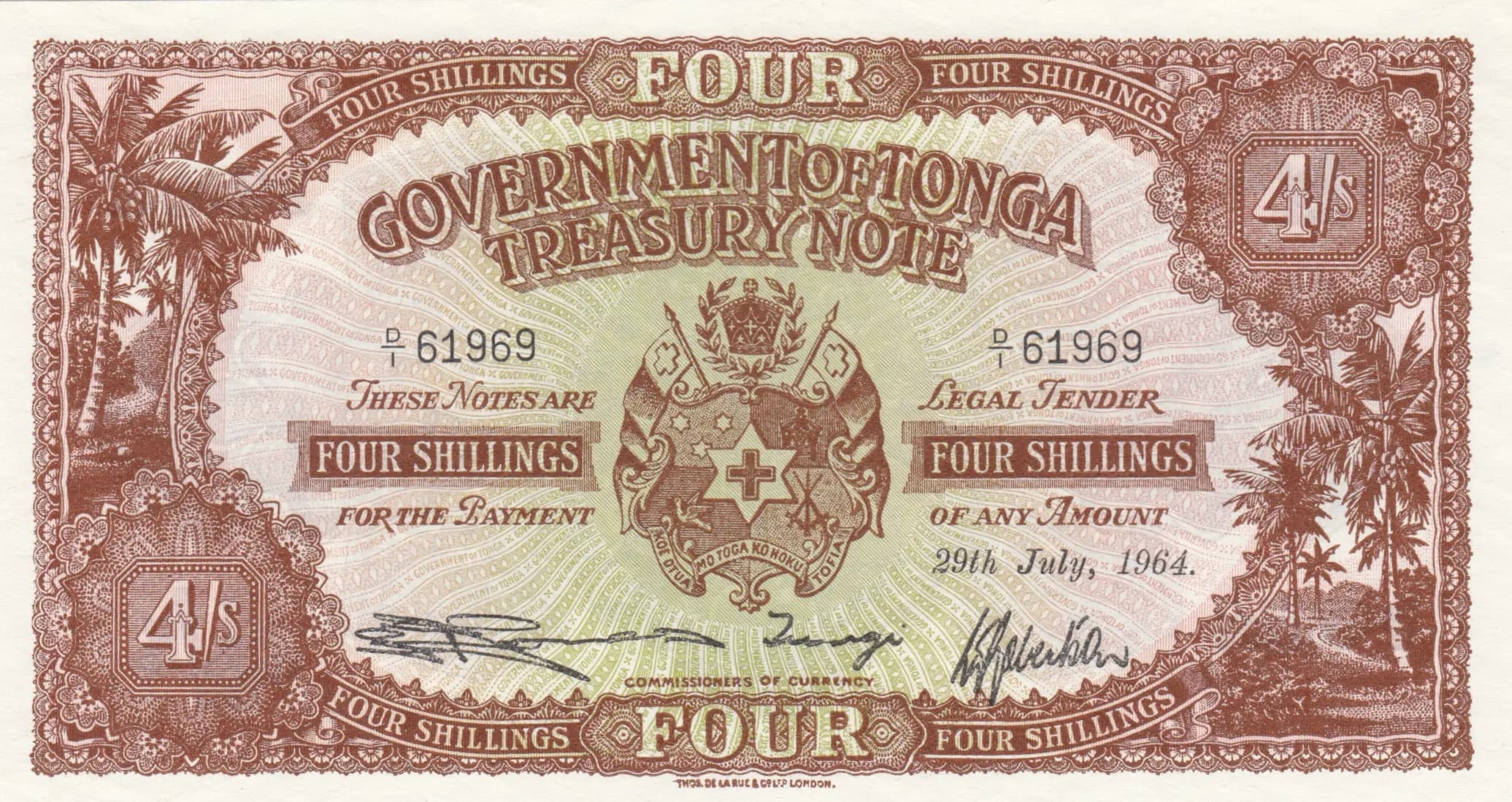
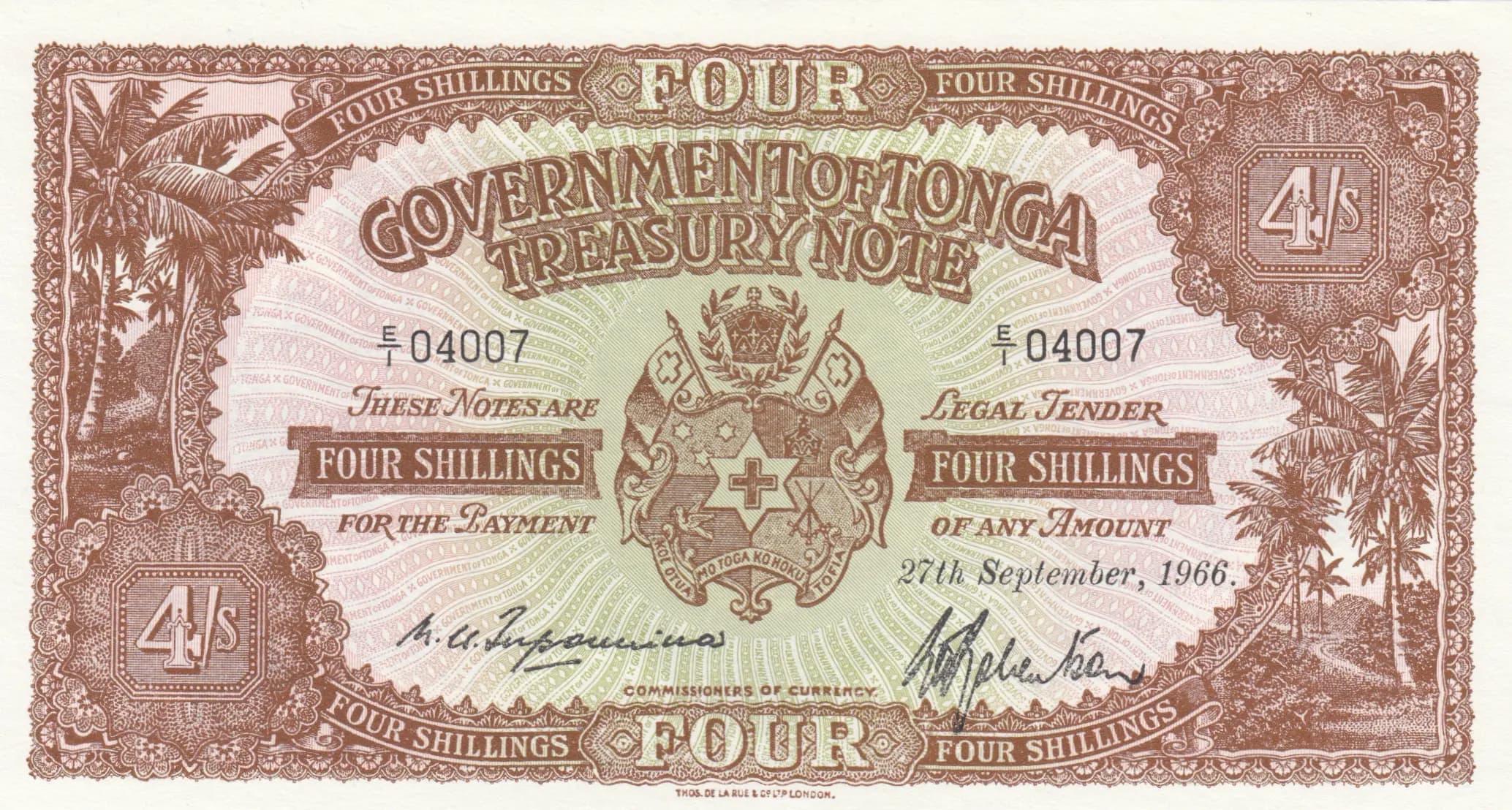
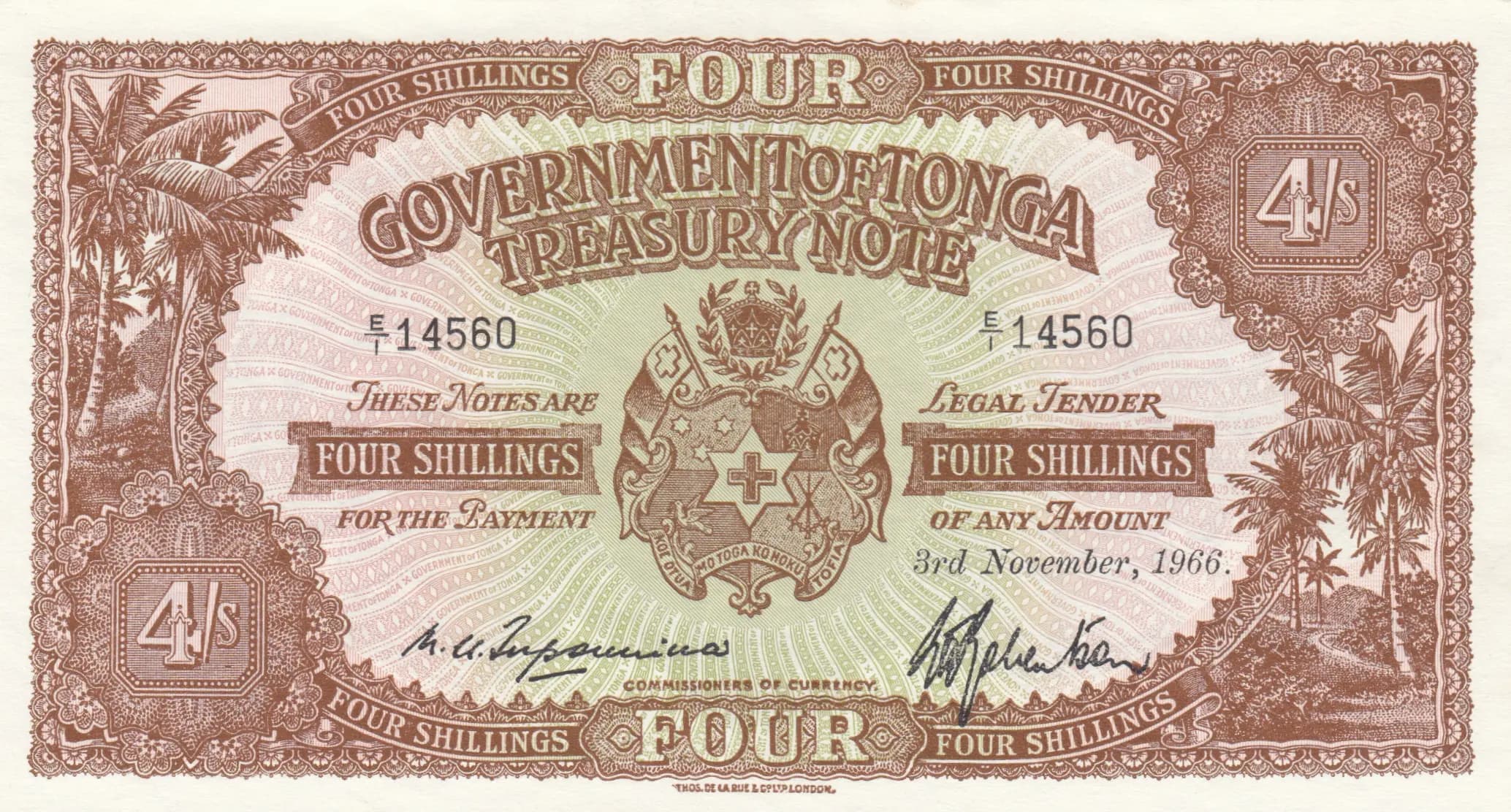
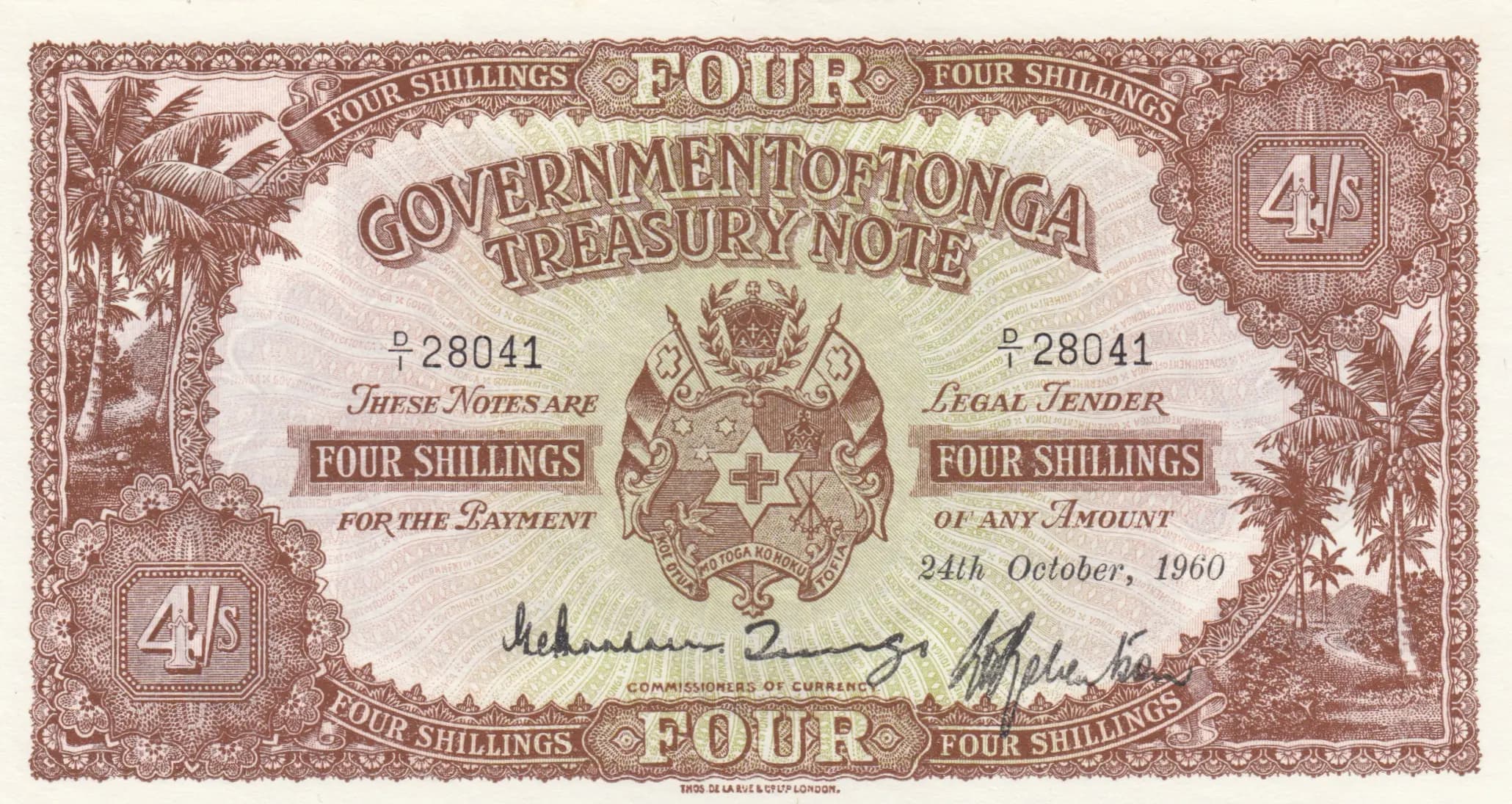
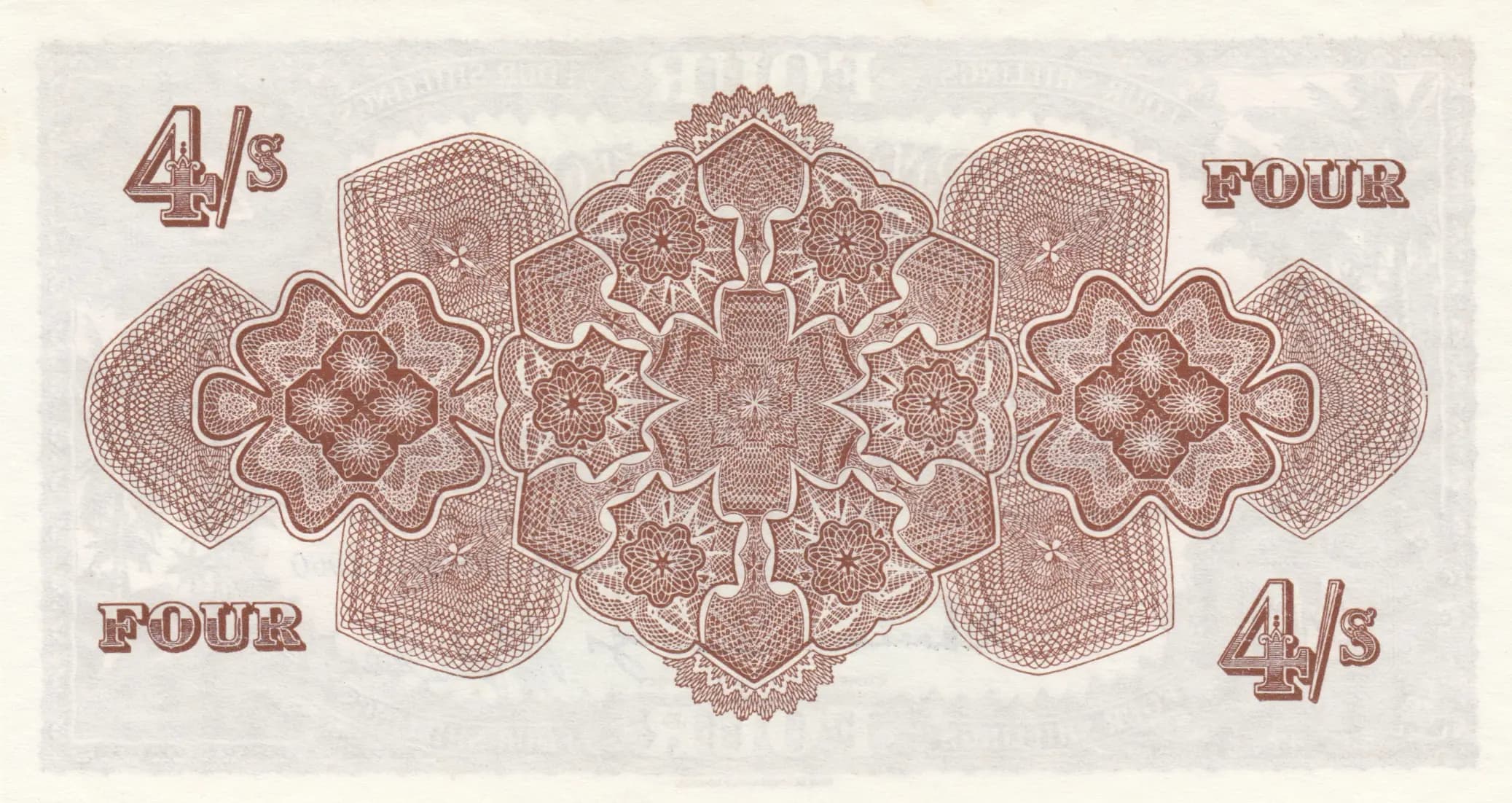
A well-preserved uncirculated example of Tonga's 1960 Government Treasury Note for 4 Shillings, featuring the distinctive coat of arms with crown and crossed flags at center, surrounded by ornate brown decorative borders and tropical palm foliage. The reverse showcases an intricate symmetrical rosette pattern characteristic of De La Rue's fine engraving work. This note represents an important transitional period in Tonga's monetary history, issued shortly before the country's shift to decimal currency.
Common. eBay market data shows UNC examples selling regularly in the $99-100 range (2019-2023 catalog value for UNC: $100), with consistent sales activity over multiple years and auction lots averaging 15-28 bids, indicating steady collector demand rather than scarcity. The note was issued across a broad date range (1960-1966) as a standard treasury issue of the Government of Tonga. The Pick number P-9d represents one of four documented variants by PMG, but this variant is not indicated to be scarcer than others. No historical evidence suggests limited print runs or recall that would elevate rarity status.
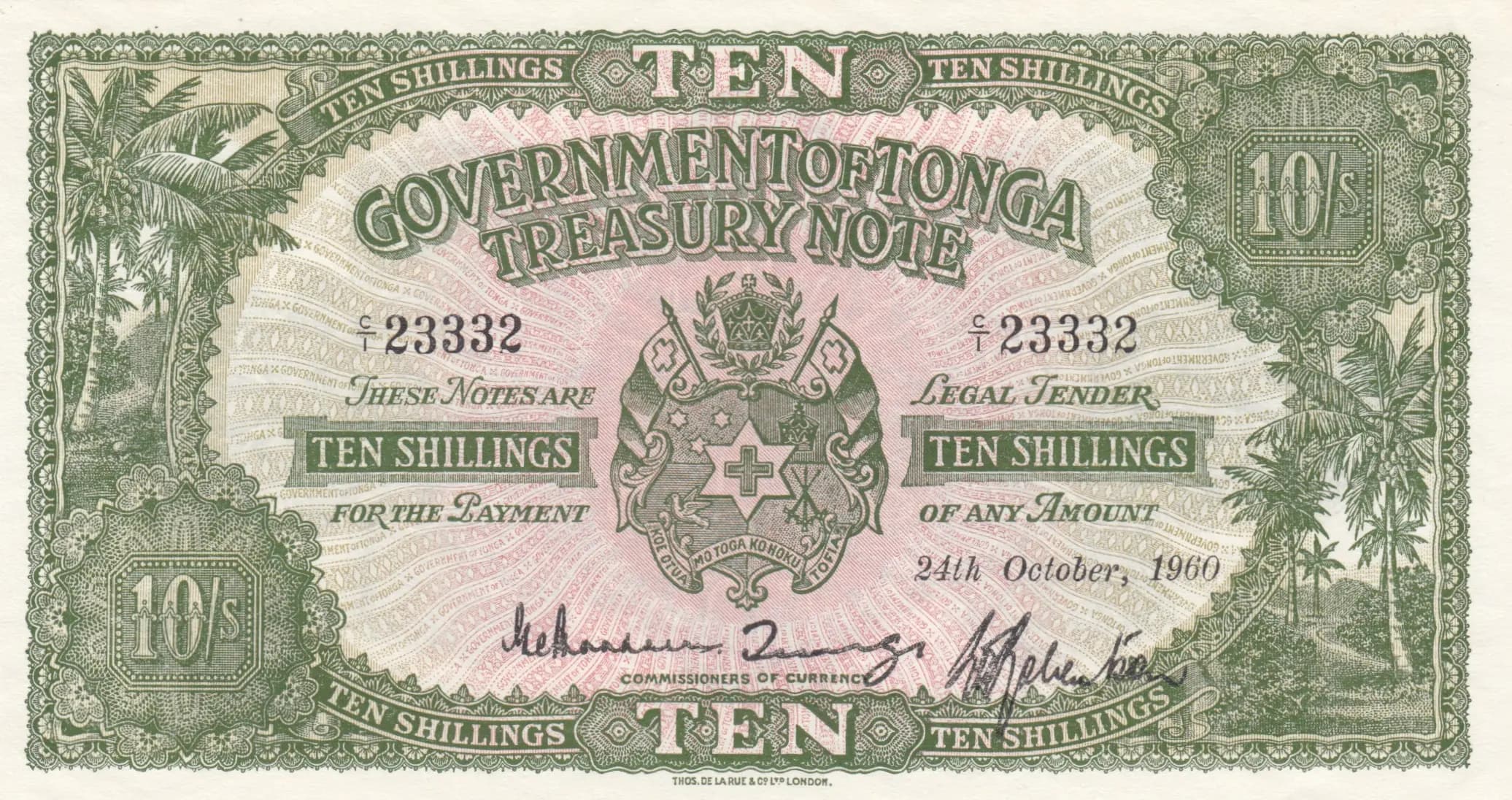
Issued on 24th October 1960 by the Government of Tonga's Treasury, this note reflects Tonga's pre-decimal sterling currency system and the island nation's colonial-era monetary arrangements. The prominent coat of arms with crown symbolizes Tonga's status as a British protectorate during this period, while the reference to 'Commissioners of Currency' indicates the formal monetary authority structure of the era. The 1960 date marks the early phase of Tonga's Treasury Notes, issued during a transitional period before the country would eventually adopt decimal currency and move toward greater monetary independence.
The obverse features a centrally positioned coat of arms of Tonga, incorporating a crown at the apex and crossed flags beneath, representing the nation's heraldic identity during the British protectorate period. The design is framed by an elaborate ornamental border composed of interlocking geometric and floral patterns in brown/reddish-brown engraving. Tropical palm trees flank both sides of the central coat of arms, reflecting Tonga's geographic and cultural identity. The denomination '4 SHILLINGS' is prominently displayed in multiple locations (top center, top right, bottom left) with additional legal tender text and official signatures in the lower center. The reverse presents a highly symmetrical mandala-like rosette pattern of exceptional intricacy, with geometric and floral filigree elements radiating from a central point, demonstrating the security printing sophistication characteristic of De La Rue's work during this era.
FRONT: 'FOUR SHILLINGS' (denomination, appears multiple times); 'GOVERNMENT OF TONGA' (issuing authority); 'TREASURY NOTE' (note type); 'D 28041' (serial number); 'THESE NOTES ARE LEGAL TENDER FOR THE PAYMENT OF ANY AMOUNT' (legal tender declaration); '24th October, 1960' (issue date); 'COMMISSIONERS OF CURRENCY' (monetary authority); '4/S' (denomination abbreviation); 'THOS DE LA RUE & COTT LONDON' (printer identification). BACK: '4/S' (appears in four corners, denomination abbreviation); 'FOUR' (denomination text, appears above and below central pattern).
Intaglio engraving (line engraving) executed by Thomas De La Rue & Co., London. The fine line work visible throughout both obverse and reverse, combined with the intricate rosette pattern and detailed ornamental borders, are characteristic of traditional steel plate engraving used for high-security currency production. The sharp, clear impressions and consistent line weights observed in the visual analysis confirm professional intaglio printing methodology. No evidence of additional security printing techniques (such as microprinting or security threads) is visible, consistent with 1960-era Commonwealth currency production standards.
This example is catalogued as Pick 9d, representing one of four identified variants (P-9a, P-9c, P-9d, P-9e) of the 4 Shillings Treasury Note. All known variants were printed by Thomas De La Rue & Co., London. The specific variety differentiation likely relates to signature combinations, date ranges, or serial number prefixes rather than major design changes. The observed specimen bears the date '24th October, 1960' and serial number 'D 28041', with handwritten signatures visible in the lower portion of the obverse, which may be specific identifying characteristics for this particular variant within the P-9d classification.