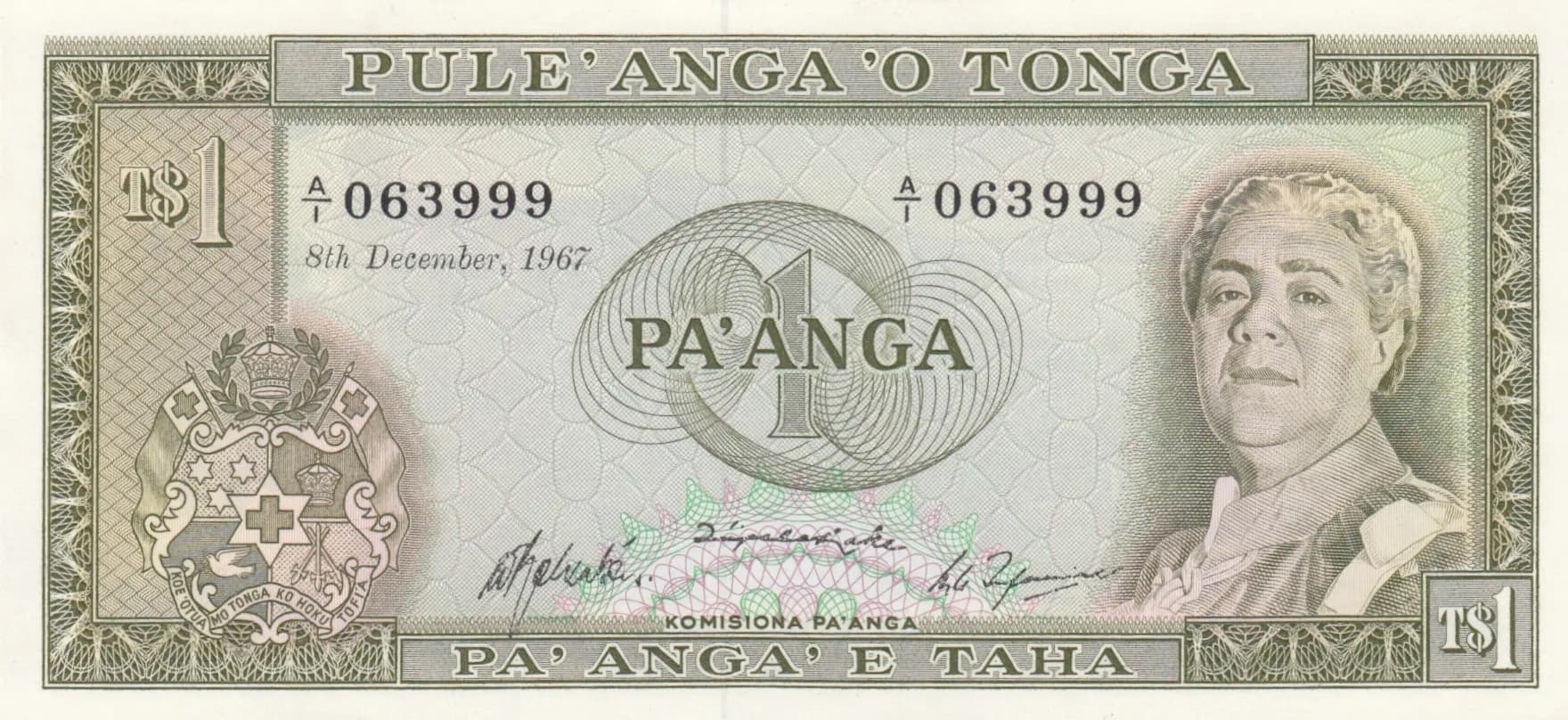
1 pa'anga 1967
“12.04.67”
Market Prices
2 salesAbout This Note
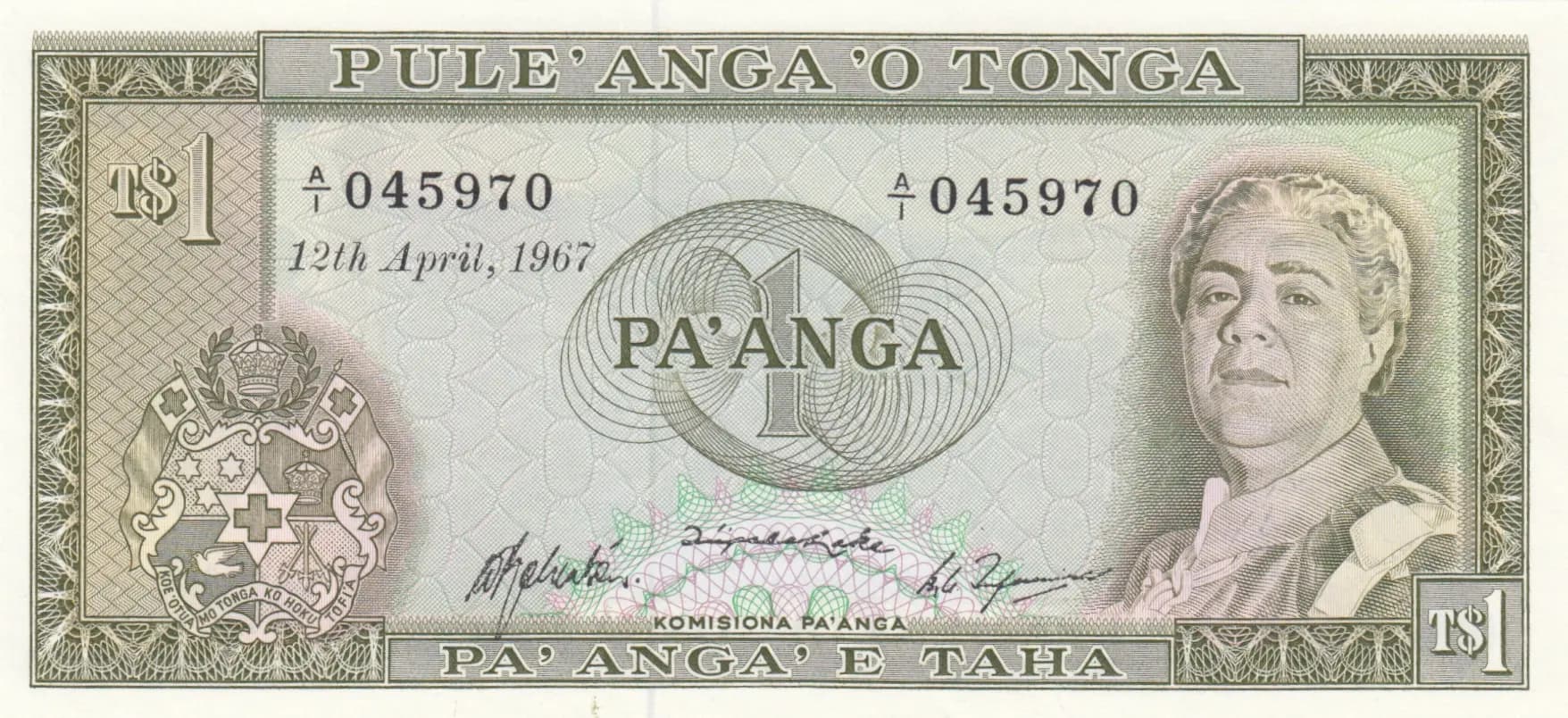
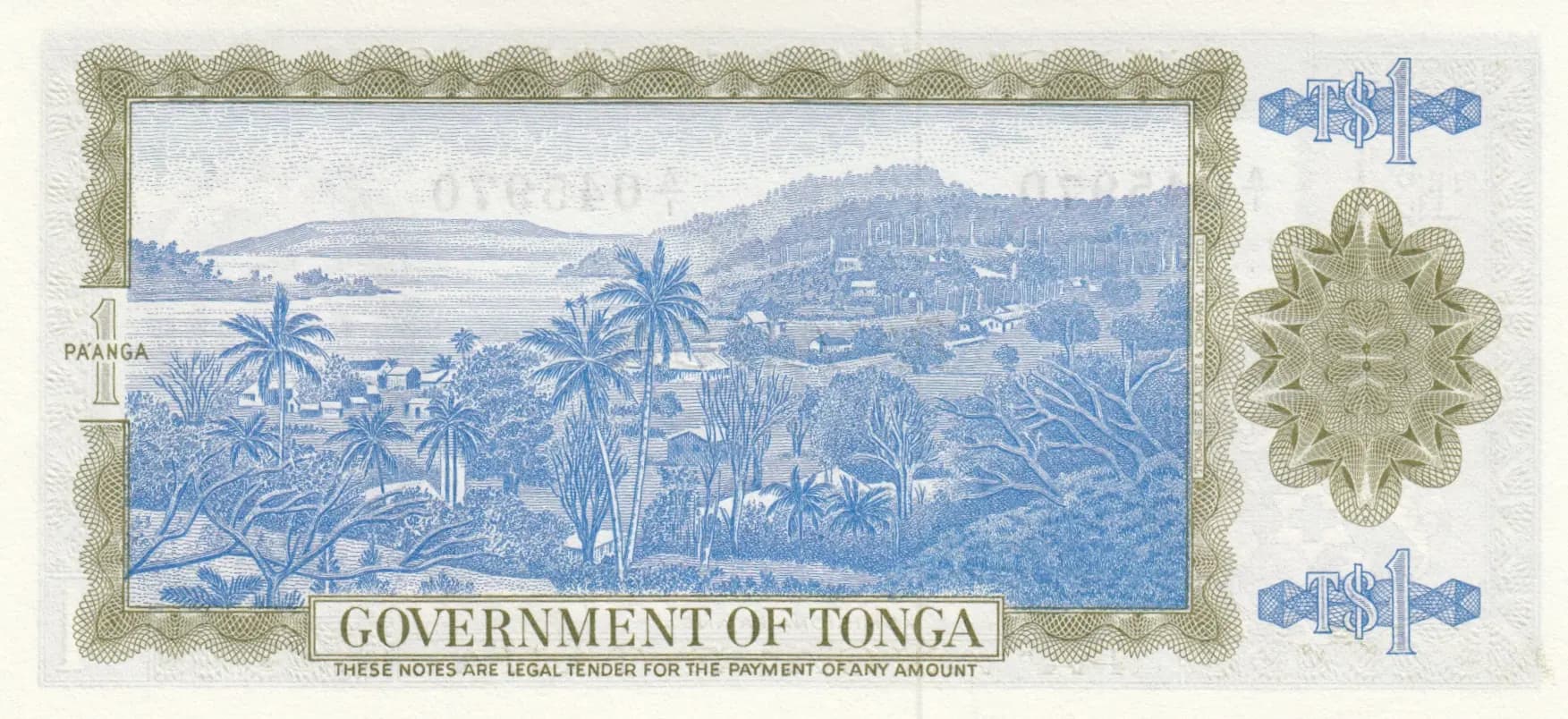
This Tongan 1 Pa'anga from 1967 is an exceptional example of early post-independence currency, presented in pristine uncirculated condition with sharp, clear printing throughout. The note features Queen Salote Tupou III in formal portrait on the obverse and a detailed tropical landscape vignette on the reverse, both rendered in the fine line engraving technique characteristic of Thomas de la Rue's security printing. With its early April 1967 issue date marking Tonga's Currency Commission's inaugural banknote series, this specimen represents a significant piece of Tongan numismatic history in outstanding preservation.
Common. The 1967 1 Pa'anga (Pick P-14b) is the foundational denomination of Tonga's first banknote series and was issued in substantial quantities during the 1967–1972 period. eBay market data shows typical UNC specimens cataloging at $175 (2019 valuation) with regular sales activity at moderate prices ($77–$103 for graded examples), indicating steady collector demand but no scarcity premium. Multiple date and signature varieties exist, further suggesting robust print runs across the series.
This note was issued in 1967 during a pivotal period for Tonga, as the kingdom transitioned to greater financial autonomy under the Currency Commission (Komisiona Pa'anga). The portrait of Queen Salote Tupou III, who reigned during this modernization period, underscores the monarchy's central role in Tongan governance. The reverse landscape—depicting a coastal tropical settlement with palm trees and mountain terrain—reflects the nation's geographic and cultural identity as a Pacific island kingdom.
The obverse features a formal portrait of Queen Salote Tupou III positioned on the right side, rendered in the classical style typical of Commonwealth currency portraiture. The left side displays the Royal Coat of Arms of Tonga—featuring a shield with cross and crown motifs beneath a royal crown. A prominent circular medallion with radiating concentric lines and the numeral '1' occupies the central design area. The reverse depicts an engraved landscape vignette of a Tongan coastal scene: a tropical settlement with colonial-era buildings nestled on a hillside overlooking a bay, with palm trees and lush vegetation in the foreground and mountains visible in the background. All elements are framed by ornate decorative borders with flourishes and geometric patterns, characteristic of high-security banknote design.
FRONT: 'Pule'anga'o Tonga' (Kingdom of Tonga); 'Pa'anga' and 'Pa'anga'e Taha' (One Pa'anga); 'Komisiona Pa'anga' (Currency Commission); '12th April, 1967' (issue date); '1$1' (denomination equivalency); 'A 045970' (serial number). BACK: 'Pa'anga' (Pa'anga currency unit); '1$1' (denomination, appears in corners); 'Government of Tonga'; 'These Notes Are Legal Tender for the Payment of Any Amount' (legal tender declaration).
Intaglio (line engraving) executed by Thomas de la Rue, London, the premier British security printer. The note exhibits multiple layers of intricate fine line work, complex geometric background patterns, and detailed border designs typical of De la Rue's mid-20th century banknote production. Multi-color printing was employed, with olive-green on the obverse (light green/cream background with darker green printing) and blue on the reverse, layered over the engraved security underprint to create the multicolor effect.
This specimen is identified as Pick P-14b, one of four known varieties for the 1 Pa'anga denomination (P-14a, P-14b, P-14c, P-14d, plus specimen note P-14s). The specific variety is likely determined by signature combinations and/or minor printing differences; the observed date of 12th April 1967 and serial number prefix 'A' suggest this falls within the earliest issue cohort. The exact signature variety cannot be determined from visual analysis alone, but the April 1967 date places it among the inaugural Currency Commission emissions.