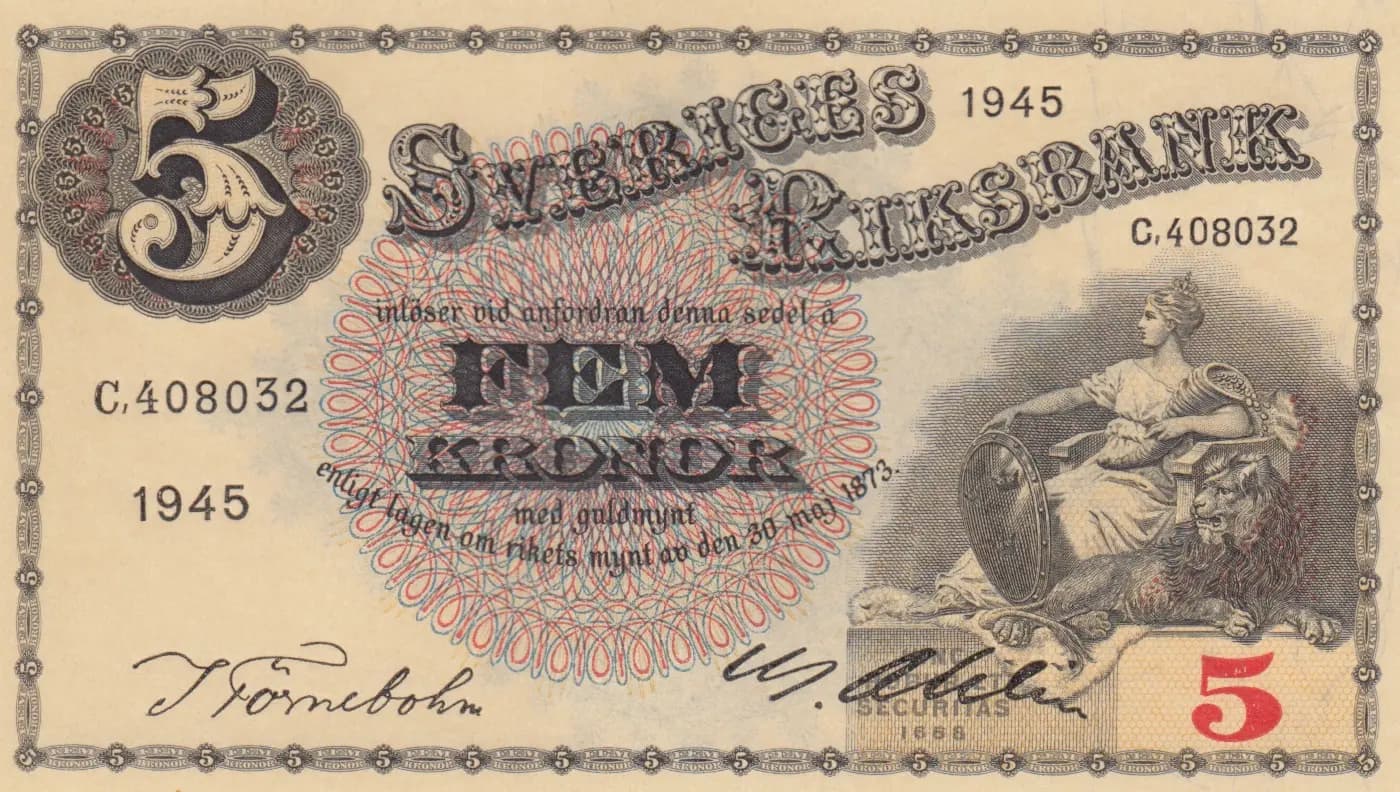
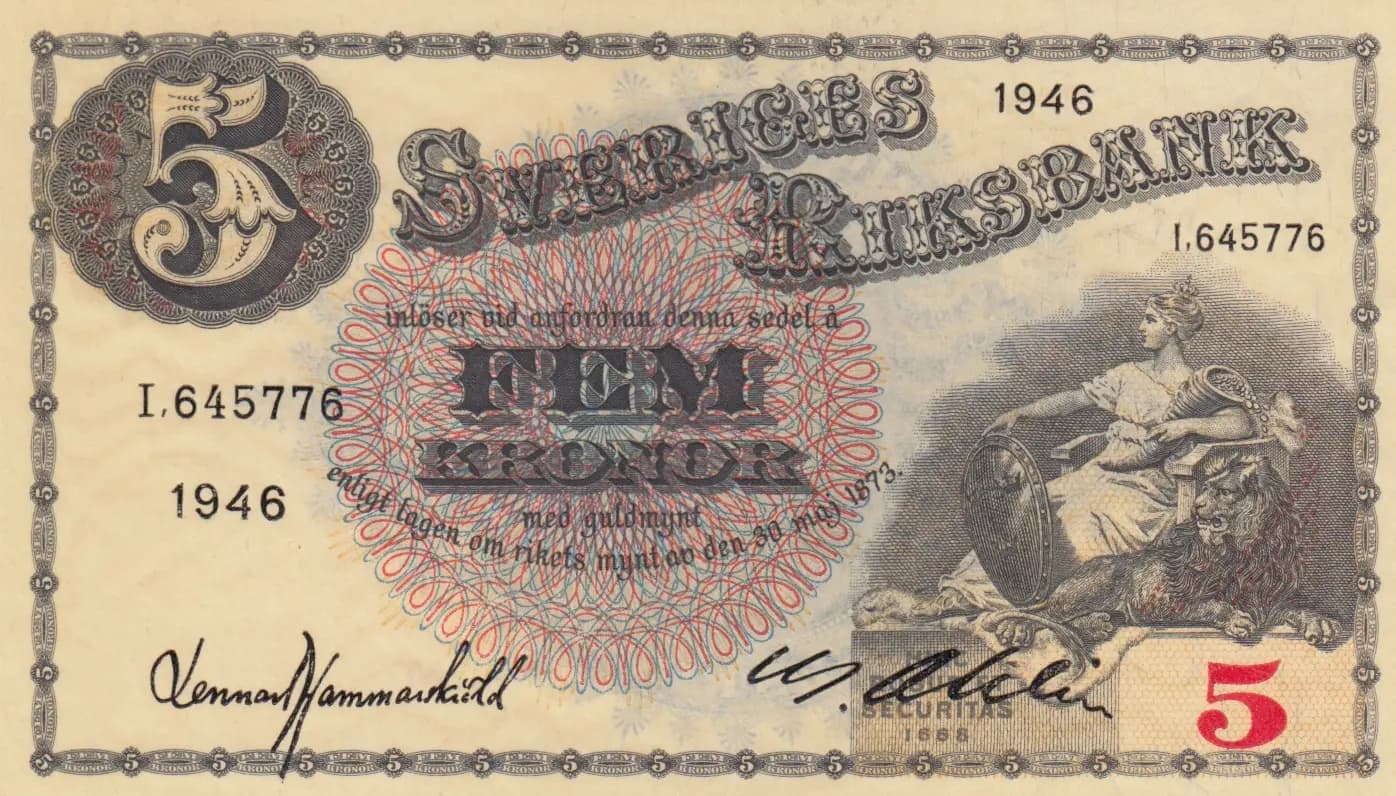
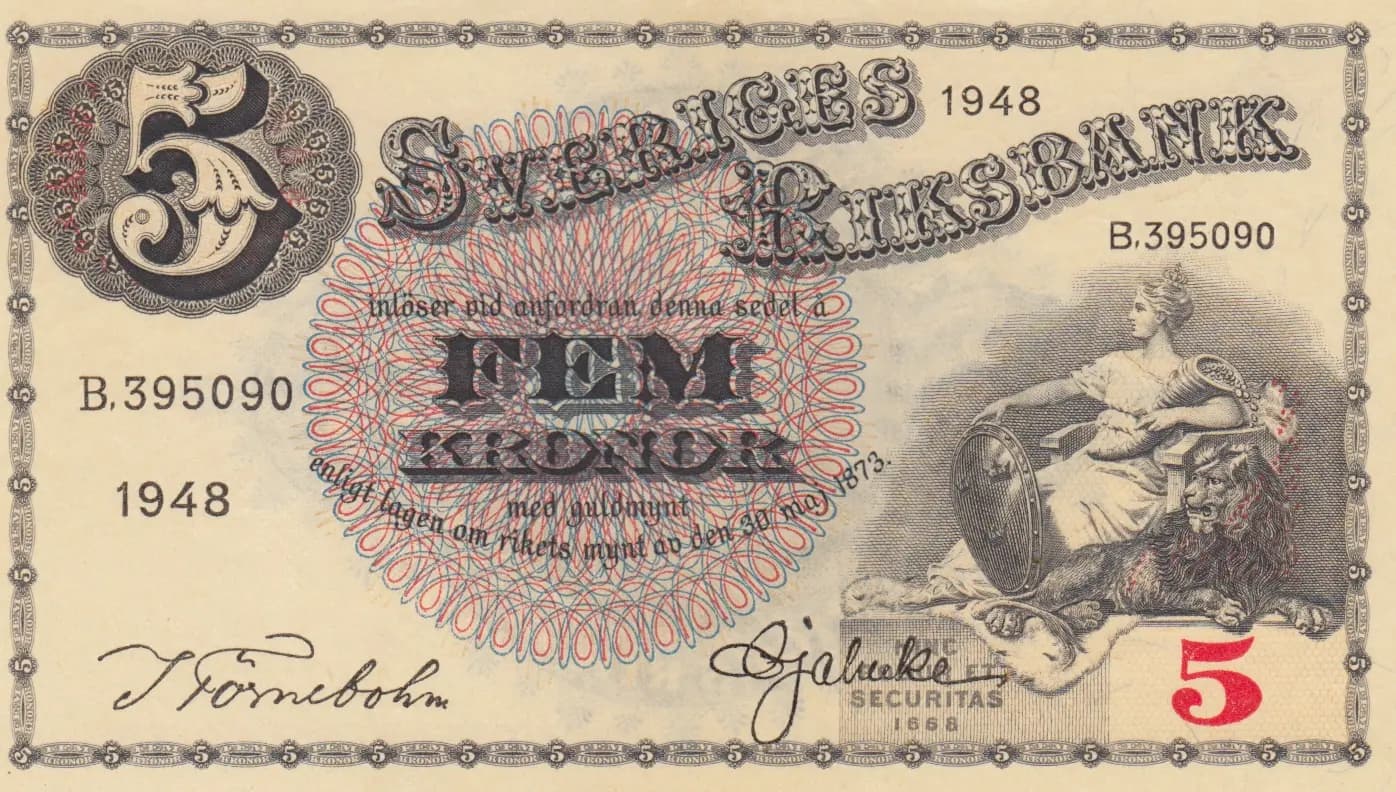
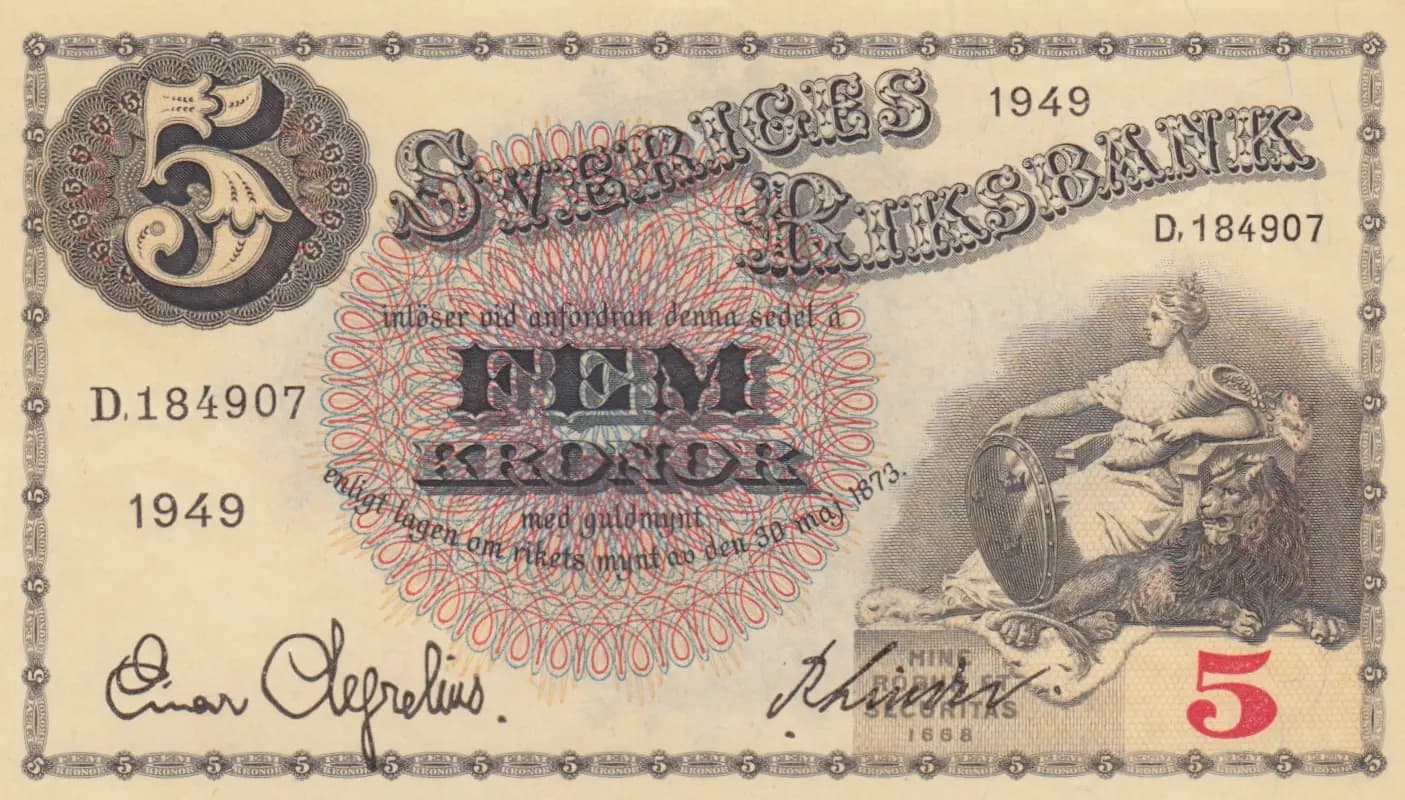
5 kronor 1947
Market Prices
26 salesAbout This Note
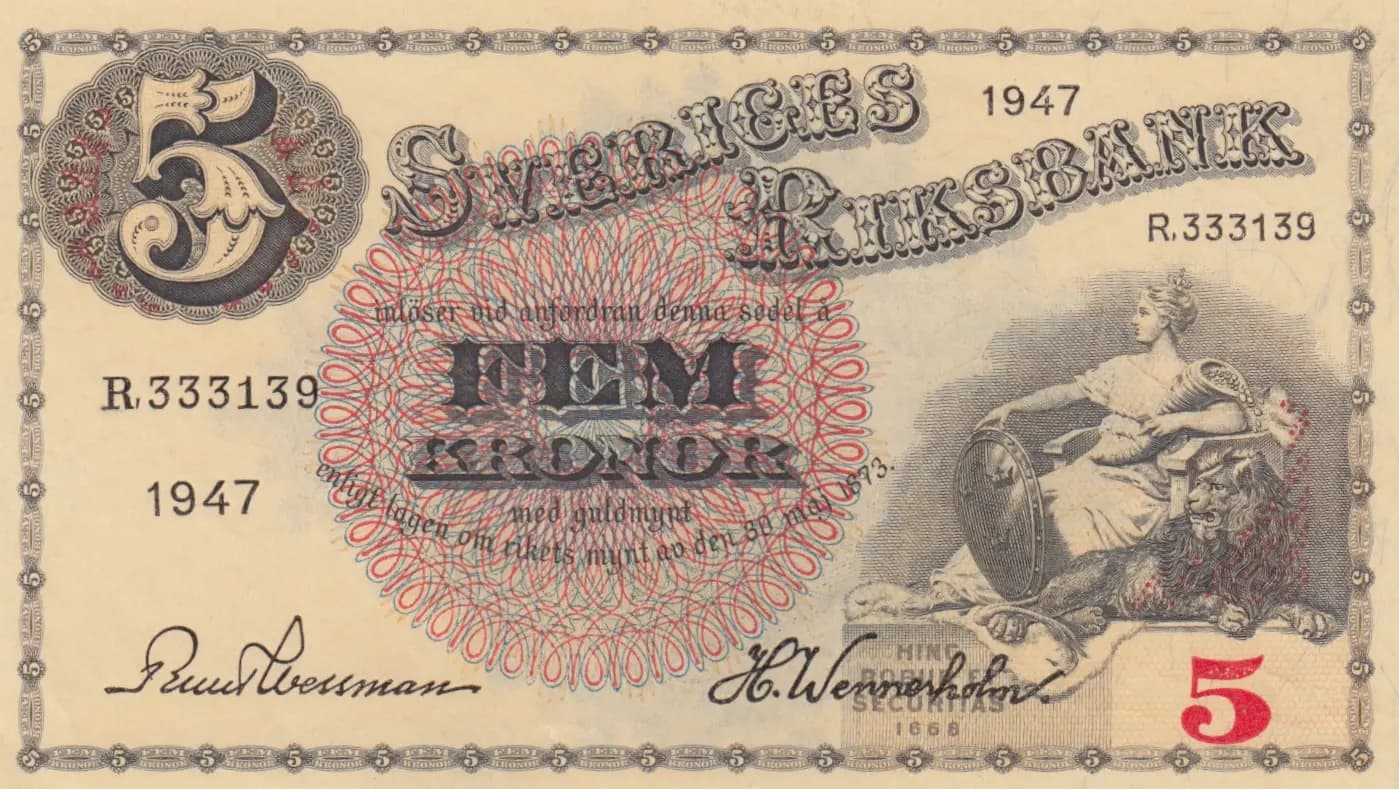
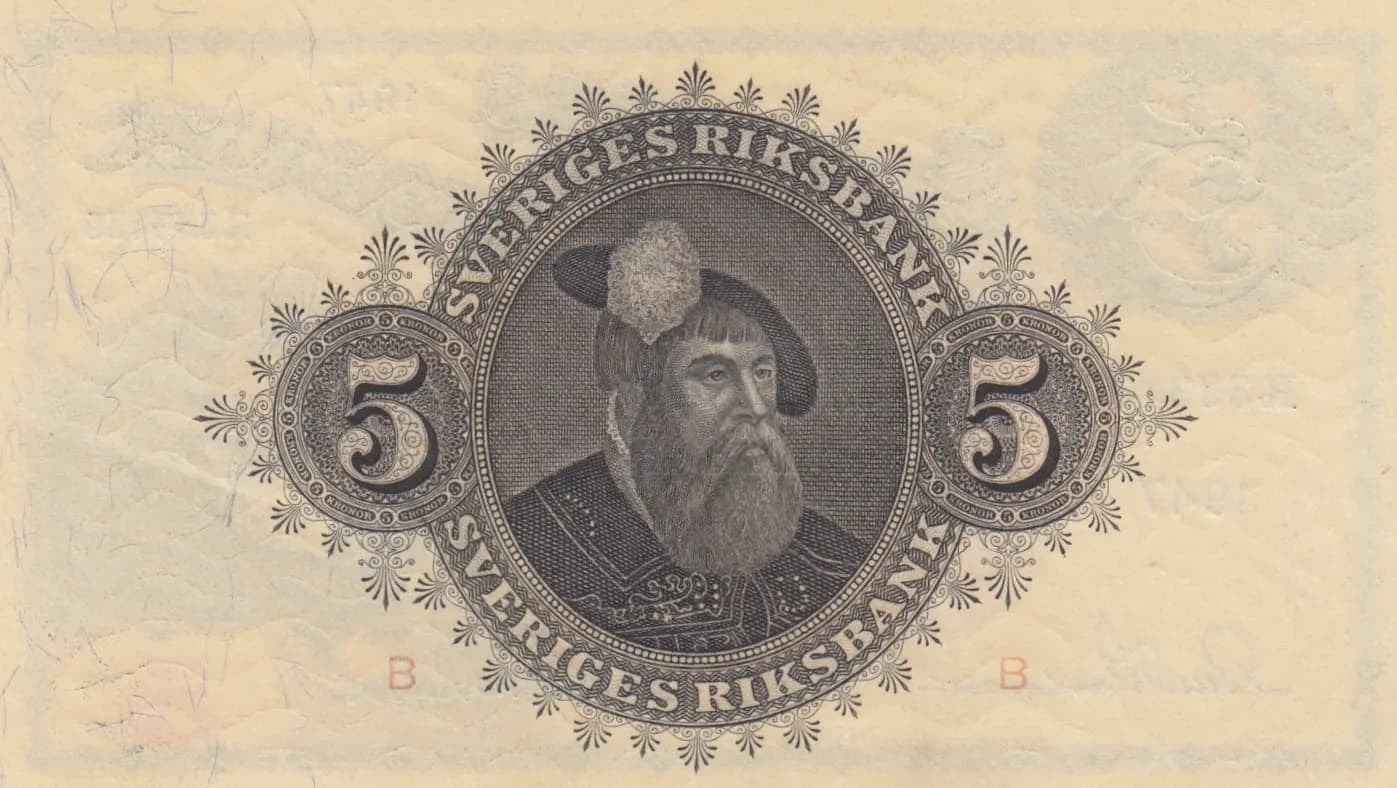
This 1947 Sveriges Riksbank 5 kronor note (Pick P-33ad) presents an attractive example of mid-20th century Swedish currency design, featuring the allegorical figure of Svea on the obverse and King Gustav Vasa in profile on the reverse. The note displays visible circulation wear consistent with its age—multiple creases, foxing, and general discoloration—placing it below uncirculated standards despite the catalog grade, though the intricate engraving remains clearly legible. The elaborate security features, including the distinctive red and black rosette pattern and ornamental borders, exemplify the security printing standards of the Swedish National Bank during the post-war period.
Common. This is a regular issue of the 5 kronor denomination with a long circulation period (1918-1952 as a type), meaning large print runs were standard. The eBay market data confirms this assessment: comparable examples in lower grades (VF, EF, AUNC) regularly sell for $2–$8, and even certified examples at PMG 65-67 typically achieve $20–$47. The 2016 catalog valuation of $6 UNC further supports a common classification. No evidence exists of limited mintage, recall, or scarcity for the 1947 date.
Issued during the immediate post-World War II period, this 5 kronor note reflects Sweden's neutral status and economic stability during European reconstruction. The choice to feature Svea, the historical personification of Sweden, alongside King Gustav Vasa—the 16th-century founder of modern Sweden—reinforces national identity and continuity during a period of international uncertainty. The ornate, traditional design aesthetic represents the conservative approach Swedish currency maintained even as other nations modernized their banknote imagery in the late 1940s.
The obverse features an ornamental arrangement with a large decorative numeral '5' in an elaborate frame on the left, a prominent red and black circular rosette security pattern in the center, and on the right, an allegorical composition depicting Svea (represented as a winged classical female figure) above a bearded male figure—likely representing historical Swedish strength or a historical personage—with heraldic shield elements. The reverse presents a dominant portrait medallion in profile showing King Gustav Vasa (the bearded historical figure in Renaissance-era attire), surrounded by an ornate circular frame with radiating fan-like decorative patterns above and ornamental text border. Both sides maintain a cream and beige background with black and red ornamental detailing, characteristic of early-to-mid 20th century European security printing.
Front side: 'SVENSKA RIKSBANK' (Swedish National Bank), '5' (denomination), '1947' (issue year), 'R333139' (serial number), signatures of 'Poul Henningsen' and 'H. Westenius' (likely bank officials). Back side: 'SVERIGE RIKSBANK' (Swedish National Bank—variant spelling), '5' (denomination on left and right), 'B' (plate letter designation).
Intaglio engraving (copperplate/steel plate engraving), the primary security printing method for Swedish banknotes of this era. The fine line work visible in the portrait medallion, the intricate rosette pattern, and the elaborate ornamental borders are all consistent with hand-engraved intaglio techniques. The red overprint rosette pattern suggests additional color printing, likely relief or lithographic application over the base intaglio impression. The printer is not definitively identified in standard references but aligns with Swedish National Bank's established security printing partnerships of the 1940s.
This note is identified as variety P-33ad, indicating it belongs to the later subset of the 1918-1952 type series with signature and/or design variants. The visible signatures of Poul Henningsen and H. Westenius identify this as a specific signatory combination. The plate letter 'B' visible on the reverse indicates this is from printing plate B. Serial number prefix 'R' and the format 'R333139' place this within a documented series of this period. No major known varieties or errors have been identified for this specific combination; the note represents a standard, documented variety within the P-33 group.