5 kronor 1949
About This Note
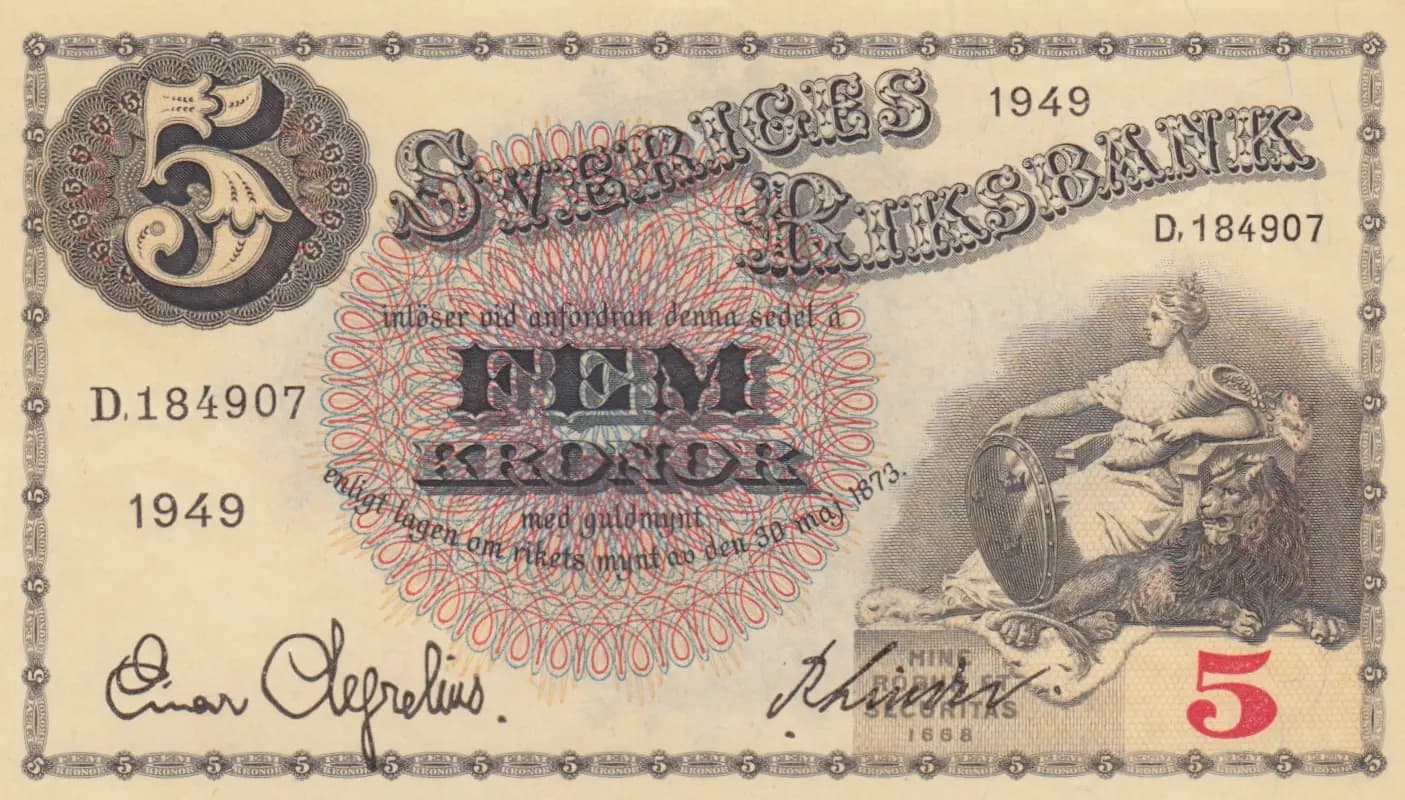
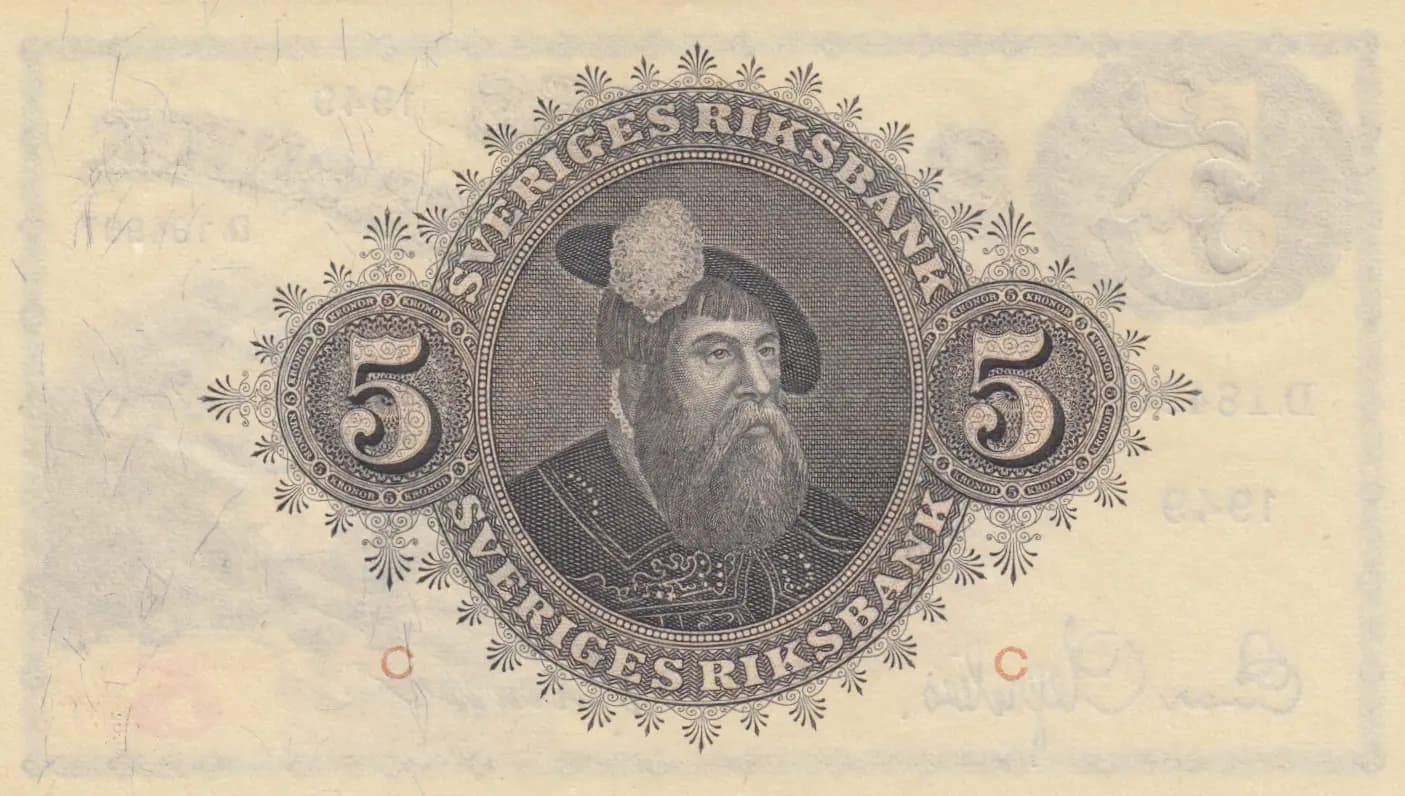
This Swedish 5 kronor banknote from 1949 (Pick P-33af(2)) presents a classical design featuring the allegorical figure of Svea on the obverse and a bearded portrait (King Gustav Vasa) on the reverse, rendered in black and red inks on cream/beige stock. The note exhibits significant wear consistent with circulation, including visible creasing, folds, staining, and foxing throughout, which contradicts the assigned UNC grade and suggests this specimen is actually in circulated condition rather than uncirculated.
Common. The 5 kronor denomination was a standard circulating note issued in substantial quantities from 1918-1952, and the 1949 date falls within a long period of continuous production. No specific information indicates this Pick variant had a limited print run or was recalled. The widespread circulation evidence on this specimen further supports its common status in the market.
Issued by Sveriges Riksbank during the post-World War II period (1949), this note reflects Sweden's stability and cultural continuity through its classical imagery. The front features Svea, the personification of Sweden herself in classical dress with her iconic lion companion, while the reverse depicts King Gustav Vasa (1496-1560), the founder of the Vasa dynasty and architect of Swedish independence—imagery that reinforced national identity during the Cold War era when this note remained in circulation.
The obverse features Svea, the female allegorical personification of Sweden, depicted in classical dress on the right side of the note, accompanied by her heraldic lion—a symbolic pairing representing Swedish sovereignty and national identity. The reverse presents a formal portrait of King Gustav Vasa, the Renaissance-era monarch who established Swedish independence and founded the dynasty that shaped the nation's early modern history, enclosed within an ornate circular frame. Both sides employ elaborate guilloche patterning, ornamental octagonal frames containing the denomination numeral '5', decorative floral and geometric borders, and fine engraved line work throughout. The color scheme employs black and red inks on a cream/beige background.
Front side: '5' (denomination), 'SVERIGES RIKSBANK' (Swedish National Bank), '1949' (year of issue), 'D.184907' (serial number), 'Oscar Alfredius' and 'Albrink' (authorized signatures). Back side: 'SVERIGES RIKSBANK' (Swedish National Bank), '5' (denomination repeated on left and right sides), 'C' (printer or series designation mark).
This note was produced using traditional intaglio engraving (also called recess printing), evident from the fine line work, depth of impression, and elaborate guilloche patterns visible throughout the design. The multiple colors (black and red) indicate multi-stage printing or color separation techniques typical of high-security banknote production. This series was printed by Swedish state printers, likely Bradbury Wilkinson or the Swedish royal printing authority based on the technical quality and security features characteristic of this Pick number era.
This specimen is cataloged as Pick P-33af(2), indicating it is the second variety of the af series within the P-33 classification for Swedish 5 kronor notes. The signatures visible ('Oscar Alfredius' and 'Albrink') and the printer mark 'C' help establish this as a specific printing variety. The serial number 'D.184907' indicates this note is from a particular numbering series, which may correlate with production batches or regional distribution, though such detailed variety classification typically requires access to comprehensive Swedish banknote catalogs beyond standard references.