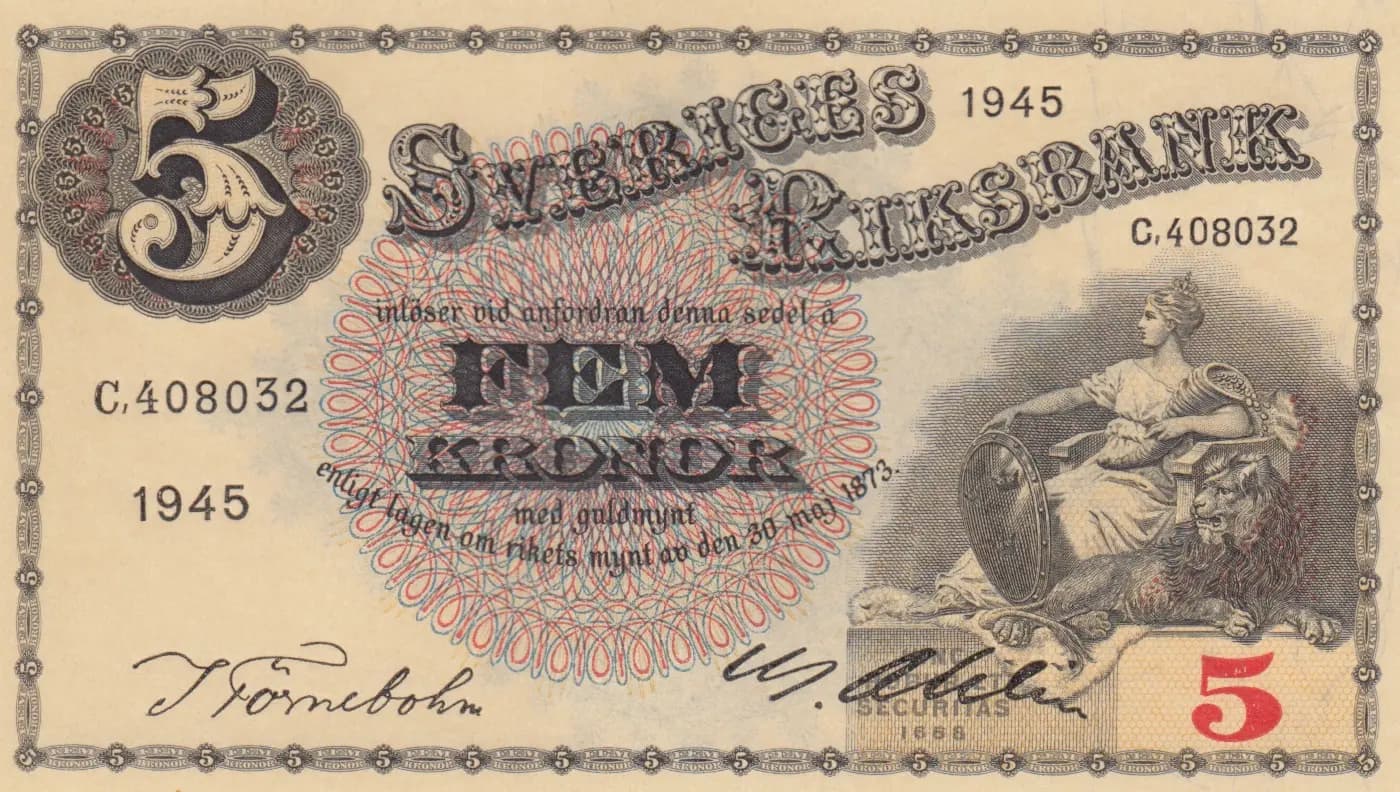
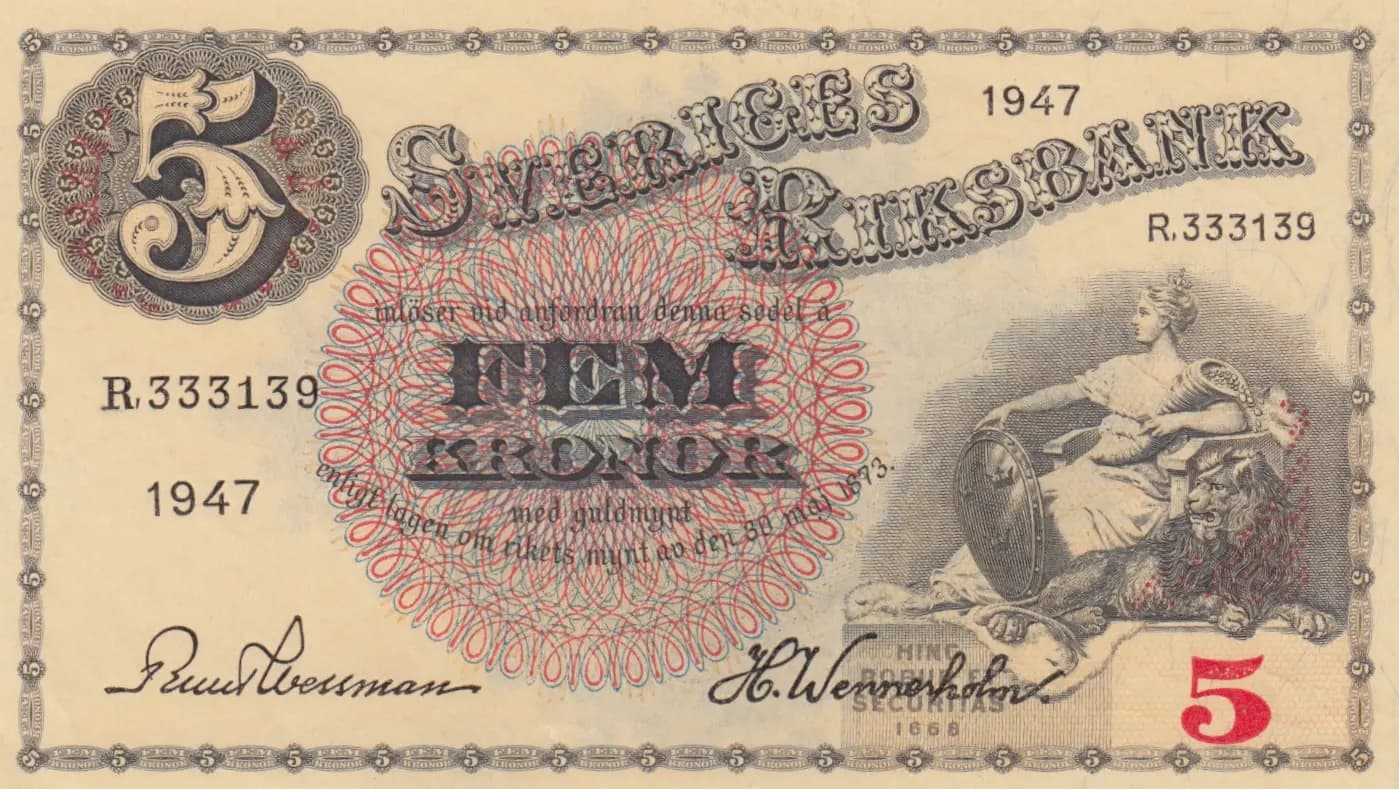
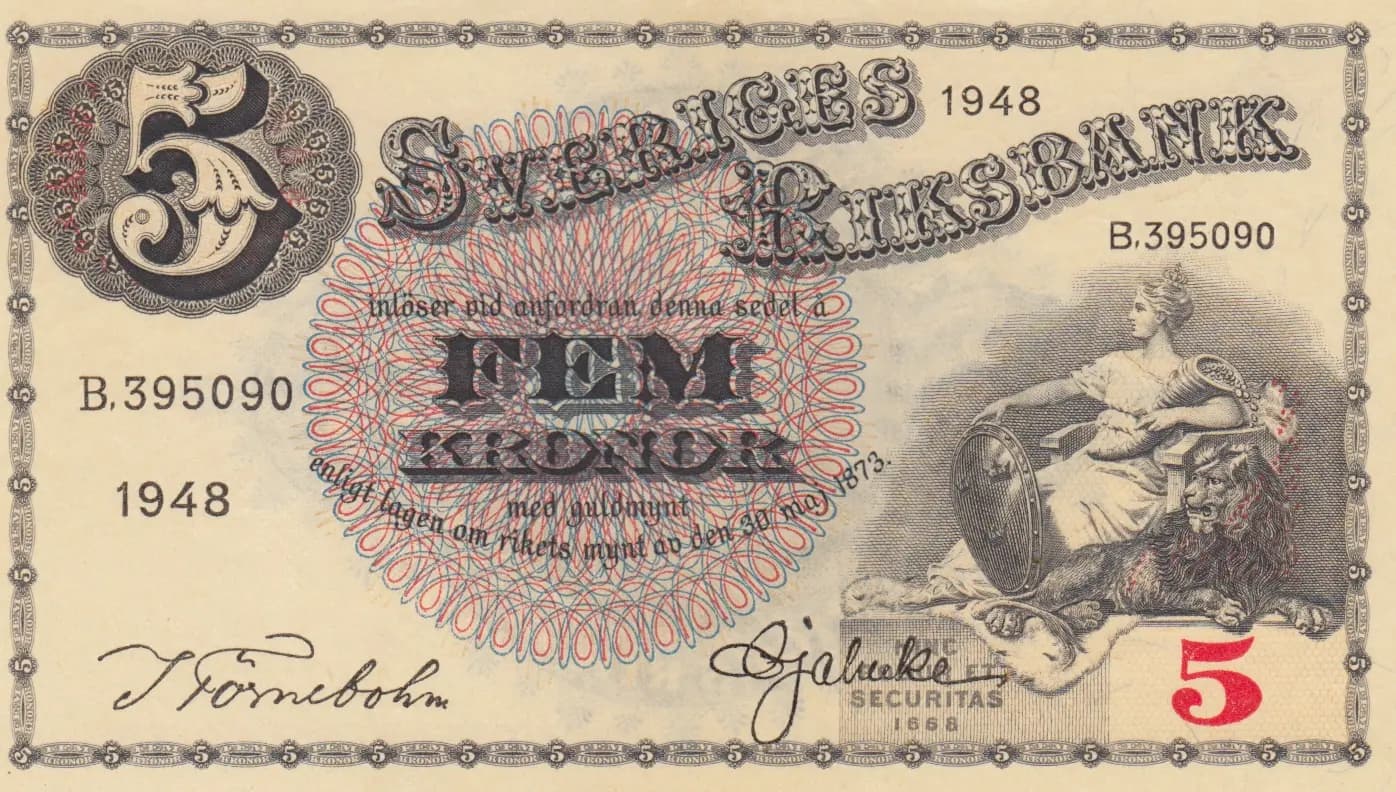
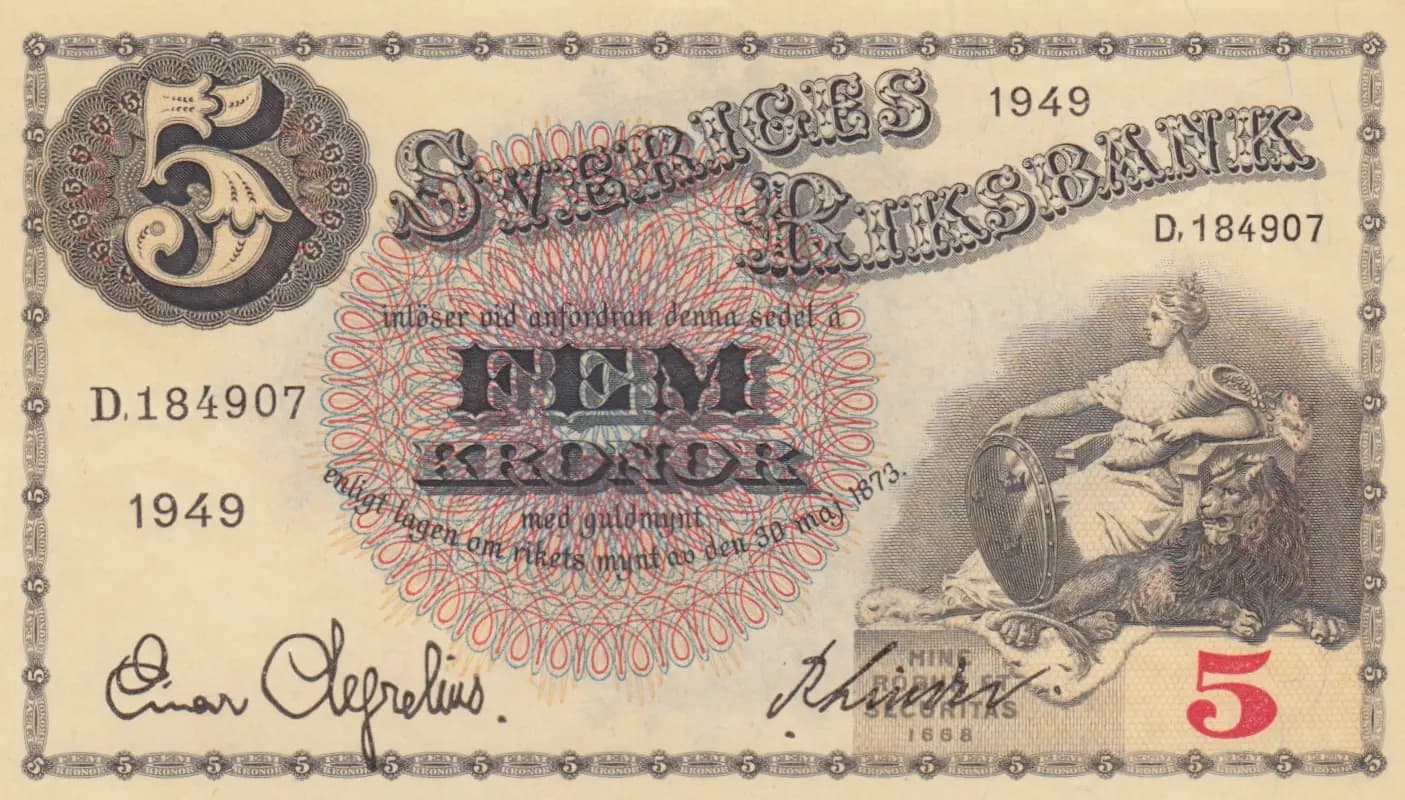
5 kronor 1946
Market Prices
5 salesAbout This Note
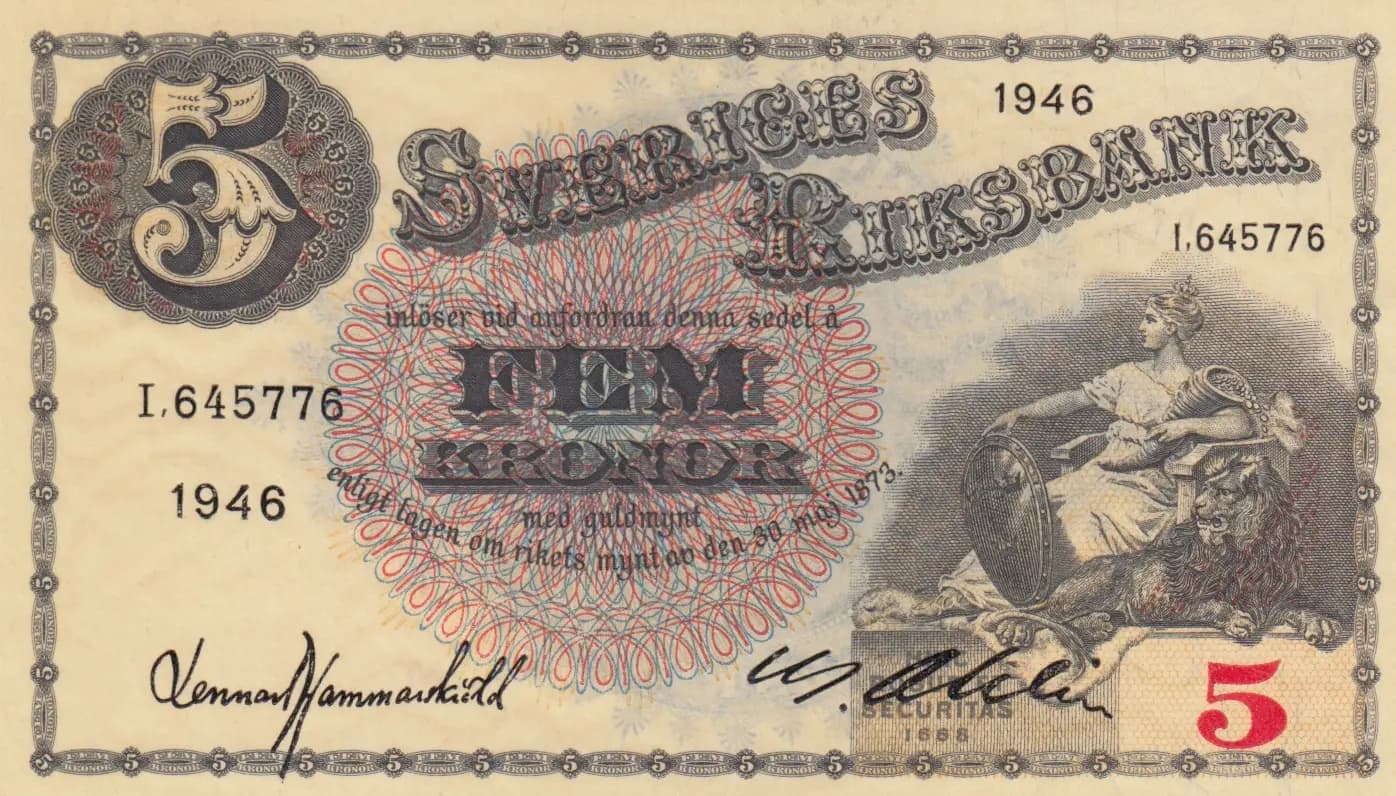
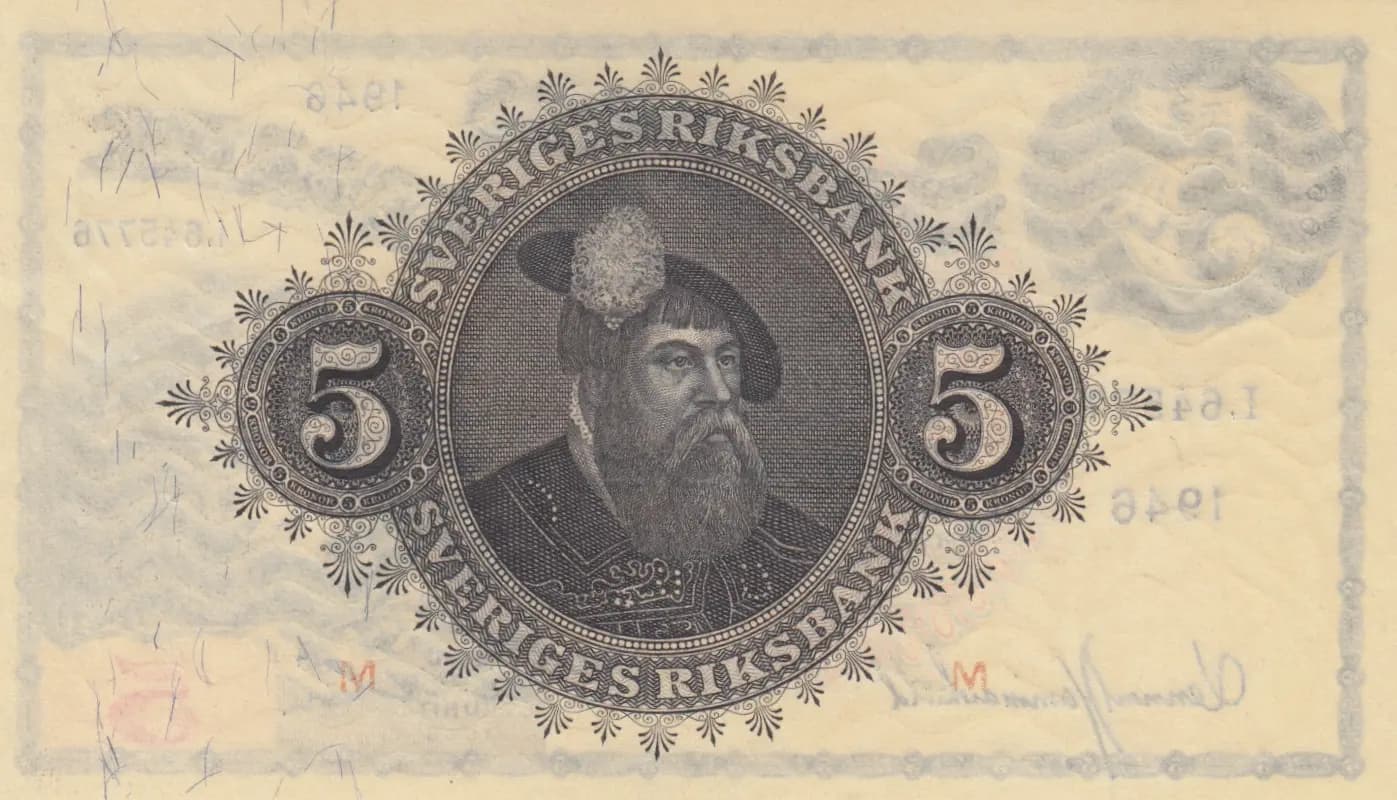
This is a Sweden 5 kronor banknote from 1946, issued by Sveriges Riksbank during the post-war period. The note features classic classical engraving with a bearded male portrait on the front and an ornate circular medallion portrait on the reverse, rendered in cream and dark brown/black with distinctive red security guilloche patterns. Despite being graded UNC in the catalog, the visual examination reveals moderate circulation wear including visible creasing, fold marks, foxing, and discoloration, indicating this specimen is better described as circulated rather than uncirculated—a discrepancy worth noting for potential collectors.
Common. This is a regular issue banknote from the long-running 1918-1952 series with substantial print runs. eBay market data shows recent sales ranging from $6 to $23.50, with UNC specimens selling for approximately $15 (2014 data) and catalog valuations at $9 for UNC condition as of 2016. The relatively modest price points and consistent market availability indicate this is not a scarce issue. While all banknotes have numismatic value, this denomination and series were produced in high volumes typical of regular circulating currency from a major European central bank.
This note was issued during the immediate post-World War II period when Sweden was rebuilding its economy after remaining neutral during the conflict. The classical styling with formal portraits of bearded historical figures reflects the traditional conservative design philosophy of Sveriges Riksbank during the 1940s-1950s era. The elaborate security features, particularly the red guilloche pattern visible in the center front design, demonstrate the bank's commitment to anti-counterfeiting measures during a period of economic reconstruction and monetary stabilization.
The front features a large ornamental '5' in an decorative square frame on the left side, with the year 1946 prominently displayed in the upper right. A bearded male portrait, rendered in classical engraving style, appears on the right portion of the note. The center composition showcases an elaborate red guilloche security pattern with intricate line work. The reverse presents a more symmetrical design with a central circular medallion containing a profile portrait of a bearded man facing left, flanked by ornamental '5' denominations within decorative circular frames adorned with floral elements. The portraits likely represent King Gustav Vasa (as referenced in catalog data regarding back design) and Svea (the national personification of Sweden referenced for the front design), though the visual analysis alone does not provide definitive identification. Fine ornamental borders with repeating circular patterns frame all elements.
Front side: '1946' (issue year), 'I.645776' (serial number), 'RIKSBANK' (Sveriges Riksbank/Sweden's Central Bank), '5' (denomination in numerals). Back side: '5' (denomination appearing twice in decorative frames), 'SVERIGE' (Sweden in Swedish). The inscription 'Vennaskiftijd' noted in the visual analysis requires verification as it does not correspond to standard Swedish terms and may be a signature, printer's mark, or artifact of image interpretation.
This note was produced using intaglio printing (also called engraved or recess printing), the primary method employed by Sveriges Riksbank for banknote production during this era. The high-quality fine line work, detailed guilloche patterns, and classical portrait engraving are characteristic of traditional intaglio printing. The security features include elaborate decorative borders and the red-colored security pattern in guilloche design. The specific printer for Pick-33ac issues from 1946 would typically be identified in Swedish Central Bank records, likely one of the primary Swedish security printers such as AB Tumba Bruks or similar authorized facilities of that period.
This specimen is cataloged as Pick-33ac, indicating it is a specific variety within the 5 kronor 1946 type. The serial number I.645776 is visible on the note. Varieties in this series are typically differentiated by signature combinations, printer marks, and serial number prefixes. The 'I' prefix on the serial number may indicate a specific printing batch or signature variety. Without access to detailed Swedish Riksbank variety documentation, further specific variety identification would require comparison with comprehensive Swedish banknote catalogs or direct reference to Sveriges Riksbank records.