5 kronor 1948
About This Note
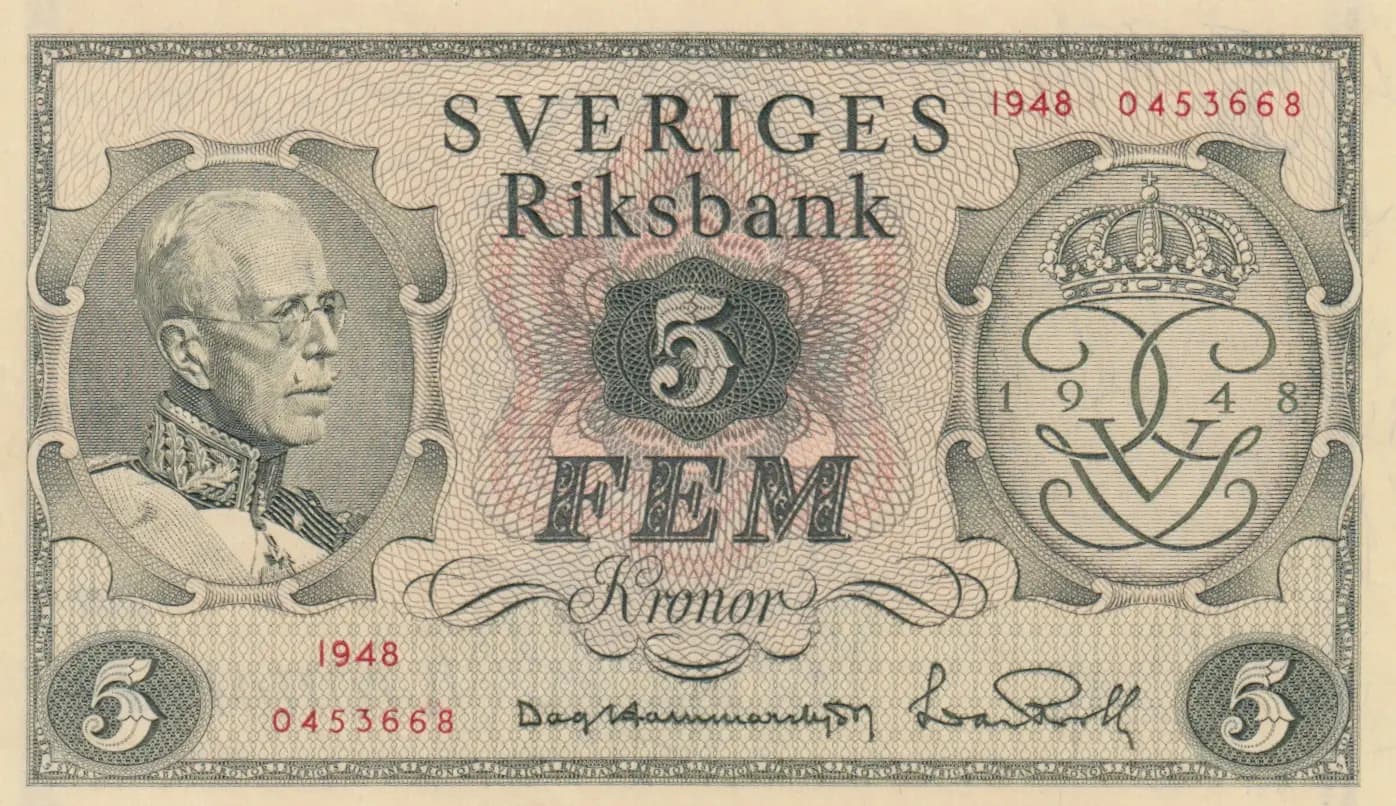
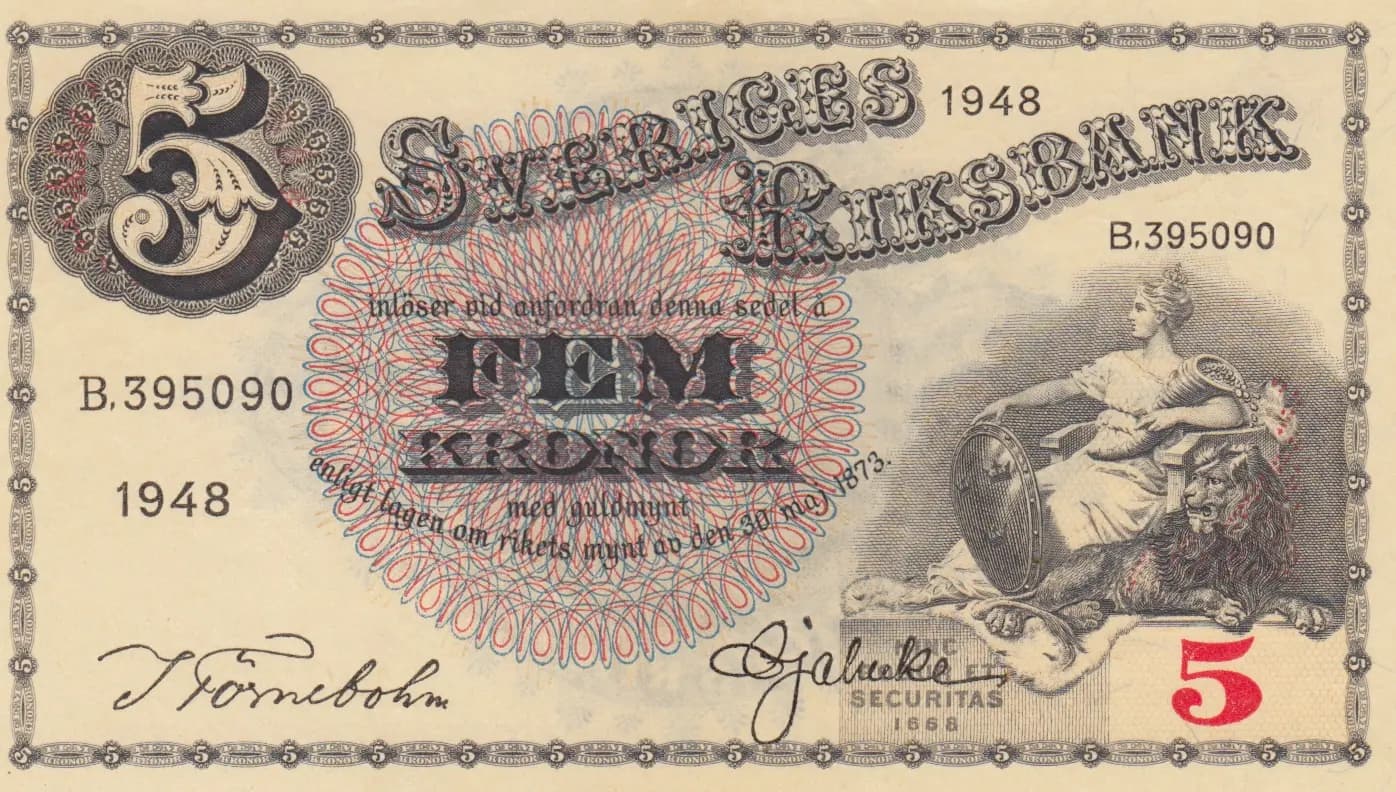
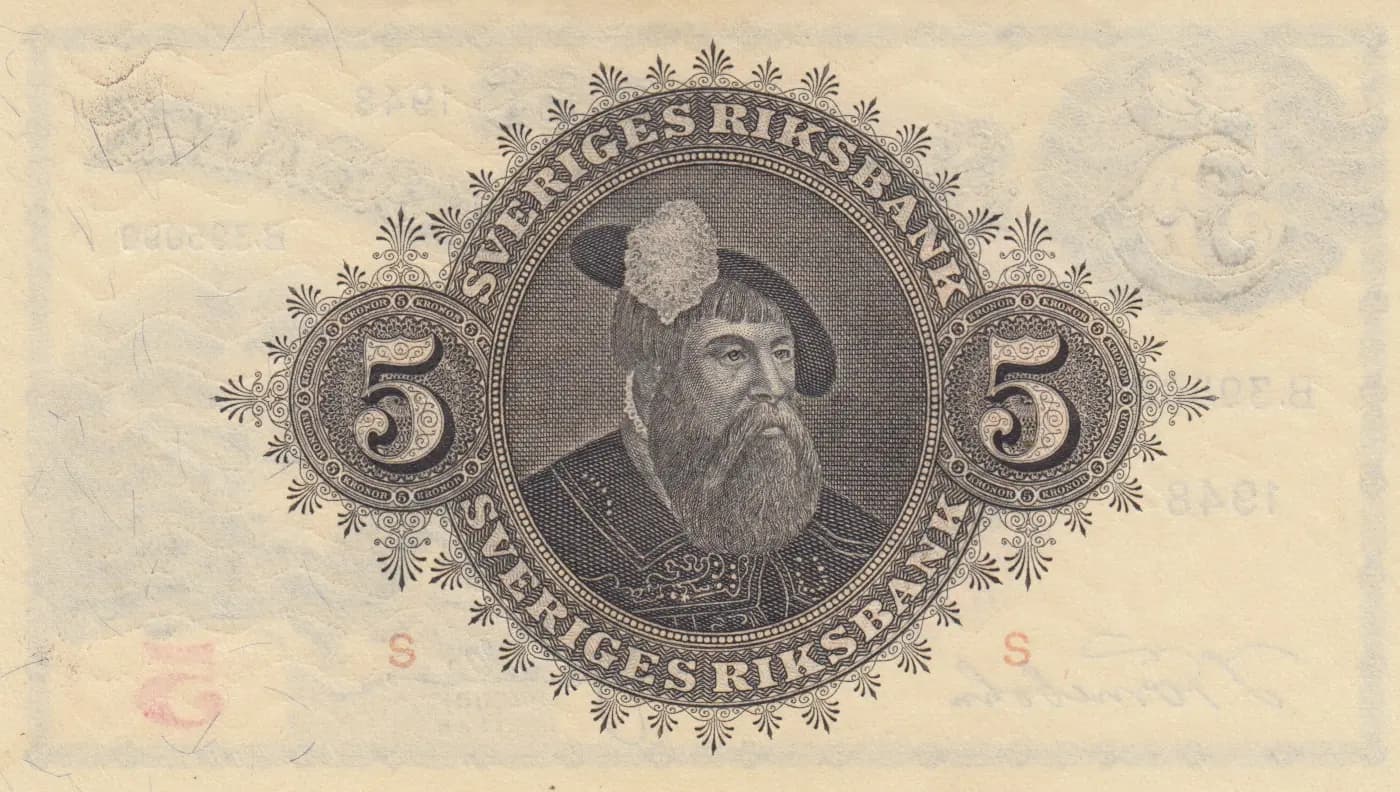
This is a Swedish 5 kronor banknote from 1948 (Pick P-33ae(1)), issued by Sveriges Riksbank, displaying the classic allegorical design typical of mid-20th century Scandinavian currency. The front features an ornate classical engraving of Svea with attendant children, framed by elaborate crown-motif borders and red guilloché security printing, while the reverse presents a fine-line portrait of King Gustav Vasa in a circular medallion with concentric decorative borders. The note exhibits UNC cataloging, though visual inspection reveals age-appropriate wear including light diagonal creasing, minor foxing, and discoloration consistent with a 75-year-old banknote that may have seen brief circulation.
Common. The 1948 issue of the 5 kronor P-33ae(1) was part of a large-circulation series (1918–1952) produced by Sveriges Riksbank during a period of stable currency demand in post-war Sweden. No evidence of limited print runs, recalls, or short-lived issuing authority applies to this denomination. Millions of these notes were produced and distributed, and they remain readily available in numismatic markets today. The UNC condition grade may command slightly higher collector interest than circulated examples, but the note itself is a common date and variety.
This 1948 issue falls within the broader 1918–1952 series of Swedish 5 kronor notes, a period when Sweden maintained strong artistic standards in banknote design despite post-war economic conditions. The front's personification of Svea—the female allegorical figure representing Sweden itself—alongside her children symbolizes national prosperity and fertility, while the reverse portrait of 16th-century King Gustav Vasa, founder of the Vasa dynasty, reinforced national historical identity and continuity during the Cold War era. The use of elaborate classical engraving and red security overprints reflects Sveriges Riksbank's commitment to anti-counterfeiting measures and design prestige during a period of currency stabilization.
The front of this note features an allegorical female figure identified as Svea, the national personification of Sweden, depicted in classical style with two children, symbolizing national prosperity, fertility, and continuity. She is enclosed within an ornate decorative border composed of repeated crown motifs—a symbol of Swedish sovereignty—with elaborate scrollwork and rococo flourishes. The denomination '5' appears in an ornamental square cartouche with elaborate baroque-style scrollwork on the left side. Red guilloché (geometric security printing) dominates the center field, providing both aesthetic and anti-counterfeiting functionality. The reverse depicts King Gustav I Vasa (1496–1560), founder of the Vasa dynasty and central figure in Swedish independence, shown as a bearded man in 16th-century royal dress, contained within multiple concentric circular frames with fan or palm-frond ornamental border motifs. The design exemplifies the high-quality classical engraving standards of Swedish Riksbank currency from this era.
Front side: 'SVENSKA RIKSBANK' (Swedish National Bank); '5' (denomination); '1948' (year of issue); 'B.395090' (serial number); 'DEM KRONOR' (ten kronor—likely part of a larger denomination text or security text); signatures 'Förnebohm' and 'Dajlake' (authorized signatories); 'SECURITAS' (Latin: 'security'—common security inscription on European notes). Back side: 'SVENSKA RIKSBANK' (Swedish National Bank); '5' (denomination); 'SVERIGES RIKSENS' (Swedish: 'of Sweden's Realm'); 'S' (printer's mark or series indicator).
This note was produced using intaglio (copperplate) engraving as the primary printing method, evident from the fine-line detail work, precise portrait rendering, and sharp definition of the ornamental borders observed in both sides. The red security printing—the intricate guilloché patterns and security overprints visible on the front—was applied using a secondary red ink pass, likely offset or additional intaglio work. The use of multiple color layers (beige background, black primary engraving, red overprint) is consistent with Swedish Riksbank's sophisticated multi-pass printing process. Security printers for this series typically included the Swedish state printing works.
This specific example is cataloged as Pick P-33ae(1), indicating it is a known variety within the 5 kronor 1918–1952 series. The serial number 'B.395090' with blue ink printing, combined with the signature pair of Förnebohm and Dajlake, places this within a specific printing and authorization period. The prefix 'B' on the serial number may indicate a particular batch or printing run. Collectors should note that different signature combinations and serial number prefixes exist for this denomination across the 1918–1952 span; this specific variety with these signatories should be recorded for attribution purposes.