5 dinara 1917
Market Prices
16 salesAbout This Note
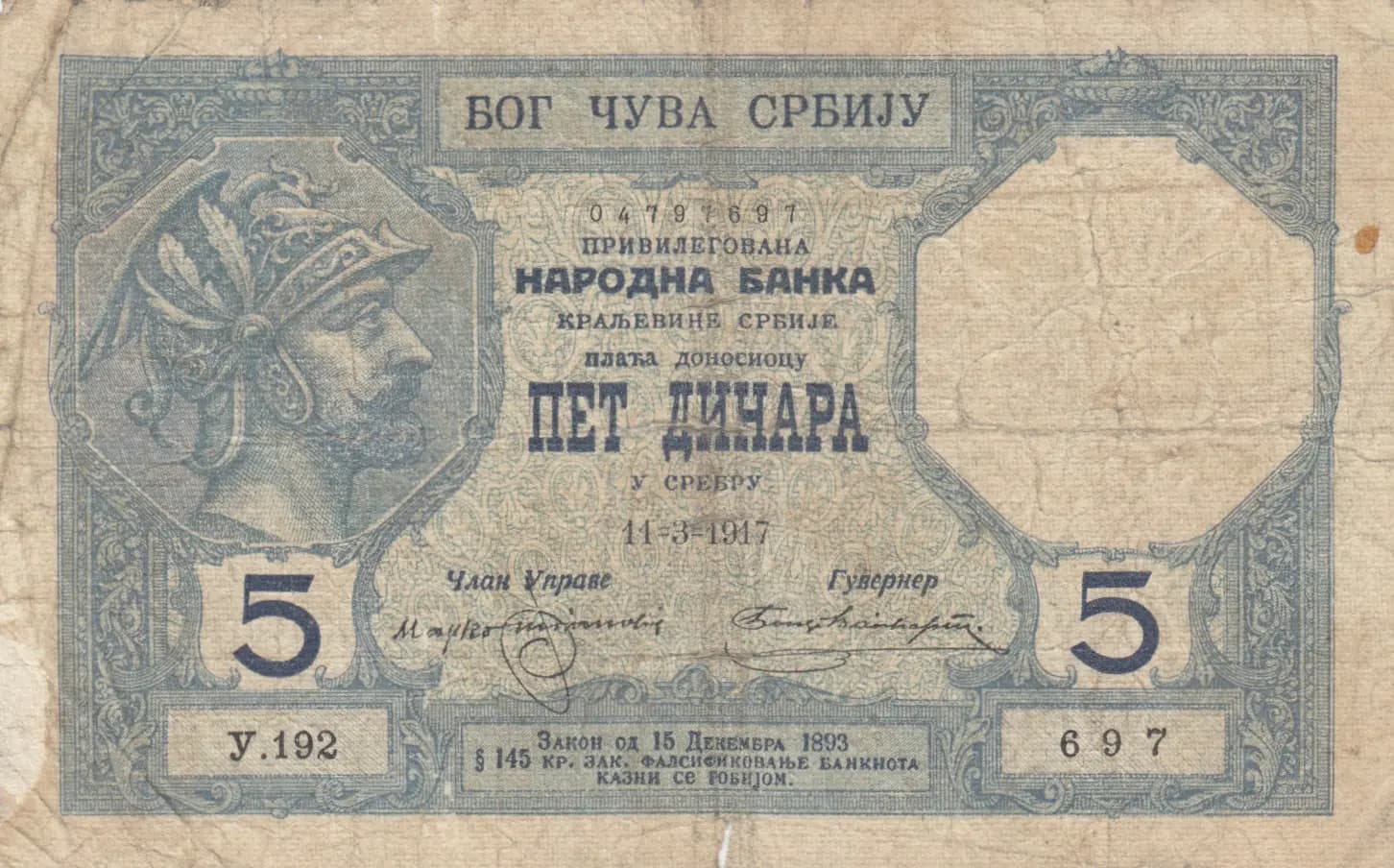
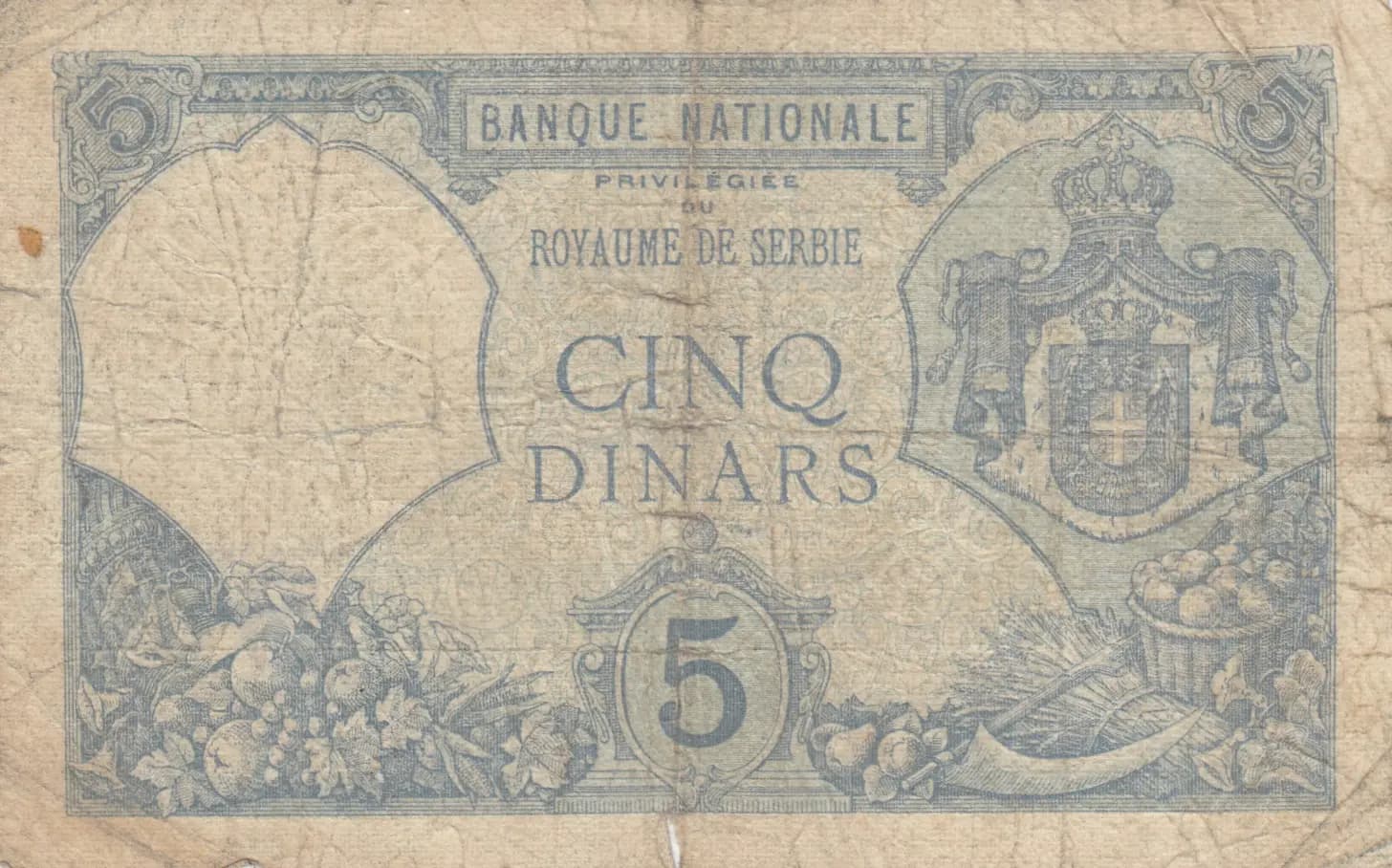
This is a well-circulated example of Serbia's 5 dinara note from 1917, issued by the Privilegovana Narodna Banka Kraljevine Srbije during World War I. The note displays the characteristic blue-teal color scheme typical of this series, with a classical male portrait on the obverse and allegorical figures with the Serbian coat of arms on the reverse. Heavy circulation wear is evident throughout, with multiple creases, folds, and age-related foxing consistent with its VG (Very Good) condition grade.
Common. Secondary market data from eBay sales records shows this Pick number trading regularly in the $10-$75 range across multiple condition grades, with VG examples (matching this note's grade) selling in the $20-$36 range. The consistent availability across numerous sales dating back over a decade, combined with the catalog value of $37.50 for this grade (2016 reference), confirms this as a regularly encountered issue. While the 1917 date variant may be slightly less common than earlier issues from the 1916-1917 series, the note remains readily obtainable for collectors and does not qualify as scarce.
This banknote was issued during a transformative period for Serbia, specifically dated March 11, 1917, during the final years of World War I and just before the unification that would create the Kingdom of Serbs, Croats, and Slovenes. The note bears the Latin inscription 'Bog čuva Srbiju' (God Protects Serbia), reflecting the nationalist sentiment and Orthodox Christian tradition of the Serbian kingdom during this turbulent era. The bilingual presentation in both Serbian Cyrillic and French reflects Serbia's Western European diplomatic alignment during the war period.
The obverse features a classical male profile portrait in the upper left quadrant, depicted wearing a laurel wreath crown, facing left in the neoclassical style. This portrait represents Miloš Obilić, the legendary Serbian medieval hero, chosen to symbolize Serbian national pride and historical continuity. The design incorporates ornate decorative borders with double-headed eagles—the heraldic emblem of Serbia—and elaborate scrollwork throughout. The reverse depicts allegorical figures (representing virtues or prosperity) flanking a prominent Serbian royal coat of arms positioned on the right side, with decorative agricultural motifs including grapes and wheat symbolizing fertility and national wealth. The entire composition is printed in blue-teal ink on cream-colored paper with a helmeted man watermark matching the obverse portrait. The design reflects Austro-Hungarian banknote aesthetic conventions, typical of early 20th-century Central European currency design.
FRONT SIDE: 'БОГ ЧУВА СРБИЈУ' (God Protects Serbia) - motto; 'ПРИВИЛЕГОВАНА НАРОДНА БАНКА КРАЉЕВИНЕ СРБИЈЕ' (Privileged National Bank of the Kingdom of Serbia) - issuer name; 'ПЛАТА ДОНОСИОЦУ' (Pay to Bearer) - negotiability clause; 'ПЕТ ДИНАРА У СРЕБРУ' (Five Dinars in Silver) - denomination and metal backing; '11-3-1917' (March 11, 1917) - issue date; 'Члан Управе' (Board Member) and 'Guvernер' (Governor) - signature lines; 'Закон од 15 Дцембера 1893' (Law of December 15, 1893) - legislative reference; '§ 145 КР. ЗАК. ФАЛСИФИКОВАНЕ БАНКНОТЕ КАЗНЕ СЕ ЈУБИЛЕЈНОМ' (Section 145 Criminal Law. Counterfeit banknotes are punishable) - anti-counterfeiting warning. BACK SIDE: 'BANQUE NATIONALE PRIVILEGIEE DU ROYAUME DE SERBIE' (Privileged National Bank of the Kingdom of Serbia) and 'CINQ DINARS' (Five Dinars) - French language denomination and issuer identification.
This note was produced using intaglio engraving, the standard security printing method of the era. The fine detail work visible in the portrait, ornamental borders, allegorical figures, and coat of arms demonstrates the deep engraving technique characteristic of high-security banknote production. The complex border patterns and micro-detail throughout would have required skilled engraving plates. While the specific printer is not documented in readily available sources, Serbian banknotes of this period were typically produced by established European security printers, possibly including Giesecke+Devrient or similar firms with Austro-Hungarian connections.
This example bears the specific date '11-3-1917' (March 11, 1917), placing it within the documented 1916-31.12.1917 issue period. The note is cataloged as P-14a in the Pick standard, representing the regular issue 5 dinara srebru denomination. The serial number observed (0479169) and signature varieties would represent standard production variants rather than cataloged sub-varieties. The bilingual design (Serbian Cyrillic/French) is consistent with the entire P-14a issue series and represents no special variety. PMG records confirm a single primary variant for this Pick number, indicating no rare sub-varieties or overprint issues exist for this denomination.