10 dinara 1893
Market Prices
15 salesAbout This Note
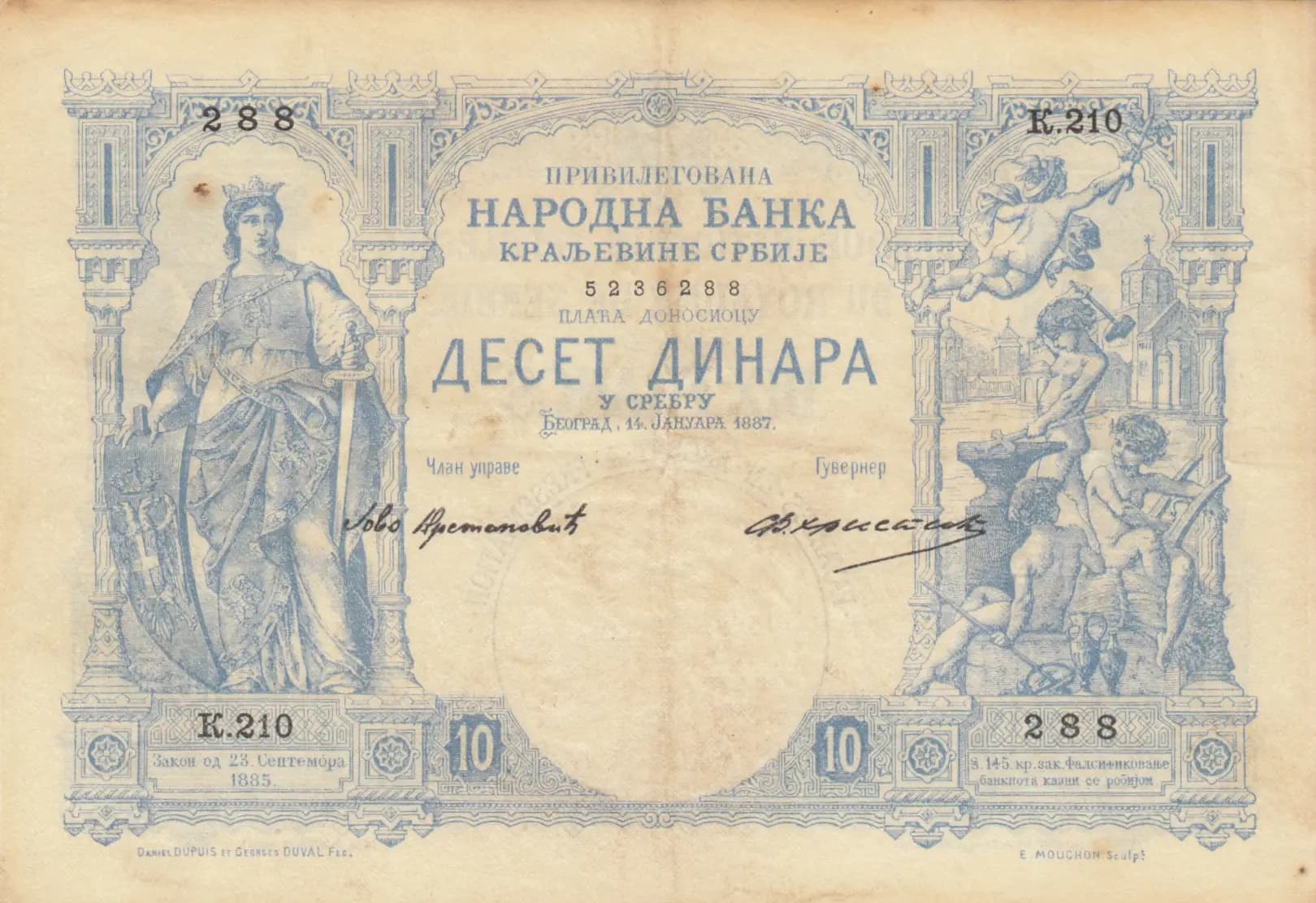
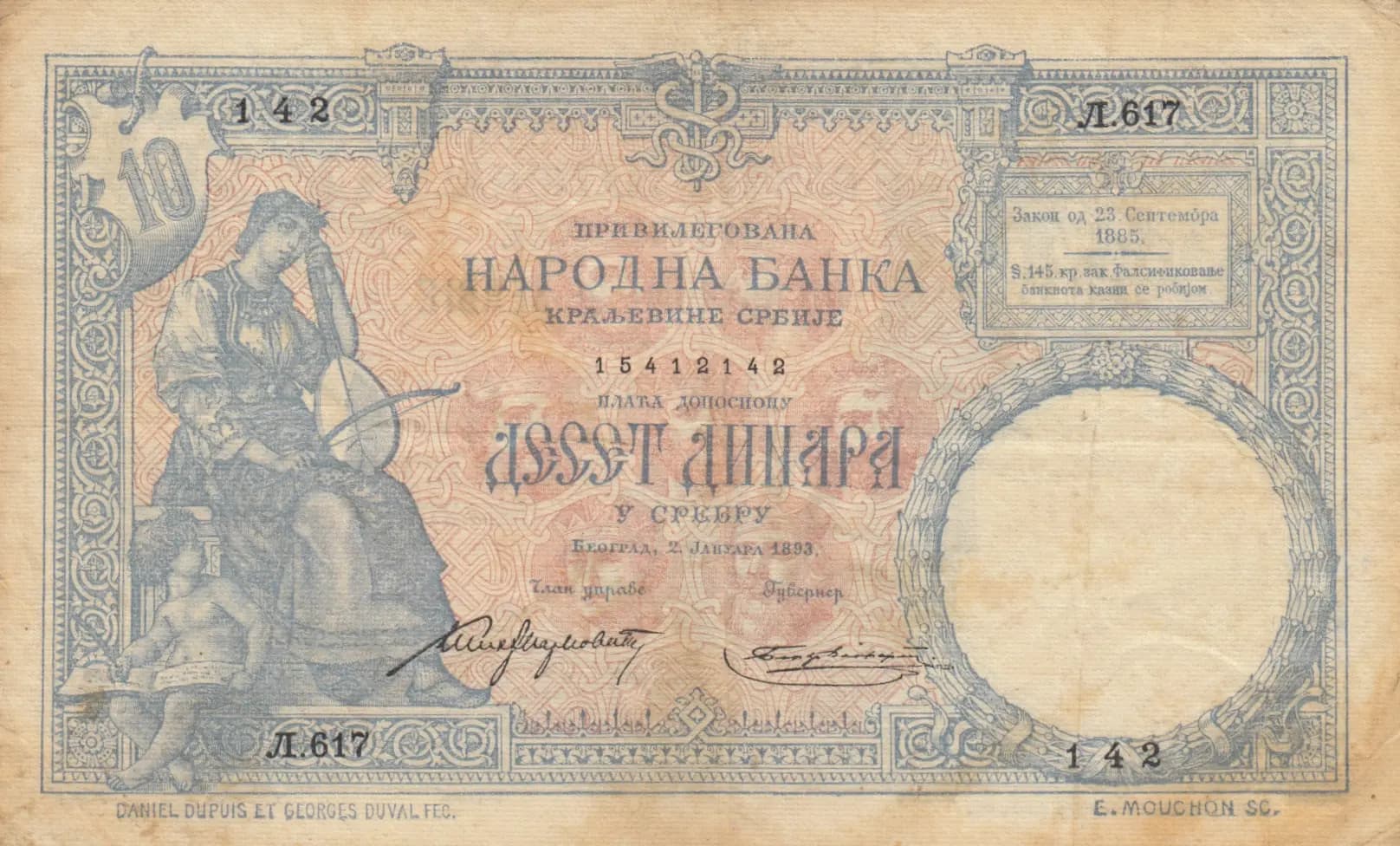
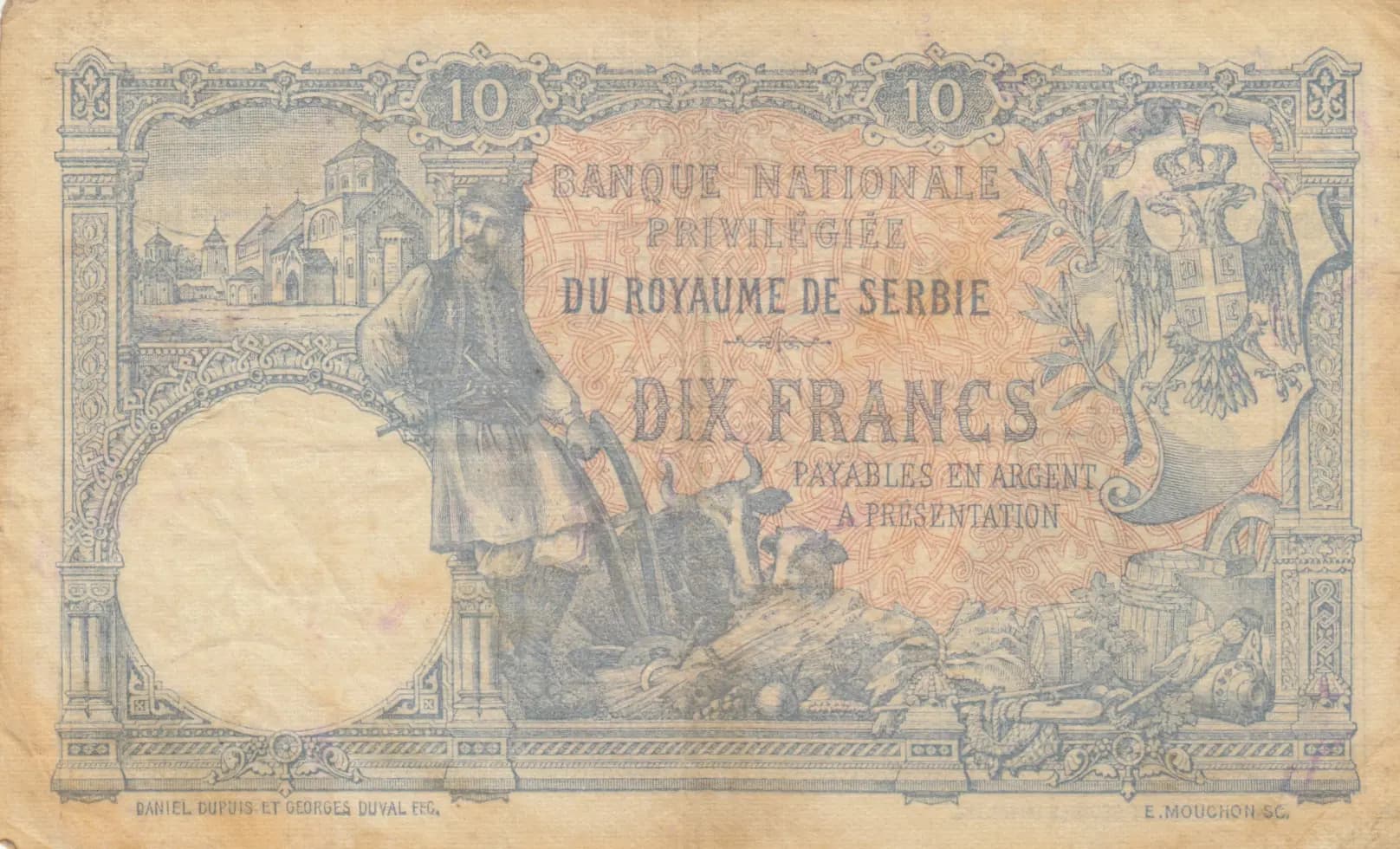
This is a Serbian 10 Dinara from 1893, issued by the Privilegovana Narodna Banka Kraljevine Srbije (Privileged National Bank of the Kingdom of Serbia). The note is in Fine (F) condition, displaying the characteristic ornate blue and cream borders with peach-colored center panels typical of late 19th-century Serbian currency. The front features a bearded man in traditional dress with a spear, while the reverse depicts a standing military figure with an Orthodox church and Serbian landscape in the background, reflecting the nation's cultural and historical identity during this formative period.
Common. The eBay sales history shows consistent, steady availability of this note in Fine condition at prices ranging from $12.50 to $36 over the past decade, with an average price around $20-25 for F-graded examples. The 2016 catalog value of $75 for F condition appears to be significantly overestimated compared to actual realized prices. With multiple documented sales annually and no indication of a restricted print run or recall, this is a standard circulation issue from the early Serbian National Bank period. This note is actively traded and readily available to collectors.
Issued on January 2, 1893, this banknote represents Serbia's early modern monetary system under the Privileged National Bank, established following the Law of September 23, 1865. The depicted figures—a traditional Serbian nobleman and a military/armed figure—along with the Orthodox church visible on the reverse, reflect Serbia's struggle for national independence and consolidation during the late Ottoman period. The bilingual inscriptions in Cyrillic and French indicate Serbia's dual orientation toward Slavic identity and Western European financial practices during this transitional era.
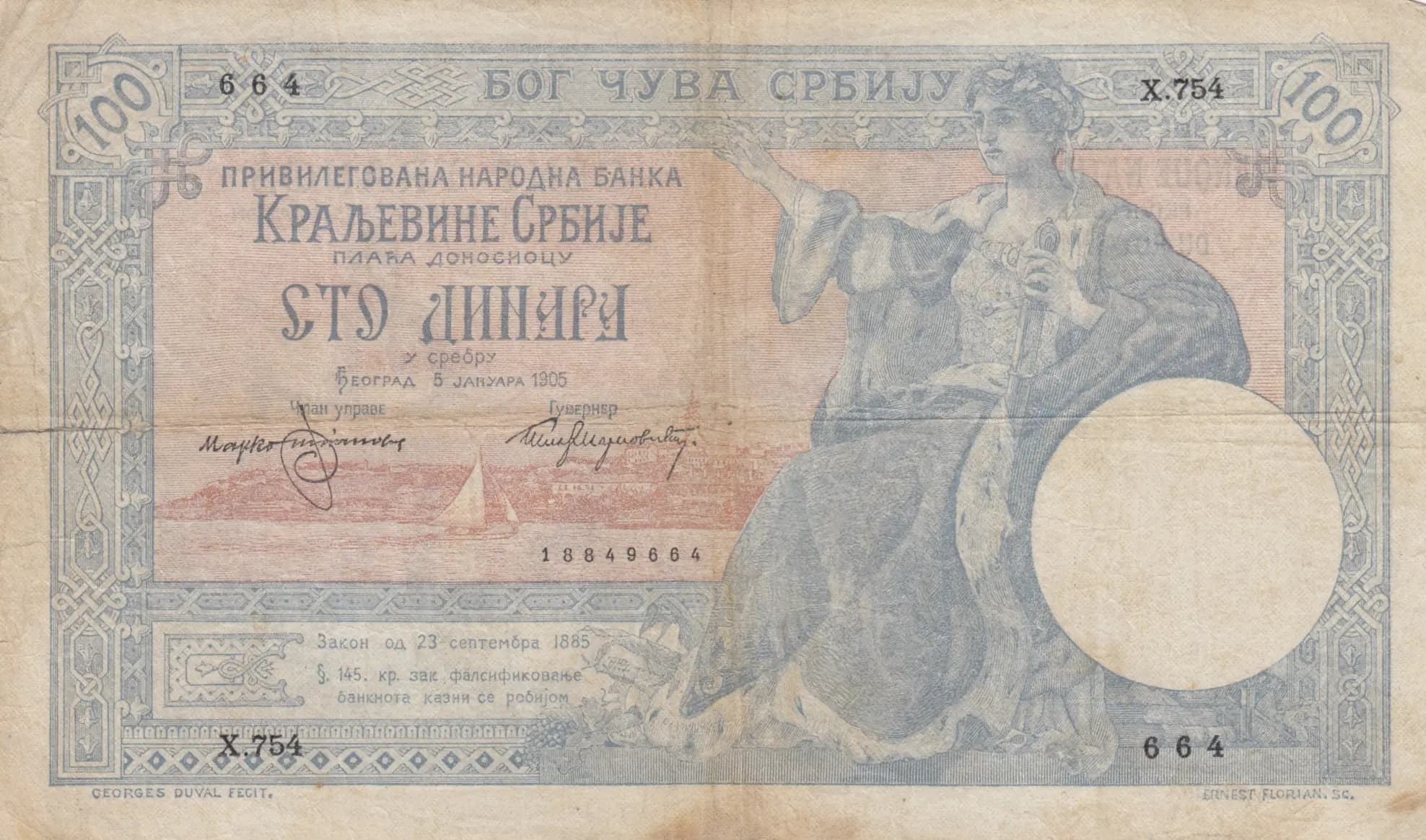
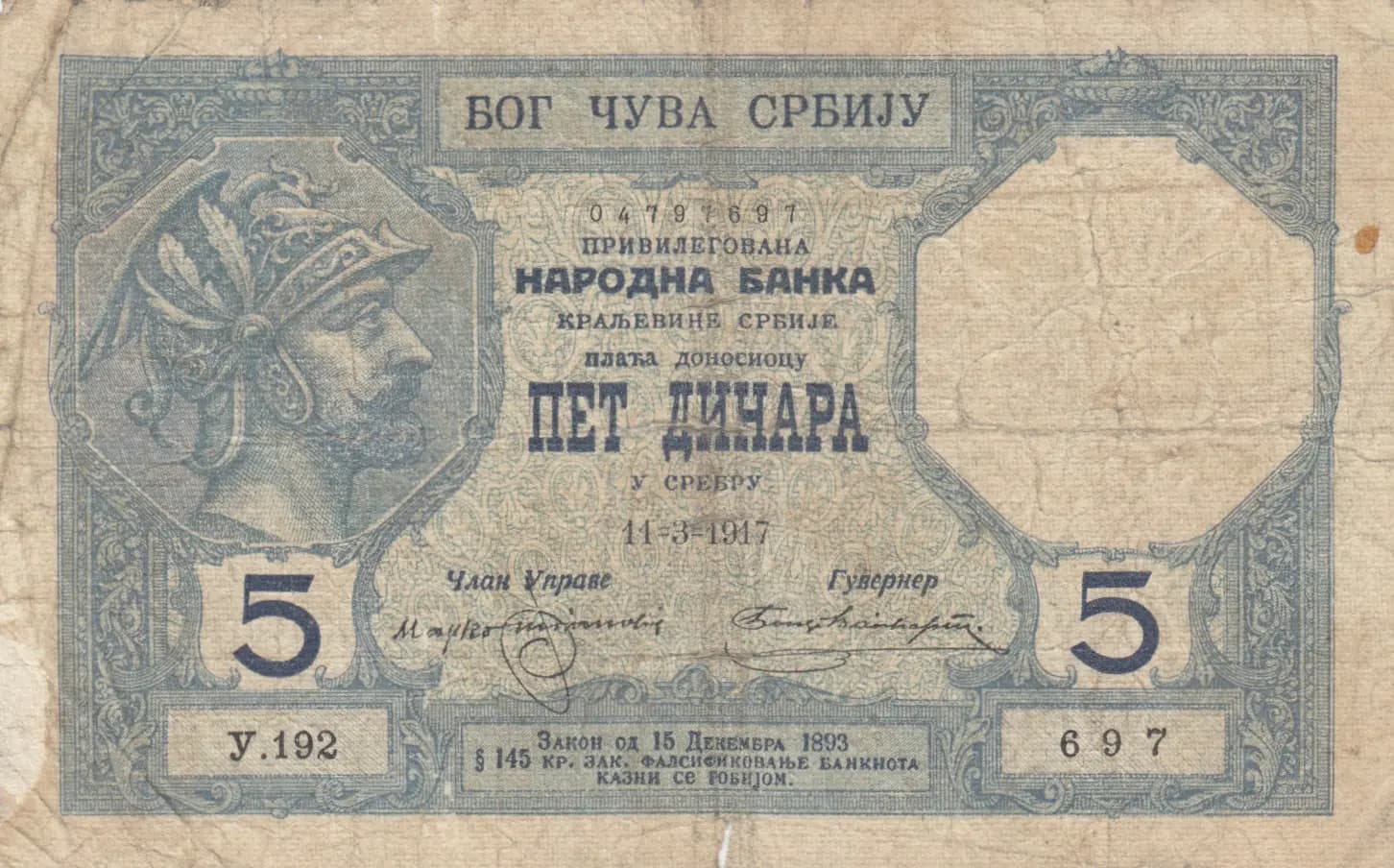
This banknote is a masterwork of late 19th-century European engraving, designed by the renowned French engraver E. Mouchon and produced by the Paris firm Daniel Dupuis et Georges Duval. The obverse features a bearded Serbian nobleman or historical figure in traditional medieval dress, holding a spear or staff, positioned on the left with a fortified structure visible nearby—likely representing Serbian medieval power and sovereignty. The reverse depicts a standing military figure in uniform with weapons and armor, positioned centrally with an Orthodox church (representing Serbian religious identity) and mountainous Serbian landscape visible in the background, alongside heraldic symbols including the double-headed eagle with crown. The design is framed by intricate ornamental borders featuring floral and geometric patterns in blue and cream, with large blank circular areas (watermark spaces) positioned symmetrically on each side. The color scheme of blue, peach/salmon, cream, and gray creates a dignified, formal appearance appropriate for a national bank currency of the period.
FRONT SIDE: 'Privilegovana / Narodna Banka / Kraljevine Srbije' (Privileged National Bank of the Kingdom of Serbia); 'Deset Dinara' (Ten Dinars); 'U Srbiju' (In Serbia); 'Beograd, 2. Januara 1893.' (Belgrade, 2 January 1893); 'Zakon od 23 Septembra 1865.' (Law from 23 September 1865); 'Daniel Dupuis et Georges Duval F.C.' (Printer attribution); 'E. Mouchon Sc.' (Engraver: E. Mouchon). BACK SIDE: 'Banque Nationale / Privilégiée / Du Royaume de Serbie' (Privileged National Bank of the Kingdom of Serbia); 'Dix Francs' (Ten Francs); 'Payables en Argent / À Présentation' (Payable in Silver on Presentation); 'Daniel Dupuis et Georges Duval F.C.' (Printer attribution); 'E. Mouchon Sc.' (Engraver signature). Both sides include serial numbers and reference marks (Л.617, 1428, 1541-2148).
This note was produced using intaglio engraving (steel plate printing), as evidenced by the fine detail work, complex line patterns in the decorative borders, and the precision of the portrait engravings visible throughout. The work was executed by the prestigious Parisian security printer Daniel Dupuis et Georges Duval, F.C. (Firmin Didot's commercial printing division), under the engraving supervision of E. Mouchon, who was the principal banknote designer of the Banque de France during this period. The multi-color printing (blue on brown/peach underprint) indicates the use of multiple plates and careful registration typical of high-security banknote production of the 1890s.
The PMG catalog recognizes two variants of this Pick number: P-10a (with Helmeted Man watermark) and P-10p (watermark unspecified or alternative). The visual analysis does not reveal definitive watermark details due to image quality, though large circular blank areas visible on both obverse and reverse are consistent with planned watermark spaces. The serial numbers visible (1541-2148 and serial mark Л.617) and the hand-added blue ink signatures are consistent with standard production practices. No overprints, specimen markings, or anomalous serial number patterns are evident in this example, suggesting it is a standard circulated note of the regular P-10 issue type.