10 dinara 1887
Market Prices
1 saleAbout This Note
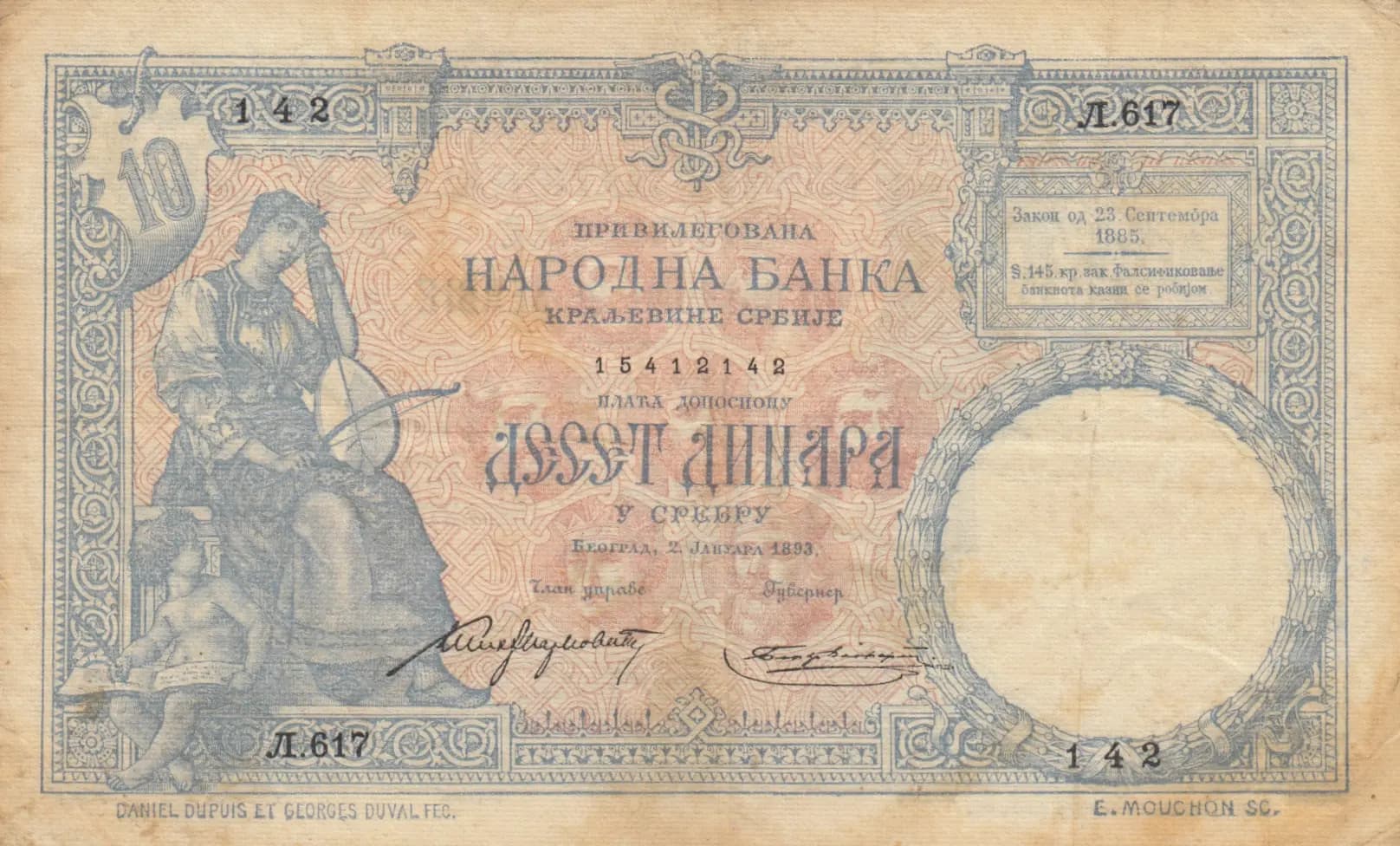
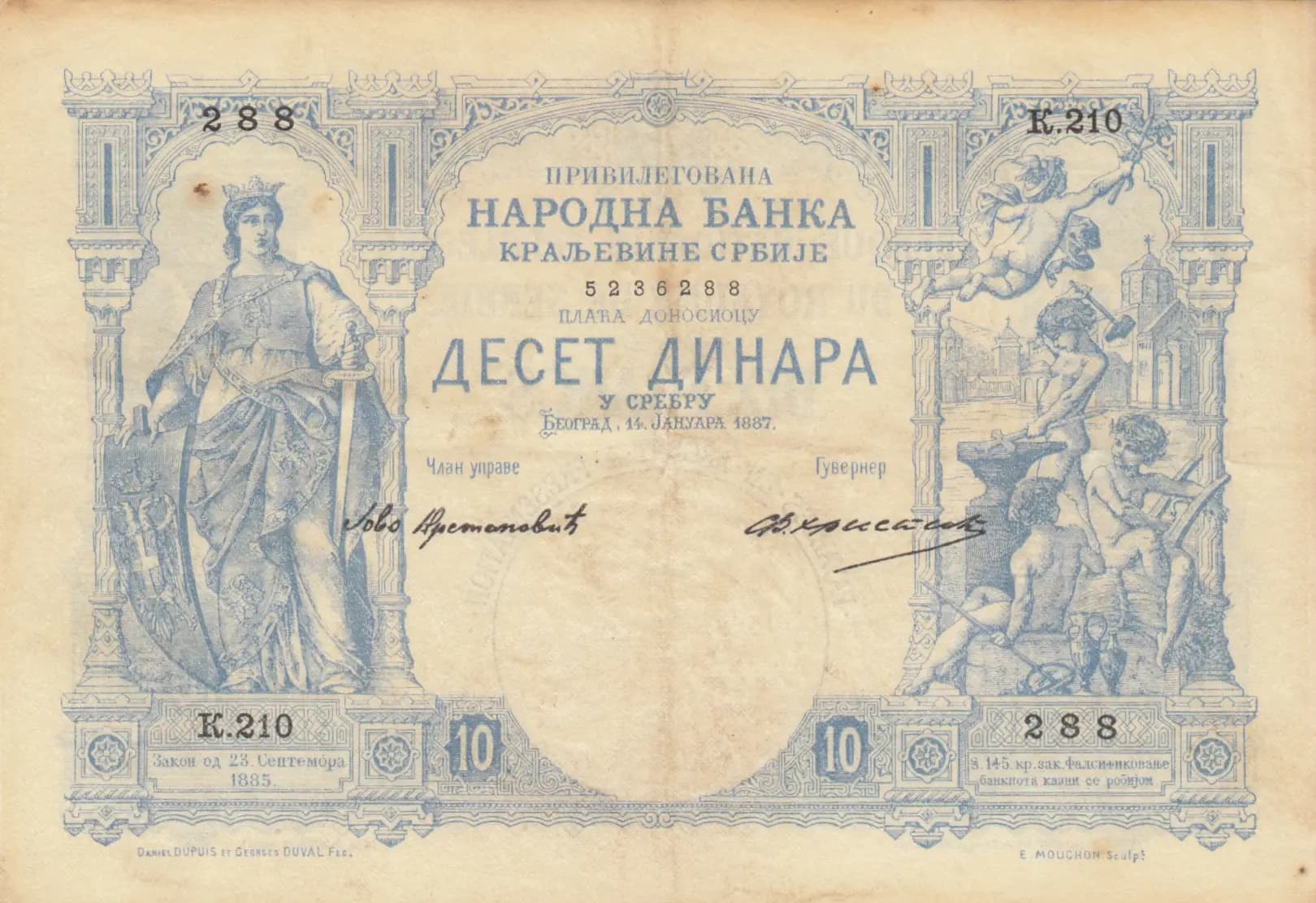
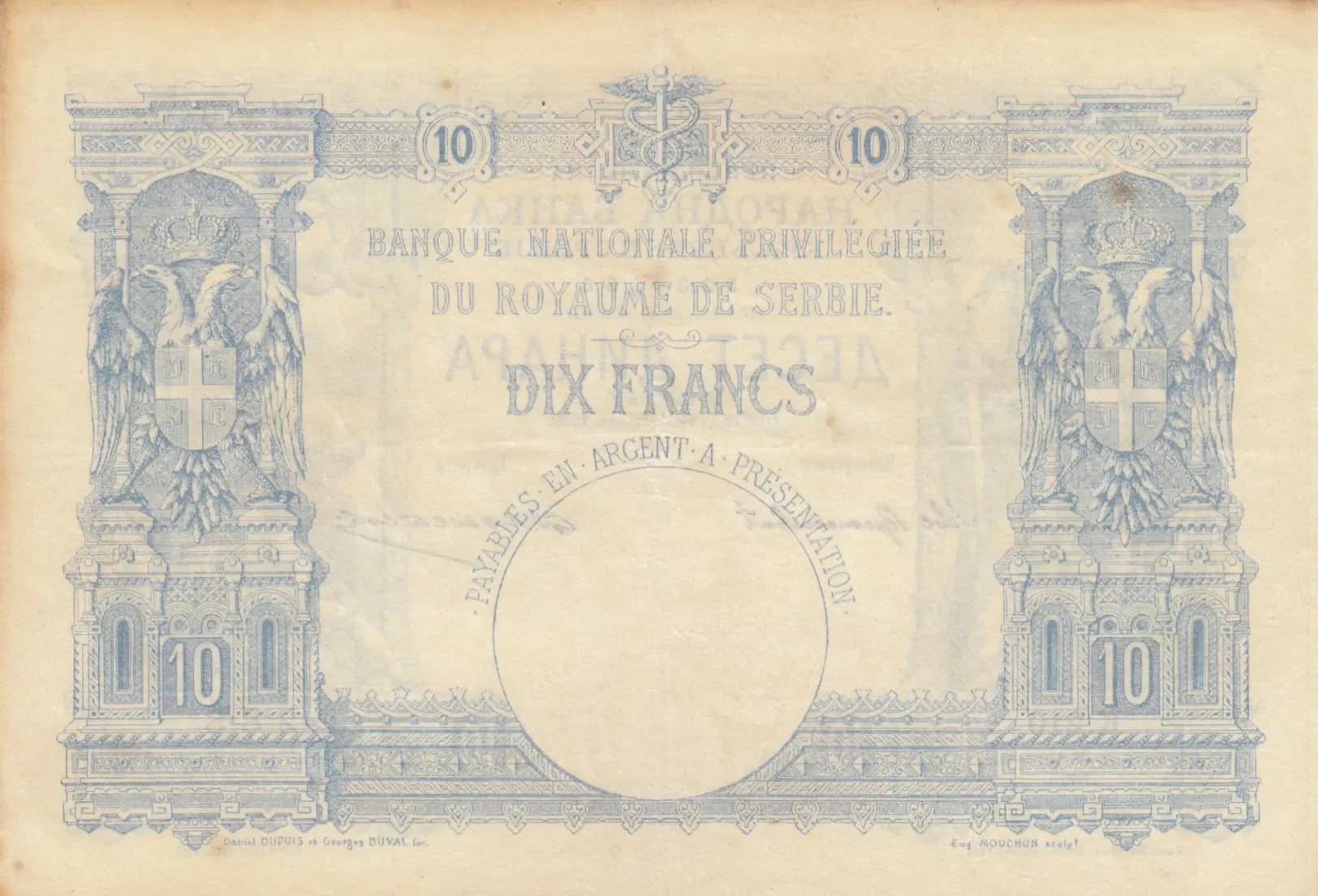
This is an exceptionally well-preserved example of Serbia's first national banknote issue, the 10 Dinara from January 14, 1887, issued by the Privilegovana Narodna Banka Kraljevine Srbije. The note displays the characteristic blue ink on cream background with elaborate engraved borders, featuring a crowned female allegory on the obverse and heraldic double-headed eagles on the reverse, reflecting the nation's newly established monetary sovereignty. In VF condition, this note shows expected signs of age and light circulation with minor foxing and discoloration, yet maintains excellent legibility and retains the crisp detail of its fine engraved design.
Common. The 10 Dinara P-9 from 1887 is a well-catalogued regular issue from Serbia's initial banknote series. Market data indicates specimens in F condition have sold for approximately $375-425 on the secondary market, with EF examples valued around $900, placing it firmly in the common category. The note had a substantial print run, as evidenced by the availability of multiple examples in collector circulation. The VF grade of the specimen described represents a desirable mid-range condition but does not constitute scarcity.
This banknote was issued following Serbia's passage of the banking law on September 23, 1885, marking a pivotal moment in the young nation's financial independence after centuries of Ottoman rule. The crowned female figure on the obverse represents Serbia itself, while the composition with allegorical children (putti) and Mercury reflects 19th-century European artistic conventions for depicting national prosperity and commerce. The dual-language presentation (Serbian Cyrillic and French) and the heraldic double-headed eagles on the reverse emphasize Serbia's aspirations toward Western European status and the gold/silver backing that underpinned its currency system.
The obverse features an allegorical representation of Serbia as a crowned female figure in royal regalia positioned on the left, symbolizing the nation's sovereignty. To the right are cherubic putti figures and the winged figure of Mercury, representing commerce and prosperity. The entire design is framed by an ornate architectural border with classical columns, capitals, rosettes, and circular emblems, all rendered in fine engraved detail. The reverse displays a symmetrical heraldic composition with double-headed eagles bearing shields containing crosses (the Serbian coat of arms) on both left and right sides, with a caduceus symbol at the top center. The bilateral inscriptions (Serbian on obverse, French on reverse) and dual denomination labeling ('ДЕСЕТ ДИНАРА' and 'DIX FRANCS') reflect the note's backing in silver and its intended circulation in a multilingual region. The denomination '10' appears prominently in circular emblems on both sides.
FRONT (Obverse) - Serbian Cyrillic: 'ПРИВИЛЕГОВАНА НАРОДНА БАНКА КРАЉЕВИНЕ СРБИЈЕ' (Privileged National Bank of the Kingdom of Serbia); 'ПЛАЋА ДОНОСИОЦУ' (Pays to Bearer); 'ДЕСЕТ ДИНАРА' (Ten Dinars); 'у СРБИЈУ' (in Serbia); 'Београд, 1к ЯНУАРА 1887.' (Belgrade, January 1, 1887); 'ЗАКОН ОД 23 СЕПТЕМБРА 1885.' (Law of September 23, 1885); 'Члан управе' (Board Member); 'Гувернер' (Governor); 'Daniel DUPUIS et Georges DUVAL Fec.' (Engraved by Daniel Dupuis and Georges Duval); 'E. MOUCHON Sculpt' (Sculpted by E. Mouchon). Serial number: 5236288. BACK (Reverse) - French: 'BANQUE NATIONALE PRIVILEGIEE DU ROYAUME DE SERBIE.' (Privileged National Bank of the Kingdom of Serbia); 'DIX FRANCS' (Ten Francs); 'PAYABLES EN ARGENT A PRESENTEPORT' (Payable in Silver at Presentation); 'Daniel DUPUIS et Georges DUVAL fac.' (Engraved by Daniel Dupuis and Georges Duval); 'E. MOUCHON Sculpt' (Sculpted by E. Mouchon).
This banknote was produced using intaglio engraving (taille-douce), the premium security printing method of the 19th century. The engravers Daniel Dupuis and Georges Duval, with sculptor E. Mouchon credited for the design, created the master plates using hand-engraved line work of exceptional fineness. The blue ink printing on cream/beige paper stock and the subtle gradations visible in the portraits and ornamental work are characteristic of intaglio production. This technique, combined with the complex border designs and multiple security elements, was state-of-the-art for preventing counterfeiting during this period.
The Pick catalog recognizes two variants for this base number: P-9 and P-9p (likely referring to proofs or presentation notes). The specimen described here, with serial number 5236288 and standard signatures for board member and governor positions, represents the standard P-9 variety. No overprints, date variations, or other distinguishing markers indicative of a specific sub-variety are noted in the visual analysis. Collectors should verify signature combinations and reference codes (the note shows 'К.210' and '288') when determining specific variety within the P-9 classification.